
Lecture
Magnesium (Mg) - this is one of the most important macronutrients required for the healthy growth and development of plants. Its importance in plant nutrition can be summarized as follows:
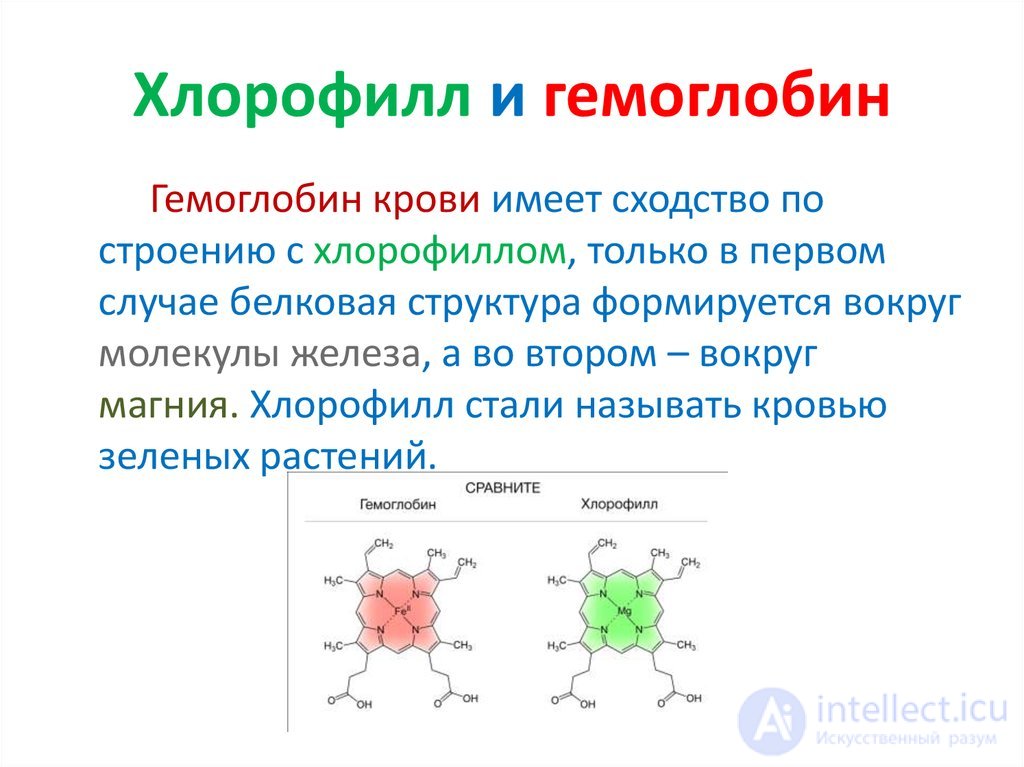
Photosynthesis: Magnesium plays a decisive role in photosynthesis - the process by which plants convert solar energy into chemical energy. It is an integral part of chlorophyll, the pigment that absorbs light for photosynthesis. Without a sufficient amount of magnesium, plants cannot carry out the process of photosynthesis effectively, which can lead to slowed growth and low yield.
Enzyme activation: Magnesium is involved in activating numerous enzymes in the plant. These enzymes are necessary for metabolic processes such as protein synthesis, carbohydrate metabolism, and DNA biosynthesis.
Membrane stability: Magnesium contributes to the stability of cell membranes, which is important for preserving cell integrity and protecting against stress conditions such as drought and salt stress.
Transport of other elements: Magnesium also plays a role in the transport of other macronutrients, such as phosphorus and potassium, within the plant.
A deficiency of magnesium in plants can cause a number of problems, including:
Chlorosis (yellowing of leaves): This is one of the most common symptoms of magnesium deficiency. Yellowing leaves can indicate a lack of chlorophyll.
Limited growth and development: A magnesium deficiency can slow plant growth and reduce yield.
Magnesium is a component of chlorophyll, phytin, and pectic substances; it is also present in plants in mineral form. Chlorophyll accounts for 15-30% of all the magnesium taken up by plants. It is found in larger amounts in seeds and young growing parts of plants, while in grain it is localized mainly in the embryo. Exceptions are root and tuber crops and most legume crops, in which there is more magnesium in the leaves. Magnesium plays an important physiological role in the process of photosynthesis.
It also affects oxidation-reduction processes in plants. With a magnesium deficiency, peroxidase activity increases, oxidation processes in plants intensify, and the content of ascorbic acid and invert sugar decreases. Visual signs of magnesium starvation in some plants are shown in color illustrations 21-27. A good supply of magnesium to plants, on the other hand, promotes the intensification of reduction processes in them and leads to a greater accumulation of reduced organic compounds — essential oils, fats, and others. Magnesium activates many enzymatic processes, especially phosphorylation and the regulation of the colloidal-chemical state of cell protoplasm.
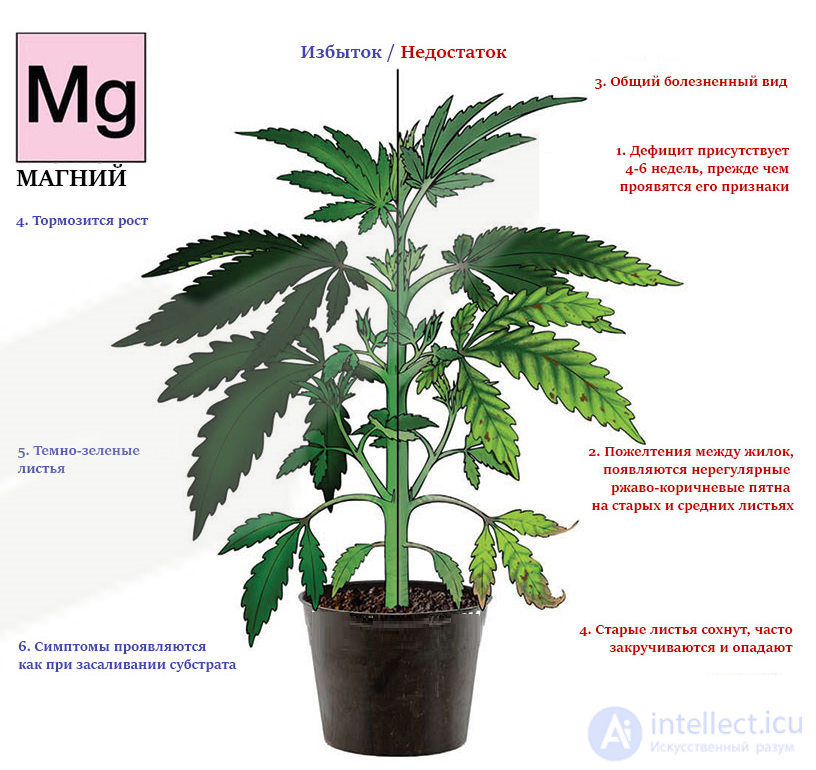
Fig. Excess and deficiency of magnesium
A magnesium deficiency inhibits the synthesis of nitrogen-containing compounds, especially chlorophyll. An external sign of a deficiency of this element is chlorosis of the leaves (color ill. 21-27). In cereal grains, magnesium deficiency causes mottling and striping of the leaves, while in dicotyledonous plants the areas of the leaf between the veins turn yellow. The yellowed part of the leaf gradually turns brown and dies off. Signs of magnesium starvation appear first of all on the older leaves of plants. The average magnesium content is expressed by the following values (in % MgO relative to the air-dry substance): in winter wheat grain — 0.15, peas — 0.13, buckwheat — 0.15, potato tubers — 0.06, in straw — respectively 0.11; 0.27; 0.19, potato haulm — 0.21. The average gross magnesium content in various types of Russian soils is as follows (in % of dry matter): in podzolic soils — 0.5, forest-steppe soils — 0.7, in chernozems — 0.9, sierozems — 1.45. It is usually present in the form of carbonates. When determining the need for magnesium fertilizers, it is necessary to take into account the presence of magnesium in the soil absorbing complex in exchangeable form.
The sum of calcium and magnesium as a proportion of the total exchange capacity is approximately 57% in peaty-podzolic soils, 53 in sod-podzolic soils, 80 in forest-steppe soils, 85 in ordinary chernozems, 90 in thick chernozems, 92 in chestnut soils, and 93% in sierozems. Of the total amount of calcium and magnesium in the soil absorbing complex, magnesium accounts for 20%, and less on light podzolic soils. A sharp manifestation of magnesium deficiency is observed when the soil contains 2 mg/100 g of soil or less of exchangeable magnesium. A magnesium deficiency shows up above all on acidic sod-podzolic soils of light particle-size composition. The lighter the soils are in particle-size composition and the more acidic they are, the less magnesium they contain and the more acute the need for applying magnesium fertilizers. The uptake of magnesium by plants depends not only on its content in available form in the soil; it is also affected by the antagonism of cations present in the soil solution. For example, ammonium forms of nitrogen fertilizers, as well as potassium fertilizers, impair the uptake of magnesium by plants, while nitrate forms improve it. The removal of magnesium with the harvest depends on the crop, the yield, the soil type, and other conditions. With high agricultural crop yields, 10-70 kg of MgO per hectare is removed.
The largest amounts of magnesium are absorbed by potatoes, sugar and fodder beet, tobacco, grain legumes, and leguminous grasses. Hemp, millet, sorghum, and corn are sensitive to a deficiency of this element. Losses of magnesium from the soil through leaching amount to approximately 10-20 kg of MgO per hectare. They are higher in wet years and on light soils, as well as when accompanying mineral fertilizers are applied. For example, applying potassium chloride increases the losses of magnesium with drainage water. Somewhat less is lost when potassium sulfate and single superphosphate are applied. The leaching of magnesium decreases sharply when single superphosphate is replaced with double superphosphate, which is related to the absence of gypsum in the latter. To maintain a positive magnesium balance in the soil, it must be applied annually in an amount of 30-40 kg of MgO per hectare. Magnesium is applied to the soil with liming materials, with potassium fertilizers containing this element, with manure, and so on. 30 t of semi-rotted manure contains 30 - 40 kg of MgO.
To prevent magnesium deficiency in plants, attention must be paid to the composition of the soil and to fertilizers. Fertilizers containing magnesium can be used to make up the deficit. It is also important to monitor the correct soil pH level, since acidic soil can impair the availability of magnesium to plants.

Comments