
Lecture
The absorption of water and nutrients through the roots, i.e. root (mineral) nutrition, is closely linked to the carbon nutrition of plants through the leaves. Although, from an energy standpoint, photosynthesis is a process of capturing an enormous amount of solar energy and converting it into the potential energy of the yield, it can proceed successfully only under optimal conditions of root nutrition. Photosynthesis and root nutrition are, in essence, a single, albeit multi-stage, process by which plants absorb the necessary nutrients from the external environment and convert water, carbon dioxide and mineral salts into numerous organic compounds, utilizing solar energy with the participation of enzymes. Almost all the elements of D.I. Mendeleev's periodic system that are present in the soil and in the air are found in the composition of the plant. More than 75 chemical elements have been detected in plants.
Mineral (root) nutrition of plants is carried out through the roots and involves the absorption of the necessary mineral elements from the soil. These mineral elements play a key role in various biochemical processes and in the growth and development of plants. It is important that the soil contain a sufficient amount and a correct ratio of these elements to ensure optimal plant health. Below are some of the main mineral elements and their roles in root nutrition:
Nitrogen (N): Nitrogen is a key component of amino acids, proteins and other organic compounds. It is necessary for the formation of green mass and for plant growth and development. A nitrogen deficiency can lead to stunted growth and yellowing of the leaves.
Phosphorus (P): Phosphorus is involved in the formation of nucleic acids and energy molecules (ATP), as well as in root growth, flowering and fruit formation.
Potassium (K): Potassium influences the regulation of water balance, supports the structure of cell walls, participates in enzyme activation and regulates photosynthesis.
Magnesium (Mg): Magnesium is a component of chlorophyll, which makes it necessary for photosynthesis. It is also involved in many biochemical reactions within the plant.
Calcium (Ca): Calcium is necessary for the development of cell walls, giving them strength and stability.
Sulfur (S): Sulfur is part of amino acids, vitamins and many other organic molecules. It is important for proteins and other biochemical processes.
Micronutrients (iron, zinc, copper, manganese, boron, molybdenum, etc.): These micronutrients are needed in small quantities, but play a critical role in various physiological processes of plants, such as enzyme activation and participation in the formation of biochemical compounds.
Management of the mineral nutrition of plants involves maintaining an optimal level of nutrients in the soil, taking into account the requirements of specific plant species, and regularly monitoring soil conditions. This makes it possible to ensure effective plant nutrition and to maintain plant health and growth.
Depending on their content in plants, elements are divided into macronutrients, micronutrients and ultramicronutrients. Macronutrients are essential elements whose content in plants ranges from tens to hundredths of a percent (from n% down to n·10⁻²%): C, H, O, N, P, K, Ca, Mg, S and Fe. Micronutrients include: B, Cu, Zn, Mn, Mo, Co, Se and Fe. Their content in plants ranges from 10⁻² to 10⁻⁵%. They are found mainly as constituents of numerous enzymes. Ultramicronutrients are present in plants in quantities of less than 10⁻⁷%. Their physiological and biochemical role has not yet been clearly established. In small quantities they are present in water, air, salts used as fertilizers, in the material of vessels used for conducting pot experiments, and in other media. Ultramicronutrients include Ag, Au, Cr, Ni, W, Br, U, Rb, Cs and others. The significance of these elements in the life of plants has been very little studied. In addition to the elements listed, plants also absorb other substances present in the soil which, although not essential, can in some cases have a positive effect on plants and in others a negative one. Regarding ultramicronutrients, it can be said that no one has experimentally proven, and no one has disproven, their physiological significance for plants, so on that same basis any chemical element could be attributed to them
that has not been included in the group of macronutrients or micronutrients. When organic matter is burned, all elements except nitrogen remain in the ash, which is why they are often called ash elements. Oxygen and hydrogen enter the plant with water. Essential nutrients are those elements without which plants are unable to complete their life cycle «from seed to seed». These elements are called biogenic or biophilic. Each of them performs a specific biochemical and physiological role in the plant. The absence or acute deficiency of a required element causes deep disturbances in metabolic biochemical processes, leading to morphological changes in organs and to the death of plants. When plants are grown under various soil and climatic conditions, their requirement for each nutrient element is not the same. Almost everywhere, nitrogen, phosphorus and potassium are, above all, required for the formation of a high yield of agricultural crops. The need for calcium arises on acidic soils with weak buffering capacity and a low degree of base saturation. A strong effect of magnesium is often observed on light soils of the sod-podzolic zone. At present, some researchers consider it necessary to apply sulfur to the soil as a plant nutrient element. However, this question requires thorough study, especially given the considerable amount of sulfur falling on the soil in industrial centers. The effectiveness of individual micronutrients depends on the natural conditions of the zone.
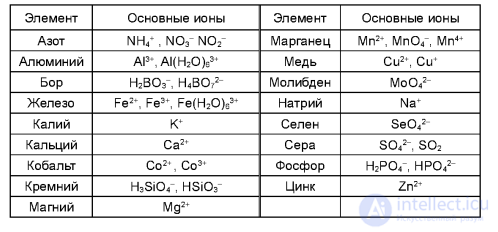
4.1. Main forms in which nutrient elements are taken up by plants (Kidin, 2008)
A positive effect of zinc, manganese and iron is noted on neutral soils of the steppe zone, especially on carbonate chernozems, whereas on soils of the sod-podzolic zone plants often suffer from an excess of these elements. In the forest-steppe and steppe zones, a demonstrable yield increase from the application of copper as a micronutrient fertilizer is rarely observed, with the exception of some experiments with maize. On drained peat bog soils, however, a good yield of grain crops cannot be obtained without the application of copper fertilizers. It should be noted that the positive effect of molybdenum on the yield of legume crops is almost universal, which is related to the participation of this element in the physiological and biochemical processes of fixation of atmospheric molecular nitrogen by the nodule bacteria of these plants. But the effectiveness of this element differs considerably under different soil and climatic conditions, which is explained by the uneven content of mobile forms of molybdenum in soils.
A differentiated scientific approach is needed for developing optimal conditions of plant nutrition, and, of course, a special study of the role of each nutrient element. At present, the composition and quantity, as well as the forms of compounds in which mineral substances should be supplied to plants, have been well studied (Table 4.1). This is evidenced by the extensive experience of growing various plants in water and sand cultures and in hydroponics, where record-high yields can be obtained on nutrient mixtures of mineral salts. Plants can also use organic compounds for nutrition: amino acids, organic acids, sugars, sugar phosphates and others. When the nitrogen of amino acids is used inside the plant, they undergo deamination, and the released ammonia then undergoes the same transformations as the ammonium ion absorbed by the roots. A much more complex question is: how do plants feed? Despite the fact that many studies have been devoted to the mechanism of ion absorption and their movement and transformation in plants, much remains unclear in this respect (Fig. 4.1). Most studies on the role of nutrients and their transformation in plants have been carried out under conditions in which a deficiency of one or another element was created by excluding it from the nutrient medium.
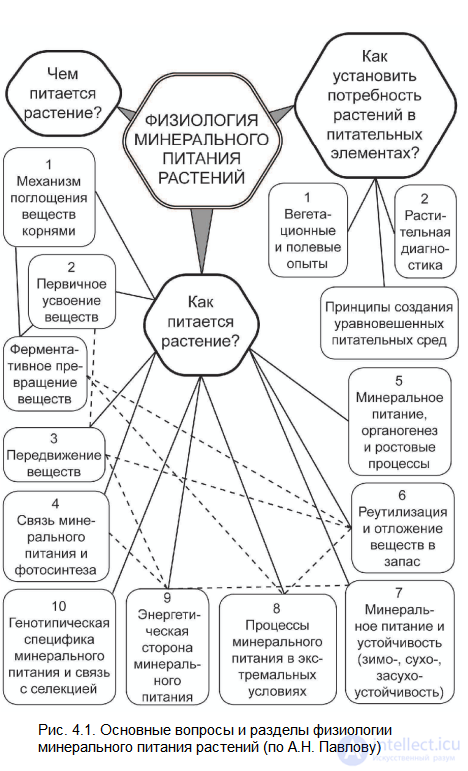
Fig. 4.1. Main questions and sections of the physiology of plant mineral nutrition (after A.N. Pavlov)
By the end of the 20th century, the study of the process of mineral nutrition — the absorption and movement of substances in the plant — began to be carried out not only under conditions of deficiency of one or another element, but also under conditions of an increased supply of plants with elements of mineral nutrition. This is related to the need to clarify the conditions of mineral nutrition under which the potential productivity of the plant is realized. The main organs through which a plant feeds are the leaf and the root. The latter performs several functions, above all the absorption of mineral substances and water from the soil. Another important function of the root is the processing of the absorbed ions: their reduction and incorporation into various organic compounds, including the biosynthesis of physiologically active compounds. Roots have a highly developed surface area and length of their peripheral, most deeply penetrating parts, but their mass is insignificant. Owing to them, the elements of mineral nutrition dispersed in the substrate are deposited in the upper horizons of the soil, where the bulk of the roots is located. The plant is thus not only a consumer of soil fertility but also its most important creator. A whole range of agrotechnical practices depend on the function of different parts of the root: the depth and manner of fertilizer placement, the depth and width of cultivation during plant care, the depth of primary tillage, etc. When a grain germinates, the primary embryonic root begins to grow first, after which several new embryonic rootlets appear. After tillering begins, nodal or adventitious roots form at the base of the leaves from the stem, forming a secondary root system that performs the same function as the embryonic roots. Each root has three main zones: 1) the zone of growth and elongation, 1.5 mm long — it is through the division of cells of this apical meristem that root growth occurs; 2) the zone of root hairs, or absorption, characterized by the presence of special outgrowths — root hairs up to 1 mm long, with the zone itself being 1-2 cm long; 3) the zone of lateral roots. Under field growing conditions, the main role in plant nutrition belongs to the root-hair zone, the so-called absorbing zone. The rate of entry and movement of nutrient elements in the plant is hundreds of times greater than the rate of such physical phenomena as diffusion and osmosis. For example, using labeled carbon (¹⁴C) it has been established that carbon dioxide moves from the roots to the leaves in 10-15 minutes. The rate of movement of photosynthesis products from the leaves to the roots is 40-100 cm/h. Nutrient elements, including fertilizers applied to the soil, enter through the root system of plants even faster. For example, when barley roots were immersed in a solution containing labeled phosphorus (³²P), it was found in the leaves after 5 minutes. From the roots of fourteen-day-old maize, it entered the leaves after 2 minutes. The same rate of movement of nutrient elements from the soil into the roots and leaves of plants was observed in experiments with wheat and other crops. At the same time, however, the rate of nutrient uptake changes considerably with the age of the root. Thus, as maize plants age (from 20 to 80 days), the rate of uptake of N, P, K, Ca and Mg decreases by a factor of tens or more. Although young plants absorb, in absolute amounts, far fewer mineral nutrition elements than mature ones, the soil must have a high content of these elements in order to adequately satisfy the root's high requirement for nutrients at the early stages of its growth. When the concentration of nutrients in the soil increases, roots intensify their uptake. For example, when a small strand of roots is supplied with readily available phosphoric acid at an elevated concentration, the intensity of phosphorus uptake by that small part of the roots increases sharply. This explains the effectiveness of localized fertilizer application, despite the fact that only a small part of the roots comes into contact with the fertilizer. A study of the function of embryonic and nodal roots has shown the important role of the tillering node in the distribution of water and mineral substances. The tillering node consists of loose, porous parenchymal tissue, so that substances moving along the conducting pathways of the roots readily pass from one conducting vessel to another and can therefore be used by any aboveground part of the plant. The roots of the tillering node have a high absorptive capacity and play a more significant role in plant nutrition than the primary (embryonic) roots. Their role increases especially during the tillering period of cereals, when intensified branching of the nodal roots occurs. Embryonic roots take part in plant nutrition, to some extent, at later stages of development as well. Thus, different zones of the root differ in their capacity to absorb ions.
Roots are not only organs for the absorption of mineral elements and water. They also have a synthetic capacity. Many organic compounds are formed in them: proteins, amino acids, amides, alkaloids, phytohormones, in particular cytokinin, and others (Fig. 4.2). The absorption of mineral nutrition elements by plants, depending on the nature of the energy expended, can be active or passive. Active absorption requires the expenditure of metabolic energy, whereas passive absorption occurs without the expenditure of metabolic energy, being accomplished by means of thermal diffusion energy or solar energy.
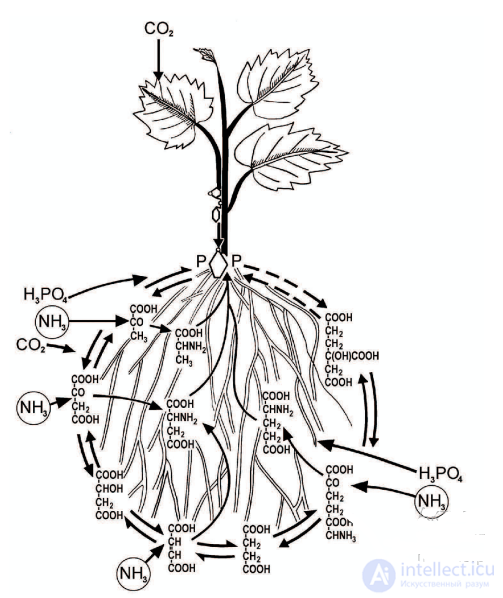
Fig. 4.2. Cycling of substances and the metabolic role of roots
Active absorption and movement of ions take place through a system consisting of cell protoplasts connected to one another by strands of protoplasm — plasmodesmata. During passive movement, ions that reach the root surface enter the free space of the root either by mass flow or by diffusion, and are then carried through the plant by the transpiration stream. Plant cells (unlike animal cells) have loose cellulose walls which, joining together, form a continuous system known as the apoplast. It is through this system, owing to the transpiration of water by the leaves, that the movement of water and of the substances dissolved in it takes place. Ions in the free space also move by diffusion. Diffusion always proceeds from a higher concentration to a lower one. This process is slow: for example, fluorescein dye diffuses 5 mm in 1 hour, 25 mm in 24 hours, and 50 cm in a year. Diffusion therefore plays no role in the movement of soluble substances over long distances within the plant, for example from the root to the leaf. Ions that come into contact with the root are adsorbed by the cell walls. The process of ion adsorption by roots is of an exchange nature. The high intensity of metabolism and the considerable rate of entry and movement of substances in plants can be explained by adsorptive exchange between the root system of plants, on the one hand, and the soil colloids (solid phase) as well as the soil solution (liquid phase), on the other. There is close contact between the root system of plants and the soil colloids, as well as the soil solution. The roots of plants in the soil are strongly branched. They penetrate to a depth of 1.5-2 m, and in some plants to 5-10 m or more. For example, in dry years the roots of alfalfa sometimes penetrate to a depth of up to 18 m. In width, the roots of cultivated plants spread 30-65 cm. Roots and the finest rootlets, and root hairs, entangle the soil and its colloidal particles in a dense network. And if one takes into account that root hairs live for one or a few days and that their number is enormous (for example, there are 425 or more root hairs per 1 mm² of maize root surface, and on average 200-500 for most agricultural crops), the perfect contact that exists between the soil and the root system of the plant, through its root hairs, through which food enters, becomes clear. It is owing to this contact that the process of exchange adsorption occurs, the essence of which is as follows. Nutrient ions (for example, K+, Ca2+, Mg2+, NH4+, NO3-, H2PO4-, SO4²⁻) enter the plant through the root system in exchange for H+ and HCO3- ions located on the surface of the root hairs and arising during root respiration. The root system of plants releases a large amount of carbon dioxide; for example, mustard releases 2.25 t of CO2 per hectare over 85 days of life, and the same can be said of other agricultural crops. The carbon dioxide that is produced reacts with water to form carbonic acid: CO2 + H2O → H2CO3. Being a weak acid, it partially dissociates into H+ and HCO3- ions. Thus, as a result of the respiratory process, ever new portions of H+ and HCO3- ions constantly appear on the surface of the root hairs. Soil cations K+, Ca2+, Mg2+, NH4+ and others immediately enter into an exchange reaction and displace the H+ cation from the surface of the root hair. Anions such as NO3-, H2PO4-, SO4²⁻ and others are exchanged and displaced into solution by the HCO3- anion. The nutrient cations and anions that appear on the surface of the root hair inevitably come into contact with the basoid (basic) and acidoid (acidic) parts of the cell plasma, and there they give rise to various organic compounds or move on to the leaves, where organic substances are also synthesized. The transfer of ions from cell to cell occurs by the principle of adsorption-desorption from one protein molecule to another, all the way to the conducting vascular system of the root. This physicochemical process proceeds at high speed. It is important to note that the absorption of nutrient elements by the root system of plants can occur not only in exchange for H+ and HCO3- ions formed in the process of respiration, but also for ions of organic and mineral compounds released by the roots. It has been established, for example, that plant roots release citric, malic, oxalic and other organic acids, which dissociate weakly but nevertheless break down into H+ and organic anions. These ions are located on the surface of the root hairs and can take part in exchange reactions with the corresponding cations and anions of the soil solution. With closer contact between the root system and the soil absorbing complex, the absorption of nutrients by the plant proceeds more intensively. The best conditions for plant nutrition are created when there is a sufficient amount of ions both in the soil solution and in the adsorption-bound state. Confirmation of the existence of adsorptive absorption of nutrient elements is the presence of a certain cation and anion absorption capacity in root hairs, just as in soil colloids. The magnitude of the absorption capacity of roots depends on the plant species, the conditions of their nutrition and other factors. For example, the cation absorption capacity per 100 g of dry root matter was 40-60 mmol for legumes, 35-38 mmol for potatoes and tomatoes, and 9-29 mmol for cereals. When plants are supplied with nitrogen, the cation absorption capacity of the roots increases, which can apparently be explained by increased synthesis of protein substances. A significant part of the cation absorption capacity consists of hydrogen ions (H+), which are exchanged for the cations of the soil solution needed for plant nutrition. Anion absorption is less studied, but in principle it is analogous to cation exchange. An important role here should be played by the HCO3- anion. In many crops, anion exchange quantitatively exceeds cation exchange, which indicates the presence of a greater amount of colloids with a positive charge in the active part of plant roots. Thus, cells adsorb on their surface positively or negatively charged ions of mineral salts, which can be exchangeably displaced into the free space by other ions of the same charge. The main barrier to the absorption of ions and substances is the surface membrane, or plasmalemma. The ability of plants to absorb or exchange ions with the environment largely depends on the properties of the membranes. This explains researchers' attempts to act on membranes in order to regulate the entry of ions into the roots. In this respect, membrane-active compounds, by means of which ion transport in plants can be influenced, are of interest. These include antibiotics (valinomycin, gramicidin and others), 2,4-dinitrophenol, dimethyl sulfoxide and others. The most promising of these is dimethyl sulfoxide, which has a mild action. It increases the permeability of the sulfolipid layer of membranes. Enhanced absorption and movement of nitrate and phosphate ions in sugar beet plants treated, under field experiment conditions, with a 2.5-5% aqueous solution of dimethyl sulfoxide, together with activation of the outflow of assimilates from the leaves to the roots, contributed to a higher efficiency of use of soil nutrients and fertilizers, activated growth and increased root crop yields by 30-60 c/ha, and increased sugar yield by 5-10 c/ha. The absorption of nutrients is a complex physicochemical and metabolic process that includes diffusion, adsorption, and the metabolic transport of substances against an electrochemical gradient. Diffusion is important for the movement of soluble nutrients in the soil toward plant roots, while exchange adsorption is important for the entry of nutrient elements into the plant through the root system. Subsequently, the absorbed nutrient elements interact with the cell protoplasm either metabolically or non-metabolically. Metabolic absorption and movement of nutrients occur very rapidly and depend on aerobic respiration, temperature and aeration of the soil solution. In this type of absorption, an important role is played by macroergic compounds, in particular ATP, which supply energy for this process. Non-metabolic, or passive, absorption may not be directly related to the vital activity of plants and therefore depends little on temperature and other conditions of the life of the plant organism. An example of non-metabolic absorption is pinocytosis — the uptake of a portion of the nutrient solution, whereby cells of young rootlets can absorb ions, molecules, their aggregates, and droplets of solution. There are three mechanisms for the delivery of nutrients to the root surface: 1) root interception, 2) mass flow, 3) diffusion. The contribution of each of these mechanisms depends on the intensity of nutrient absorption by the root and on the soil's supply of nutrients. Root interception. As roots grow, they move through the soil, coming into contact with nutrients and absorbing them. The share of root interception in nutrition is small, since the volume of the root system in the soil at a depth of 15 cm does not exceed 0.5-2% of the total soil volume. Root interception plays a significant role when the soil contains nutrients in quantities large relative to the plant's requirements. If, however, there is less of them than is needed to ensure the plant's maximum requirement, most of the nutrients absorbed by the roots is provided by mass flow and diffusion.
Mass flow. The roots of plants absorb water from the soil, which causes the soil solution to move through the soil toward the roots. Since the soil solution contains nutrients, they are also carried by mass flow to the root surface, becoming available for absorption. Depending on the plant species and weather conditions, the intensity of the water flow can vary considerably, but it is usually within the range of 1 to 6×10⁻⁴ cm³ of water per 1 cm² of root surface per second. Diffusion. The absorption of a nutrient by the root is accompanied by a decrease in its concentration at the root surface and the formation of a concentration gradient. This makes diffusion of the nutrient toward the root possible. The rate of diffusion of ions through the soil varies depending on the soil type and the nature of ion sorption by the soil. For ions that are not adsorbed by the soil, such as nitrates, the concentration gradient (the ratio between the ions in solution and the ions adsorbed on the surface of soil particles) can reach 1. For ions strongly sorbed by the soil, such as phosphate, this ratio can be 10⁻⁷. For a root to be able to absorb a nitrate ion, the latter may be located at a distance of up to 1 cm or even more from it, while for the absorption of a phosphate ion the distance must not exceed 0.1 cm. Meanwhile, the roots of annual plants are often spaced in the soil, on average, 0.5 cm apart. The contribution of the mechanisms mentioned differs for different nutrient elements. Thus, phosphorus and potassium are delivered to the roots mainly by diffusion, while calcium and magnesium are delivered by mass flow. Mass flow acquires an important role at a higher concentration of nitrates in the soil solution (about 10 mol NO3-/L). At low nitrate concentrations, diffusion is of great importance. The concentration of nitrates in the layer of soil close to the root is 3-4 times higher than in the soil away from the root, which is especially noticeable when high doses of nitrogen are applied (120 kg/ha). This increase in the concentration of nitrates in the soil adjacent to the root is related to the fact that nitrates moved toward the root by mass flow, but the rate of water absorption by the roots (and transpiration) was higher than the rate of nitrate absorption. Since both mass flow and diffusion mainly depend on the concentration of the corresponding substance in the soil solution, the level of nutrients in the soil solution is the factor that, first and foremost, determines the availability of nutrients to the plant.
Everything said about the mechanisms of delivering nutrients to the root surface refers to that part of them which is located in the soil solution and is most readily available for direct use by plants. A plant is not merely a consumer of nutrients already present in the soil in ready form. Plant roots actively influence the soil adjacent to their surface. The ability of roots to release organic and mineral substances into the external environment (sugars, organic acids, nitrogen-containing organic compounds, vitamins, enzymes, etc.) is well known. The organic substances released by roots serve as food for microorganisms, which, in the course of their life activity, contribute to the mobilization of soil nutrients, increasing their availability to plants in areas immediately adjacent to the roots. However, the significance of microorganisms does not lie in the fact that they supply the plant with organic forms of nitrogen and phosphorus, which are less effective than mineral forms. Microorganisms supply plants with physiologically active substances (auxins, vitamins, antibiotics) which, under certain conditions, can have a positive effect on plant growth even in negligible amounts. This effect of plant root exudates on the availability of soil nutrients through rhizosphere microorganisms is indirect. Plants also exert a direct effect on soil compounds that are difficult for them to access (especially phosphorus compounds), converting them into assimilable forms. D.N. Pryanishnikov demonstrated the ability of lupine, buckwheat and mustard to use the phosphorus of tri-substituted phosphates or natural phosphorites. The ability of these plants to assimilate phosphorus from poorly available phosphates is associated above all with the acidity of their root exudates. Thus, in the solution surrounding the root hairs of lupine, the pH is 4-5, while for clover it is 7-8. The role of the root system is exceptionally important in synthetic processes as well. Roots are organs not only for the accumulation and transfer of nutrients from the soil, but also for the synthesis of organic substances. Numerous studies carried out in the 1930s-1960s of the last century have shown that many synthetic processes are inherent to the root system of plants. In studying the root exudate (bleeding sap) of various plants, a wide range of soluble organic compounds has been found in it: amino acids, oligopeptides, sugars and growth substances. A significant contribution to the study of the physiology of the root system, its permeability
and the ability to absorb, release and process mineral substances and certain organic compounds was contributed by D.A. Sabinin. He was one of the first to suggest that the root system is an organ not only of absorption, but also of the synthesis and transformation of substances. In essence, this work marked the beginning of a new direction in the study of plant mineral nutrition, one that established the concept of the synthetic capacity of the root system. This direction was subsequently developed further in the work of many researchers. Using the stable nitrogen isotope ¹⁵N, F.V. Turchin (1965) established that practically all of the ammonium nitrogen (¹⁵NH4) absorbed by the root system, and a significant part of the nitrate nitrogen (¹⁵NO3), is present in the root exudate (bleeding sap) in the form of various nitrogen-containing organic compounds. In the roots of various agricultural crops, about 18 of the 20 amino acids found in plant proteins are synthesized. Studies conducted with labeled phosphorus (³²P), sulfur and a number of micronutrients have shown that, already in plant roots, the anion of phosphoric acid (H2PO4-) is incorporated, by means of ester bonds, into various organic compounds, while the sulfate ion (SO4²⁻), upon reduction, forms sulfur-containing amino acids: cystine, cysteine and methionine. Convincing evidence of the synthetic activity of the root system was obtained by academician A.A. Shmuk (1941), a student of D.N. Pryanishnikov, together with his co-workers. They established that nicotine is synthesized by the root system of tobacco, and not by the leaves. If tobacco is grafted onto tomato, practically no nicotine is found in the tobacco leaves, whereas, conversely, in the leaves of tomato grafted onto tobacco, 3-4% nicotine accumulates. Further undeniable evidence of the synthetic activity of the root system is the rapid appearance of new shoots (suckers) after removal of the aboveground part in rhizomatous and root-sprouting plants, including fruit and berry crops. The synthetic activity of the leaf and the root of plants is closely interconnected. For example, as the supply of nutrients through the roots increases, respiration and the influx of carbohydrates from the leaves to the roots intensify, while amino acids and other organic compounds move from the root system to the aboveground part, to the leaves and generative organs. The discovery of the diverse synthetic activity of the root system is one of the greatest achievements of 20th-century science in the field of the physiology of plant root nutrition. The root is such a
synthesis laboratory as the leaf, i.e. the biosynthesis of complex organic substances occurs through the interconnected synthetic activity of the leaf and the root. The energy for all vitally necessary transformations and movements of substances is released during respiratory processes, which continuously take place in all living cells and tissues of plants. In all these movements and transformations, a prominent role is played by the protein plasma of the cell, which has a dual nature — basoid and acidoid. In the protein plasma, in its molecules, the acidoid and basoid parts are arranged in a mosaic pattern, so that as nutrients move from cell to cell, a gradual exchange and interaction of cations and anions with the positively charged (basoid) and negatively charged (acidoid) parts of the protein molecules of the cell plasma take place. This property of the living cell must always be taken into account in order to understand the processes of the entry, movement and transformation of nutrients in plant organisms. Plants possess a selective capacity: they absorb more of the elements they need and less of those they do not need. This is explained by the physiological laws of the living organism. For example, when sodium nitrate (NaNO3) is applied to the soil, the plant absorbs more of the NO3- anion and less of the Na+ cation. When ammonium sulfate ((NH4)2SO4) is applied, the plant absorbs more of the NH4+ cation and less of the SO4²⁻ anion, and so on. Substances physiologically necessary for the plant, as they enter through the roots, are immediately subjected to synthesis processes and are assimilated, being converted into other compounds, in particular organic ones, i.e. they leave the adsorption surface of the root hair. Substances that the plant does not need, on the other hand, do not undergo any change and remain in it in a mineral, readily soluble ionic form, in the same state as before they entered the plant. After their concentration is equalized in the cell and soil solutions at the surface of the root hair and at the surface of the soil colloidal particles, they cease to enter the plant, since the entry of ions from the soil occurs according to the principle of adsorption-desorption (as much is adsorbed as is desorbed, in accordance with the law of mass action). The nutrient elements that the plant needs (their anions and cations), on the other hand, are assimilated through the synthesis of organic compounds from them, i.e. they disappear from the surface of the root hairs. Consequently, the equilibrium of the needed ions will be continuously disturbed for as long as these nutrient elements continue to be assimilated by the plant.
The selectivity of nutrient absorption by plants and their active entry from the soil solution into the roots is evidenced by the fact that the concentration of salts of a number of nutrient elements in the cell sap of plants is much higher than in the nutrient solution in which the root system is immersed. For example, the concentration of potassium in the exudate (sap) of maize was 20 times higher, phosphorus 14 times higher, and calcium 4 times higher than in the external nutrient solution. With the completion of the life cycle, the entry of nutrients into the plant ceases, the utilization of cations and anions stops, and their concentration reaches equilibrium at the surface of the root hair and in the soil solution, as well as on the surface of the colloidal particles. Since plants selectively absorb ions (more of some, less of others, depending on their physiological need for them), mineral fertilizers (salts) can be either physiologically acidic or physiologically alkaline. If a plant absorbs more of the cations of a salt, while its anions accumulate more in the soil solution, such a salt will be physiologically acidic. For example, mineral fertilizers such as ammonium sulfate, ammonium chloride, ammonium nitrate, and potassium chloride are physiologically acidic. If, on the other hand, a plant absorbs more of the anion of a salt, while its cation accumulates in the soil solution, such a salt will be physiologically alkaline. These include sodium nitrate, calcium nitrate and others. When toxic substances (heavy metals, pesticides, etc.) are present in the soil solution, a considerable part of them is retained already in the roots; the part of them that does nevertheless penetrate into the stems and leaves is, in turn, retained in these aboveground organs, and only an insignificant part of the toxicants reaches the seeds. Thus, the mechanisms that limit the entry and accumulation of toxic substances in reproductive organs are present not only in the roots but also in the vegetative organs, which is very important from the standpoint of the use of plant produce. The entry of nutrients into the plant is selective and depends on the intensity of respiratory processes and, above all, on the energy of root respiration and the release by the roots of H+ and HCO3- ions. An important role is played by the degree of development of the root system, the increase in its absorbing surface and its assimilating capacity. Two periods of nutrition can be distinguished in the life of a plant, which must be taken into account when applying fertilizers.
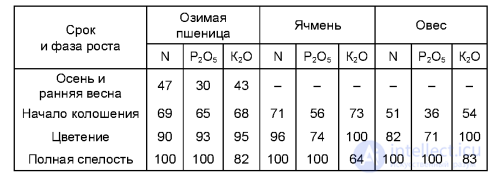
The first, known as the critical period, coincides with the initial phases of growth and development of most plants. During this period, plants are particularly sensitive both to a deficiency and to an excess of nutrients. The chemical composition of plants during the initial growth phases is characterized by a high content of nitrogen and many ash elements. During this period, plants make increased demands on the conditions of mineral nutrition. The second period is known as the period of maximum nutrient consumption. It is characteristic of later phases of development and is determined by the biological features of the plants. The entry of nutrients into cereal plants, with the exception of maize, is almost complete by the end of heading, although by that time they have formed no more than 50-60% of the plant mass relative to the full yield (Table 4.2). Thus, winter wheat, under good development, already assimilates 43-47% of its nitrogen and potassium in the autumn period, while the dry mass of the plants amounts to no more than 10% of the full yield. This applies fully to winter rye as well, which assimilates up to 50-60% of its nitrogen, phosphorus and potassium during the autumn period. Barley and oats absorb 100% of their potassium already by the flowering phase, after which a loss of this nutrient element even occurs (exosmosis, or release). The accumulation of nutrients by maize proceeds more slowly. Even by the onset of flowering, only 30-40% of the nitrogen and potassium and 15% of the phosphorus enter the plant, relative to the content of these elements in maize at maturity. Sugar beet, potato, cabbage and other vegetable crops are distinguished by a longer or more extended nutrition period. They assimilate nitrogen, phosphorus and potassium over almost the entire growing season (Table 4.3).
4.2. Dynamics of nutrient element accumulation in plants, % of maximum
4.3. Dynamics of nutrient element uptake in sugar beet plants (data from the Research Institute of Sugar Beet), % of maximum
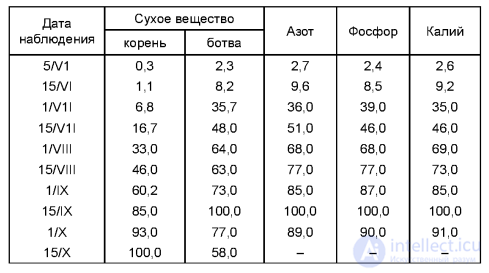
Thus, the nutrition period is not equal to the plant's growing season. In many plants it is considerably shorter than the growing season (hemp and most cereal crops). In other crops, however, it is extended and almost coincides with the plant's growing season (sugar beet, potato, cabbage and other vegetable crops). Thus, plant nutrition, taking into account the biological features of plants, can be regulated by growth periods, which makes it possible to shape the quantity and quality of the yield. The periodicity of plant nutrition provides the theoretical basis for split fertilizer application (at different times and into different soil layers). Applying fertilizers in a single application and into a single soil layer does not always make it possible to achieve full use of their potential. Doses of readily soluble mineral fertilizers that are sufficient for the critical nutrition period will be too small for the period of maximum nutrient consumption. Conversely, a large dose is harmful during the first (critical) period, when the young rootlets of the plant are sensitive to a high concentration of nutrients. This is why a proper system of plant nutrition provides for a combination of basal fertilization (to a depth of 18-25 cm), starter (row) fertilization (to a depth of 5-8 cm), and top dressings during the plant's growth period (to a depth of 10-15 cm).

Comments