
Lecture
The humus balance in soil plays an important role in maintaining the health of the soil ecosystem and plant growth. Humus is organic matter formed as a result of the decomposition of plant and animal residues. It has several important functions:
Moisture retention: Humus is able to retain water in the soil, which provides moderate moisture for plants. This is especially useful during periods of drought.
Improving soil structure: Humus promotes the formation of granules and aggregates in the soil, which improves its structure. This facilitates the penetration of water and air deep into the soil and also provides space for plant roots.
Maintaining fertility: Humus contains many nutrients that can gradually be released and become available to plants. This helps maintain soil fertility over a long period of time.
Suppression of diseases: Humus may have antimicrobial properties that can help reduce the risk of certain soil-borne diseases developing.
To maintain the humus balance in soil, it is useful to apply the following methods:
Mulching: Covering the soil with mulch (for example, organic residues) helps conserve moisture and nutrients and also promotes humus formation.
Composting: Making compost from plant and organic waste can be an excellent source of humus for the soil.
Crop rotation: The practice of alternating the types of plants grown on a single plot helps maintain the balance of nutrients and humus.
Green manure: Growing plants that are subsequently worked into the soil as green manure (for example, clover or alfalfa) promotes the enrichment of the soil with organic material.
Avoiding excessive tillage: Excessive ploughing and tillage can destroy humus and degrade soil structure.
By monitoring the state of humus in the soil and applying sustainable cultivation methods, you can maintain a healthy balance and provide optimal conditions for plant growth.
While mineral fertilizers improve the cycling and balance of biogenic elements, organic fertilizers are not only an important source of nutrients for plants but also replenish the soil's humus reserves — one of the main indicators of its potential fertility. Organic matter regulates the expenditure of nutrient elements and prevents unproductive losses of nutrients through leaching, the formation of gaseous products, and poorly soluble mineral compounds, while increasing the effectiveness of mineral fertilizers. Soils with a high humus content are biologically more active: they have a higher number of microorganisms, a more diverse species composition, more intensive CO2 production, and increased enzymatic activity. Humus-rich soils are distinguished by better physical properties, water-air and thermal regimes, and resistance to erosion processes. The role of soil humus content becomes especially important under unfavorable weather conditions.
Therefore, the problem of achieving a non-deficit and positive humus balance — one of the most important problems in agrochemistry and agropedology. The development of agriculture, the increase in its intensification, and the widespread use of mineral fertilizers and other means of chemicalization have made it possible to reveal and assess the role of soil organic matter in a new way. Whereas previously the main function of humus was reduced to supplying plants with the necessary nutrient elements, in the era of intensive agriculture, when plants receive the necessary nutrient elements from fertilizers, other functions of soil organic matter come to the fore, such as the ability to regulate the water-physical properties of soils, to rapidly transform the excess amount of mineral salts introduced © ‘fertilizers, to act as an inactivator of heavy metals, pesticides, and their metabolites by retaining them in the soil mass and reducing the possibility of their entry into plant produce, surface and internal soil waters, and the atmosphere, as well as to make up for the deficiency of any nutrient element not supplied in sufficient amount with mineral or organic fertilizers.
At the same time, methods of intensifying agricultural production, such as an increase in the area under row crops, a decrease in the share of perennial grasses, severe soil exhaustion from ploughing, and deforestation, lead to a widespread decline in soil humus content and a loss of organic matter. The deficit of organic matter in arable soils is the main cause of the decline in their fertility, which, in turn, leads to a decrease in the effectiveness of mineral fertilizers, a deterioration in the quality of agricultural produce, and contamination of the surrounding natural environment with residual amounts of mineral salts and with the residues and metabolites of chemical crop-protection agents.
The main causes of humus losses in arable soils are the following:
— a decrease in the mass of plant residues entering the soil when a natural biocoenosis is replaced by an agrocoenosis;
— increased mineralization of organic matter as a result of intensive tillage and increased soil aeration;
— decomposition and biodegradation of humus under the influence of physiologically acidic fertilizers and the activation of microflora due to the fertilizers applied;
— increased mineralization of humus in irrigated soils during the first years of irrigation (in subsequent years, the maintenance of humus stabilizes and even increases);
— increased mineralization of humus as a result of drainage reclamation of waterlogged soils;
— water and wind erosion of soils.
3.24. Estimated amounts of soil nitrogen losses depending on slope steepness and crops (Trepachev et al., 1976)
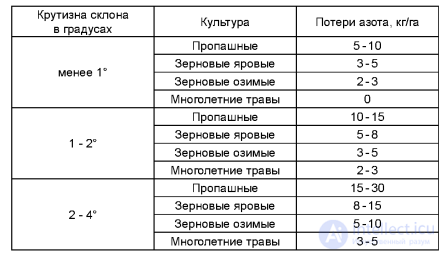
Modern agriculture must provide for the development of agrotechnical and agrochemical methods that ensure a non-deficit or positive humus balance. The main ways of compensating for mineralized humus in soil are: 1) the use of all types of organic fertilizers, including in combination with mineral fertilizers; 2) the ploughing-in of green manure crops, post-harvest and root residues, and others; 3) sowing legume grasses and legume-cereal grass mixtures with a predominance of the legume component in crop rotations; 4) using straw as fertilizer according to the appropriate technology with the addition of nitrogen fertilizers; 5) using various organic wastes as fertilizer. The system of rational use of organic fertilizers for the expanded reproduction of humus in soil should be regarded as an important link in the scientific system of agriculture. The humus balance is calculated in order to forecast and determine the need of arable soils for organic fertilizers required to obtain the planned yield and to reproduce fertility. The humus balance is determined from the difference between the income side (from the input and humification of post-harvest and root residues and the organic matter of fertilizers) and the expenditure side (mineralization of humus during the cultivation of crops and the fallowing of fields). The balance calculation can be carried out for a crop rotation, a farm division, an enterprise, a district, a region, and so on.
The following data are needed to calculate the balance:
— the arrangement of crops in the rotation;
— the planned yield;
— the area occupied by the crops;
— the rates of mineral fertilizers;
— the types and rates of organic fertilizers;
— the type, subtype, and variety of soil.
The expenditure of humus through mineralization depends on a whole range of
factors:
— soil-climatic conditions
— the intensity of soil tillage
— the structure of the sown area
— crop yields
— the level of chemicalization, and so on.
The highest mineralization of humus is observed under bare fallow; next, in decreasing order, come row crops, solid-sown crops (cereals, grain legumes, annual grasses), perennial grasses, meadows, and pastures. For example, on light sod-podzolic soils, the annual mineralization rate under bare fallow — 4,5%, under potatoes, root crops, and vegetables — 3,4 - 3,9%, under maize for silage — 3,3 - 3,9%, under silage crops — 1,9 - 2,2%, under cereals — 1,9 - 2,1%, under annual grasses — 1,7 - 1,8%, and under perennial grasses and lupin — 0,6-0,9% of the gross humus reserves in the arable layer (Popov et al., 1986). The level of humus mineralization also depends on the granulometric composition of soils. It increases on light soils. To calculate humus mineralization taking these factors and the intensity of soil tillage into account, A.M. Lykov (1976) introduced correction coefficients. 1) For heavy loam, the coefficient is 0,8; for medium loam — 1,0; for light loam — 1,2; for sandy loam — 1,4; for sand — 1,8. 2)
For perennial grasses, it equals 1,0; for cereals and other solid-sown crops — 1,2; for row crops — 1,6. The lack of direct observational data on the dynamics of soil organic carbon has led to the widespread use of calculation methods for determining the need of soils for organic fertilizers to ensure a non-deficit humus balance. The most widely used method is that of calculating the humus balance from the nitrogen removal by plants. The method is based on data from I.V. Tyurin (1957) showing that soil humus contains, on average, 5 - 6% nitrogen. Therefore, the uptake by plants of 50 kg of soil nitrogen is accompanied by the mineralization of approximately 1 tonne of humus. Studies using the nitrogen isotope 15N have shown that even with the application of high rates of mineral fertilizers, soil nitrogen accounts on average for 50-60% of the nitrogen removed by plants. Therefore, knowing the value of the total nitrogen removal,
it is easy to determine how much humus can be mineralized in the cultivation of crops, taking into account different levels of farming intensity. Under practical conditions, the amount of humus mineralization can be determined using the formula:
Gm = (YoKy + YoKpKyp) x 0,6 x 20,
where Gm — the amount of mineralized humus, t/ha; Yo — the yield of the main produce, t/ha; Ky — the nitrogen removal per 1 t of main produce (including by-products), kg; Kp — the coefficient of plant residue yield relative to the main produce; Kyp — the nitrogen removal per 1 t of plant residues, kg; 0,6 — the average coefficient of soil nitrogen removal relative to the total removal by plants; 20 — the coefficient for converting nitrogen to humus. All the necessary initial data for use in this formula can be found in the usual reference literature for agronomists. The annual replenishment of humus from root and post-harvest residues on average amounts to (t/ha): for cereal crops — 0,4 - 0,6, for row crops — 0,2 - 0,3, for perennial grasses — 0,5 - 1,0. The proposed method is convenient for calculations but is quite approximate, since it is based on averaged, approximate indicators. Another approach to calculating the humus balance is based on using data on humus content and coefficients of mineralization or humification of organic residues. Thus, the need for organic matter can be determined by the formula
A = K (No + A),
where A — the annual application of organic matter; No — the level of humus content at equilibrium, t/ha; K — the average coefficient of mineralization of organic fertilizers, which amounts to 0,02 - 0,08 depending on the intensity of farming. Many researchers, in calculating the income side of the humus balance, take into account the organic mass entering the soil with fertilizers and with the root and post-harvest residues of crops, and the coefficients of their humification. In doing so, isohumic coefficients are widely used (the amount of humus formed from various organic materials, in % of dry matter). To calculate the expected humus reserves in soil for a link or a complete rotation of a crop rotation, N.F. Ganzhara (1978) proposes the following formula:
St = So + Kr x A x t x (1 - Km),
where St — the humus reserve, t/ha, after t years; So — the initial humus reserves, t/ha; Kr — the humification coefficient of fresh organic matter, as a fraction of unity (A is taken as unity); A — the amount of fresh organic matter entering the soil, t/ha; t — the time for which the humus balance is calculated, years; Km — the mineralization coefficient of humus, as a fraction of unity (the value So + KrAt is taken as unity). To determine the total volume of accumulation of organic fertilizers on a farm, the following conversion coefficients to standard manure can be used (Resources of Organic Fertilizers in Russian Agriculture, 2006):
bedded manure (moisture content 75-77%) — 1,0;
solid fraction of unbedded manure — 1,0;
semi-liquid manure (moisture content up to 92%) — 0,5;
liquid manure (moisture content up to 97%) — 0,25;
manure-based compost (moisture content up to 84%) — 1,0;
semi-liquid poultry droppings — 1,4;
straw — 2,0
sapropel — 0,8;
lime-defecation mud — 0,8;
green manure of legume crops - 0,7;
green manure of cruciferous crops — 0,8.
At present, the Pryanishnikov All-Russian Research Institute of Agrochemistry (VNIIA), in collaboration with leading agricultural institutes, has developed normative data for calculating the humus balance, based on a generalization of the available results of field experiments on the main income and expenditure items for different soil types under the cultivation of various crops, which make it possible to calculate an approximate humus balance for different types of crop rotations.

Comments