
Lecture
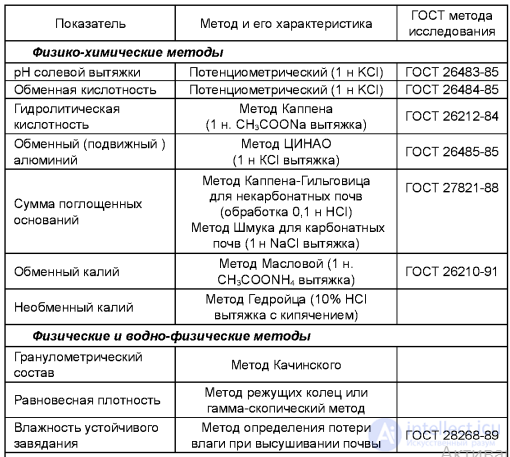
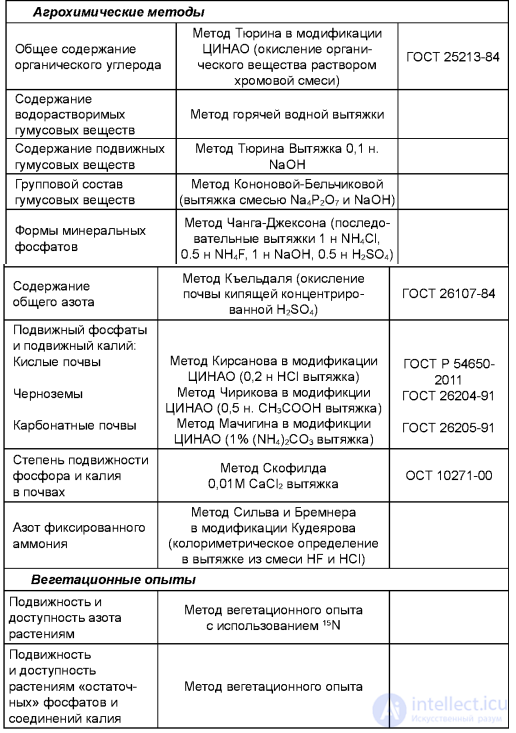
The combination of modern farming practices is aimed at the steady improvement of fertility and soil properties. In this, the main role belongs to a scientifically grounded system of fertilizer application. Managing soil fertility requires a comprehensive study of soil processes, the interaction of fertilizers with soil and plants, and the factors determining the availability of residual nutrients. The interaction of soils, plants and fertilizers can be studied in the greatest detail in long-term stationary experiments with systematic fertilizer application. Such experiments create exceptional standardization conditions, making it possible to better study the effect of climate and agrometeorological conditions on crops, soils, and the factors regulating soil fertility. The main directions of agrochemical research in long-term stationary experiments are as follows: 1) comparative evaluation of the doses, types and forms of mineral fertilizers applied in equivalent amounts of nutrients; 2) evaluation of the effectiveness of mineral, organic and organomineral fertilizer systems in crop rotations of various specializations; 3) determination of the optimal distribution of fertilizers among crop-rotation crops in order to obtain their greatest return; 4) achieving maximum effectiveness when combining various fertilizer systems with chemical soil amelioration and their effect on soil properties and the productivity of crop rotations; 5) the feasibility of periodic application of phosphorus and potassium fertilizers; 6) optimization of soil fertility and properties; 7) regulation of the biological cycle and balance of biogenic elements in the agrocenosis; 8) ecological functions of agrochemical means. In agrochemistry, the following methods of studying soil properties in long-term stationary experiments have been adopted (Table 3.4). Physicochemical properties of soils, besides their direct effect on the yield of cultivated plants, have a significant influence on the nutrient regime of soils and their biological activity, determine the nature of the transformation of fertilizers applied to the soil in the arable horizon, and, under conditions of a leaching water regime, determine the possibility of the movement of certain compounds into deeper soil layers.
3.4. Methods for studying soil fertility (according to OST 10152-88 and the Methodological Guidelines for Conducting Comprehensive Monitoring of the Fertility of Agricultural Land Soils, 2003, as amended)
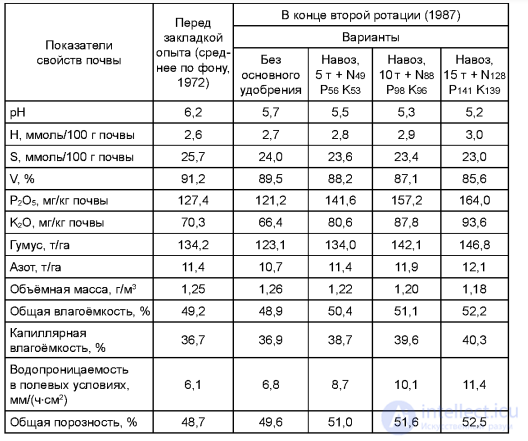
The systematic application of organic and mineral fertilizers is accompanied by changes in the physicochemical properties of soils. Long-term application of manure, as a rule, increases the amount of organic matter and the absorption capacity of soils, decreases the exchangeable and hydrolytic acidity, and increases the degree of base saturation of soils, i.e., it improves the physicochemical properties of soils. The substantial influence of fertilizers on the agrochemical and agrophysical properties of soil, even on chernozem, is evidenced by the data in Table 3.5. The combined application of manure and mineral fertilizers over 15 years increased the humus content by 12.6 t/ha, nitrogen — by 0.7 t/ha, decreased soil density by 0.08 g/cm³, increased total and capillary moisture capacity by more than 3%, water permeability — by 4.3 mm/(h·cm²), and total porosity — by 3%.
3.5. Effect of the systematic application of fertilizers on the agrochemical and agrophysical properties of soil (deep low-humus chernozem, soil layer 0-30cm)
With long-term application of mineral fertilizers, soil properties may deteriorate. This is explained by the acidification of the soil solution reaction as a result of the displacement of hydrogen and aluminum from the absorbing complex, as well as the physiological acidity of nitrogen and potassium fertilizers. With correct fertilizer application (against a background of manure or liming, with the addition of amendments to neutralize the physiological acidity of fertilizers), soil acidity not only does not increase, but in a number of cases even decreases. On neutral and near-neutral chernozems, a certain acidification resulting from fertilizer application can even be considered positive, since many compounds thereby become more mobile and available to plants.
Consequently, the nature and evaluation of the effect of fertilizers on the physicochemical properties of soils, like all other fertility indicators, depend on soil-climatic conditions and the forms of fertilizers applied. Under the leaching water regime of sod-podzolic and gray forest soils, changes in their properties under the influence of fertilizers occur not only in the arable layer but also in deeper layers. This is explained by the increased amount of precipitation in this zone and by acidification of the soil at high doses of mineral fertilizers, by the formation of exceptionally mobile organic compounds when manure is applied, and also by the peptization of soil colloids under the influence of monovalent cations contained in fertilizers, and their leaching, together with adsorbed compounds, beyond the arable layer. Particularly favorable conditions for the migration of nutrients into underlying layers as a result of colloid peptization are created when fertilizers are applied to fallow land and under row crops, and with frequent soil tillage. The lighter the particle-size composition of the soil and the higher the fertilizer dose, the more pronounced the process of colloid leaching. Under the influence of systematic fertilizer application, the increase in yield leads to an increase in the amount of crop residues and root remains in the soil, whose decomposition causes the formation of new organic colloids in the arable layer and, together with the peptization of larger soil particles, leads to an increase in the content of the silt fraction in it. In low-buffer soils of light particle-size composition, the process of colloid leaching may prevail over their formation. Changes in the physicochemical properties of chernozems are concentrated mainly in the arable and subarable layers, which is explained by the limited amount of precipitation in the steppe zone and the shallow wetting of the soil. On these soils, long-term fertilizer application also leads to an increase in the silt fraction of the soil and in the absorption capacity. In this case, soil acidity decreases against a background of manure, while it increases with the application of mineral fertilizers. This is explained by the physiological acidity of nitrogen and potassium fertilizers and the non-exchangeable absorption of monovalent cations, combined with the absence of conditions for the leaching of hydrogen and the acid residue. An increase in the acidity of chernozems often contributes to an increase in the mobility of certain nutrients and increases their availability to plants.
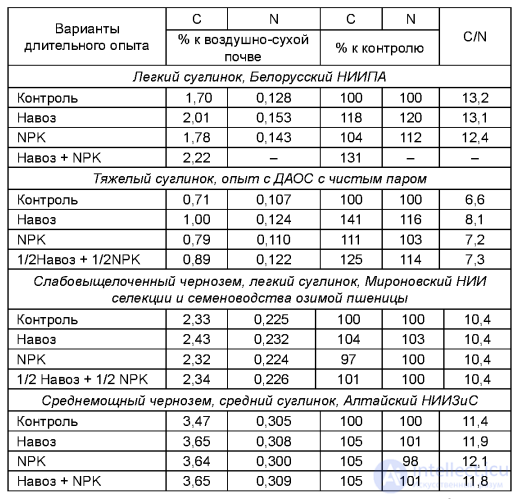
The systematic application of manure and mineral fertilizers on sierozems has no significant effect on the reaction of the soil solution, owing to their carbonate content and buffering capacity. Some increase in the silt fraction and in the absorption capacity of these soils in the upper layers occurs through the formation of colloids from organic plant residues. The arable layer of sierozems is not depleted of colloids, because these soils contain a large amount of calcium, which, being absorbed by the colloids, prevents their dispersion and leaching. The downward movement of fertilizer nutrients through the profile in sierozems, and their loss with groundwater and drainage water during irrigation, are caused by the leaching water regime and the good solubility of certain compounds. Long-term application of organic and mineral fertilizers increases the total content of carbon and nitrogen (compared with the control) in humus-poor sod-podzolic and sierozem soils, while having little effect on humus-rich chernozems (Table 3.6). In treatments with manure application, an increase in organic matter content is observed mainly in the upper horizons, while the weaker effect of mineral fertilizers sometimes appears also in the subarable soil layer.
Manure and mineral fertilizers do not change the group composition of the organic matter of various soils. The humus composition of long-fertilized soils retains the properties inherent in the organic matter formed under the regional conditions of soil formation. Long-term fertilizer application is accompanied by an enrichment of the soil with mobile organic matter in the early (hydrophilic) stages of humification — chemically “young,” more biochemically active organic compounds — and enriches the soil with mobile nitrogen available to plants. The strongest effect of fertilizers on this indicator is noted on sod-podzolic soils, a weak effect on chernozems, and a very weak effect on sierozems.
The effect of mineral nitrogen and potassium fertilizers on soil fertility is closely related to the concept of cation exchange. With systematic application of these fertilizers, fixation occurs — the fixation of the monovalent potassium and ammonium cations contained in the fertilizers by soil colloids. This is related to the entry of cations into the crystal lattices of minerals. The type of clay mineral, the particle-size composition of the soil, its organic matter content, the reaction of the soil solution, the concentration of potassium and ammonium cations in the soil solution, the composition and concentration of accompanying cations, the degree of saturation of the absorbing complex with these cations, and the hydrothermal conditions under which fixation occurs, are all of substantial importance in the transition of potassium and ammonium into the non-exchangeable state.
3.6. Effect of long-term fertilizer application on the content of organic carbon and total nitrogen (Shevtsova L.K., 1993, 1998)
Non-exchangeable absorption of cations reduces their availability to plants and the utilization coefficient of nitrogen and potassium fertilizers. The introduction of ammonium forms of nitrogen fertilizers into the soil is accompanied by the fixation (non-exchangeable absorption) of nitrogen in the form of NH₄⁺ by clay minerals, which significantly reduces its availability to plants. Nitrogen fixation in the arable and deeper layers can reach considerable amounts and must be taken into account in the overall nitrogen balance of the crop rotation. Long-term application of nitrogen fertilizers is accompanied by an increase in the amount of fixed ammonium in the soil. Soils of light particle-size composition fix ammonium to a lesser degree than heavier soils, since fixation is related to the silt fraction and the clay minerals composing it. With systematic application of nitrogen fertilizers, the increase in fixed ammonium content occurs not only in the arable layer but also in deeper soil layers, especially in soils of light particle-size composition. Apparently, non-exchangeably absorbed ammonium is leached into the lower layers together with colloids, whose content noticeably increases down the soil profile (Table 3.7). Different crops, depending on the structure of the root system and its absorptive capacity, substantially influence the processes of migration of mineral forms of nitrogen and the non-exchangeable absorption of ammonium. With the combined application of nitrogen and potassium fertilizers, ammonium fixation decreases owing to the competing action of potassium. Ammonium from mineral fertilizers is fixed more intensively than ammonium from manure, since it is distinguished by greater mobility. When manure is applied, the non-exchangeable absorption of ammonium is less pronounced than in treatments with mineral fertilizers. This is explained by the increased fixation of potassium, the improvement of the physicochemical properties of the soil, and, consequently, the enhanced nitrification capacity of the soils.
3.7. Change in the content of non-exchangeable ammonium nitrogen in the soil profile of long-term stationary experiments, mg/kg of soil. Gray forest medium-loamy soil, Novosibirsk Region (Yakimenko V.N., 2009)
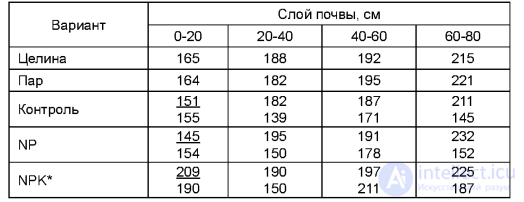
Above the line — vegetable crop rotation, below the line — grain crop rotation. *Potassium at a dose of 50% of the removal by the planned yield
The fixation of nitrogen in the soil in the form of non-exchangeably absorbed ammonium occurs in the first years of systematic fertilizer application, and once the fixation capacity is filled, no further increase in the amount of fixed ammonium occurs with fertilizer application. Potassium, like ammonium, is most actively fixed in the first years of fertilizer application, and once the fixation capacity is filled, the fixation of non-exchangeable potassium decreases over time, while its availability to plants, and consequently the coefficient of its utilization by plants, increase. The nature of the transformation of fertilizer potassium depends strongly on soil-climatic conditions (Table 3.8).
In sod-podzolic and gray forest soils, the amount of exchangeable potassium noticeably increases, while the content of non-exchangeable potassium changes little. The accumulation of exchangeable potassium is observed not only in the arable layer, but also in deeper layers of the soils studied. In the arable layer of chernozems, non-exchangeable absorption of potassium predominates, while the amount of exchangeable potassium increases to a lesser degree. In sierozems
3.8. Content of various forms of potassium in soils under long-term fertilizer application, mg K₂O/100 g of soil
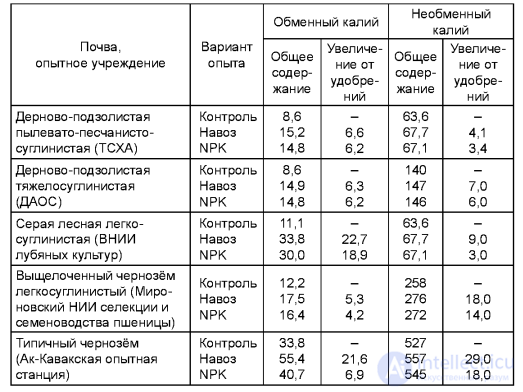
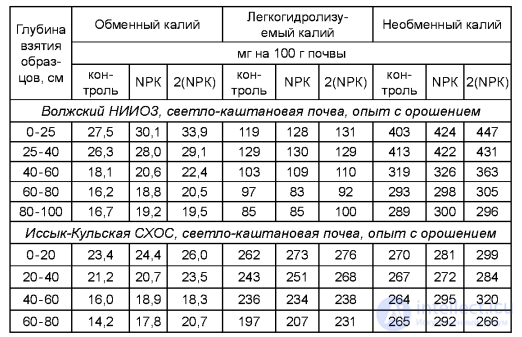
the content of both exchangeable and non-exchangeable absorbed potassium increases significantly. The features of the change in potassium forms under systematic application of mineral fertilizers on light chestnut soils under irrigation conditions are shown in Table 3.9. The leaching regime created by irrigation changes the content of non-exchangeable forms of potassium to a greater degree. The greatest changes are observed in the arable horizon, but the effect of irrigation extends to the entire meter-thick soil layer. The fixation of cations is largely determined by soil type. Thus, sod-podzolic soils are characterized by a low capacity to fix potassium, despite the high dispersity of the minerals. This is explained by the acidic reaction of the soil solution, the base unsaturation of the soils, the low organic-matter content, and the increased moisture content of the soils. In such cases, unfavorable conditions are created for the non-exchangeable absorption of potassium, which is fixed only in small amounts and only in the upper arable layer of the soil.
Liming and long-term application of manure increase the potassium-fixing capacity of acid soils compared with mineral fertilizers, which is related to the increase in the amount of organic matter, as well as to the coagulating action of
the divalent cations that are part of manure and lime fertilizers. With the combined application of nitrogen and potassium fertilizers, owing to the competing action of the NH4 + ion contained in the fertilizers, potassium fixation decreases by more than 2-3 times.
3.9. Effect of systematic fertilizer application on the potassium regime of chestnut soils (Zhukova L.M., Nikitina L.V., 1986)
Potassium fixation on sod-podzolic soils is small and poses no danger, since the non-exchangeable potassium of soil colloids is the main source for replenishing the reserves of exchangeable potassium available for plant nutrition. In gray forest soils, the fixation of potassium and ammonium is more pronounced than in sod-podzolic soils. The reaction of the soil solution, the mineralogical composition of these soils, and their increased organic-matter content contribute to the intensification of this process. In chernozems, conditions for cation fixation are exceptionally favorable: a high degree of base saturation of the absorbing complex, a higher pH value compared with sod-podzolic soils, a large amount of organic matter, a mineralogical composition of the colloidal fraction dominated by the montmorillonite group, and periodic drying of the upper layer, during which irreversible coagulation of colloids occurs — all of this contributes to the non-exchangeable absorption of cations.
The combined application of potassium and nitrogen fertilizers does not significantly reduce the fixation of potassium, since nitrification processes proceed intensively in chernozems. This is also the reason for the small increase in the amount of fixed ammonium in fertilized treatments. Fixation of potassium and ammonium occurs only in the upper layers of chernozems. In chestnut soils (Table 3.9) and sierozems, long-term fertilizer application leads to an increase in the amount of non-exchangeable potassium and ammonium. The transition of these cations into the non-exchangeably absorbed state is related to the predominance of hydromica minerals in the composition of the soils' silt fraction. These minerals possess an exceptionally high capacity for fixing monovalent cations. The alkaline reaction of the soil, saturation with divalent bases, and periodic drying of soils under the hot climate of dry-steppe and desert zones are also of great importance.
The leaching regime under irrigation conditions causes an increase in fixed cations in the lower layers of the soil profile. The combined application of nitrogen and potassium fertilizers has little effect on cation fixation, since the mineralogical composition of these soils has a high fixation capacity for monovalent cations.
By content of exchangeable potassium and fixed ammonium, soils are arranged in the following sequence: sod-podzolic < gray forest < chernozems < chestnut < sierozems. Within a single soil type, the amount of non-exchangeable cations increases from soils of light to soils of heavy particle-size composition. The reserves of non-exchangeable cations are substantial and must be taken into account when assessing soil fertility and in balance calculations.
The natural reserves of phosphorus in soils and their distribution through the profile are determined by the phosphorus content of the parent rocks and by the nature of the soil-forming process. With systematic fertilizer application, the gross phosphorus content and the reserve of its mobile compounds increase, and the mobility of phosphates increases. The degree to which these changes appear is determined by the fertilizer doses, the duration of the experiment (their application), and the properties of the soil itself. The bulk of the phosphorus accumulated as a result of fertilizer application remains in the arable soil layer.
However, at high fertilizer doses the subarable layer becomes enriched with phosphorus, and in some cases (on light soils without liming, under irrigation, etc.) so do deeper soil layers as well. The group composition of mineral phosphates throughout the profile is determined by the genetic features of the soils. In sod-podzolic soils, phosphates of sesquioxides predominate, while in chernozems — calcium phosphates predominate. With the application of mineral fertilizers, soils accumulate somewhat more phosphates of sesquioxides compared with manured soils.
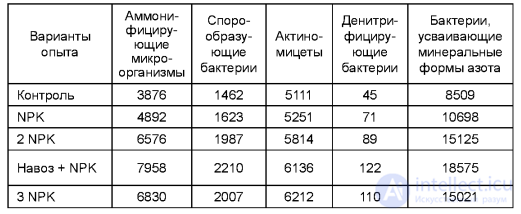
An important indicator of soil fertility is its biological activity — the totality of biological and biochemical processes occurring in the soil, determined by the genetic features of the soil, hydrothermal conditions, and agrotechnical measures. The biological activity of soils largely determines the degree of mineralization and humification of plant residues, the mobilizing capacity of soils, and, consequently, the availability of accessible nutrient elements to plants. The relationship between the biological activity of soil and its fertility has been studied to a lesser extent. It has been established that systematic fertilizer application in crop rotations activates the activity of soil biota. On acidic sod-podzolic soils, liming has a substantial effect on the activity of biological processes in the soil. Periodic liming reduces the content of mobile aluminum and exchangeable hydrogen, improves the living conditions of microorganisms in the soil, which enhances the processes of organic matter mineralization. A positive effect on biological activity is exerted by manure in its pure form, and in combination with mineral fertilizers and liming (Table 3.10). Liming enhances the effect of fertilizers on the enzymatic activity of the soil. The effect of fertilizers on the enzymatic activity of sod-podzolic soils is similar to their effect on biological activity. Maximum enzyme activity is noted against a background of manure.
On chernozem, dark gray forest soil, and sierozem, manure in its pure form and together with mineral fertilizers has a positive effect on enzymatic activity. In most cases urease activity increases, since a neutral or slightly alkaline soil reaction is favorable for its producers — urobacteria. This explains the higher urease activity against a background of manure compared with mineral fertilizers. Under the influence of fertilizers, invertase activity also increases. Moreover, the activity of the processes of decomposition and synthesis of nitrogen-free forms of organic matter increases to the same degree against a background of manure and of mineral fertilizers. Consequently, agrochemical means exert a complex effect on the fertility and properties of the soil:
1. Acidify or alkalinize the soil solution.
2. Improve or worsen agrochemical properties.
3. Enhance or weaken the biological and enzymatic
activity of the soil.
4. Contribute to the enhancement or weakening of physicochemical and
chemical absorption.
5. Contribute to the mobilization or immobilization of toxic
elements and radionuclides.
6. Enhance the processes of mineralization or humus synthesis in the soil.
7. Weaken or activate the biological fixation of N2 from the atmosphere.
8. Enhance or weaken the action of other nutrient elements of the soil and fertilizers.
9. Contribute to the mobilization or immobilization of biogenic macro- and micronutrients of the soil.
10. Cause antagonism or synergism of ions in the soil during their uptake by plants, which affects metabolism.
3.10. Effect of systematic fertilizer application on the biological activity of chestnut soil. Winter wheat and alfalfa. (Number of microorganisms, thousands per 1 g of dry soil, averaged over the growing season). Long-term experiment of the Gorsky Agricultural Institute (Dzhanayev G.G. et al., 2005)

Comments