
Lecture
The State Standard gives the following definition of soil: Soil is an independent, natural-historical, organo-mineral natural body that has formed on the Earth's surface as a result of prolonged exposure to biotic, abiotic and anthropogenic factors, consisting of solid mineral and organic particles, water and air, and possessing specific genetic-morphological features and properties that create conditions suitable for plant growth and development. Soil consists of three phases: solid, liquid (soil solution) and gaseous (soil air), which are in constant contact and interaction. The gaseous phase of the soil is soil air, which plays an important role in the life of plants, their roots and aerobic microorganisms. Soil air is found in non-capillary pores (large gaps in the soil), since water is mostly found in the capillaries. When all the pores become filled with water, the soil air is displaced from the soil.
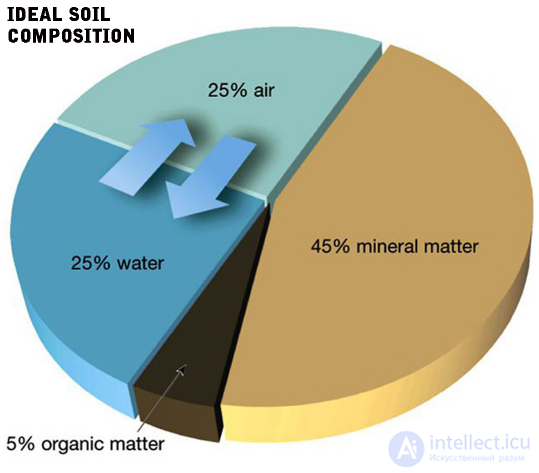
If the soil is dry, air fills all the pores (both capillary and non-capillary). In either case, plant nutrition is disrupted and plants die. The most favorable ratio of water to air is possible in loose, structured, cultivated and well-tilled soils. Soil structure is the physical arrangement of the solid part and the pore space of the soil, determined by the size, shape, quantitative ratio, character of interconnection and arrangement of both the mechanical elements and the aggregates formed from them. On structured, cultivated soils, applied fertilizers are most effective, since plants receive normal, uninterrupted nutrition. In composition, soil air differs greatly from above-ground air. It is rich in carbon dioxide, while in loose, poorly cultivated soils it is poor in oxygen. A sufficient amount of oxygen in the soil ensures the beneficial activity of aerobic microorganisms, whereas its absence promotes the development of anaerobic microbes, which often produce substances toxic to plants; vegetation then develops poorly or dies. Processes of organic matter decomposition by microorganisms, respiration of plant roots, and many chemical processes constantly occur in the soil, consuming oxygen and releasing carbon dioxide. Therefore, compared with the atmosphere, the gaseous phase of the soil is distinguished by an elevated content of carbon dioxide (from several tenths up to one percent, and sometimes up to 2-3%) and a somewhat lower oxygen content. Constant gas exchange between the soil and the atmosphere enriches the above-ground air layer with carbon dioxide. This improves the air (carbon) nutrition of plants with carbon dioxide (photosynthesis), which leads to an increase in plant productivity. At an elevated concentration of CO2 in the soil air, it dissolves in the soil solution, forming carbonic acid, which acidifies the soil solution:

As a result, the soil solution enhances the dissolution of mineral compounds in the soil (phosphates, carbonates, etc.), converting nutrients into a form available to plants. Under poor soil aeration (excess moisture, strong compaction), an excess of CO2 and a deficiency of oxygen build up in the soil, microbiological processes are suppressed, while anaerobic reductive processes are activated. As a result, root respiration and growth deteriorate, and plant growth slows down. It is therefore important to create conditions for good soil aeration, which will favorably affect its biological activity and the nutrition and growth of plants. The liquid phase of the soil. No life, including life in the soil, and no chemical processes are conceivable without water, without solutions. All transformations of substances take place in soil solutions or at the boundary between colloidal particles and the solution (the liquid phase). V.I. Vernadsky noted that in nature there is not a single solid body that does not contain water in its composition. Soils on average contain about 20% water of their total mass, i.e., one-fifth of the soil is water, its liquid part. However, depending on weather conditions, the water content of the soil varies. Plant nutrition with various substances occurs through the solution. It is no coincidence, therefore, that a plant can experience hunger even with a full set of nutrients if the soil lacks moisture. Consequently, fertilizers can play their positive role only when there is sufficient moisture in the soil. Water in the soil occurs in different states. In the air filling the gaps between soil crumbs, it is present as vapor. As the temperature drops, the vapor turns into liquid and settles on the solid particles as a continuous film. Soil water adjacent to soil particles, owing to strong attraction, loses all ability to move and is in a state close to solid. This water is called hygroscopic water. The water shell in the form of a film, located beyond the immobile layer of hygroscopic water, is called film water. The combination of hygroscopic water and vapor, together with the part of the film water most tightly pressed to the molecular layer of water, is called the dead reserve of moisture. It is unavailable to the plant and is usually equal to twice the maximum hygroscopicity of the soil. The dead reserve of moisture is higher the greater the amount of silty (colloidal) particles and organic matter (humus) in the soil. For example, sandy soil poor in humus contains only 1% of moisture unavailable to plants, while very heavy loams and clay soils rich in humus contain up to 15% of such moisture. In peat soils, the dead reserve reaches 20-50%. The water regime of the soil, and consequently the effectiveness of fertilizers, depends largely on its moisture capacity and water permeability. Moisture capacity is the ability of soils to retain water under the influence of sorption and capillary forces.
Water permeability is the ability of soil to absorb and let water pass through it. Clayey soils rich in organic matter (humus) have high moisture capacity and low water permeability and, consequently, a significant dead reserve of moisture; sandy soils poor in humus, on the contrary, have low moisture capacity but high water permeability. This must be taken into account when determining the availability of useful moisture in the soil and when applying fertilizers. When the amount of water in the soil begins to exceed its dead reserve, it penetrates into the finest soil pores — capillaries. Water filling them is called capillary water. This moisture is readily absorbed by plants in the course of nutrition. When moisture is in excess, it also fills the larger, non-capillary gaps in the soil. This water is called gravitational water. It moves through the soil under the influence of gravity and therefore easily percolates deep into the soil. The largest amount of gravitational water is observed only after rains, snowmelt or artificial irrigation. Water with substances dissolved in it (salts, acids, bases, etc.), gases, and microorganisms contained in it is called the soil solution. In different soils, the composition of the soil solution and its concentration differ, which determines the different nutrition regimes of plants. The soil solution is the most dynamic and active part of the soil. Various soluble chemical compounds constantly enter it, formed as a result of weathering and the breakdown of minerals, the decomposition of organic matter by microorganisms, and the application of organic and mineral fertilizers. The content of various cations and anions in the soil solution is determined primarily by the type of soil. For plant nutrition it is especially important to have a sufficient amount of K+, Ca2+, Mg2+, NH4+, NO3-, SO42-, H2PO4- in the solution, and a constant replenishment of these ions. The concentration of salts in the soil solution depends on the type of soil, its properties and chemical composition, natural conditions, the degree of salinization, the migration of salts through the soil profile, anthropogenic impact on the soil, etc. It usually amounts to hundredths of a percent (about 0.05%). At a salt concentration in the soil solution exceeding 0.2%, they have a harmful effect on the plant. In saline soils, the concentration can reach several percent. The solid phase of the soil consists of a mineral part (90-99% of the mass of the solid phase) and an organic part. The mineral part of the soil contains all the ash chemical elements; 1-3% of nitrogen from the total amount is present, and it is found almost entirely in the organic part of the soil. Elements such as carbon, hydrogen, oxygen, phosphorus and sulfur are found in both the mineral and organic parts of the soil.
1. Which mineral part of the soil is formed from weathered rock?
Hint: this is the foundation of the soil, originating from the parent rock.
2. Which component of the organic part of the soil is a product of the decomposition of plant residues?
Hint: it is this that gives the soil its dark color and fertility.
3. Which mineral element is most commonly found in the composition of soil?
Hint: it is part of sandy and clay particles.
4. Which organic component improves soil structure?
Hint: it promotes aggregate formation and moisture retention.
5. Which mineral element is responsible for soil acidity?
Hint: its ions can increase the acidity of the environment.
6. Which organic component is a source of nitrogen for plants?
Hint: nutrients are released during decomposition.
7. Which mineral element contributes to the formation of the structure of clay soils?
Hint: it helps particles bind together.
8. Which organic component affects the color of the soil?
Hint: the more of it there is, the darker the shade.
9. Which mineral element improves the water permeability of the soil?
Hint: large particles create pores for water.
10. Which organic component accelerates the formation of soil aggregates?
Hint: it acts as «cement» for particles.
11. Which mineral element affects soil fertility?
Hint: necessary for plant growth.
12. Which organic component regulates the moisture capacity of the soil?
Hint: retains water and nutrients.
13. Which mineral element gives the soil a reddish tint?
Hint: oxides of this element color the soil.
14. Which organic component promotes the development of microorganisms?
Hint: it serves as a source of energy for living organisms.
15. Which mineral element increases soil alkalinity?
Hint: its compounds neutralize acids.
16. Which organic component improves soil aeration?
Hint: they create channels for air.
17. Which mineral element is necessary for plant photosynthesis?
Hint: it is part of chlorophyll.
18. Which organic component affects the biological activity of the soil?
Hint: it provides a nutrient medium for microorganisms.
19. Which mineral element participates in the formation of soil structure?
Hint: fine particles retain water and bind aggregates.
20. Which organic component increases soil fertility?
Hint: contains the main nutrients for plants.

Comments