
Lecture
The theory of soil absorption capacity was created by K.K. Gedroits. An important role in developing this theory was played by the work of G. Wiegner and S. Mattson. Soil absorption capacity is provided by the soil absorbing complex (SAC), understood as the totality of mineral, organic and organo-mineral particles of the soil's solid phase that possess absorption capacity. K.K. Gedroits understood the absorption capacity of soil as its ability to retain substances that come into contact with its solid phase through the water circulating within it. Substances that can be retained include those in a dissolved state, mineral or organic colloidally dispersed particles, living microorganisms and coarse suspensions. Depending on the mode of absorption and the nature of the process involved, the following types of absorption capacity are distinguished: mechanical, physical, physico-chemical (exchange), chemical and biological. Mechanical absorption capacity of the soil is its ability to mechanically retain, in its pores, particles suspended in water filtering through the soil. This retains coarse suspensions of aluminosilicate and organic particles and colloidally dispersed substances, which helps preserve the valuable colloidal fraction and certain fertilizers, for example rock phosphate meal, among others. The intensity of mechanical absorption depends on the degree of soil porosity, pore size, the dispersity of the substance, etc. Hence clay and loamy soils have greater mechanical absorption capacity than sandy and sandy loam soils. This type of absorption capacity also plays a significant role in the distribution of microorganisms within the soil profile. Physical absorption capacity is the ability of the soil to retain mineral and organic substances on the surface of its solid phase by means of adsorptive forces, i.e. soil particles absorb (adsorb) whole molecules of electrolytes dissolved in the soil, as well as the main products of the hydrolytic breakdown of salts of weak acids and bases. Physical absorption is due to the presence, in the highly dispersed "soil + soil solution" system, of often considerable free surface energy. It is this energy that brings about the concentration of substances dissolved in the soil near the surface of the soil's solid particles together with soil moisture. In coarse-grained soils, for example sandy soils, surface energy is small and plays no particular role in soil processes. As soil dispersity increases, as the amount of silt increases, and as its colloidal fraction (particles with a diameter of <0.25 μm) grows, surface energy increases. In accordance with the fundamental law of colloid chemistry, the disperse system of the soil tends to reduce its free surface energy either by lowering the degree of dispersity (reducing the total surface area of the disperse phase) or by reducing the surface tension of the dispersion medium, i.e. soil solution. Substances that reduce surface tension are adsorbed on the surface of soil particles. An increase in the concentration of a dissolved substance in the layer of the dispersion medium immediately adjacent to the particles of the phase is called positive adsorption. Substances that increase the surface tension of the dispersion medium produce the opposite effect — negative adsorption. In positive adsorption the disperse phase, as it were, draws dissolved substances from the dispersion medium toward its surface, while in negative adsorption it, as it were, repels them from its surface. This type of absorption is called physical because the substance absorbed from the solution remains in solution, but in the layer of liquid immediately adjacent to the solid particles of the soil. Metal hydroxides from salts of strong bases and weak acids, or from pure solutions of these hydroxides, are adsorbed positively. Anions are adsorbed negatively. Given the complexity of the qualitative composition of the soil, as well as the constantly changing concentration of substances in the soil solution depending on meteorological and other conditions, physical absorption of the soil can be regarded as a dynamic process, as a result of which a varying concentration of salts is created in the soil. Positive adsorption plays an important role in soil processes and in plant nutrition, since substances dissolved in soil moisture remain in the soil in a bound state while remaining in solution. In addition, dissolved substances are prevented from being leached downward out of the soil layers, thereby preserving soil fertility. Thanks to physical absorption, various concentrations of nutrient elements are created in the soil, and plants select the solution in which the salt concentration best matches their biological requirements. Physical absorption in the soil can also arise as a result of the coagulation of colloidal particles. This process prevents the leaching of the soil's silt fraction as well as of nutrients from the root zone. It is very difficult to isolate physical absorption in the soil, since it is constantly interrelated with chemical absorption and exchange adsorption. Biological absorption is the absorption by plants and soil microflora of nutrients from the soil, fertilizers and air. As a result of the activity of plants and soil microorganisms, organic matter accumulates that contains ash elements and nitrogen. This type of absorption capacity is of great importance in the life of the soil, in soil-formation processes, and plays a significant role when fertilizers are applied to the soil. One of the features of the process by which organisms absorb mineral nutrition elements is the selectivity of this process: plant roots and microorganisms take up from the soil mainly those elements that they need. Most microorganisms consume the same elements for nutrition and for building their bodies as plants do. The quantity of microbes can reach several tonnes per hectare. Biological absorption also includes the assimilation of free nitrogen by nitrogen-fixing microorganisms. A certain portion of the nutrients applied to the soil as fertilizers (N, P, K, etc.) is consumed by microorganisms; if this process is strongly expressed, it can have a negative effect on the nutrition of cultivated plants. In cultivated sod-podzolic soils, microbial biomass contains about 125 kg of N, approximately 40 kg of P2O5, and about 25 kg of K2O per hectare. At the same time, under certain conditions biological absorption can be beneficial, since the nutrients absorbed in this case are protected from leaching and from moving toward the soil surface. Studies using the stable isotope 15N showed that 10–20% of the nitrogen from nitrate fertilizers and 20–40% of the nitrogen from ammonium fertilizers becomes fixed in the soil in organic form. This is especially important for nitrate nitrogen, which, owing to its assimilation by microorganisms, becomes fixed in the soil and is protected from leaching. Although this process is a positive one, under conditions of intense microbiological activity, a high content of nitrogen-free organic material in the soil, and a low nitrogen content in the soil, negative effects are possible owing to competition for nutrients between plants and microbes. The intensity of biological absorption, which depends on the activity of microorganisms, is substantially influenced by soil aeration conditions and by the presence in the soil of energy-yielding material (soil organic matter, plant residues, organic fertilizers). A readily available source of energy-yielding material for soil microorganisms is provided by plant root exudates. That is why microbiological processes proceed especially intensively in the rhizosphere zone (the space immediately adjacent to plant roots). In plant nutrition a major role belongs to the fungi that colonize plant roots, forming mycorrhiza. Fungi, being aerobic organisms, are supplied with oxygen through the plant's roots; they are capable of decomposing soil organic matter and supplying the host plant with mineral nutrient elements released during this decomposition. As a result, plant nutrition under natural conditions is strongly dependent on microbiological activity in the soil. Microbiological processes in the soil can be regulated by applying organic and mineral fertilizers, by liming the soil, and by using bacterial fertilizer. Chemical absorption capacity is the ability of the soil to retain certain ions by forming, as a result of chemical reactions, insoluble or poorly water-soluble compounds, or the ability of the soil to convert the anions and cations of the soil solution into poorly soluble compounds. Anions of nitric and hydrochloric acids (NO3- and Cl-) do not form poorly soluble compounds in water with any of the cations (Ca2+, Mg2+, K+, Al3+, NH4+), and consequently are not absorbed chemically by the soil. Anions of carbonic and sulfuric acids (CO3^2-, SO4^2-) are chemically absorbed in soils containing large amounts of Ca2+ and Mg2+, since they form poorly water-soluble compounds with them. Chemical absorption of phosphoric acid in the soil occurs through the formation of poorly soluble or insoluble salts with divalent and trivalent cations (Ca2+, Mg2+, Fe3+, Al3+). In soils with a neutral or slightly alkaline reaction, containing exchangeable-absorbed calcium and calcium or magnesium bicarbonates in the soil solution, chemical fixation of phosphoric acid occurs as a result of the formation of sparingly soluble calcium and magnesium phosphates. For example, when a water-soluble phosphate fertilizer (superphosphate) is applied to a soil with a high calcium content, the following reactions take place. With bicarbonate:

With exchangeable-absorbed calcium in the soil:
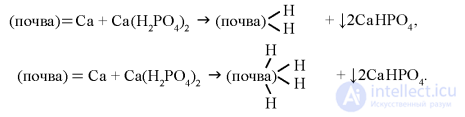
The sparingly soluble salts formed as a result of such chemical reactions precipitate and pass from the soil solution
into the solid phase of the soil. Such processes are therefore called chemical absorption. If the soil solution has an acidic reaction, the formation of water-insoluble calcium phosphate is impeded. Conversely, when an acidic solution interacts with a solid phase containing CaHPO4 or Ca3(PO4)2, processes directly opposite to chemical absorption occur, namely dissolution processes. Acidification can occur as a result of carbon dioxide released by plant roots and microorganisms, or as a result of the formation of nitric acid during nitrification. However, in an acidic medium, sparingly soluble salts of phosphoric acid can also form when it interacts with iron hydroxide or aluminum hydroxide:

The salts formed, unlike calcium phosphates, are sparingly soluble in a soil solution with an acidic reaction. Therefore, depending on the reaction of the medium, chemical absorption of phosphoric acid in soils proceeds differently. In soils with an acidic reaction, sparingly soluble phosphates of sesquioxides form predominantly, while in soils with a neutral or alkaline reaction chemical absorption of phosphoric acid may be associated with the formation of sparingly soluble calcium phosphates. As a result of chemical absorption, the phosphorus of phosphate fertilizers passes into a form less available to plants. In order of increasing intensity of chemical absorption of phosphoric acid, soils are arranged in the following sequence: chernozems < sierozems < sod-podzolic soils < red soils (krasnozems). Exchangeable cation absorption — this is the ability of the soil to retain, on the surface of its particles, ions capable of equivalent exchange, or the ability of finely dispersed colloids of soil particles, both mineral and organic, carrying a negative charge, to absorb various cations from solution. Exchangeable absorption consists in the fact that some cations pass from the solution into the solid phase, while at the same time a corresponding amount of other cations, which had previously been in the soil in an absorbed state, is displaced from the solid phase into the solution. K.K. Gedroits formulated the basic law governing the exchange adsorption of soils: all soils possess the ability to exchange the absorbed cations contained in their absorbing complex (both metallic and hydrogen ones) for any electro
lytes (both metallic and hydrogen ones), whereby the amount of cations absorbed by the soil is equivalent to the amount of cations displaced from the soil into solution. In the exchangeable absorption of cations, as in the physical absorption capacity of soils, surface energy plays a substantial role. However, whereas in physical absorption the process is limited to a positive or negative concentration of the substance dissolved in the layer of liquid at the surface of soil particles, in exchangeable absorption the electrolytes of the soil solution enter into a chemical reaction with molecules located on the surface of soil particles. Such a chemical reaction is possible, on the one hand, owing to the presence of surface energy, and, on the other hand, because negatively charged soil colloidal particles attract to their surface the cations of the soil-solution electrolytes, where these cations then enter into an exchange reaction with the cations of molecules located on the surface of the particles. These exchange reactions have a dual nature — physical and chemical. This is why the absorption capacity of soils is called physico-chemical. It is important to note that, unlike chemical absorption (in which the composition and overall concentration of the solution change owing to the formation of insoluble compounds), in exchangeable absorption the concentration of the solution does not change, but the composition of cations in the solution changes owing to the exchange, while the concentration of anions remains almost unchanged. When the soil absorbs any given cation from solution, it simultaneously releases into the solution an equivalent amount of another cation that had previously been in the solid phase:
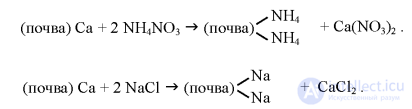
Depending on the concentration of the solution, its volume, the nature of the exchanging cations, and the properties of the soil's adsorbing particles, a certain mobile equilibrium becomes established between the cations of the solution and the absorbed cations of the soil's solid phase. A change in the composition of the soil solution upon the application of fertilizer, the formation of soluble compounds as a result of the activity of microorganisms in the soil, and the release of CO2 and other substances by the roots of higher plants — all these factors shift the mobile equiliDepending on the concentration of the solution, its volume, the nature of the exchanging cations, and the properties of the soil's adsorbing particles, a certain mobile equilibrium becomes established between the cations of the solution and the absorbed cations of the soil's solid phase. A change in the composition of the soil solution upon the application of fertilizer, the formation of soluble compounds as a result of the activity of microorganisms in the soil, and the release of CO2 and other substances by the roots of higher plants — all these factors shift the mobile equilibrium between the solid phase of the soil and the soil solution and cause some cations to pass from solution into the absorbed state and others to pass from the absorbed state into the soil solution. Exchangeable absorption in soils was first studied deeply and comprehensively by K.K. Gedroits. He proposed calling the entire assemblage of finely dispersed soil particles (mineral and organic), which are the carriers of the soil's exchangeable absorption capacity, the soil absorbing complex. It includes soil colloids, i.e. particles from 0.00025 to 0.001 mm in size. The latter possess a considerably lower capacity for exchangeable absorption. Soil colloids are divided into organic, mineral, and organo-mineral ones (the latter are poorly studied). Organic colloids are represented mainly by humic substances (humic acids, fulvic acids and their salts). Mineral colloids include crystalline clay minerals of the kaolinite and montmorillonite groups, hydrous micas, as well as amorphous compounds — hydrated sesquioxides, silicic acid, and others. All organic and mineral colloids carry a negative charge, with the exception of aluminum and iron hydroxide colloids, which are positively charged. This explains the pronounced tendency of most soils to absorb cations rather than anions. Kaolinite-group clay minerals can also acquire positive charges under acidic conditions. Hydroxyl ions bound to aluminum in the octahedral layer located on the outer surface of the microcrystalline kaolinite particles can split off under acidic conditions, i.e. in the presence of excess hydrogen ions in the solution, resulting in the appearance of positive charges on individual sections of the colloidal particle. The basic properties of such colloids can manifest themselves in strongly acidic sod-podzolic soils and red soils (krasnozems). Consequently, kaolinite-group minerals can, under acidic conditions, carry both positive and negative charges simultaneously in different regions. In this case they are capable of absorbing anions from the soil solution in exchange for OH-. Therefore, the more minerals of this group, as well as aluminum and iron hydroxides, are present in the soil's absorbing complex, the lower the capacity for exchangeable cation absorption, while the capacity for exchangeable anion absorption increases. Exchangeable cation absorption has its own regularities.
1. The exchange reaction proceeds in equivalent proportions and is reversible. In this process a mobile equilibrium is established between the soil and the solution. 2. At a constant solution concentration, the amount of cations displaced from the soil into the solution increases as the volume of the solution increases, while at a constant solution volume, the amount of cations displaced from the soil into the solution increases as the concentration of the displacing-salt solution increases. 3. The cation exchange reaction proceeds at high speed, with equilibrium being established within a few minutes. 4. Different cations are absorbed by the soil with unequal energy and are held in the absorbed state to differing degrees. In general, the higher the relative atomic mass and the greater the charge of the cation, the more strongly it is absorbed and the more difficult it is to displace from the absorbed state by another cation.
For example, in the series of monovalent cations, absorption increases in the following order: 
with relative atomic masses of 6, 9, 23, 18, 39, and 85, respectively.
Divalent cations are arranged in the series  (relative atomic masses of 24, 40, and 59, respectively),
and trivalent cations:  (relative atomic masses of 27 and 56).
At the same time, doubly charged magnesium cations are absorbed more strongly than singly charged sodium cations, calcium is absorbed more strongly than potassium, and so on (at approximately equal relative atomic masses). To characterize the unequal sorbability of different cations, K.K. Gedroits introduced the concept of «cation absorption energy». There are notable exceptions to the general rule. Thus, hydrogen ions, despite having the smallest relative atomic mass, possess a high capacity to displace other cations from the absorbed state. Its absorption energy is 4 times greater than that of calcium and 17 times greater than that of sodium. The increase in cation absorption energy with increasing atomic mass is explained by the fact that, as the atomic mass and size of the cation increase, its degree of hydration decreases. Weakly hydrated cations are more strongly attracted to the surface of the colloid. It should also be noted that minerals of the kaolinite group absorb cations only on the outer surface of the crystal, since they have very little free space between the layers of the crystal lattice (2.8 Å). In minerals of the montmorillonite group, on the other hand, the free space between the layers is signifi
-cantly greater (9.4 Å when dry, increasing to 21 Å upon swelling), which makes it possible for even comparatively large ions to penetrate this space. Non-exchangeable cation absorption also occurs in the soil, whereby clay minerals (muscovite, vermiculite, illite, montmorillonite) having a three-layer crystal lattice capable of expanding fix cations (potassium, ammonium, cesium, rubidium). It is assumed that the cations enter the interlayer spaces of the crystal lattice of these minerals. Non-exchangeable absorption of ammonium and potassium varies within very wide limits, depending on the genetic characteristics of the soils and their mechanical and mineralogical composition. In chernozems it is expressed considerably more strongly than in sod-podzolic soils. It also increases with alternating wetting and drying of the soils. Therefore, shallow incorporation of ammonium and potassium salts into soil layers subject to alternating wetting and drying enhances the non-exchangeable absorption of ammonium and potassium applied as fertilizers. Ammonium and potassium absorbed by the soil non-exchangeably are released into plant-available forms more slowly than those absorbed exchangeably. The cation absorption capacity of the soil is the maximum amount of exchangeable cations that can be absorbed by the soil. Absorption capacity is most conveniently expressed in millimoles per 100 g of soil. If, for example, 100 g of soil contains 500 mg of absorbed calcium (and no other cations), then the absorption capacity of such a soil equals 500 : 20 = 25 mmol/100 g of soil (the equivalent mass of calcium is 40 : 2 = 20, so 1 mmol of calcium equals 20 mg Ca). If all the calcium (500 mg) is displaced with NH4Cl, then 450 mg of NH4 will be absorbed in place of the calcium, and the soil will contain 450 mg of absorbed ammonium (the equivalent of NH4" = 18). Therefore, when exchanging Ca for NH4, 18 mg of ammonium is absorbed in place of 20 mg Ca. The absorption capacity, however, remains the same; if expressed in millimoles, it will again equal 25 mmol/100 g of soil, since 450 : 18 = 25, i.e. the absorption capacity for a given soil is a constant quantity. The magnitude of the absorption capacity is determined by a number of factors: 1) the content of highly dispersed particles in the soil; 2) the chemical and mineralogical composition of the soil colloids; 3) the reaction of the soil (the pH value). Soils containing large amounts of highly dispersed particles are distinguished by a high absorption ca
pacity; the cation absorption capacity of clay soils is higher than that of sandy soils. Different groups of soil colloids differ sharply in absorption capacity. Among clay minerals, minerals of the montmorillonite group have the highest absorption capacity. These minerals are characterized by a high degree of dispersity, and accordingly the cation absorption capacity of montmorillonite is comparatively large — 60–150 mmol/100 g of mineral. Kaolinite is distinguished by low dispersity and a small active surface. Accordingly, its cation absorption capacity is also low — only 3–15 mmol/100 g of mineral. Organic soil colloids — humic substances — possess a considerably greater absorption capacity compared with mineral ones. Differences in the cation exchange capacity of humic acids of different origin are determined by their differing content of functional groups: the humic acids of podzolic soils have an exchange capacity of about 350 mmol/100 g of substance (at pH = 7.0), while the humic acids of chernozem and chestnut soils under the same conditions have 400–500 mmol/100 g. Chernozems therefore have a higher absorption capacity (40–60 mmol/100 g of soil) compared with sod-podzolic soils (10–15 mmol/100 g). The absorption capacity of the third group of highly dispersed soil particles — amorphous mineral colloids — depends on the ratio of SiO2 : R2O3 in their composition. The wider this ratio, the greater the acidoid portion, and the higher the value of their cation absorption capacity. As pH increases, absorption capacity also increases, since the negative charge of the colloids increases and, consequently, so does their absorption capacity with respect to cations. Exchangeable absorption capacity depends on the composition of the soil colloids. The greater the content of organic matter and clay minerals of the montmorillonite group in the finely dispersed fraction of the soil, the higher the absorption capacity tends to be. The capacity of soil organic matter for cation adsorption is due to the acidic (acidoid) nature of humus substances, thanks to which organic soil colloids carry a negative charge. The negative charge is imparted to organic colloids by carboxyl groups according to the following scheme:

The exchange reaction of cations absorbed by organic soil colloids can be represented as follows:

-persed fraction of soils is likewise associated with a negative charge. The appearance of a negative charge in soil minerals is mainly related to the presence of isomorphous substitutions in silicate and aluminosilicate structures (for example, silicon substituted by aluminum, among others), which can be explained as follows. A compound of composition SiO2 is neutral, but if, in the silica-oxygen structure, some of the silicon atoms in tetrahedral coordination are replaced by aluminum atoms, such a substitution disrupts the neutrality and imparts a negative charge to the aluminosilicate formation. Schematically this can be represented as follows:

The negative charge in aluminosilicates is balanced by a corresponding amount of cations such as K+, Na+, Ca2+, and others. In clay minerals forming part of the finely dispersed fraction of the soil, these cations turn out to be capable of dissociation and exchange for other cations according to the scheme

The scheme given shows why it is precisely the aluminosilicates, and not free SiO2, that serve as the carriers of the exchangeable absorption capacity of the mineral part of the soil. Aluminum, which forms part of the silica-oxygen (tetrahedral) structure and partially replaces silicon within it, imparts to this structure acidic properties that pure SiO2 does not possess. Among soil minerals, montmorillonite has the highest exchange capacity for the reasons indicated. The montmorillonite lattice consists of numerous flat layers (packets), the composition and structure of which can be represented schematically as follows:

Such a structure is neutral; aluminum (in the central part of the layer) forms a layer with octahedral coordination in it, and in this position it does not impart a negative charge to the aluminosilicate structure. However, a charge appears if aluminum partially replaces silicon in the silica-oxygen layer, for example:

Thus, the influence of aluminum on the charge of the aluminosilicate structure depends on its position within it. Aluminum that forms an independent alumo-oxygen or alumo-hydroxyl layer with octahedral coordination does not possess acidoid properties. Besides the partial substitution of aluminum for silicon, other isomorphous substitutions can also give rise to a negative charge in montmorillonite, for example the partial replacement of aluminum in octahedral coordination by magnesium:

The high exchange capacity of minerals of this type is also due to the fact that cation exchange in them is not limited to the outer surface of the microcrystalline particles but extends into their interior, because upon swelling the solution penetrates into the interlayer spaces of the microcrystals' crystal lattice. Other minerals of the finely dispersed soil fraction have a denser packing, and therefore cation exchange in them occurs only on the outer surface of the microcrystals. These include, in particular, minerals of the kaolinite group, the composition and structure of whose layers can be represented as follows:

Compared with minerals of the montmorillonite group, kaolinite is distinguished by a higher aluminum content and a lower silicic-acid content. In such a structure, aluminum not only fails to impart acidoid properties to the mineral, but, on the contrary, can display its basic properties owing to the hydroxyl ions bound to aluminum that emerge on the outer surface of the microcrystalline particles:

The basic (basoid) properties are expressed to an even greater degree in free sesquioxides (of aluminum and iron) not bound to silicic acid, which in an acidic medium react predominantly as bases:

As the overall content of aluminum and iron in the finely dispersed fraction of soils increases and the amount of silicic acid decreases, there is, as a rule, a decline in cation exchange capacity and a decrease in absorption capacity.
Thus, the absorption capacity of the soil depends on the total content of the finely dispersed colloidal fraction, on its chemical composition, and on the associated structure of the adsorbing particles. The low absorption capacity of light sandy soils poor in organic matter is explained in general by their low content of the finely dispersed colloidal fraction. The low absorption capacity of sod-podzolic soils may be due to an increased content, in the finely dispersed fraction, of free sesquioxides, and, among aluminosilicate minerals, of clays in which structures of the kaolinite type predominate. The high absorption capacity of chernozem-type soils is due both to their increased content of a finely dispersed fraction with a large proportion of organic matter in its composition, and to the predominance, among the clay minerals, of montmorillonite with a high SiO2 : (Al2O3 + Fe2O3) ratio. The absorption capacity is also influenced by the reaction of the medium. Both organic and most mineral soil colloids possessing acidoid properties display them to a greater degree under neutral and slightly alkaline conditions. Under an acidic reaction, on the contrary, the charge of the soil colloids decreases, as a result of which the cation absorption capacity is somewhat reduced. Composition of the absorbed cations. Most of the absorption capacity of chernozem soils is, as a rule, occupied by calcium (30–40 mmol) and magnesium (5–10 mmol). In the absorbing complex of solonetzic and saline soils (solonetz, solonchak) sodium cations are present in addition to calcium and magnesium, while in podzolic and lateritic soils aluminum and hydrogen ions are present. The composition of the absorbed cations has a definite influence on the properties of the soil. 1. Owing to the reversibility of the cation exchange reaction, the soil has the capacity to regulate the composition of the soil solution (KCl displaces Ca2+ in chernozem, while in acid soils it displaces Al3+ and H+). The composition of the absorbed cations can substantially influence the action of fertilizers. 2. The composition of the absorbed cations affects the state of the absorbing complex itself (calcium and magnesium increase the absorption capacity and improve the physical properties of the soil, while sodium impairs them). Hydrogen ions create soil acidity and cause the gradual destruction of the minerals that make up the soil's absorbing complex. Therefore, the displacement of absorbed calcium by hydro
gen leads to a decrease in absorption capacity, which also impairs the structure of the soil. By applying fertilizers, the ratio of absorbed cations in the soil can be regulated. Liming of sod-podzolic soils and gypsum application to solonetzic soils increase the calcium content of the absorbing complex. The reaction of the soil solution is the ratio of the concentration of H+ and OH- ions in the soil solution, expressed through the pH of a water or salt extract from the soil. Soil reaction is a significant factor affecting higher plants and microorganisms. Fertilizers often change the reaction of the soil solution (for example, upon liming or the application of physiologically acid salts). A physiologically acid fertilizer is one whose application acidifies the soil owing to the predominant uptake of its cations by plants. The reaction of the soil solution (like that of any other solution) is determined by the concentration of hydrogen ions (H+) and hydroxide ions (OH-) present in it. In pure water, which has a neutral reaction, the concentration of hydrogen ions equals the concentration of hydroxide ions. Electrolytic dissociation of water yields equal amounts of H+ and OH- ions. The degree of dissociation of water is very small. The concentration of hydrogen ions in pure water equals 10⁻⁷ g/L. Hydrochloric and nitric acids dissociate completely in dilute solution, so if 1 mmol of HCl is added to 1 L of water, the solution will contain about 1 mmol of H+, i.e. 0.001 g = 10⁻³ H+. For simplicity, the concentration of hydrogen ions is expressed through pH (the negative logarithm of the hydrogen ion concentration). Since in a neutral solution the concentration of hydrogen ions equals 0.0000001 = 1×10⁻⁷, pH = 7. The reaction of soil solutions can vary within fairly wide limits, ranging from pH = 3–3.5 (the most acidic reaction, characteristic of sphagnum peats and the litter of sphagnum forests) to pH = 10–11 (such an alkaline reaction can occur in solonetz soils). Soil acidity is a property of the soil due to the presence of hydrogen ions in the soil solution and of exchangeable hydrogen and aluminum ions in the soil's absorbing complex. A solution will be alkaline if the concentration of OH- ions is greater than the concentration of H+ ions, as compared with pure neutral water. Consequently, if the pH value is below 7 it is an acidic reaction, if the pH equals 7 it is neutral, and if the pH is above 7 it is alkaline.

The concentrations of hydrogen and hydroxide ions are related as follows:

i.e. the greater the concentration of hydroxide ions, the smaller the concentration of hydrogen ions, and vice versa. The soil solution always contains carbonic acid, which forms as a result of biological activity. It has an acidifying effect on the soil solution:
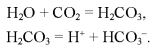
However, this acidity is neutralized by absorbed bases (of calcium and magnesium) and by carbonates of the same metals:

If the soil's absorbing complex contains absorbed sodium, the formation of sodium bicarbonate or sodium carbonate in the solution is possible:
Carbonate salts in solution undergo hydrolytic dissociation:

Since Ca(OH)2 and NaOH are strong bases, while H2CO3 is a very weak acid, when carbonate salts dissolve in water the predominance of OH- shifts the reaction toward the alkaline side. Sodium carbonate makes the solution alkaline especially sharply, sodium bicarbonate less so, and calcium and magnesium bicarbonates still less so. Thus, soil alkalinity is its ability to display the properties of bases. The reaction of the soil solution in different soils depends on the composition of the absorbed cations and on the presence of carbonates in the soil. If the absorbing complex contains a large amount of sodium (solonetz, solonchak soils), the reaction of the soil solution is determined by the presence of carbonate salts. In such soils it is usually around 8–8.5. When calcium cations predominate in the absorbing complex, or when calcium and magnesium carbonates are present (carbonate soils, many chernozems), the reaction is regulated mainly by the presence of calcium bicarbonate in the soil solution; the pH of such soils ranges from 7 to 8. If, in addition to calcium and magnesium, the soil also contains aluminum and hydrogen (leached and degraded chernozems, sod-podzolic soils), the reaction of the soil solution is determined simultaneously by the presence of free carbonic acid and calcium bicarbonate

as well as soluble organic acids and their salts. The less calcium and the more hydrogen there is, the less there will be of 
and the more free  the pH ranges from 5 to 7.
In addition to CO2 and organic acids, aluminum salts can also acidify the soil solution:

to 3.5–4. A distinction is made between actual (active) acidity and potential acidity, the latter being subdivided into exchangeable and hydrolytic acidity. The actual acidity of the soil solution is created by carbonic acid (H2CO3) and by partially soluble organic acids and hydrolytically acid salts. It is detected by determining the pH of the soil solution or of a water extract from the soil. Exchangeable acidity is created by the presence of hydrogen and aluminum ions in the exchangeable state of the soil, which are displaced when a neutral salt interacts with the soil's absorbing complex:
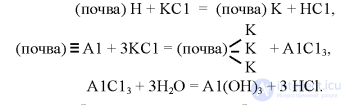
Applying fertilizers to soils with exchangeable acidity can cause even greater acidification, so this must be taken into account when applying fertilizers. The hydrolytic acidity of a soil is created by the action of a hydrolytically alkaline salt (CH3COONa) on the soil's absorbing complex. Sodium acetate imparts an alkaline reaction to the solution:

Leached and podzolized chernozems have hydrolytic acidity. Determining hydrolytic acidity is important for solving practical problems related to fertilizer application, liming, phosphating of soils and other agrochemical practices. The degree of base saturation of soils shows what proportion of the total absorption capacity is accounted for by exchangeable bases:

where V — degree of base saturation (%); S — sum of exchangeable bases (mmol); H — hydrolytic acidity (mmol); T — absorption capacity. There are the concepts of soil buffering and acid-base buffering of soil. T = S + H. Soil buffering is the soil's ability to resist changes in its properties under the action of various factors, while acid-base buffering of soil is its ability to resist changes in the pH of the soil solution when the soil interacts with acids and bases.
For example: 
If alkali is added to such a solution, the equilibrium will shift and part of the CH3COOH molecules will pass into the dissociated state. Therefore the pH of the solution will change little; the solution will exert a buffering action against alkalization. A solution of a mixture of a weak acid and its salt, for example CH3COOH and CH3COONa, will also be buffered against acidification. Under the influence of the electrolytic dissociation of the salt, the dissociation of the already weak acid is suppressed:
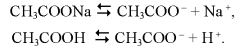
If a strong acid is added to such a mixture, hydrogen ions will combine with CH3COO — anions and pass into the undissociated state, so the pH will change little — the solution will buffer against acidification. The soil solution possesses a buffering capacity of this kind, since it contains weak acids and their salts (for example, carbonic acid, organic acids, phosphates).
Buffering occurs when calcium, magnesium and other elements are present in the soil absorbing complex:

The greater the absorption capacity of the soil and the degree of soil base saturation, the stronger its buffering properties. The buffering action against a shift of the reaction toward the alkaline side is also related to the absorbing complex, and to exchangeable and hydrolytic acidity:

The higher the hydrolytic acidity of the soil, the more actively the soil will counteract a shift of the reaction toward alkalization. Thus, the buffering action of soil is mainly determined by the degree of soil base saturation and the magnitude of the absorption capacity. The higher the degree of soil base saturation and the lower the hydrolytic acidity, the more resistant the soil is to a shift of the reaction toward the acid side. In the case of a low degree of saturation, conversely, the soil's resistance to alkalization is especially pronounced. The application of increasing amounts of agrochemical inputs in intensive farming substantially affects soil fertility and properties, which in turn determines the yield of agricultural crops and the quality of the produce. A thorough knowledge of the complex of factors and processes occurring in the soil - fertilizer - plant system is necessary, the most important of which are: 1) changes in the properties and fertility of soil under systematic fertilizer application combined with other agrotechnical practices; 2) the cycling and balance of nutrients and humus in the soil and their regulation; 3) the study and development of a set of optimal parameters for the main indicators of soil fertility.

Comments