
Lecture
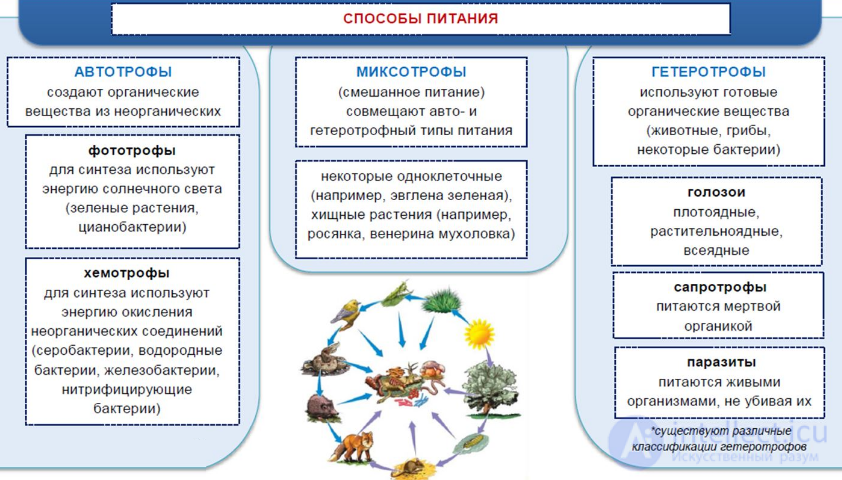
There are several types of plant nutrition, depending on the source of the nutrients. The main types of nutrition include:
Autotrophic nutrition: Plants capable of synthesizing their own organic compounds from inorganic substances are called autotrophic. They carry out photosynthesis, using solar energy to convert carbon dioxide and water into glucose and other organic substances. Photosynthesis is a form of autotrophic nutrition.
Heterotrophic nutrition: Some plants are not able to synthesize organic substances from inorganic materials and obtain them from outside. This type of nutrition is called heterotrophic. In such cases, plants absorb organic substances from the environment, including from the soil.
Saprotrophic nutrition: Some plants, such as fungi, obtain nutrition by decomposing organic remains (dead plants, wood, etc.) and absorbing the products of decomposition. They are saprotrophs and play an important role in the processing of organic material in the soil.
Parasitic nutrition: Some plants, called parasites, extract nutrients from other plants or organisms on which they parasitize. They can penetrate the host plant with the help of specialized structures, such as parasitic roots or hemiparasitic plants.
Mycorrhiza: Mycorrhiza is a symbiotic association between plant roots and fungi. The fungi help plants absorb water and nutrients, while the plants provide the fungi with carbon dioxide and other organic compounds.
Profitic nutrition: Some plants can obtain nutrients formed as a result of the decomposition of animal remains (for example, insects). This type of nutrition is called profitic.
Different plants can use combinations of these types of nutrition, and can also adapt to different conditions and sources of nutrition.
There are autotrophic and symbiotrophic (mycotrophic and bacteriotrophic) types of plant nutrition. In most cases, plants are dominated by the autotrophic type of nutrition (from the Greek «troph» — «food»), i.e. independent provision with inorganic elements and soil nitrogen and carbon dioxide, from which organic substances are synthesized. In addition to green photosynthesizing plants, some bacteria that carry out carbon nutrition by means of photosynthesis or chemosynthesis also belong to autotrophic organisms. Autotrophic organisms do not need an external supply of ready-made organic substances; instead, in the process of carbon nutrition (photosynthesis), they carry out their primary synthesis from the carbon of atmospheric CO2, i.e. they create organic compounds anew. In the symbiotrophic type of nutrition, the higher plant lives in close association with other organisms (symbionts). Symbiosis developed in the course of the historical evolution of organisms as a form of relationship useful to them. In the symbiotrophic type of nutrition, there is a mutual use of the products of metabolism for nutrition. The boundaries of symbiosis are not always clearly defined, so it is often difficult to determine the benefit that one organism brings to another. When a higher plant is in symbiosis with fungi, the mycotrophic type of nutrition is established. The fungal mycorrhiza supplies the higher plant with water and with mineral salts dissolved in it, and with other
substances, while the fungi use carbohydrates and other organic compounds synthesized by the higher plant. The biological significance of mycorrhiza also lies in the increase in the absorbing surface of the higher plant's roots through the growth of the fungal mycelium. In recent years, mycorrhizal fungi have been discovered that improve the phosphorus nutrition of higher plants, especially on soils with a low content of available phosphorus. As the content of this form of phosphorus increased, the effectiveness of plant inoculation with mycorrhiza decreased. The extensive study of this symbiosis and its use in farming practice make it possible to reduce the use of scarce industrial phosphorus fertilizers. Thus, in a field trial in Wales, with liming and phosphorus top dressing, the dry-matter yield of clover inoculated with mycorrhiza was three times higher, shoot formation doubled, and the formation of rhizobium nodules increased fivefold. Similar data have been obtained on soils poor in available phosphorus in Tropical Africa, Brazil, Australia and Spain. The most striking example of the bacteriotrophic type of plant nutrition is the symbiosis of nodule bacteria (rhizobium) with leguminous plants.
Under conditions that ensure effective symbiosis, the amount of biological nitrogen fixation reaches several hundred kilograms per hectare per year. During the period of intensive chemicalization of agriculture, the use of the unique ability of leguminous plants and microorganisms to fix molecular nitrogen from the atmosphere is increasing. Determining the optimal ratio of biological to industrial nitrogen makes it possible to properly balance the cycling of this element in agriculture and to avoid disturbing the balance of the environment, i.e. to more successfully solve the ecological problems of nitrogen agrochemistry. Biological fixation of atmospheric nitrogen therefore represents great scientific as well as practical interest. It is difficult to overestimate this most important gift of nature, with its unlimited resource potential. Above every hectare of land and water surface on the globe there are 80 thousand t of nitrogen, which becomes available to plants through their symbiosis with the nodule bacteria living on the root system of legumes. Every year, some 40 × 10^6 t of nitrogen is fixed biologically in the soil as a result of the symbiosis of bacteria with leguminous plants. The development of a plant depends on the environment. The most favorable conditions for maximum productivity and the best yield quality are created by an optimal combination of nutrients, water supply, temperature, illumination and air. On acid or solonetzic soils, an important condition is the neutralization of the acidity or alkalinity of the soil solution. In practice, as a rule, optimal conditions for plant nutrition and growth are absent in most cases. They must be created in accordance with the biological requirements of plants.
The main task of agriculture is to create optimal conditions of nutrition and water supply for plants, the necessary air regime of the soil, and the soil-solution reaction best suited to the given crop.
Only in this case can the greatest agronomic effect be obtained from the complex of measures applied. For example, when optimal nutrition conditions are provided through fertilizer application, plants use moisture more economically to form a unit of yield. The transpiration coefficient thereby decreases by 15 - 20% or more, which is especially important in areas of insufficient moisture. On the other hand, the payback of fertilizers through additional yield rises sharply when plants are well supplied with water, including under irrigation. There are numerous known cases of the absence of a positive effect of fertilizers on acid and solonetzic soils. Eliminating the alkalinity or acidity of the soil, as a rule, sharply increases the effectiveness of fertilizers. When good conditions of plant nutrition are being created, underestimating any one factor of plant development inevitably leads to failure. All factors are important for the plant, so in each specific case it is necessary to know which of them is lacking. For example, in northern regions characterized by abundant natural moisture but low-fertility soils, plants need above all an adequate supply of nutrients. Here there is also often a lack of warmth and air, which necessitates measures to combat excess moisture. On acid soils, the effectiveness of fertilizers drops sharply, and such soils need to be limed.
In southern regions, especially on ordinary southern chernozems and chestnut soils with high potential fertility, yield is less limited by a lack of nutrients. The factor most often limiting yield here is a lack of moisture. On these highly fertile soils, given favorable natural moisture, conditions are created for realizing the potential productivity of agricultural crops.
Irrigation and the creation of optimal plant nutrition conditions through fertilizer application help to obtain the maximum yield in these regions. The large sum of positive temperatures and sunny days makes it possible, over a considerable area of the southern regions of Russia, Kazakhstan and Ukraine, to obtain two harvests a year. Where soil salinization stands in the way of this, gypsum application and other measures that reduce the alkalinity of solonetzic soils must be used. A plant is nourished through its roots and leaves. Carbon nutrition of plants (photosynthesis) takes place through the leaves, i.e. the assimilation by green leaves of carbon dioxide from the atmosphere with the help of solar energy. Photosynthesis is therefore also called the air nutrition of plants. Through its roots, a plant absorbs and assimilates water and various mineral-salt ions from the soil, as well as small amounts of certain organic substances. At present, thanks to the use of the labeled-atom method, our knowledge of the theory of plant nutrition has been considerably deepened and broadened. Studies have shown that the division into root and air nutrition is conventional, since the same substances are capable of being absorbed by both roots and leaves.
For example, carbonic acid enters the plant through the roots to the same extent as through the leaves, and can take part in the synthesis of organic compounds. Sulfur likewise enters the plant through the roots in the form of salts of sulfuric acid. Later, thanks to the use of the radioactive isotope of sulfur, it was shown that plants are also able to assimilate oxides of sulfur (SO2, SO3) that enter through the leaves from the air. For many years it was believed that the formation of complex organic substances occurred only in the leaves. However, thanks to the labeled-atom method, scientists have established that active synthetic processes forming complex organic compounds also take place in the roots. Attaching enormous importance to the plant leaf in the creation of organic substances, K.A. Timiryazev wrote: «It can be said that the very essence of plant life is expressed in the life of the leaf, that a plant is a leaf». Taking into account the modern achievements of the science of plant nutrition and the synthesis of organic substances, it must be said that the leaf and the root are the essence of the plant, for in them are concentrated two synthetic laboratories that mutually complement and condition each other's work. For example, mineral salts can be absorbed and assimilated by plants not only through the roots but also through the leaves. The entry of nutrient elements into plants through above-ground organs is called foliar (non-root) nutrition of plants. This gave rise to the widespread use of foliar top dressings, which often not only increase the yield but also improve its quality. These two types of plant nutrition are closely interrelated. For example, a lack of nutrients in the soil delays the formation of organic compounds in the leaves, which in turn inhibits plant growth and reduces their productivity.

Comments