
Lecture
The external environment has a significant influence on the conditions of plant nutrition and the efficiency of fertilizer use. Various aspects of the external environment can affect the availability of nutrients and plants' ability to use them. Here are some of these aspects:
Soil conditions:
Climatic conditions:
Light level:
Soil pH:
Presence of other substances:
Fertilizer application:
Understanding these factors and their influence on plant nutrition allows agronomists and growers to make more effective decisions regarding fertilization, soil cultivation and the management of plant growth conditions.
In the course of evolution, different species of plants, along with general relationships and requirements toward the external environment, also developed specific ones, characteristic of that particular species. For this reason, normal plant development is possible only through a combination of both the general conditions of the external environment and the particular conditions characteristic of a given species. Plants display differing sensitivity to acidic and alkaline conditions — the reaction of the soil solution. The approximate pH values given in Table 4.4 may show considerable variation for each crop, depending on many factors.
4.4. Optimal or permissible soil-solution reaction for the main agricultural crops
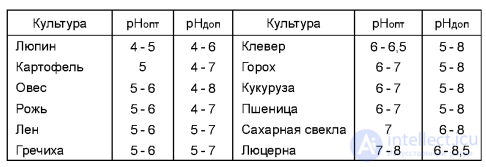
For example, an increased content of Ca2+ in the soil solution weakens the harmful effect of an acid reaction owing to the antagonism that exists between Ca2+ and H+. Moreover, the sensitivity of one and the same plant to an acid reaction changes with age. Plants are most sensitive to an acid environment during the initial period of development. The reaction of the soil solution has both a direct and an indirect effect on the plant. In its direct action, the reaction of the soil solution changes the quantity of H+, HCO3-, OH- ions on the surface of the root hairs, which cannot fail to affect the concentration of these ions in the cell sap. As a result, the pattern of nutrient uptake from the soil changes. Increased acidity or alkalinity of the soil solution disrupts the physiological balance of ions, which impairs plant nutrition; in particular, carbohydrate, protein and phosphorus metabolism are disturbed. The indirect action consists in the fact that an increase in the concentration of hydrogen ions is accompanied by an increase in the content of mobile forms of aluminum, manganese, and sometimes iron, which have a toxic effect on the plant. When the reaction of the medium becomes more acidic, the solubility of calcium and magnesium phosphates increases, while it decreases when the medium becomes more alkaline. Acidification of the soil reduces the availability of molybdenum to plants and increases the availability of boron. An acid reaction enhances the uptake of anions, while an alkaline reaction enhances that of cations. Under an acid reaction, plant nutrition with phosphorus and calcium deteriorates. The percentage content and removal of these elements with the harvest decrease sharply; in addition, metabolism in the plants and protein synthesis are disturbed, and the processes by which monosaccharides are converted into disaccharides and other, more complex organic compounds are delayed. Increased acidity also disrupts the activity of enzymes in the root system: the activity of catalase and peroxidase increases, and the hydrolytic activity of proteolytic enzymes rises. For example, in experiments with various crops, N.S. Avdonin observed a decrease in the activity of catalase in plants
and an increase in the activity of peroxidase on acid soil, whereas on neutral, well-cultivated soil the activity of catalase increased and that of peroxidase decreased. The effect of the reaction of the medium on the plant depends not only on its biological characteristics but also on a number of external factors. Thus, as the concentration of the soil solution increases, the harmful effect of an acid reaction on plants is weakened. The effect of the reaction of the medium depends on the forms of nitrogen fertilizer used: against a background of ammonium forms, an acid reaction is more harmful than against a background of nitrate forms. Chlorine, which is part of potassium fertilizers, intensifies the negative effect of hydrogen ions. Phosphate fertilizers weaken the negative effect of an acid reaction on plants. Under reduced illumination, the negative effect of an acid reaction of the medium on the plant is more pronounced than under normal illumination.
Under excess acidity combined with reduced illumination, the formation of generative organs and the fertilization process were disrupted, the productive tillering coefficient decreased, the number of spikelets and grains per ear decreased, and grain filling proceeded more weakly. The effect of the reaction of the medium on plants depends on moisture conditions. Its more harmful influence on the formation of generative organs, the fertilization process and grain filling appears under excess moisture. In some experiments, the grain yield under an acid reaction decreased by 47.5% under optimal moisture and by 70.9% under excess moisture.
Excess acidity suppresses the activity of beneficial soil microflora (ammonifiers, nitrifiers, azotobacter and others). At the same time, many bacteria and fungi that secrete substances poisonous to plants develop well. The most important condition for normal plant nutrition is the creation in the soil of an optimal quantitative ratio between cations and anions. The soil solution must contain a varied set of ions, i.e., it must be physiologically balanced. Experiments have established that when ions of like charge enter the plant together, they mutually inhibit one another, a phenomenon known as ion antagonism. For example, high concentrations of NO3- ions inhibit the uptake by plants of H2PO4- and HPO4^2- ions, while H2PO4- and HPO4^2- ions hinder the assimilation by plants of NO3- anions. This same pattern is also observed in the uptake of cations by plants. Calcium in high concentrations hinders the uptake of potassium, and high concentrations of potassium suppress the uptake of calcium. Similar antagonistic relationships exist between K+ and Na+ ions, Ca2+ and Mg2+ ions, and K+ and Ca2+ ions. Moreover, antagonism is expressed more strongly between ions that are closer to one another in their properties; for example, among anions it is expressed more strongly between NO3- and HPO4^2- than between NO3- and H2PO4-, and among cations more sharply between K+ and Na+ than between K+ and Ca2+, and so on. Various cations and anions are simultaneously present in the soil solution, and there is constant competition among them for adsorption sites on the root surface and in the free intercellular space. For example, an increase in the Ca2+ content of the soil solution leads to an increase in its share on the root surface owing to the displacement into solution of other, previously adsorbed cations (K+, Mg2+, NH4+ and others), while an increase in the Cl- content of the soil solution leads to a decrease in the uptake by plants of NO3-, HPO4^2- and other anions. Ions carrying the same charge mutually inhibit one another, and the closer their valence, the stronger this mutual inhibition. Conversely, ions with opposite charges mutually accelerate each other's uptake by the plant.
This phenomenon has been called synergism. A harmful excess of any cation or anion can always be weakened by the corresponding ion. When necessary, the addition of an oppositely charged ion is used to accelerate the uptake of a beneficial ion. For example, the uptake of the NO3- ion can be accelerated by adding the cation Ca2+; a harmful excess of Ca2+ is weakened to a certain extent by Mg2+, and the harmful action of H+ and Al3+ ions, which cause soil acidity, is eliminated by adding Ca2+ and Mg2+ to the solution. Thus, a soil solution should be considered physiologically balanced when its cations and anions are present in an optimal ratio, which ensures the most effective use of nutrients by the plant.
With a physiologically balanced solution, all the nutrient elements a plant needs enter it unimpeded and in the required amount. The overall concentration of the soil solution also affects plant nutrition. At excessive concentration, plants wilt and die. Plant roots have a high absorption capacity; they are able to use nutrient elements even at a very weak concentration of the soil solution. For example, the minimum threshold concentration of phosphoric acid that ensures normal nutrition is only 0.03-0.1 mg P2O5 per liter of soil solution. But here, too, there is a lower limit below which plants begin to suffer. The upper limit usually lies in the range of 2-3 g of all nutrient salts per liter of solution. An elevated concentration of micronutrients is especially harmful. Sensitivity to concentration differs among different plants. Flax, lupin, cucumbers and carrots show the greatest sensitivity to elevated concentration. The sensitivity of one and the same plant changes with age. Young plants are more sensitive to elevated concentration. The air, water and thermal regimes of the soil are of substantial importance for plant nutrition. Air is necessary for root respiration; in its absence, plant nutrition is disrupted. Optimizing the supply of oxygen to the root system is the most important condition for it to perform all its vital functions. In farming practice, an adequate oxygen supply to the plant root system is achieved through proper soil tillage and by keeping the soil in a loose condition, which also improves soil aeration.
With excessive compaction, however, water stagnates on the surface, which disrupts gas exchange between the soil and the atmosphere and, consequently, leads to a lack of oxygen for the respiration of the root system. Realization of the potential productivity of cultivated plants is possible only under an optimal water regime. Water is necessary for photosynthesis. The plant expends it on the transpiration and cooling of its above-ground organs, as well as on the transport of nutrient elements through its vascular system. That is why fertilization is especially effective under irrigation. In this case both food and water are used more efficiently. Besides water and air, plant nutrition also requires a certain thermal regime. For example, plant roots cannot develop and assimilate food at low temperature. It is therefore no accident that on cold soils in spring plants develop slowly not because of a lack of food and water, but because the root system is unable to absorb water and nutrient ions in a cold environment. The temperature regime determines the accumulation of mobile nutrients in the soil through the mobilization of its potential fertility and their uptake by plants from the soil and from applied fertilizers. For example, as the temperature rises from 10 to 25° C, the mobilization of soil nutrients increases, while below 10°C these processes are largely suppressed. This explains the heightened responsiveness of winter crops to nitrogen fertilizers in early spring. In the regions of Siberia, often even on chernozems, many crops make use in spring of the nitrogen that has remained in the soil since the autumn of the previous year. On all the soils of Transbaikalia, the greatest effect in raising yields is observed with the application of phosphate fertilizers, which is explained by the slowed uptake of phosphorus by plants under conditions of low temperature and moisture deficiency. It is possible that at low temperatures metabolic uptake, which takes place in the active zone, is suppressed, but uptake by diffusion is not affected by temperature. As the concentration of the solution increases, the uptake of nutrient elements by plants depends less on temperature. Thus, the uptake of nutrient elements at low temperature can be enhanced by applying increased doses of fertilizer. Low temperatures at the start of plant growth substantially affect nitrogen and phosphorus nutrition. This is explained by the weak mobilization and insufficient use of the nitrogen and phosphorus of the seed's reserve substances, less intensive uptake of these elements from outside, and slowed seedling development. Disruption of nitrogen and phosphorus metabolism occurs, together with a decrease in the intensity of oxidative phosphorylation in the cells of the seedlings.
Excessively high temperature likewise has a negative effect on the uptake of nutrients by plants. For the uptake of nitrogen and phosphorus by plants, the optimal temperature in most cases is 23 - 25°C. Light is an important factor affecting plant nutrition. The absorption of nutrients by the plant's root system and their use in synthetic processes proceed more actively in light than in darkness. This is explained by the fact that photosynthesis proceeds more intensively under good illumination; the carbohydrates and other assimilates formed enter the root system and, together with nitrogen and ash elements, take part in the synthetic processes that form complex organic compounds. Under poor illumination, on the other hand, photosynthesis proceeds more weakly, the movement of assimilates into the root system is slowed, and consequently the uptake of nutrient elements by the plant is weakened. Microorganisms are of great importance in plant nutrition, especially under field conditions. Along with absorbing water and food from the soil, plant roots release into it the end products of metabolism: carbonic acid, excess salts, organic substances, and also enzymes — catalase, amylase, urease, invertase, cellulase, lipase and others. These enzymes act on the soil and promote the conversion of poorly available forms of nutrients into readily available ones. Most importantly, these organic exudates are an excellent nutrient substrate for the numerous soil microorganisms that settle around plant roots, in the rhizosphere. The role of rhizosphere microorganisms is exceptionally important in the soil nutrition of plants. In the course of their life activity, plants release harmful toxic substances. Without rhizosphere microorganisms, plants would die from the accumulation of their own toxins. But this does not happen, simply because the microorganisms utilize the plant waste products — the toxins — as they appear. Beneficial microorganisms promote the conversion of many poorly soluble compounds containing nitrogen, phosphorus, potassium and other elements into forms available for plant nutrition. A prominent role in plant nutrition belongs to various nitrogen fixers, both those living on the roots of legumes and free-living ones. The soil contains water-soluble nutrients that are temporarily immobilized by microorganisms. After the microorganisms die and decompose, these substances pass back into solution and are used by plants. In this case, rhizosphere microorganisms act as biological «fixers» of nutrients, protecting them from leaching and removal from the root-inhabited soil layer. Microorganisms secrete various enzymes, growth stimulants and vitamins, which are absorbed by plant roots and thereby promote more vigorous growth. In addition, they secrete large quantities of antibiotics. As a result, an unfavorable environment for the development of phytopathogenic agents is created in the rhizosphere. Many antibiotics readily enter plants through the roots and thereby protect them from disease. But some microorganisms can also act as antagonists in plant nutrition. For example, bacteria that break down cellulose and hemicellulose consume nitrogen and phosphorus from readily available soil compounds and thus impair the nitrogen and phosphorus nutrition of plants.

Comments