The impact of various food treatments (freezing, boiling, frying, salting, canning, etc.), acids and alkalis significantly affects the main food components — proteins, fats, carbohydrates and water.
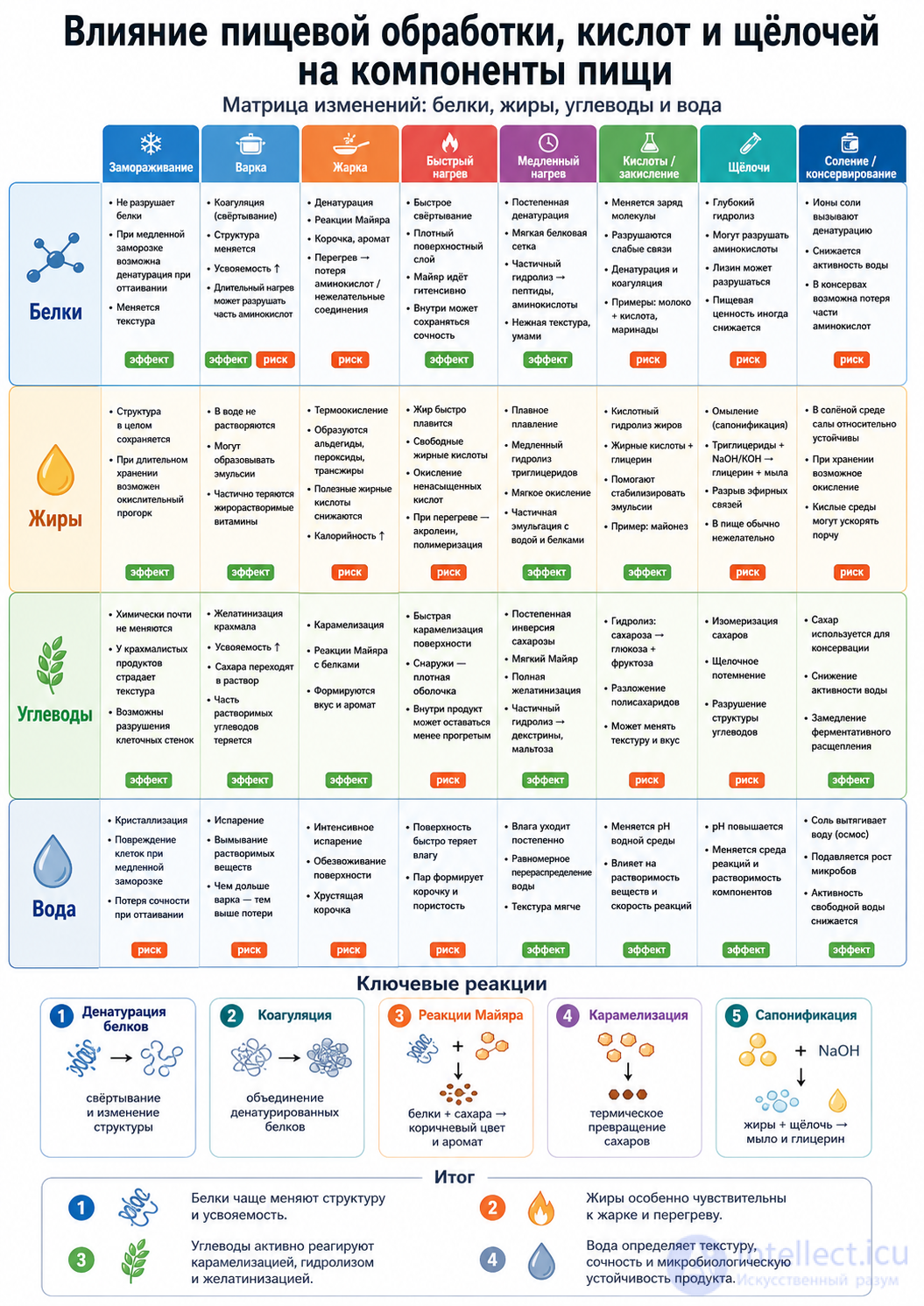
The main features are outlined below:
1. Proteins
-
Freezing:
- Does not destroy proteins, but slow freezing may disrupt their structure (denaturation upon thawing).
- Nutritional value may decrease due to changes in texture and amino acid availability.
-
Boiling:
- Proteins coagulate (curdle), and their structure changes.
- Some amino acids may be destroyed during prolonged heating.
- Digestibility increases.
-
Frying:
- Proteins denature and may form new compounds (including undesirable ones, such as acrylamide at high temperatures).
- Partial loss of amino acids.
-
rapid temperature rise (searing, immersion in boiling water):
- Proteins denature quickly → they curdle and lose solubility.
- A dense crust or «set» layer forms on the surface.
- Maillard reactions (proteins + sugars) are quickly triggered → brown color, intense aroma.
- Partial degradation of amino acids is possible upon overheating.
- Example: meat over high heat → quickly sets on the outside while remaining juicy inside; an egg in boiling water → the white sets instantly.
-
slow temperature rise (heating) (simmering, stewing, cooking at low temperature):
- Proteins denature gradually, forming a soft network.
- The texture becomes tender and even.
- Maillard reactions proceed gently, and the flavor turns out more delicate.
- Proteins are partially hydrolyzed → peptides, amino acids, which enhances flavor (umami).
- Example: stewed meat → proteins break down slowly, connective tissue softens; soup or broth → proteins pass into solution, adding richness.
-
effect of acids on proteins:
- the charge of the molecule changes (pH affects ionic groups)
- weak bonds (hydrogen, ionic) are broken
- the protein «unfolds» → denaturation. Example: curdling of milk with acid, then it clumps together → coagulation (curdling)
-
effect of alkalis:
- may destroy amino acids
- cause deep hydrolysis
- sometimes reduce nutritional value
- treatment in an alkaline environment can destroy lysine
- treatment of cocoa powder with a K₂CO₃ solution (alkalization or «Dutch process»)
-
Salting and canning:
-
Salting causes denaturation of proteins due to the action of salt ions.
-
In canned goods, some amino acids may be lost due to high temperature or prolonged storage.
-
Fermentation, souring, acidification, acidity regulation or acid treatment
-
Acids can denature proteins, altering their structure and properties. For example, lemon juice or vinegar curdle the proteins in milk or eggs, making them denser
-
Proteolysis: In an acidic environment, enzymes such as pepsin are activated, which promote the breakdown of proteins, making them softer. This can be used in marinades for meat.
2. Fats
-
slow temperature rise (heating) (simmering, stewing, cooking at low temperature):
- Fat melts gradually and is distributed evenly throughout the product.
- The temperature rises smoothly, without sharp overheating.
- Slow hydrolytic breakdown of triglycerides → glycerol + fatty acids.
- Oxidation proceeds gently, forming aromatic compounds without a pungent odor.
- Fat partially emulsifies with water and proteins → a soft texture of the dish.
- Example: stewed meat or vegetables → fat is released smoothly, binds with the juices, the flavor becomes rich but without bitterness.
-
effect of alkalis, saponification:
- Fats (triglycerides) + alkali → glycerol + soaps (Triglyceride+NaOH→Glycerol+Soap (RCOONa)
- alkali (NaOH, KOH) breaks the ester bonds, forming: glycerol + salts of fatty acids (soap)
- an undesirable process in food products (rancidity)
- weak alkalis are used in processing (for example, olives)
- Ca(OH)₂ defecation of beet juice in sugar production
-
Salting and canning:
- During canning, fats may oxidize.
- They are stable in a salty environment, but storage in an acidic environment may accelerate the spoilage of fats.
-
Fermentation, souring, acidification, acidity regulation or acid treatment
- Acids can participate in the breakdown of fats into fatty acids and glycerol, which is important for digestion
- Hydrolysis of fats: Acids can promote the breakdown of fats, especially during prolonged heating. For example, in the presence of acids, hydrolysis of triglycerides can occur, leading to the formation of fatty acids and glycerol.
- Emulsification: Acids, such as vinegar, help in the formation of emulsions (for example, in mayonnaise), where fats (oil) are evenly distributed in water. Acidity helps stabilize the mixture.
Fats after thermal processing (frying, baking) are considered more harmful than «raw» fats such as butter. When heated, fats undergo oxidation and decomposition, forming trans fats, aldehydes and peroxides, which have a toxic effect on the body.
Why thermally processed fats are more dangerous
1. Changes in fat structure
-
During frying and baking, fatty acids are destroyed, with up to 20–40% of beneficial polyunsaturated acids (linoleic, arachidonic) being lost.
-
Aldehydes, dioxy acids, peroxides are formed – oxidation products that are toxic to cells and accelerate aging.
2. Trans fats
-
During prolonged heating (especially in deep-frying), some of the fats turn into trans fats, which raise the level of «bad» cholesterol (LDL) and lower the «good» (HDL).
-
Trans fats are associated with the risk of cardiovascular disease and inflammatory processes.
3. Additional factors
-
In cookies and baked goods, fats are combined with refined flour and sugar, which increases the harm: high caloric content, glucose spikes, strain on the pancreas.
-
In fried meat and chicken, AGEs (glycotoxic compounds) are formed at high temperatures, which damage blood vessels and tissues.
Comparison of raw and thermally processed fat
| Type of fat |
What it contains |
Potential harm |
| Raw fat (butter, cream) |
Saturated fats, vitamins A, D, E |
Excess → raises cholesterol, risk of obesity; but retains beneficial substances |
| Fat after baking (cookies) |
Saturated fats + trans fats + sugar |
Loss of beneficial acids, formation of trans fats, high caloric content, strain on the heart and metabolism |
| Fat after frying (chicken, deep-frying) |
Saturated fats + oxidation products |
Formation of toxic compounds (aldehydes, peroxides), risk of inflammation and CVD |
Conclusion
- Raw fats (for example, butter in moderate amounts) are less harmful, since they retain vitamins and do not contain oxidation products.
- Fats after thermal processing (cookies, fried chicken) are more dangerous: they lose their beneficial properties and acquire toxic compounds.
- The greatest risk is associated with deep-frying and the repeated use of oil.
3. Carbohydrates (sugars, starch, etc.)
-
Freezing:
-
Boiling:
- Starches gelatinize (swell), digestibility improves.
- Simple sugars may pass into solution.
- Partial loss of water-soluble carbohydrates.
-
Frying:
- Caramelization of sugars, formation of flavor and aroma compounds.
- Undesirable Maillard reactions with proteins are possible.
-
rapid temperature rise:
- With sudden heating, they quickly pass into the stage of caramelization and Maillard reactions on the surface of the product.
- The outer layers of the product quickly gelatinize and stick to surfaces, but the inner part may remain raw.
- The surface dries out and forms a dense shell → a «crust» effect or a dense film
-
slow temperature rise (heating):
- Gradual inversion of sucrose occurs → glucose + fructose.
- Maillard reactions proceed gently, the flavor becomes sweetish and mild.
- There is time for complete gelatinization: the granules swell evenly and bind water.
- Then partial hydrolysis follows → dextrins → maltose → slight sweetness.
-
effect of alkalis on carbohydrates:
- isomerization of sugars
- darkening (alkaline Maillard reactions)
- destruction of structure
-
effect of acids on carbohydrates:
- hydrolysis: sucrose → glucose + fructose
- decomposition of polysaccharides
-
Salting and canning:
- Sugars are added for preservation (preserves, jams).
- In salted products, water activity is reduced, slowing down the enzymatic breakdown of carbohydrates.
-
Fermentation, souring, acidification, acidity regulation or acid treatment
- Some acids help break down complex carbohydrates into simple sugars, accelerating their absorption by the body
- Hydrolysis of carbohydrates: Acids can break down carbohydrates, especially complex sugars, into simpler forms. For example, when boiling potatoes or other starchy products with an acidic component (such as citric acid), partial hydrolysis of starch occurs, which can change the texture and taste of the food.
- Caramelization: Although the caramelization process itself requires high temperatures, the presence of acids can affect the final taste of caramelized carbohydrates, making them richer and more complex.
4. Water
-
Freezing:
- Water crystallizes and may damage cells (especially during slow freezing).
- Loss of juiciness upon thawing.
-
Boiling:
- Loss of water (evaporation), especially during prolonged boiling.
- Water washes out soluble substances (minerals, vitamins, sugars).
-
Frying:
- Intense evaporation of water, dehydration of the surface.
- A crispy crust — the result of moisture loss.
-
Salting and canning:
- Salt draws out water (osmotic effect), thereby suppressing the growth of microbes.
- Preservation in brines/marinades limits the activity of free water.
-
Fermentation, souring, acidification, acidity regulation or acid treatment
-
Fermentation, souring, acidification, acidity regulation or acid treatment
Food treatments have a significant impact on proteins, fats, carbohydrates and water, altering their physical and chemical properties. Thermal processing, such as boiling, frying or baking, leads to the denaturation of proteins, the destruction of their structure and the formation of new compounds that affect the texture and digestibility of food. Fats undergo oxidation, hydrolysis and emulsification, which affects taste, stability and nutritional value. Some treatments, such as fermentation, can break down complex carbohydrates into simpler sugars, improving their absorption and changing the organoleptic properties of the product. Water plays an important role in food processing, participating in dissolution, diffusion and heat transfer, as well as determining the moisture content of the final product. Various technological processes, including marinating, salting, sublimation and thermal processing, affect the composition and structure of food, altering its properties and nutritional value.
See also
- Protein denaturation – a change in the structure of proteins under the influence of temperature, acids or mechanical processing.
- Hydrolysis – the process of breaking down complex compounds (for example, proteins and carbohydrates) into simpler components under the action of water and enzymes.
- Emulsification – the process of mixing fats with water using emulsifiers, for example, when preparing mayonnaise.
- Caramelization – the thermal decomposition of sugars, leading to the formation of new flavor and aroma compounds.
- Maillard reaction – a chemical reaction between amino acids and sugars that gives products their characteristic taste and color during frying.
- Osmosis – the process of water movement through a semipermeable membrane, important during salting and marinating of products.
- Fermentation – a biochemical process in which microorganisms break down organic substances, changing the taste and texture of products.


Comments