
Lecture
All food products are made up of primary biomaterials that inevitably change over time due to the influence of a variety of external and internal factors. It is impossible to prevent the deterioration of food quality during storage, but
the chemical and biochemical processes that lead to undesirable changes in the quality characteristics of food
(appearance, color, odor, consistency, taste, nutritional value) can be slowed down by selecting an appropriate formulation, method of technological processing,
packaging, and storage and transportation conditions. The period during
which a product ceases to meet even one of the above criteria is usually referred to as its shelf life.
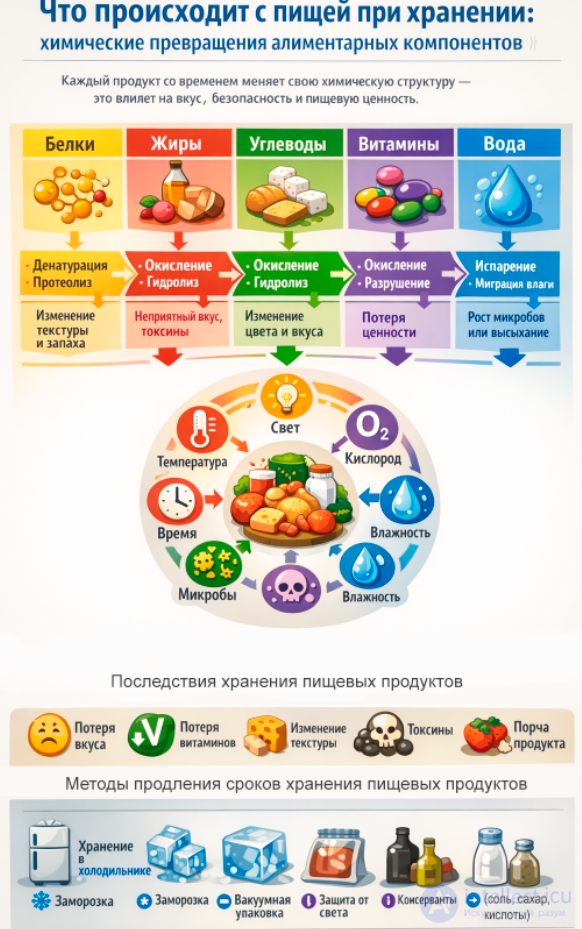
One of the reasons for the decline in food quality is spoilage. A spoiled food product is unacceptable to the consumer, as it can lead to illness and sometimes even death
of a person. For this reason, food technology employs the concept of
«shelf life» – the period of time during which a food
product remains safe for the consumer, provided it is used in accordance with its intended purpose. The processes that lead
both to the deterioration of quality and to the spoilage of food products can
be classified into three main groups (see table):
table Types and factors leading to poor quality and spoilage of food products
| Food product | Types of spoilage | Factors |
|---|---|---|
| Pasteurized milk | Oxidation, rancidity, microbial growth | Oxygen, temperature |
| Powdered milk | Oxidation, browning, caking | Oxygen, humidity, temperature |
| Raw beef | Microbial growth, oxidation, moisture loss | Temperature, oxygen, light, humidity |
| Raw fish and seafood | Microbial growth, oxidation | Temperature, oxygen |
| Fruit | Enzymatic softening, microbial growth, bruising, moisture loss | Oxygen, light, temperature, humidity, mechanical damage during transport |
| Bread | Moisture migration, starch retrogradation, microbial growth | Oxygen, humidity, temperature |
| Dry breakfast cereals | Moisture migration, starch retrogradation, oxidation, brittleness | Temperature, oxidation, mechanical damage during transport, humidity |
| Beer | Oxidation, microbial growth | Oxygen, light, temperature |
| Coffee, tea | Oxidation, loss of volatile substances | Oxygen, humidity, light |
| Chocolate | Crystallization of sugar (sugar bloom), of fat (fat bloom), oxidation | Temperature, humidity |
There is a certain correlation between the types of spoilage, expressed in the fact that spoilage caused by processes
of a certain type may promote the development of spoilage of another type. Below is a more detailed characterization of the types of
spoilage and deterioration in the quality of food products.
The physical processes of food quality deterioration include:
Examples of mechanical damage to food products:
– fresh fruits and vegetables. During transport, marketing, and as a
result of being dropped, bruising occurs, and depending on its severity these
products may change color (the cell structure is damaged
and non-enzymatic browning appears), lose moisture at the site of the bruise, and, due to disruption of the integrity of the surface layer (the waxy layer), various microorganisms penetrate into the plant tissue, which leads to spoilage and to fruits and vegetables becoming unacceptable for consumption by consumers;
– dry products. During careless transport and loading and unloading operations, breakage of these products is possible, which renders them substandard. A properly designed packaging system
that protects against vibration and mechanical damage
during transport and loading and unloading operations can minimize mechanical damage to dry products.
As a result of moisture migration, or mass transfer of the components
of a food product, the following occurs:
– both loss and increase in its moisture content;
– the formation of substandard specimens and the initiation of chemical and microbiological spoilage processes;
– a change in water activity (aw) as a result of moisture transfer
under the influence of a chemical potential gradient.
For example, in bakery products moisture migration causes
staling, brought about by the redistribution of moisture from the crumb (high aw) to the crust (low aw). This leads to dry, hard, and brittle crumb and to a harder, less crisp crust. In multicomponent products (breakfast cereals with pieces of fruit, flour
and confectionery products with a moist filling), moisture migration contributes to the deterioration of consumer properties (loss of crisp consistency, moistening of the flour part of the product) due to the different
values of water activity (aw) of the individual components. Moisture loss
by fresh fruits and vegetables, especially leafy ones stored
in the open air, causes them to wilt and age rapidly.
The influence of temperature on the deterioration of quality and spoilage of food products can be demonstrated by the following examples. Thus, the quality of fruits and vegetables depends on the intensity of
respiration and on the optimal temperature range for storage.
During the ripening of a number of fruits, an increase in the production of ethylene occurs, which is an effective regulator of plant growth (it accelerates the ripening of most crops). Therefore, its complete elimination or reduction makes it possible to regulate these
biochemical processes. Many fruit and vegetable crops
are sensitive to damage from a slow lowering of temperature, when the product is not fully frozen (plant cells are damaged, which leads to spoilage of the product). Tropical
fruits and vegetables are sensitive to chilling at temperatures from 5
to 15°C before freezing, and therefore such defects arise
as pitting, sogginess, discoloration, the development of off-odors, and accelerated aging or ripening (overripening).
The shelf life of a number of food products is significantly affected by changes in the glass transition temperature Tg (the temperature at which the «glassy» or brittle state of the product
changes to a «rubbery» or soft one). The temperature at which the vitrification of a product occurs depends on its moisture
content and on the forms in which it is bound. For example, crackers should be crisp, but if relative humidity
conditions are not maintained during storage, they absorb moisture (Tg decreases)
and undergo vitrification, becoming viscous and moist. Bakery products, on the contrary, tend to lose moisture, becoming
«glassy», that is, hard and brittle. Fluctuations in temperature around Tg affect the rate at which many reactions proceed:
– at T > Tg moisture is mobile and the rate of chemical reactions
limited by diffusion usually obeys the Williams-Landel-Ferry kinetics (an empirical equation associated with time–temperature superposition);
– at T < Tg moisture is less mobile, and reaction rates are usually
significantly lower.
For dry powders, the consequence of vitrification is caking, caused by their absorption of moisture; they become
amorphous, stick together, and form lumps.
For deep-frozen products, moisture loss is accompanied by so-called «freezer burn» – dehydration
due to the evaporation or sublimation of moisture from the surface
of the product. Therefore, such products must be stored in airtight packaging.
Crystal formation is another cause of the deterioration of food quality. The growth of ice crystals in frozen
products leads to the appearance of a grainy texture (for example,
in ice cream). Crystal formation occurs as a result of
slow freezing or repeated refrigeration cycles.
During rapid freezing, small crystals form inside
the cells, which are more stable than the large crystals formed during slow freezing. However, even this can
lead to damage to cell structure and the onset of enzymatic reactions. To prevent these processes, moisture-binding substances are added, minimizing the formation of large crystals, and the storage temperature is kept below the glass transition point,
at which moisture is less mobile and does not redistribute.
Similar processes occur during the crystallization of sucrose
in products with a high sugar content, when non-crystalline or «glassy» sugar undergoes vitrification as a result of the absorption of moisture and a rise in temperature. In the «rubbery»
state, sugar can crystallize and expel moisture,
an example of which is cotton candy, which at high
humidity acquires a grainy texture; sugar bloom of chocolate, caused by storing chocolate in a humid environment, which leads to the condensation of moisture on its surface (sucrose molecules
diffuse from the inner layers of the product to the surface, giving it a gray or white color). Crystallized sugar is considered to be one of the factors in the spoilage of sugar confectionery products and in the formation of «grains» in candies and ice cream.
Another type of crystallization – the migration and recrystallization
of fat (cocoa butter) in chocolate – is fat bloom of chocolate, characterized by a whitish greasy coating. One of the main ways to prevent this defect is the tempering of chocolate (crystallization of the cocoa butter into a polymorphic
structure of the proper size and shape occurs). However, improper
conduct of this process can lead to the formation of insufficiently stable forms of fat crystals, and the likelihood of
fat bloom increases. Fat bloom can
also be associated with partial melting and re-cooling
of chocolate, abrasion of the surface, the use of incompatible fats, or rapid cooling with the formation of cracks.
Also an example of crystal formation is the breakdown of the
emulsion in products such as margarine, mayonnaise, and salad dressings. Instability of the emulsion occurs as a result of an error in the choice of emulsifier, which is unable to ensure the achievement of an appropriate degree of dispersion of the phases
(particle size). Emulsifier molecules (for example, lecithin,
which is part of egg yolk) are adsorbed onto the surface of the particles, reducing surface tension, since they possess
both hydrophobic and hydrophilic properties. Emulsion stability is achieved:
– if the attractive forces (Van der Waals) are balanced with the repulsive forces (electrostatic or steric
interactions). These particles prevent the coalescence of the oil particles, that is, the separation of the emulsion;
– by increasing the viscosity of the continuous phase.
The destabilization of emulsions occurs due to a disruption of the conditions of their formation (excessive vibration), the loss by the emulsifier
of its properties as a result of partial freezing or under the influence of very high temperatures.
Thus, physical factors most often impair
the quality of stored food products and at the same time can
initiate the processes of their chemical or microbiological spoilage.
Chemical reactions, or reactions of the degradation of their chemical components (proteins, fats, carbohydrates), are also a cause of food spoilage. The rate of these chemical reactions
depends on the water activity (aw) of the product, the storage temperature
Tg (the glass transition temperature), pH, exposure to light, and the presence
of oxygen. For each reaction there are optimal conditions
under which it proceeds. The products formed as a result of the reactions affect
the appearance, color, odor, taste, and/or texture of the food product, as well as its chemical composition and the degree of danger to the health of consumers.
The catalysts of these reactions are enzymes and atmospheric oxygen. It is known that enzymatic activity is low in products with a low water activity value, especially if this indicator is below the moisture level of the monomolecular layer. There are many enzymes that interact with various
ingredients of food products, causing the deterioration of their quality and spoilage. For example, the proteolytic enzyme plasmin withstands
the pasteurization temperature of milk and, during its storage, causes
the breakdown of milk proteins, coagulation, and gel formation.
Other proteolytic enzymes contribute to the breakdown
of meat proteins, as a result of which the meat acquires a mushy consistency. Enzymatic spoilage of fruits and vegetables leads to browning and softening of the tissues. These reactions are catalyzed
by phenol oxidases, enzymes that react with phenolic compounds and oxygen to form brown pigments. Phenol oxidases are activated by mechanical damage to the tissue of fruits and vegetables (impact, cutting, peeling).
The breakdown of pectin in fruits and vegetables under the action of pectinase and
polygalacturonase causes softening of the plant tissue. Spoilage
of fats under the action of lipolytic enzymes (enzymatic
hydrolysis) occurs in many lipid-containing products (nuts, dried fruit, meat, milk powder, coffee, margarine) and is activated by the influence of light, heat, and trace elements (in particular, copper and iron). Inhibitors of enzymatic spoilage of fats
include tocopherols, citric acid, rosemary extract, and others.
In addition to enzymatic spoilage, proteins, fats, and carbohydrates undergo oxidation. Thus, the myoglobin and oxymyoglobin of meat, when
available oxygen is present, oxidize and are converted into metmyoglobin (the red color becomes brown); non-enzymatic browning (the Maillard reaction) leads to the formation of volatile substances and dark pigments, which is manifested in the golden-brown color of certain food products, in changes to their
texture, and in a reduction of nutritional value (lysine is rapidly consumed).
Oxygen interacts with unsaturated fatty acids, which leads to a change in color, the formation of off-odors, and even of toxic substances. Oxygen can be dissolved in oil and other liquid food ingredients, be present in
the headspace of the packaging, or penetrate through it during
storage.
Let us consider in more detail the oxidative spoilage of lipids in
dairy products. It has been established that during the prolonged
storage of milk at low temperatures, as well as under the influence
of light radiation with a wavelength of less than 500 nm, oxidized off-flavors arise in the product – «cardboard» and «sunlight» ones, which are sometimes accompanied by metallic, fishy, and
tallowy off-flavors, which are caused by the formation
of aldehydes (ethanal, propanal, methional, pentanal, and others), methyl ketones, and alcohols. The appearance of an oxidized
off-flavor in milk can be prevented by reducing the degree of mechanical
impact during storage, eliminating the action of light, adding to the
milk ascorbic acid (in an amount of 25–50 mg per 1 kg),
β-carotene, nisin, pasteurization at high temperatures, and homogenization of the milk.
The formation of peroxides, aldehydes, ketones, hydroxy acids, and other compounds during the oxidation of the lipids of butter from cow's milk
during storage leads to a reduction in its quality, biological
value, and to the occurrence of off-flavors and off-odors – tallowy,
rancid, fishy, metallic, and oily. The rate and
direction of the oxidation process, and consequently the stability
of butter during storage, depend on many factors. These
include: the chemical composition and structure of the butter, the volume and composition
of the plasma, its dispersity, the content in the butter of air, metals,
sodium chloride, lactic acid, natural and synthetic
antioxidants, the type of packaging materials, and the storage temperature. The chemical composition of milk fat significantly affects
the stability of butter during storage, especially its content of polyunsaturated fatty acids (linoleic, linolenic, and arachidonic). Butter produced from spring milk is most often unstable during prolonged storage. The oxidative spoilage of butter
proceeds mainly at the fat–water and fat–air phase interfaces. Consequently, the stability of butter, all other conditions being equal, depends on the degree of dispersion of the moisture (plasma) and on the content in
it of air. As the degree of dispersion of the moisture increases, the resistance of the butter to the oxidation process decreases. Butter produced by the method of converting high-fat cream is characterized by the finest distribution of moisture. Therefore, during
storage at low sub-zero temperatures (minus 18°C)
it is less stable than butter obtained by churning cream, which is characterized by larger plasma droplets. However, it possesses increased stability at higher sub-zero
(minus 5°C) and above-zero temperatures, when not only
chemical but also enzymatic processes take place. Among the factors affecting the stability of butter during storage is its content of
antioxidants, which retard the oxidation
of the fat. Butter of summer production, rich in natural antioxidants (tocopherols, β-carotene), is more stable during storage
than butter produced in winter. To increase the stability of butter
during prolonged storage, it is necessary to reduce the contamination of cream and butter with copper and iron, to add antioxidants, to protect it from contact with air, light, and moisture, and to use as packaging materials polymer and combined
materials possessing resistance to gas, light, and moisture.
The oxidation of the lipids of dry dairy products is one
of the types of spoilage that leads to the deterioration of their organoleptic properties and to a reduction in biological value. Oxidized, tallowy, and other off-flavors can be caused by a high content in the product of air (more than 0.1%), free fat (above 9%),
and copper and iron salts (more than 10 mg/kg of milk dry matter). The amount of air in dry products depends on the size of the particles and on the content of destabilized fat in the raw material. The amount of air and the content of free fat in dry dairy
products depend on the regimes of condensation, atomization, and drying, on the cooling rate of the product after it exits the drying tower,
on the type of packaging, the storage temperature, and the humidity of the surrounding
air. The resistance of dry dairy products to oxidation
can be increased by the addition of antioxidants, as well as by carrying out the homogenization of condensed products before drying,
and by storing them in a nitrogen atmosphere.
A separate problem that arises during the storage of food
products is the lability of vitamins. It is considered that vitamin losses during the storage of products are very large and in some cases reach 90%. The greatest losses of these essential nutrients occur during the storage of vegetables and fruits.
Atmospheric oxygen, an increase in temperature, and the relative humidity of the surrounding air contribute to the destruction of vitamin C
and, in part, of vitamin A. Since vitamin C is the least stable, those measures that contribute to its preservation
also, to a significant extent, preserve the other vitamins
contained in food products. Therefore, maintaining a proper
and constant temperature and relative humidity, the use of a controlled gas atmosphere in the storage areas of this plant raw material, as well as a defined storage duration, are the main ways of slowing down the breakdown of
vitamins in fruits and vegetables.
It is known that meat and its processed products are one of the sources of B-group vitamins, whose stability during
the storage of these products depends on the method of technological processing. For example, in frozen meat B-group vitamins are preserved for a long time, whereas prolonged storage of canned meat
leads to significant losses of them. In butter from cow's
milk and in cheeses stored in refrigerators, the inactivation of vitamin A occurs extremely slowly; however, the oxidative spoilage
(rancidity) of butter contributes to the destruction of this nutrient.
In summarizing the information on the influence of chemical processes occurring during the storage of food products on their
quality and safety, it should be concluded that in many cases the onset of these processes is associated with physical factors. It should also be added that the result of the action of enzymes and atmospheric oxygen on the nutrients that determine the
nutritional value of products is the deterioration of their quality, and
subsequently their unsuitability for consumption due to the formation
of compounds harmful to human health.
Since the microbiological spoilage of food products is
the subject of study of other academic disciplines, only general information is provided in this subsection. Obviously, most food
products contain various types of microorganisms that are their
natural microbiota, specially introduced beneficial microbiota (starter cultures, baker's, ethanol, and wine yeasts) or pathogenic microbes that have entered the products as a result of
violations of technological regimes and non-compliance with production sanitation and personal hygiene. Among the natural and pathogenic microbiota there may be present microorganisms that cause spoilage of food products, which include
some bacteria, yeasts, molds, viruses, and mycoparasites. As a result of their vital activity, the following nutrients undergo changes in food products:
Microbiological spoilage of food products can be
detected visually, and in some cases laboratory studies are required to prove its existence.
Moreover, the damage from the action of spoilage microorganisms is expressed not
only in enormous losses of food, but also in significant
expenditures on the treatment of people poisoned by spoiled food and on
other measures associated with eliminating the source of contamination. In modern food technology there are various methods for
preventing the microbiological spoilage of food products:
sanitary and hygienic measures, the application of barrier
technologies, the use of special packaging, and others.
In summing up all of the above, it is necessary
once again to note that, in order to provide consumers with quality
and safe food, it is important to have knowledge of all the processes that occur with food substances during storage in
different environmental conditions.

Comments