
Lecture 3 min.
Surfactants (surface-active agents) play an important role in the food industry. These compounds have the ability to reduce the surface and interfacial tension between different substances — for example, between water and oil — which helps stabilize emulsions, foams, suspensions, and dispersions. Thanks to these properties, surfactants are widely used in food production to improve texture, taste, appearance, and shelf life.
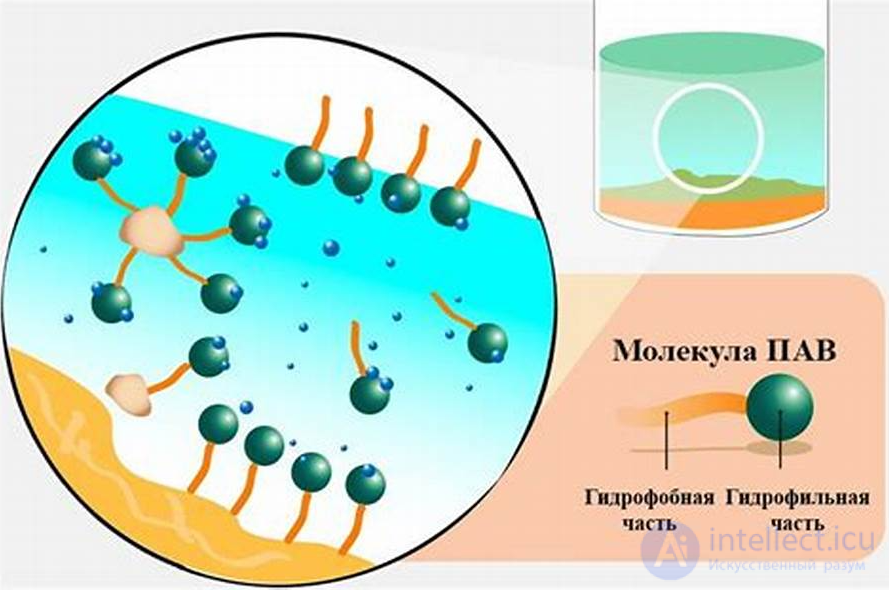
Food surfactants represent an important class of compounds actively used in the food industry due to their ability to influence the structure, texture, stability, and organoleptic properties of products. Owing to their special physicochemical properties, surfactants significantly enhance the quality and functionality of food products.
One of the key functions of food surfactants is reducing the surface tension of water. This is critically important for the formation and stabilization of emulsions and foams, which in turn promotes better mixing and interaction of the various phases within a product.
Food surfactants also actively interact with lipids, promoting their effective emulsification. They can form microemulsions in which fatty components (oils and fats) are evenly distributed within an aqueous medium. This facilitates food preparation and improves its flavor and culinary characteristics.
An additional advantage of surfactants is their ability to stabilize foam-forming systems — for example, in desserts, soufflés, or mousses. This allows products to acquire the desired airy structure and volume, easing the technological process.
In addition, surfactants often act as emulsifiers and stabilizers in multi-component products, where it is important to maintain a balance between the fatty and aqueous phases. This ensures uniformity of texture, improves visual and flavor properties, and extends the shelf life of products.
Thus, surfactants play a crucial role in the production of modern food products, ensuring stability, an appealing structure, and high quality of the final product — from oil emulsions to confectionery creams and desserts.
Surfactants are molecules that contain both hydrophilic (water-loving) and hydrophobic (fat-loving) parts. This allows them to act as mediators between immiscible phases — water and fat. The main classes of surfactants are:
Anionic surfactants — negatively charged, rarely used due to their aggressive action;
Cationic surfactants — positively charged, often used as antiseptics;
Nonionic surfactants — uncharged, the safest and most common in the food industry;
Amphoteric surfactants — can behave as cationic or anionic depending on the pH of the medium.
Uses of surfactants in the food industry
1. Emulsifiers
This is the most common type of food surfactant. They are used to create and stabilize emulsions — for example, in mayonnaise, ice cream, creams, and sauces.
Examples:
Lecithin (E322) — a natural emulsifier from eggs and soy;
Mono- and diglycerides of fatty acids (E471) — obtained from vegetable oils;
Polysorbates (E432–E436) — synthetic nonionic surfactants.
2. Foaming agents and defoamers
Surfactants can both create foam and suppress it. This is important, for example, in the production of whipped desserts and foamy beverages (foaming), or, conversely, during heat treatment, when excess foam is a nuisance (defoaming).
3. Wetting and solubility
Some surfactants improve the solubility of powders (for example, cocoa, coffee) in water by reducing surface tension and facilitating dissolution.
The origin of food surfactants can be either natural or synthetic. These substances are part of many food products, where they perform important technological functions.
In nature, surfactants are found in products such as vegetable oils, milk, and animal fats. They include natural emulsifiers capable of combining the aqueous and fatty phases, ensuring the uniformity and stability of products. In addition, similar compounds are produced by certain species of fish and birds — to protect roe or eggs with a special shell resistant to external influences.
Nevertheless, a significant portion of food surfactants is created industrially. Such substances are obtained through chemical or biotechnological processes. Synthetic emulsifiers and stabilizers are actively used in the food industry — they improve texture, increase the resistance of products to separation, extend shelf life, and can enhance flavor qualities.
The principle of action of food surfactants is based on their unique ability to alter the surface properties of liquids, promoting the formation of protective films, the stabilization of emulsions, and the reduction of surface tension.
Food surfactants can be either of natural origin (for example, from vegetable oils or animal fats) or synthetic. They are actively used in the food industry to improve the texture of products, increase their stability, extend shelf life, and enhance flavor qualities.
When they reach the surface of a liquid, surfactant molecules orient themselves in a specific way: their water-soluble (hydrophilic) part is directed toward the aqueous medium, while the fat-soluble (hydrophobic) part is directed toward the air or oil. This orientation makes it possible to form thin films that can retain air (for example, in foam structures) or protect a product from external influences, including moisture and oxygen.
In addition, surfactants play a key role in the creation and stabilization of emulsions — systems in which one liquid is evenly distributed within another with which it does not normally mix (for example, oil in water). Surfactant molecules line up at the boundary between the two phases, forming a shell around the droplets of one liquid and preventing them from coalescing and separating.
No less important is the fact that surfactants reduce surface tension. This facilitates the penetration of liquid into porous or dry ingredients and promotes a more even distribution of components within a product.
Thus, the basis of surfactants' action lies in their ability to line up at phase boundaries, create stable protective films, maintain the even distribution of ingredients, and alter the physical properties of liquids. All of these processes directly affect the quality, appearance, and stability of food products, making surfactants indispensable in modern food production.
Some surfactants are sensitive to high temperatures: they may break down or lose activity. Therefore, in cooking, preference is given to stable emulsifiers such as lecithin and E471.
The acidity of the medium affects the activity of surfactants, especially amphoteric ones. For example, in acidic sauces or marinades, surfactants may change their properties, which is important to consider when choosing additives.
Surfactants can interact with proteins, starch, and fats. For example, in baking, emulsifiers improve the structure of the crumb and prolong the freshness of bread.
The foam contains surface-active substances
When cooking meat, fish, legumes, or grains, foam forms on the surface of the water. This foam is the result of the release of proteins, saponins, and other natural surface-active substances that reduce surface tension and stabilize air bubbles. Surface-active substances in food can increase gas formation in the intestines, especially in people with a sensitive digestive system.
Food surfactants can provoke the formation of excess gases in the gastrointestinal tract. This is because they:
During food preparation, not only proteins but also blood, dirt, and mucus get into the water from the surface of the food, and in the case of inorganically grown products — traces of fertilizers, antibiotics, and other undesirable substances. Foam is a kind of «dirt trap,» and it is best to remove it.
Various types of surfactants (surface-active agents) — compounds possessing special physicochemical properties that play an important role in the production and processing of food products — are actively used in the food industry.
The main purpose of surfactants is to create stable emulsions, improve texture, increase the solubility and dispersibility of components, and form and stabilize foam. Their ability to reduce surface tension between different phases makes them indispensable in a number of technological processes.
Surfactants are most widely used in the production of dairy products — such as cream, yogurt, butter, and ice cream. Here they promote homogenization and the even distribution of fat, ensuring a stable structure and pleasant consistency of the final product.
Surfactants also find application in meat and fish processing technology, where they improve the water-holding capacity, elasticity, and texture of products. Thanks to these properties, juiciness is improved and the shelf life of meat products is extended.
In baking, confectionery production, and beverage production, surfactants act as mixing improvers and stabilizers, making it possible to achieve uniformity of the mass and preventing the separation of ingredients. This is especially important in complex formulations with a large number of components.
Beyond the food sphere, surfactants are widely used in the production of detergents and cosmetics, where they are responsible for foam formation and the removal of contaminants. Their versatility and effectiveness have made them an important element in these industries as well.
Thus, the range of applications of surfactants in the food industry is extremely broad and continues to expand. Ongoing research and development in this field make it possible to create new, more effective compounds that improve the quality of products and contribute to the technological progress of the industry.
Only those surfactants that have passed toxicological evaluation and been recognized as safe are used in the food industry. In the European Union and Russia, permitted surface-active substances have the status of food additives (E-codes), and their dosage is strictly regulated.
Most anionic and nonionic surface-active substances are non-toxic; their LD50 is comparable to that of table salt. The toxicity of quaternary ammonium compounds, which possess antibacterial and antifungal properties, varies. Dialkyldimethylammonium chlorides (DDAC, DSDMAC), used as fabric conditioners, have a high LD50 (5 g/kg) and are essentially non-toxic, whereas the disinfectant alkylbenzyldimethylammonium chloride has an LD50 of 0.35 g/kg. Prolonged exposure to surface-active substances can irritate and damage the skin, since surfactants destroy the lipid membrane that protects the skin and other cells. Skin irritation generally increases in the order nonionic, amphoteric, anionic, cationic surfactants.
Surfactants regularly enter the land and water systems in various ways, whether during an intended process or as industrial and household waste.
Anionic surfactants can be found in soils as a result of the application of sewage sludge, wastewater irrigation, and reclamation processes. Relatively high concentrations of surfactants together with polymetals can pose an environmental risk. At low concentrations, the application of surfactants is unlikely to have a significant effect on the mobility of trace metals.
In the case of the Deepwater Horizon oil spill, unprecedented amounts of Corexit were sprayed directly into the ocean at the site of the leak and on the surface of the seawater. The apparent theory was that surfactants isolate oil droplets, making them easier to digest by oil-consuming microbes. The active ingredient of Corexit is sodium dioctyl sulfosuccinate (DOSS), sorbitan monooleate (Span 80), and polyoxyethylenated sorbitan monooleate (Tween-80).
Various types of surfactants (surface-active agents) — compounds possessing special physicochemical properties that play an important role in the production and processing of food products — are actively used in the food industry.
The main purpose of surfactants is to create stable emulsions, improve texture, increase the solubility and dispersibility of components, and form and stabilize foam. Their ability to reduce surface tension between different phases makes them indispensable in a number of technological processes.
Surfactants are most widely used in the production of dairy products — such as cream, yogurt, butter, and ice cream. Here they promote homogenization and the even distribution of fat, ensuring a stable structure and pleasant consistency of the final product.
Surfactants also find application in meat and fish processing technology, where they improve the water-holding capacity, elasticity, and texture of products. Thanks to these properties, juiciness is improved and the shelf life of meat products is extended.
In baking, confectionery production, and beverage production, surfactants act as mixing improvers and stabilizers, making it possible to achieve uniformity of the mass and preventing the separation of ingredients. This is especially important in complex formulations with a large number of components.
Beyond the food sphere, surfactants are widely used in the production of detergents and cosmetics, where they are responsible for foam formation and the removal of contaminants. Their versatility and effectiveness have made them an important element in these industries as well.
Thus, the range of applications of surfactants in the food industry is extremely broad and continues to expand. Ongoing research and development in this field make it possible to create new, more effective compounds that improve the quality of products and contribute to the technological progress of the industry.
Surfactants are an integral part of modern food production. They make it possible to create stable products with improved organoleptic properties. However, when using them, it is important to consider the technological features, compatibility with other ingredients, and compliance with regulatory requirements.

Comments