
Lecture
Minerals are micronutrients and play an important role in the
vital functions of the human body. They are constituents of supporting tissues
(calcium, phosphorus, magnesium, fluorine); they take part in hematopoiesis (iron,
cobalt, phosphorus, copper, manganese, nickel); they affect water metabolism (sodium,
potassium), determine the osmotic pressure of blood plasma (sodium, potassium, calcium),
and are constituent parts of a number of hormones, vitamins, and enzymes. The total
mineral content amounts to 3-5 % of a person's body weight. The total
mass of all minerals in the human body averages 3 kg,
of which calcium accounts for about 1 kg.
Since minerals are not synthesized by the body (i.e. they are
indispensable or essential), they must be supplied in the required
amount with food every day.
Depending on their content (mass fraction) in the body and a person's requirement
for minerals, they are divided into three classes (figure 30).
If the mass fraction of an element in the body exceeds 10-2 %, it is classified as a
macroelement.
If the mass fraction of an element in the body is 10-2-10-5 %, it is considered a
microelement.
Microelements are divided into two groups:
- absolutely or vitally necessary – in their absence or deficiency
the normal vital functions of the human body are disrupted;
- probably or conditionally necessary – their vital necessity has not
been unconditionally proven.
Moreover, the division into vitally necessary and probably necessary
microelements is fairly conditional. Sometimes microelements move
from one group to another. For example, at present very
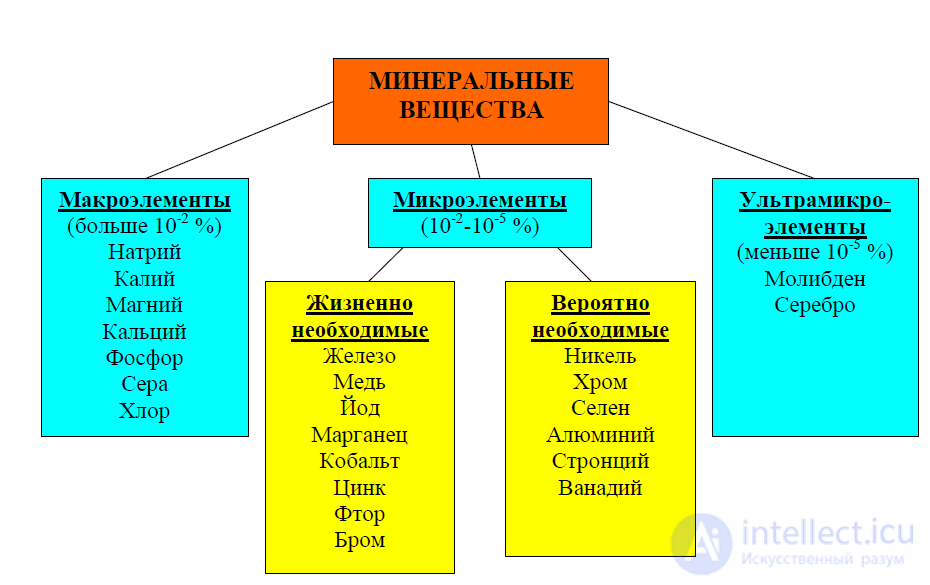
Figure 30 – Classification of minerals
much attention is being paid by scientists to selenium, substantiating its active influence on
vital processes. It is not impossible that after some time it
will move from the group of probably necessary microelements to the group of
absolutely necessary ones.
If the mass fraction of an element in the body is less than 10-5 %, it is an
ultramicroelement.
A deficiency or excess in the diet of any minerals
causes disruption of protein, lipid, carbohydrate, and vitamin metabolism, which leads
to the development of a number of chronic diseases. Table 5 presents the symptoms
of abnormalities in the human body in the case of mineral deficiency.
The most deficient minerals in the human diet
are calcium (for children and the elderly), iron, iodine; excessive ones are sodium –
(due to the high level of table salt consumption) and chlorine.
Table 5 – Symptoms of abnormalities in the human body in the case of deficiency and excess of minerals
| Minerals | Disorders in case of deficiency | Disorders in case of excess |
|---|---|---|
| Calcium | Slowing of skeletal growth | Formation of kidney stones, impaired absorption of other minerals |
| Magnesium | Muscle cramps | Low blood pressure, depression of the CNS, diarrhea |
| Iron | Anemia, decreased immunity | Liver damage, constipation, increased risk of infections |
| Zinc | Skin damage, slowing of growth and sexual maturation | Nausea, vomiting, suppression of the immune system |
| Manganese | Infertility, impaired skeletal growth | Neurological disorders, convulsions |
| Molybdenum | Slowing of cell growth, dental caries | Gout, disruption of copper metabolism |
| Cobalt | Pernicious anemia | Impaired thyroid function, polycythemia |
| Nickel | Depression, dermatitis | Allergic reactions, toxic damage to the liver and kidneys |
| Chromium | Symptoms of diabetes, atherosclerosis | Toxicity, DNA damage, gastrointestinal ulcers |
| Fluorine | Dental caries | Fluorosis of teeth and bones |
| Iodine | Thyroid dysfunction, slowing of metabolism | Thyrotoxicosis, enlargement of the thyroid gland |
| Selenium | Weakness of the heart muscle | Brittleness of nails and hair, skin damage, nervous disorders |
Table 6 – Daily human requirement for minerals
| Minerals | Daily requirement, mg/day |
|---|---|
| Calcium | 800 |
| Phosphorus | 1200 |
| Magnesium | 400 |
| Sodium | 2000 |
| Potassium | 3000 |
| Chlorine | 1000 |
| Sulfur | 1000 |
| Iron | 14 |
| Copper | 2 |
| Iodine | 0,1 |
| Manganese | 5 |
| Cobalt | 0,1 |
| Zinc | 20 |
| Fluorine | 1 |
| Molybdenum | 0,2 |
| Chromium | 0,15 |
| Selenium | 0,07 |
Sodium. Affects the buffering capacity of the blood, plays an important role in maintaining
the osmotic pressure of the extracellular fluid, participates in water metabolism
(retains moisture in the body), and maintains the optimal pH value of the blood.
It improves muscle function and is rapidly absorbed from food. It enters the body mainly
through table salt. Milk contains 50 mg/100 g of product, while
meat and fish contain – 70 mg/100 g of product.
Potassium. Participates in the transmission of nerve impulses, participates in water metabolism
(promotes the elimination of moisture), and improves muscle function. It is easily absorbed
by the body from food. It is contained in potatoes – 570 mg/100 g of product,
dried fruits – 1000 mg/100 g of product, legumes – 800 mg/100 g of product,
grains – 200-300 mg/100 g of product.
Magnesium. Participates in the processes of carbohydrate, protein, and phosphorus metabolism,
is a constituent of a number of enzymes involved in the glycolytic breakdown
of glucose, and regulates the level of phosphorus in the blood. It participates in normalizing
the excitability of the nervous system, stimulates intestinal activity, and reduces
the risk of developing atherosclerosis. It is widely distributed in plant products.
The main sources in food are: cereal products – 80 mg/100 g of product,
legumes – 100 mg/100 g of product. Vegetables and fruits, meat, eggs, fish,
and dairy products are comparatively poor in it – 10-30 mg/100 g of product.
Calcium. It is present in the human body in a greater amount than other
minerals. The bulk of it is found in the bones and teeth. It is
the most difficult element to absorb. Its absorption is promoted by a high
content of proteins and lactose in food. A significant influence on its absorbability
is exerted by its ratio with phosphorus and magnesium in foodstuffs.
The optimal ratio is Ca : P = 1 : 1,5; Ca : Mg = 1 : 0,5. A consequence
of a mismatch between the amounts of calcium and phosphorus in a person's diet is
the thinning of bone tissue and dental caries. The main source in food is
Phosphorus. It is absorbed considerably more easily than calcium. Important is
the ratio between the amounts of phosphorus and calcium. It participates in various
metabolic processes of the human body: phosphorylation of glucose, glycerol,
and the creation of buffering capacity in the body. Phosphoric acid is a constituent of many
complex compounds distinguished by high biological activity,
for example: nucleoproteins, phosphoproteins, phospholipids. The main sources
are milk – 90 mg/100 g of product and dairy products – up to 500 mg/100 g
of product, meat – 180 mg/100 g of product, fish – 250 mg/100 g of product, cereal
products – 200 mg/100 g of product.
Sulfur. It is present in the body in the form of inorganic sulfates and
organic compounds – sulfur-containing amino acids, sulfolipids, etc.
It is an important structural component of certain vitamins: thiamine,
biotin, lipoic acid, and is a constituent of hormones and enzymes. It participates in
protein metabolism, in tissue respiration and energy metabolism, and promotes
the elimination of toxic substances from the body. It has an antioxidant
effect and, together with zinc and silicon, determines the condition of the hair and skin.
The main sources are products of animal origin. Cheese
contains 260 mg of sulfur/100 g of product, eggs – 200 mg/100 g of product, meat and fish –
220 mg/100 g of product, legumes – 220 mg/100 g of product.
Chlorine. Chloride anions play an important role in maintaining the osmotic
pressure of the extracellular fluid and participate in maintaining the pH of the blood. An important
role is played in digestion; in the form of hydrochloric acid it provides the necessary
acidic environment in the stomach for the activation of digestive enzymes, for example
pepsin. Its content in foodstuffs is insignificant. The requirement for it
is met through table salt. Vegetables, milk, and meat contain
50-150 mg/100 g of product.
Iron. It is a constituent of hemoglobin and oxidative enzymes and
ensures the transport of oxygen and tissue respiration. Its deficiency in the body
manifests itself as anemia. The main sources in the body are:
offal and meat – 3-5 mg/100 g of product, cereal products – 4 mg/100 g
of product, legumes – 9 mg/100 g of product.
Copper. Together with iron it participates in the processes of hematopoiesis and tissue
respiration, is a constituent of oxidation-reduction enzymes, participates in
the synthesis of hemoglobin and erythrocytes, accelerates the absorption of iron, and stimulates
the action of hormones. It is contained in beef liver at 2 mg/100 g of product, in fish –
0,6 mg/100 g of product.
Iodine. Its main physiological significance is participation in the formation of the thyroid
hormone – thyroxine. The main sources are seafood:
sea kale, fish – 50 mcg/100 g of product, fish oil – 770 mcg/100 g
of product. Meat contains 10 mcg/100 g of product, vegetables – 10 mcg/100 g of product.
The fortification of food products with iodine is necessary for the prevention
of hypertensive and goiter diseases and atherosclerosis.
Manganese. Its main biological significance lies in its active
participation in oxidation-reduction reactions; it activates certain
enzymes and participates in the formation of bone and connective tissue. It stimulates
growth processes, enhances the action of insulin, and together with iron and copper participates
in hematopoiesis. The main sources are plant products: cereal
products and legumes – 400-1000 mcg/100 g of product, green crops,
beets – 200 mcg/100 g of product.
Cobalt. It is a constituent part of cyanocobalamin (vitamin B12).
It stimulates the processes of hematopoiesis, activating the formation of hemoglobin and
erythrocytes, and has an influence on metabolism. The source in food
products is products rich in cyanocobalamin: liver, legumes,
berries, beets.
Zinc. Participates in the processes of respiration, in maintaining the acid-base
balance, increases the intensity of lipid breakdown in the body, is a constituent of
insulin and affects carbohydrate metabolism, and promotes the growth of the body. Products
of plant origin contain it on average at 1-10 mg/100 g of product,
richest are cereal crops – 4 mg/100 g of product, legumes –
3 mg/100 g of product, meat – 3 mg/100 g of product, liver – 5 mg/100 g of product,
egg yolk – 9 mg/100 g of product.
Fluorine. Plays an important role in the formation of tooth enamel, in the formation of
bones, and normalizes phosphorus-calcium metabolism. Its intake into the body
is determined primarily by its content in drinking water. The optimal
concentration of fluorine in water is considered to be 0,5-1,2 mg/dm³. Its content in products
is 0,02-0,05 mg/100 g of product; more of it is found in seafood, in
fish – 500 mcg/100 g of product. For the prevention of dental caries,
toothpastes with added fluorine, in the form of inorganic compounds, in
concentrations of about 1 g/kg are used.
Nickel. Participates in the processes of hematopoiesis, affects the function of the
pancreas, and enhances the formation of insulin. It is contained in
seafood – 5-10 mcg/100 g of product; in offal, in vegetables and fruits
it is contained at 5-10 mcg/100 g of product, in cereal crops – 30-80 mcg/100 g
of product.
Chromium. Participates mainly in the metabolism of carbohydrates, lipids, and amino acids. It
is a glucose-tolerance factor, since it facilitates the absorption of glucose.
It is of important significance in the prevention of mild forms of diabetes and atherosclerosis.
A dietary source of chromium is liver – 10-80 mcg/100 g of product;
it is also contained in brewer's yeast.
Selenium. Participates in the activity of the cardiovascular system, regulates
the activity of cell membranes, participates in the synthesis of thyroid
hormones, that is, promotes the absorption of iodine. It increases the antioxidant
activity of tocopherol. In the case of a deficiency, the cardiovascular system
is especially affected; this manifests itself in the development of atherosclerosis and weakness of the heart muscle.
It activates the immune system and is a detoxicant. A dietary source
is cereal products – 200 mcg/100 g of product.
The role of minerals in the human body is diverse. Minerals
are contained in the protoplasm and biological fluids and play a fundamental
role in ensuring the constancy of osmotic pressure, which is a necessary
condition for the normal vital functions of cells and tissues. They are constituents of
complex organic compounds (hemoglobin, hormones, enzymes) and are
a plastic material for the building of bone and dental tissue. In the form of ions,
minerals participate in the transmission of nerve impulses and ensure
blood coagulation and other physiological processes of the body.
The distribution of minerals in the human body depends on
their chemical properties. Many elements act on a person indirectly, i.e. through
their influence on the intensity and character of metabolism; this is often connected with the influence
on the activity of various enzymes in the human body. Thus, some
microelements (manganese, zinc, iodine) affect growth, and their insufficient
intake into the body with food inhibits the normal physical development
of a child. Other microelements (molybdenum, copper, manganese) take part in
the activity of the reproductive function, and their deficiency in the body negatively
affects a person.
More and more often, a disruption of mineral metabolism is observed. The causes
of a disruption of mineral metabolism may be the following factors:
- an unbalanced diet, that is, an insufficient or excessive
amount of proteins, lipids, carbohydrates, vitamins;
- the use of methods of culinary processing of food products
that lead to the loss of minerals, for example: when discarding the broths of
vegetables and fruits, when thawing meat, fish in hot water; with such
processing, soluble salts containing valuable minerals are lost.
- the absence of dietary correction that takes into account the increased
requirements of a particular group of the population for certain minerals,
connected with specific physical loads or working conditions;
- disruption of the process of mineral absorption.
The most effective way to prevent mineral deficiency
is the fortification with micro- and macroelements of food products
that are in mass demand. Not infrequently, along with mineralization,
the vitamin fortification of products is carried out, introducing, simultaneously with minerals,
deficient vitamins. With the mineralization of food products,
their quality increases, expenses on medical treatment are reduced,
the circle of persons constantly consuming deficient minerals
is expanded, and the losses of minerals occurring during
the technological processing of food raw materials are replenished. Mineralization and
vitamin fortification can be applied to practically all food products, starting from
soft drinks and ending with bakery products.
1. What is the total mineral content in the human
body?
2. Which mineral predominates in the human body? Why?
3. Into what classes are minerals subdivided? What is the basis
of their classification?
4. Into what groups are microelements subdivided? What is the basis of their
classification?
5. List the minerals that are classified as macroelements.
6. List the minerals that are classified as microelements.
7. List the minerals that are classified as
ultramicroelements.
8. Name the most deficient minerals.
9. Name the minerals that enter the body in excessive
amounts.
10. Formulate the physiological functions of calcium.
11. Name the physiological functions of potassium.
12. Name the physiological functions of sodium.
13. Name the physiological functions of magnesium.
14. List the physiological functions of phosphorus.
15. Name the physiological functions of chlorine.
16. Name the physiological functions of sulfur.
17. List the physiological functions of iron.
18. Name the physiological functions of iodine.
19. Formulate the physiological functions of fluorine.
20. List the physiological functions of manganese.
21. Name the physiological functions of cobalt.
22. Name the physiological functions of zinc.
23. List the physiological functions of nickel.
24. Formulate the physiological functions of chromium.
25. Name the physiological functions of selenium.
26. What are the causes of the disruption of mineral metabolism?
27. Formulate the purpose of carrying out the mineralization of food.

Comments