
Lecture
Cooking is accompanied by numerous chemical processes, and it is precisely these that determine the flavor, aroma, color, and texture of the finished dish. When these processes proceed incorrectly or uncontrollably, cooking defects arise.
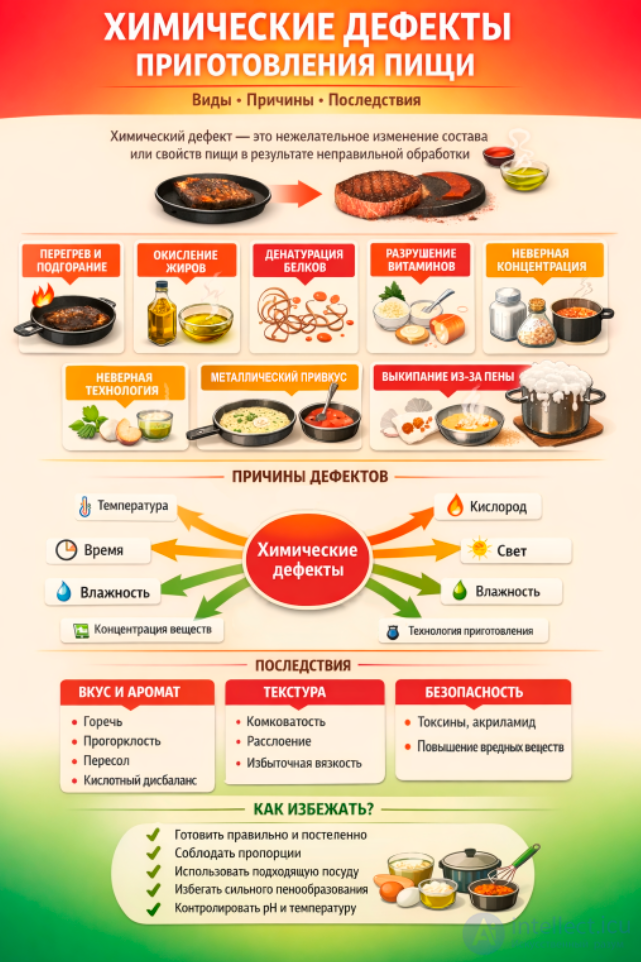
Let us examine the main examples from the standpoint of food chemistry:
Overheating of proteins
At excessively high temperatures, proteins denature and coagulate to an extreme degree → the meat becomes dry and tough.
Example: overcooked chicken or fish.
Destruction of vitamins
Vitamins C, B1, B6, and folic acid are easily destroyed by prolonged heating.
As a result, the dish loses its nutritional value.
Oxidation of fats, overheating of oil
When frying at high temperatures (or when reusing the same fat for frying) and at temperatures above the smoke point, the oil breaks down, forming peroxides and aldehydes, acrolein, aldehydes, and carcinogenic compounds → unpleasant odor, bitterness, development of cancer of the digestive tract.
Example: rancid oil.
Burning (scorching) - a combination of physical processes (sticking, evaporation of water, overheating) and chemical reactions (pyrolysis, oxidation, degradation of proteins and fats)
Chemical cause: carbonization of carbohydrates and proteins at temperatures above 200–250 °C.
Physical causes: Thermal conductivity of the material - Aluminum and copper conduct heat quickly → local overheating if there is no even distribution. Cast iron and thick-walled pots accumulate heat and distribute it more evenly → lower risk of burning.
Thickness and structure of the base - A thin base heats up and cools down quickly, creating «hot spots».
A multilayer base (steel + aluminum + copper) distributes heat evenly.
Heat capacity of the material - High heat capacity (cast iron, ceramics) allows a stable temperature to be maintained.
Low heat capacity (thin steel) → sharp temperature spikes, and the food burns more quickly.
Heat transfer and contact with the food - A smooth surface (Teflon, ceramic) reduces the adhesion of proteins and starch.
A rough or damaged surface increases sticking → burning.
Results: Pyrolysis products form (char, tar, polycyclic aromatic hydrocarbons). Taste: bitterness, smell of burning.
Example: scorched porridge, meat in a frying pan.
Excessive crust formation (Maillard reaction)
With overly prolonged frying, the Maillard reactions progress to the stage of forming melanoidins and bitter compounds.
The taste becomes tough and bitterish.
Overcooking of foods
Prolonged boiling destroys the cell walls (pectin, cellulose), the starch fully gelatinizes → the porridge turns into a viscous mass.
Leaching out of flavor substances
With excessive boiling, meat and vegetables lose their extractive substances → the broth is rich, but the foods themselves are flavorless.
foaming and boiling over during boiling (during cooking, the food «escapes» along with the foam)
Terminology. Foaming — the formation of stable foam during boiling due to proteins, starch, saponins, and other surface-active substances. Boil-over — the escape of liquid and foam beyond the confines of the cookware during vigorous boiling. «undesirable turbulent boiling accompanied by foaming and boiling over of the food»
Foam formation
Proteins, saponins, pectins, and other surface-active substances (especially in legumes, grains, meat) reduce the surface tension of water.
During boiling, gas bubbles (water vapor, CO₂) are stabilized by these substances → a stable foam forms.
Accumulation of vapor beneath the foam
The foam acts like a lid: vapor cannot escape freely.
The pressure beneath the foam rises, the bubbles enlarge and lift the foamy mass upward.
Reduction of the density and viscosity of the liquid
During boiling, starch and proteins partially denature, forming colloidal systems.
This makes the liquid more viscous, the foam persists longer and more easily «creeps» upward.
Physical factor — vigorous boiling
With strong heating, vapor bubbles form too quickly.
They lift the foam and liquid to the surface, creating an «escaping» effect.
The role of the cookware
In a narrow pot with a tall layer of liquid, the vapor pressure is concentrated → the foam escapes outward more quickly.
In wide cookware, the bubbles disperse, and the liquid boils more calmly.
The material also has an effect: metal with high thermal conductivity (aluminum) creates local overheating zones, intensifying turbulent boiling.
Metallic aftertaste
Arises upon contact of acidic foods (tomato, lemon) with aluminum or iron cookware → metal ions pass into the food.
Bitterness from spices
When overheated, spices (for example, garlic, pepper) release sulfurous and phenolic compounds → a bitter taste.
Loss of aroma
Volatile essential oils (dill, parsley, coriander) are destroyed by prolonged heating → the dish becomes «flat».
Incorrect ratio of ingredients
a different taste, aroma, and consistency result
Lumpiness
Cause: incomplete gelatinization of starch (for example, when making mashed potatoes, pasta, or rice) or insufficient mechanical grinding.
Chemistry: the starch granules remain intact, and a uniform colloidal mass does not form.
Insufficient fermentation
With a shortage of sugars or weak yeast activity, little CO₂ forms → the bread is dense, with low porosity.
Excessive fermentation
Overly prolonged fermentation → sour taste, loose structure.
Incorrect ratio of ingredients
Excess water → a sticky mass; a lack of water → dry dough.
Errors in the dosing of salt or sugar change the osmotic pressure and inhibit the action of the yeast.
Darkening of vegetables
Enzymatic oxidation of phenolic compounds (for example, polyphenol oxidase in apples).
Destruction of pigments
During prolonged boiling, chlorophyll is converted into pheophytin → green vegetables turn a brownish-olive color.
Anthocyanins (in red cabbage, berries) change color depending on the pH.
Formation of an unpleasant odor
Under improper storage or frying, fats oxidize, forming volatile aldehydes.
Gray color of meat during boiling
Myoglobin is destroyed, iron is oxidized → the meat loses its pink hue.
Bitterness when frying fish
Oxidation of unsaturated fatty acids (especially omega-3).
| Food/process | Defect | Chemical cause | Example |
|---|---|---|---|
| any | Burning | Carbonization of carbohydrates and proteins, pyrolysis | Scorched porridge |
| any | Boiling over | Foam formation, elevated temperature, increased cooking time | Milk escaping during boiling, water escaping when boiling peas |
| any | Overheating of oil | Breakdown of fats, formation of acrolein | Bitter oil |
| any | Excessive crust | Excessive Maillard reactions, melanoidins | Dry meat |
| any | Overcooking | Destruction of pectin, gelatinization of starch | Overcooked vegetables |
| any | Leaching out of flavors | Loss of extractive substances | Flavorless meat in soup |
| any | Metallic aftertaste | Transfer of metal ions from cookware | Tomato in an aluminum pot |
| any | Bitterness of spices | Breakdown of essential oils and phenols | Over-fried garlic |
| any | Loss of aroma | Evaporation of volatile oils | Boiled herbs |
| Meat | Toughness, dryness | Denaturation and coagulation of proteins | |
| Oil/fat | Bitterness, odor | Oxidation of lipids, formation of aldehydes | |
| Bread | Dense structure | Insufficient fermentation, little CO₂ | non-fluffy baked goods |
| Bread | Sour taste | Excessive fermentation, accumulation of acids | crumbly baked goods |
| Vegetables | Darkening | Enzymatic oxidation of phenols | |
| Green vegetables | Brown color | Conversion of chlorophyll into pheophytin | |
| Fish | Bitterness | Oxidation of unsaturated fatty acids |
To avoid most cooking defects, one must take into account both the chemical and physical processes that occur when heating foods. Proteins should be cooked at a moderate temperature so that they denature gently and do not become tough; fats must not be overheated above the smoke point, otherwise they oxidize and produce bitterness; carbohydrates need to be controlled at the caramelization and Maillard-reaction stage so that the crust is golden rather than burnt. Vitamins and pigments are preserved with minimal boiling time and the use of gentle methods — for example, braising or steaming. To avoid burning, it is important to use cookware with a thick base and even heat transfer, to regulate the heat, and to monitor the presence of moisture. To prevent food from «escaping» along with the foam, one must cook over moderate heat, use a sufficiently wide pot, and, if necessary, skim off the foam, since its stability is provided by proteins and starch. Overcooking and loss of flavor are prevented by controlling the boiling time and maintaining the optimal amount of liquid. Spices and herbs are best added at the end of cooking in order to preserve the aromatic oils. Thus, the key to preventing defects is the control of temperature, time, cookware, and the composition of the food, as well as an understanding of the physicochemical processes that underlie each phenomenon.

Comments