
Lecture 5 min.
The food chemistry of ice cream studies the composition and interaction of the components that determine the flavor, texture, and stability of this product. Ice cream is a complex emulsion and foam in which water, fats, proteins, sugars, and air form a stable system at low temperatures. During cooling, physical and chemical transformations take place: the formation of ice crystals, the stabilization of fat droplets, the binding of proteins, and the retention of air. These processes provide a tender consistency and a pleasant sensation of cold when the product is eaten.
why does ice cream only form in the cold?
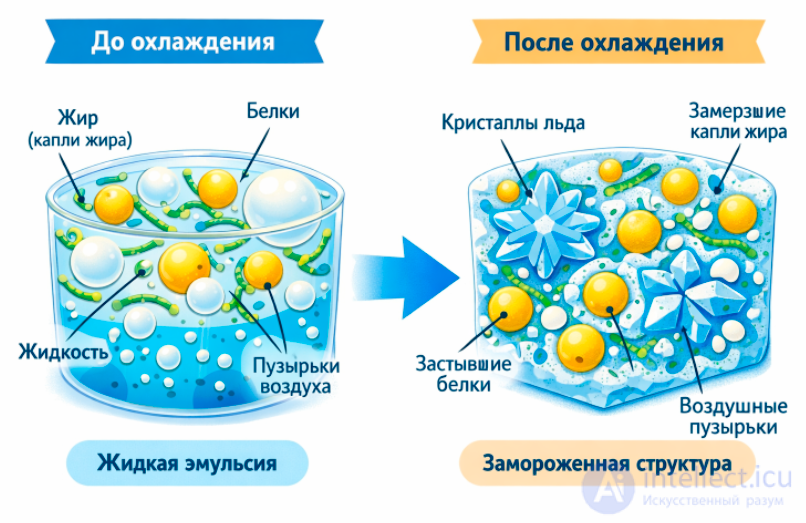
Ice cream forms only in the cold because its structure is held together by frozen water and fats: at above-zero temperatures the ice crystals melt, the emulsion breaks down, and the dessert turns into a sweet milk drink. To preserve the creamy texture, the mixture must be cooled quickly and frozen at below-zero temperatures.
Ice crystals: these are precisely what form the basis of ice cream. At temperatures above 0 °C they begin to melt, and the product loses its shape.
Fats and proteins: milk fat and casein create an emulsion that works only in the frozen state.
Air: ice cream is a foam in which air bubbles are «locked» in an icy matrix. Without cold they escape, and the dessert collapses.
Sugar: it lowers the freezing point of water, so part of the liquid remains unfrozen even at −10…−15 °C, which makes ice cream soft.
| Component | Role | What happens on heating |
|---|---|---|
| Ice | Forms the solid base | Melts → liquid mass |
| Fat | Creamy texture, protection from heat | Melts, density is lost |
| Proteins | Emulsifiers, retain air | Break down the structure |
| Air | Lightness and volume | Escapes, the product collapses |
At room temperature the mixture does not freeze but turns into a sweet cream or milkshake.
Even if cooled to +5 °C, it will be a crème brûlée or mousse, but not ice cream.
Ice cream requires a temperature of −11…−18 °C (gelato is served at −11 °C, plombir at −15 °C).
For ice cream to develop its structure (ice + fat + air), you need not only a low temperature but also time, so the mixture can freeze evenly.
Home freezer: at −18 °C a scoop of ~100 g freezes in 40–60 minutes.
Ice cream maker: thanks to constant stirring and cooling — 20–30 minutes.
Blast freezing (−30…−40 °C): the structure forms in 5–10 minutes.
Liquid nitrogen: instant freezing — less than a minute, but this is already a show technique.
If freezing is too slow → large ice crystals form, and the ice cream will be «icy».
If freezing is fast → the crystals are small, and the structure is creamy and tender.
For a 100 g mass, the optimum is — 20–40 minutes at −18 °C, to achieve a balance between speed and texture.
There is a striking dessert: fried ice cream. It is made like this: heavily frozen scoops are coated in breading and quickly deep-fried. A hot crust forms on the outside, while cold ice cream remains inside.
Thus, ice cream is an example of a delicate balance between physics and food chemistry. Its structure is formed through the interaction of water, fats, proteins, and sugars during controlled cooling. The size of the ice crystals, the creaminess, and the stability of the product depend on the freezing rate and the composition of the mixture. Understanding the food chemistry of ice cream makes it possible to create new kinds of desserts — from classic plombir to functional and low-calorie variants — while preserving harmony of flavor and texture.

Comments