
Lecture
7.1 Classification of enzymes
Enzymes are biocatalysts of protein nature. Acting in a strictly
defined sequence, they catalyze hundreds of multistage reactions in the
course of which nutrient molecules are broken down, chemical energy is stored and
transformed, and macromolecules that make up the
cell are built from simple molecules. With the help of enzymes, a balance is maintained between the various
metabolic processes necessary for sustaining the viability
of individual cells and of the organism as a whole.
Enzymes received their name from the Latin word «fermentum», which
means «leaven», «fermented sugar». This corresponds to the first
notions of enzymes, which were obtained during the study of fermentation.
A synonym for the term «enzymes» – enzymes (enzymes) – comes from the Greek word
meaning «leaven», «yeast», with the help of which the study of alcoholic
fermentation began.
At present, 2000 different enzymes are known and have been studied, many of
which are successfully used in medicine, food technology, the processing
industry, household chemistry and other branches of the national economy.
Classification by chemical composition. By chemical composition
a distinction is made between:
- single-component enzymes – simple proteins, similar to globulins,
which upon hydrolysis yield only α-amino acids;
- two-component enzymes – these are complex proteins and
consist of two parts: the apoenzyme (the protein part) and the coenzyme (the non-protein
component); vitamins, aromatic and
aliphatic hydrocarbons, heterocyclic compounds, nucleotides,
nucleosides, metals, etc. can act as the coenzyme.
Classification by the type of catalyzed reactions. The classification is based
on three principles:
1. Enzymes are divided into 6 classes according to the type of catalyzed reaction
(figure 31) .
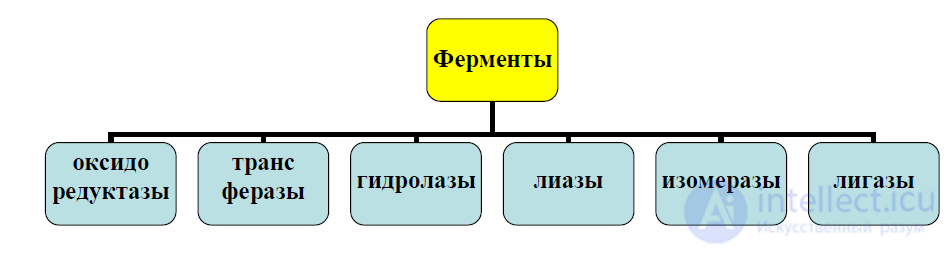
Figure 31 – Classification of enzymes
2. Each enzyme receives a systematic name that includes
the name of the substrate on which it acts, the type of catalyzed reaction and
the ending «-ase». Some enzymes have retained historically established
names.
3. Each enzyme is assigned a four-digit code (cipher). The first number
indicates the class of the enzyme, the second – the subclass, the third – the sub-subclass,
the fourth - the serial number of the enzyme within the sub-subclass.
For example, α-amylase (E.C. 3.2.1.1):
- the first digit 3 – the class of hydrolases,
- the second digit 2 – the subclass of glycosidases,
- the third digit 1– the subclass of polyases,
- the fourth digit 1- the serial number of the enzyme α-amylase.
Consequently, α-amylase accelerates the hydrolysis (first digit 3) of the glycosidic bond
(second digit 2) in polysaccharides (third digit 1).
Class 1 – oxidoreductases – enzymes that catalyze oxidation-
reduction reactions (addition of oxygen, removal and transfer
of hydrogen, transfer of electrons); examples are lipoxygenase, catalase;
Class 2 – transferases – enzymes that catalyze the transfer of atomic
groupings from one compound to another, i.e. intermolecular transfer
(of monosaccharide residues, amino acids, phosphoric acid, methyl
groups, etc.); an example is methyltransferase;
Class 3 – hydrolases – enzymes that catalyze the reactions of hydrolysis of
complex organic compounds into several simpler ones; hydrolysis reactions
proceed with the participation of water.
The class of hydrolases is very extensive, and it is subdivided into a number of subgroups
(figure 32).
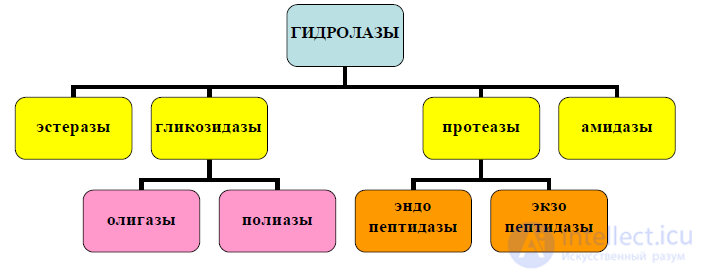
Figure 32 – Classification of hydrolases
Esterases – enzymes that catalyze the reactions of cleavage and synthesis
of the ester bond in accordance with the equation:
R-CO-O-R1 + H2O → R-COOH + R1OH
Among the esterases, first of all it is necessary to note the lipases – enzymes
that catalyze the hydrolytic cleavage and synthesis of fats in accordance with the
overall equation:
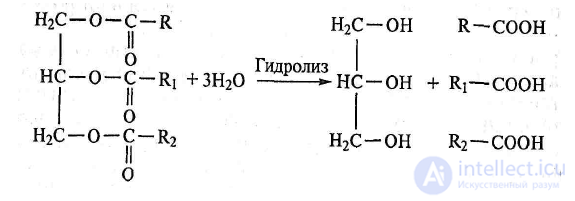
The stepwise hydrolysis of acylglycerol under the action of lipase can be
represented as the scheme:
triacylglycerol → diacylglycerol + fatty acid → monoacylglycerol
+ fatty acid → glycerol + fatty acid
Glycosidases – enzymes that catalyze the reactions of cleavage and synthesis
of the glycosidic bond in accordance with the equation:
R-O-R1 + H2O → ROH + HOR1
Glycosidases are divided into oligases and polyases.
Oligases – enzymes that cleave the glycosidic bond in glycosides and
oligosaccharides. For example, the hydrolysis of sucrose is accelerated by β-fructofuranosidase
(sucrase).
Polyases catalyze the reactions of hydrolysis of polysaccharides. An example of polyases
are the enzymes under the action of which the hydrolysis of starch occurs with the
formation of dextrins and maltose. At present, the presence of three
amylases has been established: α-amylase, β-amylase and glucoamylase; they differ in their properties
and in the way they act on starch. The enzyme α-amylase hydrolyzes starch acting
randomly, breaking the 1,4-glycosidic bond with the formation of dextrins and
a small amount of maltose. The enzyme β-amylase hydrolyzes starch
acting from the non-reducing end of the chain, breaking the 1,4-glycosidic bond and
forming maltose. At the branching points of amylopectin the action of β-amylase
stops, in which case a small amount of dextrins remains. The enzyme
glucoamylase acts from the end of the chain, cleaving off one molecule of glucose,
breaking the 1,4-glycosidic bond; at the branching points of amylopectin the action
of glucoamylase stops and a small amount of
unhydrolyzed dextrins remains.
The hydrolysis of starch under the action of a complex of amylases can be represented
as the scheme:
starch → amylodextrins → erythrodextrins →
achrodextrins → maltodextrins → maltose → α-glucose
Proteases – enzymes that catalyze the reactions of cleavage and synthesis
of the peptide bond in accordance with the equation:
RCONHR' + H2O → RCOOH + H2NR'
Proteases are divided into endopeptidases and exopeptidases. Endopeptidases
catalyze the cleavage of internal peptide bonds, and exopeptidases –
of external ones. The hydrolysis of protein under the action of endo- and exopeptidases can be represented
as the scheme:
protein → albumoses → peptones → polypeptides →
oligopeptides → dipeptides → α-amino acids
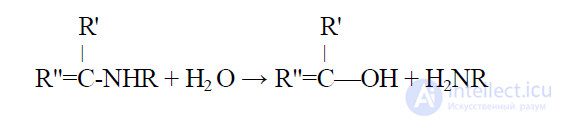
Amidases – enzymes that catalyze the following reaction:
Class 4 – lyases – enzymes that catalyze the reactions of non-hydrolytic
removal of atoms and groups of atoms from a substrate with the formation of a multiple bond
(removal of water, carbon dioxide, ammonia) or the addition of groupings at
the site of breaking of multiple bonds; an example is fumarate hydratase;
Class 5 – isomerases – enzymes that catalyze isomerization reactions,
i.e. the transfer of chemical groupings within a molecule; an example is
ribose-phosphate isomerase;
Class 6 – ligases (synthetases) – enzymes that catalyze synthesis reactions
coupled with the breaking of some bonds and the formation of others (C-C, C-S, C-N,
C-O bonds); an example is glutamine synthetase.
In the processing of food raw materials, one most often has to deal with
enzymes of class 1 – oxidoreductases, such as catalase, peroxidase,
lipoxygenase; and with enzymes of class 3 – hydrolases, such as lipases
(enzymes that hydrolyze lipids), amylases (enzymes that hydrolyze starch),
disaccharidases (enzymes that hydrolyze disaccharides), proteases (enzymes that
hydrolyze protein).
7.2 Classification of enzyme preparations
In the food industry, enzyme preparations are actively used.
The difference between an enzyme preparation and an enzyme is that an enzyme
preparation includes several enzymes, which significantly expands the area
of its application and gives the technologist more possibilities. The use of enzyme
preparations makes it possible to intensify technological processes, improve
the quality of the finished product, increase its yield, save valuable food
raw materials, since their use makes it possible to accelerate several
processes simultaneously.
By origin they can be divided into three groups (figure 33).
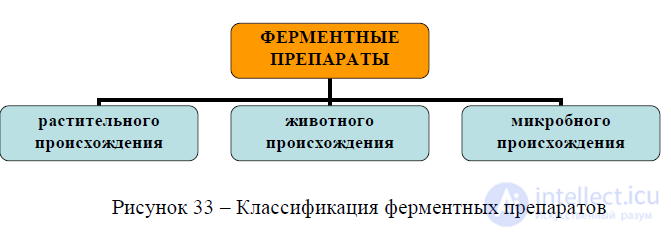
Figure 33 – Classification of enzyme preparations
Enzyme preparations of plant origin are represented by
malt and preparations based on malt. Malt is artificially germinated
grain, at a certain temperature and humidity. During germination, in the
kernel the enzyme systems that were previously in a zymogen
(inactive) state become activated. These changes create in the malt grain a powerful
enzyme system containing enzymes of various actions, mainly
hydrolases. In the manufacture of malt preparations, with the help of solvents,
most often water, the enzyme complexes are extracted from the malt, the extracts are concentrated, and
malt extracts and syrups are obtained. Preparations based on malt possess
a more pronounced enzymatic activity compared to malt.
Enzyme preparations of animal origin are isolated from sections of the
gastrointestinal tract of animals. In essence, these are digestive enzymes.
Porcine pepsin and rennet are produced.
Pepsin in its pure form is an enzyme secreted in the stomachs of mammals,
which curdles milk for its better assimilation.
Rennet, from the word «abomasum» (little abomasum) – the salted and dried
stomach of ruminant animals, has two active components: chymosin and pepsin.
Chymosin (rennin) – an enzyme of the class of hydrolases, which is produced in the
gastric glands of ruminant animals (by the glands of the abomasum (the 4th section of the stomach)).
The main source of natural rennin – the stomachs of milk-fed calves, lambs, kids,
whose age is no more than 10 days. At a later age, along with rennin,
a significant amount of pepsin is produced, which worsens the properties
of the rennet.
Enzyme preparations of animal origin possess
milk-clotting properties, and are therefore used, for example, in cheesemaking.
In the past, cheese was made precisely with the use of pieces of salted and dried
abomasums, which were placed in milk for its curdling. It should be noted that in
some places this is still done to this day – for example, in the mountain villages of the Caucasus.
Enzyme preparations of microbial origin. In the food
industry, enzyme preparations obtained during the
cultivation of specific microorganisms capable of producing
certain enzymes are widely used. A distinction is made between bacterial enzyme preparations,
obtained by submerged cultivation of bacteria, and surface ones,
obtained by surface cultivation of mold fungi.
The name of an enzyme preparation of microbial origin consists of
four parts:
1. The name of the main enzyme.
2. The name of the producer microorganism, i.e. the microorganism during the
life activity of which the enzyme preparation was obtained
3. The method of cultivation of the microorganism (S – submerged, F –
surface).
4. The degree of purification – X (2X, 3X, 10X, 15X, etc.); the higher the digit or number,
the purer and, consequently, the more active the enzyme preparation.
For example: protosubtilin S10X contains the main enzyme – protease,
the producer is the bacterial rod Bacillus subtilis, obtained by submerged
cultivation, degree of purification 10X.
7.3 The use of enzymes and enzyme preparations in the food
industry
During the storage of food raw materials, their processing into food
products and during the storage of finished products, numerous changes occur
associated with the action of various enzymes. Enzymes and enzyme preparations
are widely used in various branches of the food industry.
Gelatin hydrolysates are used for the preparation of low-calorie
beverages, where non-hydrolyzed gelatin cannot be used. The process of hydrolysis
of a gelatin solution is carried out with a mixture of alkaline and neutral proteases.
Bread of good quality can be obtained only when in the process
of dough making the rates of microbiological processes and
biochemical transformations are optimally combined. The enzymatic hydrolysis of proteins and carbohydrates to a
certain extent contributes to the intensification of these transformations and
has a positive effect on the quality of bread. If in the past malt was used as a source
of enzymes, then now the application of enzyme preparations of microbial origin is acquiring ever-larger scale.
The main
preparation widely introduced into the baking industry is
amilorizin F10X.
The starch and treacle industry produces a large assortment of
products: dry starch, modified starches, dextrins, various kinds
of starch treacles, glucose, glucose-fructose syrups. For carrying out the
technological process, enzymes and enzyme preparations are used:
glucose isomerase, amilosubtilin S10X, glucavomarin S20X, amilorizin F10X.
Complex enzyme preparations containing active proteases and
α-amylase (for example, amilorizin F10X) are used in the production of flour
confectionery products for the purpose of accelerating the fermentation process and adjusting
the physical properties of the flour gluten, changing the rheological properties of the dough,
accelerating its ripening. In the production of galettes, crackers, and cakes, it is advisable
to use complex preparations with a predominance of proteolytic action, but
containing in their composition also α-amylase. The combined action of these enzymes
provides the yeast with fermentable sugars and low-molecular-weight products
of protein hydrolysis. Part of the sugars and nitrogenous substances not used during fermentation
enters into the melanoidin-formation reaction, thanks to which galettes and crackers
acquire an intense coloring and a pleasant aroma.
Invertase is used in the confectionery industry for the production of
fondant candies and liquid fruit fillings. It is necessary in order to
obtain a semi-soft or liquid consistency at high concentrations of sugar.
The use of enzyme preparations in the production of fruit and berry juices,
wines and soft drinks is used to increase the yield of juice, to clarify
and stabilize juices, soft drinks and wines, to prevent oxidative
processes in juices, and for the inversion of sucrose in the production of soft drinks and
syrups. To achieve these aims, pectolytic, proteolytic,
macerating (breaking down protopectin but not reducing the viscosity of the juice)
enzymes, glucose oxidases, catalases, and invertases are used.
In the production of beer by the usual technological scheme, the necessary
enzyme systems are contained in the malt. The use of enzyme preparations
of microbial origin (amilorizin FX, amilorizin F10X,
amilosubtilin S10X, amilosubtilin S20X, protosubtilin S10X, tsitoryozemin FX)
makes it possible to replace part of the malt with unmalted barley. To combat cold
haze in brewing production, plant enzymes are used –
papain, ficin, bromelain, as well as fungal (produced by microscopic
fungi of the genera Aspergillus, Penicillium, Mucor, Amylomyces) and bacterial
(produced by Bacillus subtilis) proteases.
In the production of alcohol from grain raw materials, for the liquefaction and saccharification of
starch, malt and enzyme preparations of microbial origin
with amylolytic, proteolytic and cytolytic action are actively used.
Complex enzyme preparations containing endopeptidases
are used in the food-concentrate and canning industries in the
preparation of concentrates from hard-to-cook cereals, peas, and beans.
The tenderizing of meat occurs effectively under the action of endogenous proteases,
especially neutral proteases. Studies have been carried out and the possibility
of introducing the enzyme into the circulatory system of animals before slaughter has been proven; it quickly
spreads through the tissues, as a result of which all the meat tissues become more
tender. For this process the enzyme papain can be used, which
is contained in papaya. Another method of tenderizing tissues with the help of proteases
consists of injecting the enzymes into the carcass after slaughter. The process
of proteolysis must be carefully controlled in order to avoid excessive
hydrolysis of individual sections. For tenderizing meat, enzymes from
Bacillus subtilis and Aspergillus oryzae are used. Enzymes can be introduced by the following
methods: sprinkling the meat with enzyme powder, placing it in an enzyme solution,
spraying an enzyme solution onto the meat, or by injection. The tenderizing of meat in
this case mainly occurs during heat treatment.
Processes have been developed for separating meat from bones using protease,
as well as for separating meat waste into high-quality fat,
soluble protein, insoluble protein and bone fractions.
Enzymes are also used in the fish-processing industry
for processing inedible fish or fish waste into fish oil, fish
solutions. Fish odor and taste are removed from fish proteins by treating them
with proteolytic enzymes.
Most enzymes of animal origin, for example,
pancreatic esterases, are used in the production of dairy products;
the possibility of using microbial lipases for these purposes has been proven. Thus, the lipase from
Mucor miehei replaces the animal pancreatic esterase that causes
the formation of a specific bouquet in hard Italian cheeses. Fungal lipases
accelerate the ripening of cheddar cheese and improve the formation of the bouquet and coloring of cheeses.
The development of odor in some dairy products depends significantly on the action
of enzymes on milk fat, and lipolytic enzymes are used for the
increased formation of the odor of cheeses and butter when they are made from
cottonseed oil and powdered whole milk.
Review questions
1. What are the functions of enzymes?
2. What is the modern classification of enzymes?
3. What distinguishing feature underlies the classification of enzymes?
4. What reactions do enzymes of the oxidoreductase class accelerate?
5. Of what reactions are transferases catalysts?
6. What reactions do enzymes of the hydrolase class accelerate?
7. What enzymes accelerate the processes of cleavage and synthesis of the
ester bond?
8. List the intermediate products of the hydrolysis of acylglycerols under the
action of lipase.
9. What reactions do glycosidases accelerate?
10. Into what groups are glycosidases divided? Give examples of enzymes
of these groups.
11. List the intermediate products of the hydrolysis of starch.
12. What enzymes accelerate the processes of cleavage and synthesis of the peptide
bond?
13. Of what reactions are lyases the accelerators?
14. What reactions do enzymes of the isomerase class accelerate?
15. Of what reactions are ligases catalysts?
16. What are enzyme preparations, and what is their difference from enzymes?
17. Into what groups are enzyme preparations divided by origin?
18. Give examples of enzyme preparations of plant
origin.
19. Tell about enzyme preparations of animal origin.
Give examples.
20. Give examples of enzyme preparations of microbial origin.
21. Tell about the rules of nomenclature of microbial enzyme preparations.
22. Tell about the use of enzymes and enzyme preparations in the
baking industry.
23. What enzyme preparations are used in the production of flour
confectionery products?
24. Tell about the use of enzymes and enzyme preparations in the
manufacture of soft drinks, beer, and alcohol.
25. What enzymes and enzyme preparations are used in the processing
of meat?
26. For what purposes are enzymes and enzyme preparations used in the
processing of milk?

Comments