
Lecture
5.1 General characteristics of vitamins
Vitamins are organic substances of diverse chemical nature,
grouped into a single class of micronutrients on the basis of their necessity for
nutrition.
Requirements for vitamins:
- performance of catalytic functions in the body (acceleration of metabolic
processes);
- indispensability;
- physiological activity in negligibly small amounts;
- absence of energy value.
For normal vital activity, vitamins are needed in very
small amounts. The daily intake norms of vitamins and their functions in
the human body are given in table 4.
Since vitamins are practically not synthesized by the body (i.e., they are
indispensable or essential), they must be supplied in the necessary
amount with food daily. The absence or deficiency of vitamins in the human
body causes deficiency diseases – hypovitaminosis and avitaminosis.
In avitaminosis, a deep and prolonged vitamin deficiency is observed.
In hypovitaminosis, a moderate vitamin deficiency is observed. With excessive
intake of vitamins significantly exceeding physiological norms,
hypervitaminoses develop. This is characteristic of fat-soluble vitamins,
whose share in a person's daily diet is low.
As a unit of measurement of vitamin content, the
dimension mg % = 0.001 g (milligrams of vitamins per 100 g of product) is used,
mcg % = 0.001 mg % (micrograms of vitamins per 100 g of product).
Table 4 – Human daily requirement for vitamins and vitamin-like
compounds
able 4 – Human daily requirement for vitamins and vitamin-like compounds
| Vitamin / substance | Daily requirement, mg | Functions |
|---|---|---|
| C – ascorbic acid | 60–100 | Antiscorbutic factor, participates in redox reactions, boosts immunity |
| B1 – thiamine | 1.7 | Normal activity of the CNS, regulation of carbohydrate metabolism |
| B2 – riboflavin | 2 | Participates in redox reactions |
| B3 – pantothenic acid | 6 | Biochemical acylation, metabolism of lipids, fatty acids, carbohydrates |
| B6 – pyridoxine | 2.2 | Synthesis and metabolism of amino acids, proteins, unsaturated fatty acids |
| B9 – folic acid | 0.2 | Hematopoiesis, synthesis of amino acids, nucleic acids, choline, purines and pyrimidines |
| B12 – cyanocobalamin | 0.003 | Hematopoiesis, conversions of amino acids |
| PP – niacin | 19 | Redox reactions |
| H – biotin | 0.25 | Carboxylation, metabolism of amino acids, lipids, carbohydrates, nucleic acids |
| A – retinol | 2 | Cell membranes, bone growth, vision |
| D – calciferol | 0.0025 | Calcium and phosphorus in the blood, bone formation |
| E – tocopherol | 10 | Antioxidant, prevents lipid oxidation |
| K – phylloquinone | 3 | Blood clotting |
| B4 – choline | 500 | Lipotropic factor |
| B8 – inositol | 1000 | Lipotropic factor |
| B13 – orotic acid | not established | Growth of microorganisms, protein metabolism |
| B15 – pangamic acid | not established | Antihypoxic factor |
| F – PUFA | 1% of daily energy requirement (kcal) | Reduces the risk of cardiovascular diseases |
| N – lipoic acid | not established | Lipotropic factor |
| U – methylmethionine sulfonium | 200 | Antiulcer factor |
| P – bioflavonoids | 30–50 | Capillary-strengthening factor |
| H1 – para-aminobenzoic acid | 0.07 |
A number of vitamins are represented not by one, but by several compounds
possessing similar biological activity, for example: pyridoxine
(vitamin B6) includes pyridoxine, pyridoxal, pyridoxamine.
5.2 Classification of vitamins
Vitamins are subdivided into three classes (figure 29).
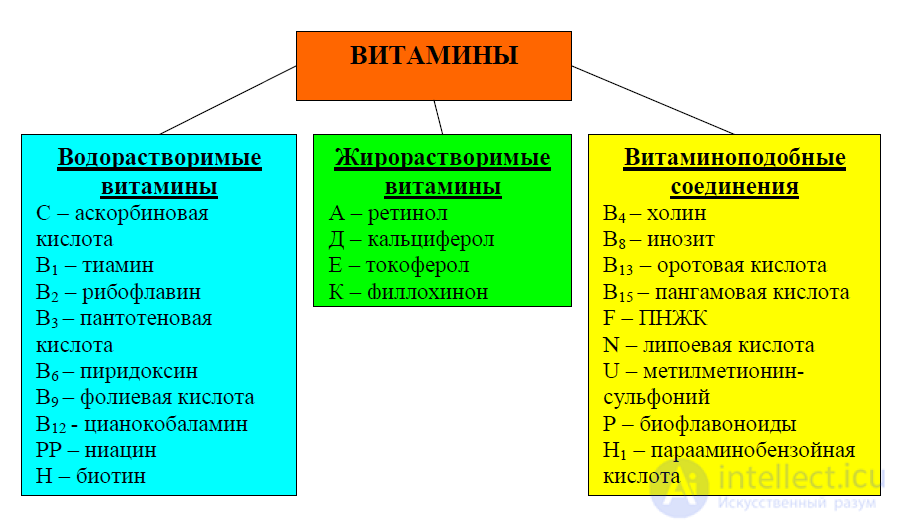
Figure 29 – Classification of vitamins
5.3 Water-soluble vitamins
Vitamin C (ascorbic acid). It is an antiscorbutic factor, since
it participates in the synthesis of connective tissue. It participates in redox
reactions and boosts human immunity. A person obtains all the necessary
amount of vitamin C from food. The main sources
are vegetables, fruits, berries: rosehip up to 1000 mg %, red pepper –
250 mg %, black currant – 200 mg %, white cabbage contains 50 mg %,
potatoes – 20 mg %. Unstable, easily destroyed by atmospheric oxygen, in light
in the presence of heavy metal ions. More stable in an acidic environment than in an
alkaline one.
Vitamin B1 (thiamine). Necessary for the normal activity of the central
nervous system. Participates in the regulation of carbohydrate metabolism. The main
sources – grain products, such as cereals, coarse-ground flour, etc., where
the vitamin content is 0.5 mg %, peas contain up to 0.8 mg %, in
meat – 0.5 mg %. Resistant to the action of light, oxygen, in an acidic environment, to elevated
temperatures. Easily destroyed in an alkaline environment.
Vitamin B2 (riboflavin). Participates in redox
reactions. When deficient, skin diseases arise (seborrhea, psoriasis),
inflammation of the oral mucosa, cracks appear in the corners of the mouth, diseases
of the circulatory system and gastrointestinal tract develop. Present in
dairy products: in milk – 0.15 mg %, in cheese – 0.4 mg %, in liver – 2.2 mg %,
in grain products – 0.1 mg %, in vegetables and fruits – 0.05 mg %. A small
amount is synthesized by the intestinal microflora. Resistant to elevated
temperatures, but destroyed in light and in an alkaline environment.
Vitamin B3 (pantothenic acid). Participates in the metabolic reactions of lipids,
fatty acids, carbohydrates. Deficiency leads to dermatitis, hair loss.
Present in offal 2.5-9 mg %, in grain products and legume
crops – 2 mg %, in egg – 2 mg %, in yeast – 4-5 mg %. A small amount
is synthesized by the intestinal microflora. Destroyed in an acidic and alkaline environment.
Vitamin B6 (pyridoxine, adermine). Participates in the biosynthesis and metabolism
of amino acids, proteins, unsaturated fatty acids. Necessary for the normal
activity of the nervous system, circulatory system, liver. When deficient,
dermatitis develops. Present in meat – 0.4 mg %, in beans – 0.9 mg %, in
potatoes – 0.3 mg %. Partially synthesized by the intestinal microflora.
Resistant to elevated temperatures, acids, alkalis, but destroyed in
light.
Vitamin B9 (folic acid, folacin). A hematopoietic factor, participates in
the activity of the cardiovascular system, in the biosynthesis of amino acids,
nucleic acids, choline. When deficient, the activity of the hematopoietic system
and the digestive system is disrupted, and the body's immunity is reduced.
Present in green crops – 110 mcg %, in liver – 240 mcg %, in yeast –
550 mcg %, less in grain products and dairy products – 10-20 mcg %.
Unstable during heat treatment.
Vitamin B12 (cyanocobalamin). Participates in the processes of hematopoiesis,
amino acid metabolism, in the synthesis of nucleic acids. When deficient,
weakness sets in, anemia develops, the activity of the nervous
system is disrupted. Contained in products of animal origin: in liver –
160 mcg %, in meat – 6 mcg %, in milk – 0.6 mcg %. Destroyed by prolonged
exposure to light, upon oxidation, more stable at neutral pH.
Vitamin PP (nicotinic acid, niacin). Participates in redox
reactions. Deficiency causes fatigue, insomnia,
reduced immunity, impairment of the functions of the nervous and cardiovascular
system. The main source – offal (up to 12 mg %), meat and fish contain
about 4 mg %. Milk, grain products, vegetables and fruits are poor in vitamin PP.
Resistant to the action of light, atmospheric oxygen, in an alkaline environment.
Vitamin H (biotin). Participates in the biosynthesis of lipids, amino acids,
carbohydrates, nucleic acids. When deficient, nervous
disorders are observed, skin depigmentation and dermatitis arise. The main sources
of biotin: liver and kidneys – 80-140 mcg %, eggs – 28 mcg %, milk and meat –
3 mcg %, legume crops – 20 mcg %, wheat bread – 4.8 mcg %. Unstable
upon oxidation in an acidic and alkaline environment.
5.4 Fat-soluble vitamins
Vitamin A (retinol). Participates in biochemical processes associated with
the activity of cell membranes, affects bone growth, human vision. When
the vitamin is deficient, bone growth slows down, damage to the mucous
membrane of the respiratory tract, the digestive system is observed, and vision suffers.
Contained in products of animal origin: in fish oil – 14 mcg %, in
cod liver – 4 mcg %, in milk – 0.025 mcg %. Plant products
contain provitamin A (β-carotene), which has a red-orange color. From
one molecule of β-carotene, two molecules of vitamin A are formed in the body.
The most β-carotene is found in carrots – 10 mg %, in tomatoes – 1 mg %; it is
present in vegetables and fruits that have a red-orange coloring.
Destroyed by the action of light, air, in the presence of heavy metals.
Vitamin D (ergosterol, calciferol, ergocalciferol). Regulates
the content of calcium and phosphorus in the blood, participates in the formation of bone tissues.
Synthesized in human skin under the influence of ultraviolet rays. When
the vitamin is deficient, rickets develops in children, in adults
osteoporosis is observed – thinning and loss of bone density, which leads to dental caries,
fractures of bone tissues. Contained in products of animal origin: in
fish oil – 125 mcg %, in cod liver – 100 mcg %, in beef liver –
2.5 mcg %, in egg yolk – 2.2 mcg %. The vitamin is stable during storage and
technological processing.
Vitamin E (tocopherol). Regulates free-radical reactions in
cells, prevents the oxidation of unsaturated fatty acids in lipids,
affects the synthesis of enzymes, has a pronounced antioxidant action
(natural antioxidant). When deficient, damage to the myocardium,
the cardiovascular and nervous system, the reproductive function is observed. Widespread in
plant raw materials: in soybean oil – 115 mcg %, sunflower oil – 42 mcg %, in
grain products – 5 mcg %. Stable upon heating, slowly destroyed
by the action of ultraviolet rays, atmospheric oxygen, in the presence of
heavy metals.
Vitamin K (phylloquinone K1, menaquinone K2). Necessary for the normalization of
blood clotting, participates in the formation of blood components. When deficient,
peptic ulcer disease develops. The main sources of the vitamin: leafy crops,
such as dill, parsley, cabbage (phylloquinone occurs in plant raw material),
meat, liver (menaquinone occurs in raw material of animal origin).
Partially synthesized by the beneficial microflora of the intestine.
5.5 Vitamin-like compounds
Substances with elevated biological activity, whose full indispensability
is not always proven, are called vitamin-like substances. They
perform diverse functions in the human body.
Vitamin B4 (choline). Is part of phospholipids. Participates in the reactions
of carboxylation-decarboxylation, metabolism of amino acids, lipids,
carbohydrates, nucleic acids. Has a lipotropic action, i.e., reduces
the accumulation of fat in the liver. Regulates the activity of the nervous system, participates in
the synthesis of methionine, adrenaline. When deficient, damage to the liver,
hemorrhages in the internal organs are observed. Contained in unrefined
vegetable oil.
Vitamins P (bioflavonoids). Flavonoids are: catechin, rutin,
hesperidin. They contribute to the strengthening of the walls of blood vessels, regulate
blood pressure, contribute to the activity of the cardiovascular system.
The activity of bioflavonoids increases in the presence of vitamin C. Catechins
are contained in tea leaves, cocoa beans, in grapes; hesperidin is contained in the zest
of citrus fruits.
Vitamin B8 (inositol). Is part of myoinositol phosphatides. Is a
structural part of phytin. Found in many food products. Resistant to
acids and alkalis, not destroyed in light.
Vitamin N (lipoic acid). Participates in the regulation of metabolic
processes. Is part of the coenzymes of the oxidative decarboxylation of
α-oxyacids (for example, pyruvic and α-ketoglutaric). Contained in
milk, meat products, yeast.
Vitamin H1 (para-aminobenzoic acid). Is a structural
element of folic acid, plays the role of an accelerator of the growth of microorganisms
Vitamin U (methylmethionine sulfonium). An antiulcer factor.
Contributes to the synthesis of choline, cholinephosphatides in the body's tissues. Contained in
white cabbage, asparagus, parsley, turnip, pepper, carrots, tomatoes, onions. Upon
heating, prolonged storage it decomposes; unstable in light.
Vitamin F (polyunsaturated fatty acids). Is part of
phosphatides, lipoproteins, connective tissue and the sheaths of nerve fibers;
affects cholesterol metabolism, stimulating its oxidation and excretion from the body,
and also forms esters with it that do not precipitate out of solution; has a
normalizing effect on the walls of blood vessels; participates in the metabolism of
B-group vitamins (pyridoxine and thiamine); stimulates the body's protective mechanisms
(increases resistance to infectious diseases and to the action of
radiation, etc.).
5.6 Vitamin fortification of food
Insufficient supply of vitamins with food leads to their deficiency in the
body and the development of vitamin deficiency disease. Two degrees are distinguished
of vitamin deficiency:
avitaminosis and hypovitaminosis. In
avitaminosis, a deep and
prolonged vitamin deficiency is observed and
diseases associated with
vitamin deficiency develop (scurvy,
rickets, dermatoses). In hypovitaminosis,
a moderate vitamin deficiency
is observed, the manifestations of the vitamin deficiency
are blurred, nonspecific (loss of appetite,
rapid fatigue, irritability,
bleeding gums). Along with a deficiency of one of the vitamins, there may
be observed polyhypovitaminoses and polyavitaminoses, in which the body
experiences a deficiency of several vitamins at once. Most often hypovitaminoses
and avitaminoses arise with insufficient supply of vitamins with food.
A vitamin deficiency can arise as a consequence of a disruption of their absorption in the
body, mainly due to the development of some disease in the person. In
some cases an increased need for vitamins is formed in a person:
under high physical loads, under stress, under the impact of harmful external
factors. The deficiency becomes especially acute in the winter and spring periods of time.
The most effective method of vitamin prevention – the enrichment
of mass-demand food products with vitamins. At present,
along with vitamin fortification, the mineralization of products is carried out, introducing
simultaneously with vitamins the deficient mineral substances, for example, iodine,
zinc, calcium, fluorine. In the vitamin fortification of food products, their
quality is improved, the costs of medical treatment of consumers are reduced,
the circle of persons constantly consuming deficient vitamins is expanded,
the losses of vitamins occurring during the technological processing
of food raw material are replenished. Vitamin fortification and mineralization can be applied to
practically all food products, both liquid (for example, non-alcoholic
beverages) and solid (for example, bakery products).
The main food products enriched with vitamins:
- flour and bakery products (B-group vitamins);
- baby food products (all vitamins);
- beverages and juices (all vitamins except A, D);
- dairy products (vitamins A, D, E, C);
- margarine, mayonnaise (vitamins A, D, E).
Review questions
1. What organic substances are called vitamins?
2. List the requirements for vitamins.
3. What is hypovitaminosis?
4. What is hypervitaminosis?
5. What is avitaminosis?
6. Name the unit of measurement of vitamin content.
7. Into what classes are vitamins subdivided?
8. List the water-soluble vitamins.
9. Name the physiological functions of ascorbic acid.
10. Name the physiological functions of thiamine.
11. Name the physiological functions of riboflavin.
12. List the physiological functions of pantothenic acid.
13. Name the physiological functions of pyridoxine.
14. Name the physiological functions of folic acid.
15. List the physiological functions of cyanocobalamin.
16. Name the physiological functions of niacin.
17. Name the physiological functions of biotin.
18. List the fat-soluble vitamins.
19. Name the physiological functions of retinol.
20. Name the physiological functions of tocopherol.
21. List the physiological functions of calciferol.
22. Name the physiological functions of phylloquinone.
23. List the vitamin-like compounds. Name their
physiological functions.
24. Formulate the purpose of carrying out vitamin fortification of food.

Comments