
You get a bonus - 1 coin for daily activity. Now you have 1 coin

Food Chemistry of Beverages

Lecture


The food chemistry of beverages studies the composition, properties, and interaction of chemical components in liquid food products. Beverages are complex multicomponent systems that include water, organic and inorganic substances, gases, aromatic compounds, and biologically active components. Their chemistry determines taste, aroma, nutritional value, and shelf life.
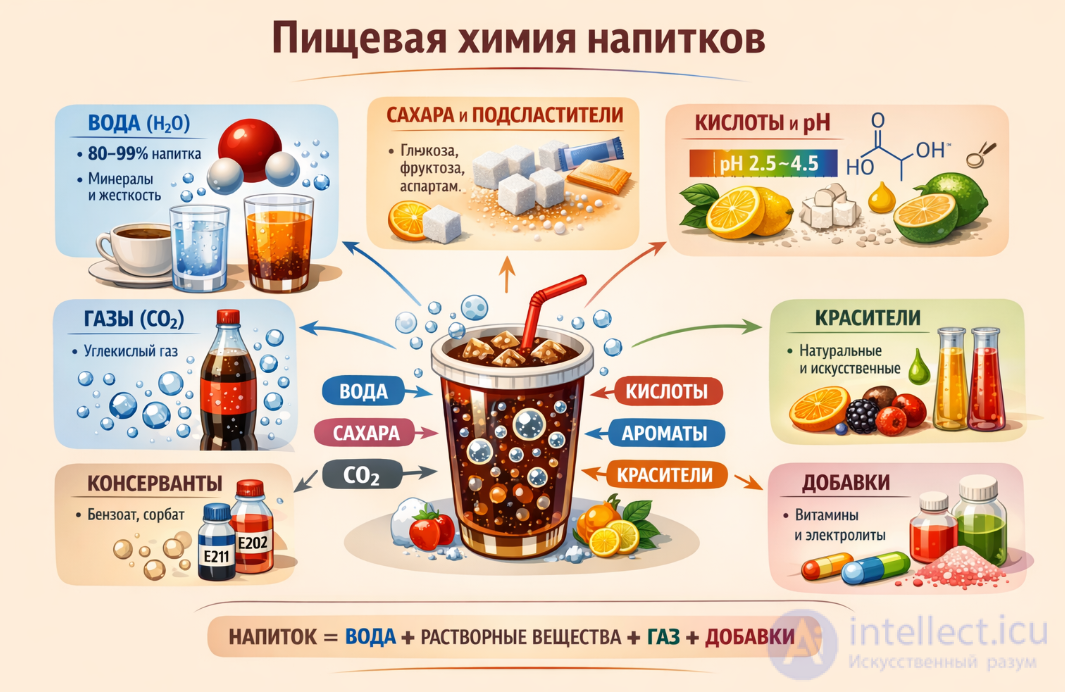
Food Chemistry of Beverages

Main Components of Beverages

  • Water The main solvent that enables the interaction of all substances.

  • Organic substances

    • Sugars: glucose, fructose, sucrose.

    • Organic acids: citric, malic, tartaric, lactic.

    • Amino acids, pectins, phenolic compounds.

    • Aromatic substances that affect taste and smell.

  • Inorganic substances Mineral salts, metal ions, phosphates, carbonates.

  • Gases In carbonated beverages — carbon dioxide, which forms carbonic acid that affects acidity and organoleptic properties.

Classification of Beverages

  • Non-alcoholic

    • Juice-containing (fruit and vegetable juices).

    • Low-calorie (with sugar substitutes).

    • Based on plant raw materials (tea, herbal infusions).

    • Based on flavorings and essences.

    • Based on grain raw materials (kvass, malt beverages).

  • Alcoholic

    • Wines, beer, strong spirits.

    • Their chemistry is associated with fermentation processes and the formation of ethanol.

The Chemistry of Taste and Aroma

  • Sugars impart sweetness and take part in caramelization reactions.

  • Organic acids create a refreshing taste and regulate pH.

  • Phenolic compounds provide astringency and antioxidant properties.

  • Aromatic substances (esters, aldehydes) create the distinctive bouquet.

Biologically Active Substances

  • Vitamins (C, group B).

  • Minerals (potassium, magnesium, calcium).

  • Alkaloids (caffeine in coffee and tea).

  • Polyphenols (in tea, wine), which have an antioxidant effect.

The Practical Significance of the Food Chemistry of Beverages

  • Improving taste and aroma by regulating the composition.

  • Extending shelf life with the help of preservatives and stabilizers.

  • Creating functional beverages (energy drinks, vitamin drinks).

  • Quality control — analysis of the content of sugars, acids, gases, and additives.

LIQUID CARBON DIOXIDE TECHNICAL REQUIREMENTS

Liquid carbon dioxide (carbon dioxide) must be manufactured in accordance with the requirements of GOST 8050-85
Carbon dioxide of all grades is used: to create a protective environment when welding metals; for food purposes in the production of carbonated beverages, dry ice, for cooling, freezing, and storing food products in direct and indirect contact with them; for drying casting molds; for fire extinguishing and other purposes in all branches of industry.
Formula CO2.
Molecular mass (according to the international masses of 1977) - 44.009.
Carbonated water (soda water)
A soft drink made from mineral or ordinary flavored water saturated with carbon dioxide. A distinction is made between lightly, moderately, and highly carbonated water.

Carbonated water. This is drinking water saturated with carbon dioxide, the optimal content of which is about 0.4% of the mass

History

ÒNatural carbonated water with gas has been known since ancient times and was used for medicinal purposes (Hippocrates devoted an entire chapter of his work to this water and instructed patients not only to drink it but also to bathe in it).

ÒLater, attempts were made to artificially carbonate water.

ÒThe first to succeed in creating carbonated water was the English chemist Joseph Priestley in 1767. He achieved this after experiments with the gas released during fermentation in the vats of a brewery. Later, the Swede Torbern Bergman in 1770 designed an apparatus that made it possible to saturate water with carbon dioxide bubbles under pressure using a pump, and he called it a saturator (Latin saturo — to saturate).
ÒThe first to begin the industrial production of carbonated water was Jacob Schweppe. In 1783 he improved the saturator and created an industrial installation for the production of carbonated water. At the beginning of the 19th century, in order to reduce production costs, Schweppe began using ordinary baking soda for carbonation, and carbonated water came to be called „soda water“.
ÒThe novelty quickly spread throughout England (such water began to be used to dilute strong alcoholic beverages) and its colonies, allowing Schweppe to found the company «Schwepp & Co», from which the Schweppes trademark originated.
ÒUnlike the USA, where soda was mostly sold bottled, in other countries it was customary to consume it from refillable siphons — both small home ones and large ones installed in cafes and bars. Later, street vending machines for selling carbonated water also appeared. In pre-revolutionary Russia, bottled water was considered a «gentleman's» drink; it was called seltzer water (selterskaya), after the name of the drink (taken from the German mineral spring Niederselters), produced by the St. Petersburg restaurateur Ivan Izler in the 1830s.

Largest producers

Dr. Pepper Snapple Group (USA)
The Coca-Cola Company (USA)
PepsiCo, Incorporated (USA)

Popular brands

Coca-Cola (USA) — since 1886
Fanta (USA) — since 194x
Sprite (USA) — since 1961
Pepsi-Cola (USA) — since 1898
7 Up (USA) — since 1929
Tarragon (Russia) — since 1887
Baikal (USSR) — since 197x
Buratino (USSR)
Production
Carbonation is carried out in two ways:
Mechanically — the introduction and saturation of the liquid with carbon dioxide: fruit and mineral waters, carbonated or sparkling wines and water. In this process, the beverages are carbonated in special devices — siphons, saturators, akratophores, or metal tanks under pressure, after first cooling and removing air from the liquid. Beverages are usually saturated up to 5—10 g/l. Carbonating water with carbon dioxide does not disinfect it.

Chemically — the beverage is carbonated with carbon dioxide during fermentation: beer, bottled and akratophore champagne, sparkling wines, cider, bread kvass, or through the interaction of acid and baking soda — seltzer water (also known as «soda water»).

Properties of carbon dioxide in the composition of carbonated water.

Carbon dioxide dissolves fairly well in water, as do other gases that enter into chemical interaction with it: hydrogen sulfide, sulfur dioxide, ammonia, and others. Other gases are less soluble in water. Carbon dioxide is used as a preservative and is designated on packaging under the code E290.
According to some sources, carbonated water quenches thirst less effectively and causes unpleasant sensations in the mouth due to the mechanical action of the bubbles. According to other sources, it quenches thirst and causes pleasant sensations in the mouth.

Does carbon dioxide affect the pH of carbonated beverages?

To answer this question, it is necessary to conduct the following study.

Health effects

Excessive consumption of sweet soda can increase the likelihood of obesity or diabetes mellitus. In some countries, a ban has already been introduced on the sale of sweet carbonated beverages on the premises of primary educational institutions.

So what exactly is harmful about carbonated beverages?

The first thing that arouses suspicion is carbon dioxide, or ordinary carbonic acid gas, which produces bubbles when the bottle is opened. In itself it is harmless (it is used for better preservation of the beverage), but its presence in water stimulates gastric secretion, increases the acidity of gastric juice, and provokes flatulence - the abundant release of gases
Next comes citric acid, possibly also malic and, less frequently, orthophosphoric acid. Sometimes, instead of the name of the acid, a numerical code is written. Citric acid - E330, orthophosphoric - E338.
A popular substance in sodas is caffeine. It belongs to the mild stimulants of the nervous system. Children who consume a lot of caffeine are more restless, fall asleep poorly, and often suffer from headaches. Their ability to concentrate may be impaired. In addition, caffeine increases the loss of calcium in the urine.
Among dyes, the dye «yellow-5» is most often used in carbonated beverages. It can cause various allergic reactions - from bronchial asthma to urticaria and rhinitis.
The most dangerous ingredient is sugar. Sugar is a pure carbohydrate.
What diseases can sweet carbonated beverages provoke?

They cause diseases of the human muscular system.

They aggravate diseases of the gastrointestinal tract. The composition of “fizzy drinks” includes citric acid and soda (alkali), and these have a negative effect on the stomach lining. And the product of the vigorous reaction of alkali with acid itself — carbon dioxide (gas) — does not behave in the best way when it enters the body. For the intestines it threatens flatulence (bloating), for the stomach — exacerbation of peptic ulcer disease, for the pancreas — pancreatitis. Carbonated beverages and soda water provoke heartburn because the gases they contain cause expansion of the stomach, and acid begins to rise into the esophagus.

Conclusion

The food chemistry of beverages is a key field that makes it possible to understand how chemical substances form the organoleptic properties and nutritional value of beverages. It combines theoretical knowledge of molecular interactions with practical methods for improving product quality.

Comments

To leave a comment

If you have any suggestion, idea, thanks or comment, feel free to write. We really value feedback and are glad to hear your opinion.
To reply

Lectures and tutorial on "Пищевая химия"

Terms: Пищевая химия