
Lecture
Food additives are substances that are added to food products in order to improve their taste, appearance, shelf life, texture and other characteristics.
Food additives are natural, nature-identical or artificial (synthetic) substances that extend the shelf life of products or give them specified properties. That said, food additives are by no means a new invention. The history of using food additives spans several thousand years. Even in ancient times, people used additives such as salt, sugar and vinegar; as
spices — mustard seeds, nutmeg, peppercorns, caraway, bay leaf, cinnamon, horseradish and parsley. All of these improve the preservation of food and stimulate digestion. Vegetables and turmeric served as
colourings.
With the development of the chemical and food industries, a great many synthetic substitutes have come into our everyday use, which are marked on product labels with a letter code E.
The classification of food additives uses the E-code system developed by the European Union. Each additive is assigned a unique code, where the first digit indicates its main function.
Manufacturers use food additives for a number of reasons:
Extending shelf life. Preservatives protect products from spoilage caused by microorganisms.
Improving taste and aroma. Flavour enhancers make dishes more appetizing.
Adding colour and texture. Colourings and emulsifiers improve the appearance and consistency of a product.
Stabilization. Some substances maintain uniformity and prevent products from separating.
The first digit in the E-code denotes the purpose of the additive:
1xx — Colourings. Add or enhance the colour of products.
2xx — Preservatives. Prevent the growth of bacteria and fungi.
3xx — Antioxidants and stabilizers. Slow down the oxidation of fats and prevent spoilage.
4xx — Emulsifiers, stabilizers, thickeners. Ensure a uniform structure.
5xx — Raising agents, anti-caking agents. Maintain free-flowing properties and the required texture.
6xx — Flavour and aroma enhancers. Enhance the perception of tastes.
7xx — Antibiotics (rarely used).
9xx — Glazing agents, sweeteners, propellants. Used to improve appearance, texture and taste.
Although most additives are recognized as safe within permissible limits, some can cause side effects:
Allergic reactions;
Disturbances in the functioning of the gastrointestinal tract;
Effects on behaviour in children (for example, hyperactivity from colourings);
Possible carcinogenic effect (for some substances when consumed in large doses over a long period).
| Group name | Mechanism of action | Examples of substances | Possible effect on health |
|---|---|---|---|
| Colourings (E1xx) | Add or enhance the colour of products | E100 (curcumin), E102 (tartrazine), E110 (sunset yellow) | Allergies, hyperactivity in children |
| Preservatives (E2xx) | Prevent the growth of bacteria and fungi | E200 (sorbic acid), E202 (potassium sorbate), E211 (sodium benzoate) | Allergies, gastrointestinal irritation, disruption of microflora |
| Antioxidants (E300–399) | Slow down the oxidation of fats, keep products fresh | E300 (ascorbic acid), E306 (tocopherols), E321 (butylated hydroxytoluene — BHT) | In large doses — gastrointestinal disorders, possible toxicity |
| Stabilizers and emulsifiers (E4xx) | Maintain structure, prevent separation | E400 (alginic acid), E410 (locust bean gum), E471 (mono- and diglycerides of fatty acids) | Possible allergic reactions, digestive disturbances |
| Anti-caking agents (E5xx) | Maintain free-flowing properties, prevent caking | E500 (sodium carbonate), E551 (silicon dioxide), E530 (magnesium oxide) | Low toxicity; in excess — irritation of mucous membranes |
| Flavour enhancers (E6xx) | Enhance or imitate taste | E621 (monosodium glutamate), E627 (sodium guanylate), E631 (sodium inosinate) | Headaches, nausea, reactions in sensitive people |
| Glazing agents, sweeteners (E9xx) | Add shine, sweetness, improve consistency and texture | E901 (beeswax), E950 (acesulfame K), E953 (isomalt), E967 (xylitol) | May cause diarrhoea, allergies, metabolic disturbances |
| Enzyme preparations E1100 - E1105 |
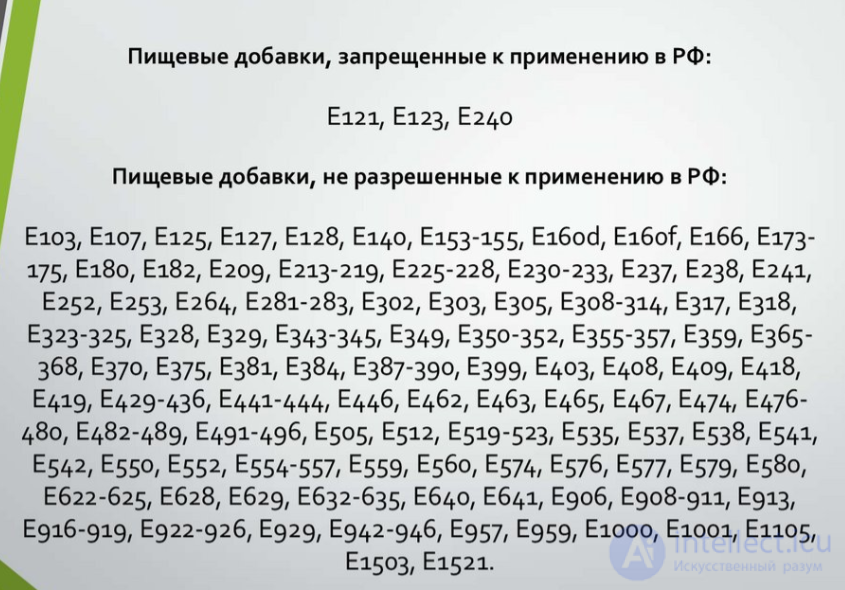
Food additives are an integral part of the modern food industry. Their use makes it possible to preserve products, improve their properties and make them more appealing to consumers. However, it is important to pay close attention to the composition of products, especially if you or your loved ones are prone to allergies or have chronic illnesses. Rational consumption and moderation are the key to the safe consumption of products containing additives.

Comments