
Lecture
In cooking, a leavening agent ( / ˈ l ɛ v ən ɪ ŋ / ) or raising agent, also called a leaven ( / ˈ l ɛ v ən / ) or leavener, is any of a number of substances used in doughs and batters that cause foaming (gas bubbles), which makes the mixture lighter and softer. An alternative or complement to leavening agents is mechanical action, by which air is incorporated into the mixture (i.e. kneading). Leavening agents can be biological or synthetic chemical compounds. The gas produced is often carbon dioxide, and sometimes hydrogen.
When a dough or batter is mixed, the starch in the flour and the water in the dough form a matrix (often further supported by proteins such as gluten, or polysaccharides such as pentosans or xanthan gum). The starch then gelatinizes and sets, leaving gas bubbles behind.
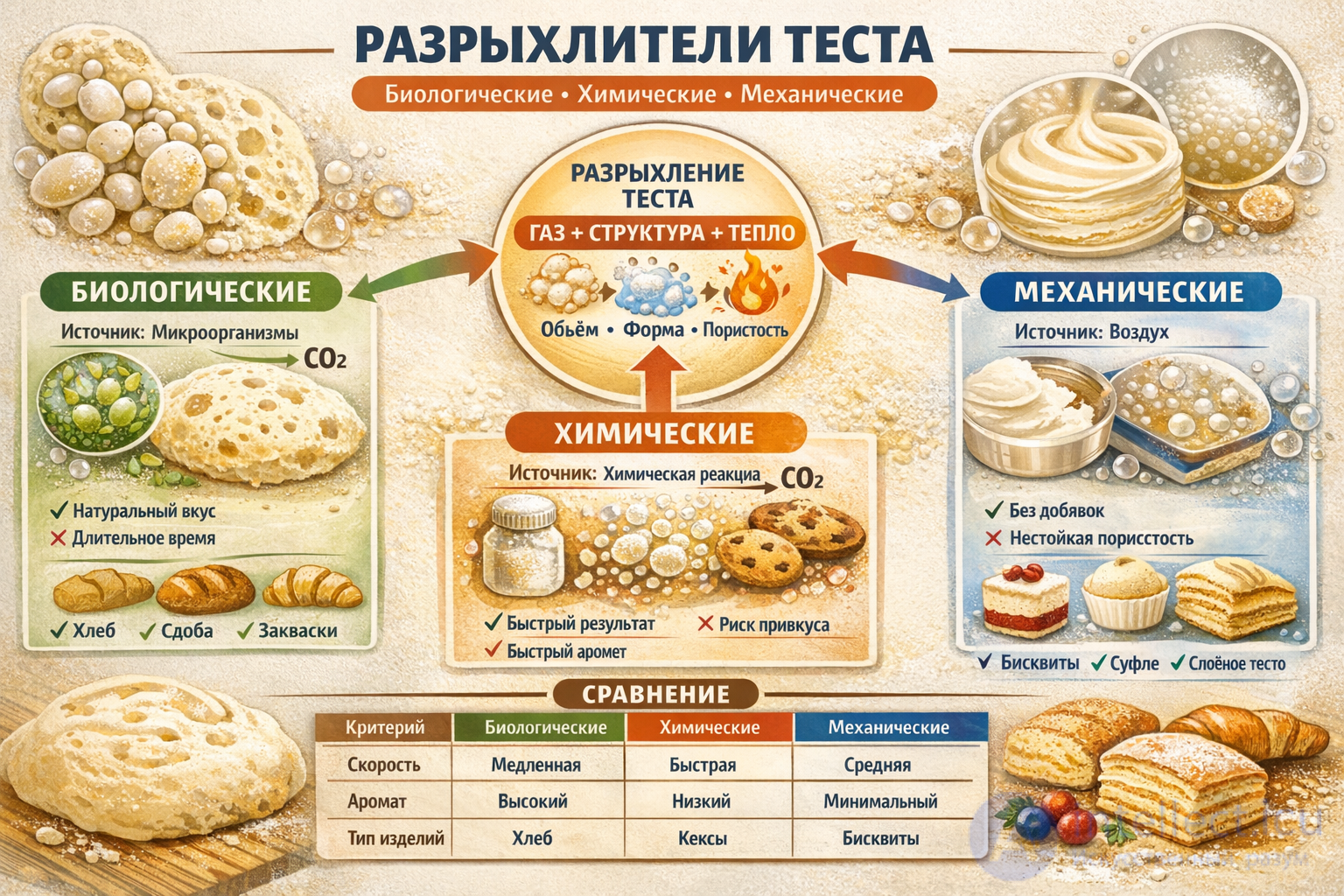
The leavening of dough is a key technological process in the baking and confectionery industries, determining the structure, volume, texture, and organoleptic properties of the finished products. This article examines the main types of dough leavening — biological, chemical, and mechanical. The mechanisms of action of each method, their physicochemical nature, advantages, limitations, and areas of practical application are analyzed.
Biological leavening is based on the activity of microorganisms, primarily yeast (Saccharomyces cerevisiae), as well as lactic acid bacteria. During the fermentation of sugars, carbon dioxide (CO₂) is released, which is retained by the gluten framework of the dough and forms its porous structure.
The main reaction of alcoholic fermentation can be represented as follows:
C₆H₁₂O₆ → 2C₂H₅OH + 2CO₂ + energy
The CO₂ released stretches the dough, while the ethanol mostly evaporates during baking.
Advantages:
improved flavor and aroma of the products;
formation of an elastic and uniform porosity;
increased nutritional value due to fermentation products.
Disadvantages:
the long duration of the technological process;
sensitivity to temperature, humidity, and acidity of the environment.
In direct leavening, purified yeast is added to the dough. Baker's yeast is usually used, which ferments very rapidly.
A sourdough starter is made from a mixture of flour and water that is fermented at room temperature, usually over the course of a week or more, using the natural yeasts and acid-forming bacteria that live on wheat and in the surrounding environment. Once formed, the starter is maintained by periodically «feeding» it with flour and water, and part of the starter is added as needed to the dough to raise the bread.
A French sponge (also known as a poolish) is a preferment made using baker's yeast and flour, fermented for 2–8 hours.
An Italian sponge (also known as a biga) is made using baker's yeast and is left to rest for 12 hours, which results in a more pronounced alcoholic smell in the dough and can promote the formation of larger pores in the finished crumb.
In the case of old dough, it is first allowed to rise, and then a portion is set aside and stored for the next loaf. For short-term storage it is kept in a bowl, and for a longer period – in the refrigerator.
Chemical leavening agents are substances that release carbon dioxide when they interact with moisture and/or when heated. These include baking soda (sodium bicarbonate), baking powders, and their combinations.
An example of a leavening reaction using soda and acid:
NaHCO₃ + H⁺ → Na⁺ + CO₂↑ + H₂O
In baking powders, the acid and base are balanced, which makes it possible to control the rate and completeness of gas formation.
Advantages:
speed of the process;
independence from biological factors;
consistency of the result.
Disadvantages:
the absence of fermentation-derived aromatic compounds;
the risk of an off-flavor if the dosage is incorrect.
Chemical leavening agents are mixtures or compounds that release gases when they react with each other, with moisture, or with heat. Most of them are based on a combination of an acid (usually a low-molecular-weight organic acid) and a bicarbonate salt (HCO₃⁻). After the reaction, these compounds leave behind a chemical salt. Chemical leavening agents are used in quick breads and cakes, as well as cookies and in many other applications where lengthy biological fermentation is impractical or undesirable.
A chemical leavening agent using pearl ash as a raising agent was mentioned by Amelia Simmons in her book «American Cookery», published in 1796.
Because creating a functional chemical leavening agent without off-flavors from the chemical precursors used requires chemical expertise, such substances are often mixed in pre-measured combinations to achieve the best results. These are commonly called baking powders. Sour milk and carbonates were used in the 1800s. A breakthrough in chemical leavening agents came in the 1930s with the appearance of monocalcium phosphates (Ca(H₂PO₄)₂). Other leavening agents that were developed include sodium aluminum sulfate (NaAl(SO₄)₂ · 12H₂O), disodium pyrophosphate (Na₂H₂P₂O₇), and sodium aluminum phosphates (NaH₁₄Al₃(PO₄)₈ · 4H₂O and Na₃H₁₅Al₂(PO₄)₈). These compounds combine with sodium bicarbonate to produce carbon dioxide in a predictable manner.
Disodium dihydrogen pyrophosphate is an inorganic compound, the acid salt of the alkali metal sodium and pyrophosphoric acid with the formula Na2H2P2O7; it forms colorless crystals that are soluble in water and forms a crystalline hydrate.
Disodium dihydrogen pyrophosphate is widely used in various branches of industry:
Mechanical leavening is based on the physical saturation of the dough with air during intensive mixing, whipping, or rolling. The air bubbles are fixed in place by the structural components of the dough — proteins and fats.
Mechanical methods include:
whipping eggs and egg mixtures;
creaming fat with sugar;
laminating dough (layered products).
Advantages:
the absence of chemical additives;
control of the dough structure at the mixing stage.
Disadvantages:
the limited stability of the air bubbles;
the need for precise adherence to the technological parameters.
Steam and air are used as leavening agents when they expand upon heating. To take advantage of this method of leavening, baking must be done at sufficiently high temperatures so that the water is instantly converted to steam, and the dough must be able to hold the steam until it sets. This effect is commonly used in products with a single large cavity, such as popovers, Yorkshire puddings, pita, and most choux pastry dishes. To a lesser extent, this effect is also observed in tempura. To make breadcrumbs, the dough is heated by electric current, evenly distributing the steam throughout the dough.
Using a whisk to beat certain liquids, particularly cream or egg whites, also makes it possible to create a foam through mechanical action. It is this method that is used in making sponge cakes, where the egg-white matrix formed during intensive whipping provides almost all of the structure of the finished product.
The Chorleywood bread process uses a combination of biological and mechanical leavening; although food manufacturers [who?] consider it an efficient way to process the soft wheat flour characteristic of agriculture in the British Isles, it is controversial [according to whom?] because of the perceived low quality of the final product. Nevertheless, this process has been adopted by industrial bakers in other parts of the world.
| Criterion | Biological | Chemical | Physical |
|---|---|---|---|
| Source of gas | Fermentation | Chemical reaction | Air |
| Speed of the process | Low | High | Medium |
| Effect on flavor | Significant | Minor | Minimal |
| Area of application | Bread, rich pastries | Cupcakes, cookies | Sponge cakes, puff pastry |
The leavening of dough is a multifactorial process that determines the quality of flour-based products. Biological, chemical, and mechanical methods of leavening have different natures and technological purposes. The choice of a particular method or their combination depends on the type of product, the requirements for structure, flavor, and production timeframes. Modern technologies often use an integrated approach that makes it possible to optimize the properties of the dough and improve the consistency of the quality of the finished products.

Comments