
Lecture
2.1 General characteristics of proteins
Proteins are high-molecular-weight compounds consisting of residues of
α-amino acids linked by peptide bonds. The number of α-amino acid
molecule residues in a single protein molecule can reach several thousand. The
composition of proteins can include 20 types of α-amino acids.

A peptide bond is a bond formed between the carboxyl
groups and the amino groups of amino acid molecules.
When 1 gram of protein is assimilated, 4 kcal or 16.74 kJ of energy is released. For
an adult, 1–1.2 g of protein per day per 1 kg of body weight is sufficient, i.e. on
average approximately 70–90 g. For children the protein requirement is significantly higher: up to
1 year – more than 4 g of protein per 1 kg of body weight, for 2–3-year-olds – 4 g, for 3–5-year-olds –
3.8 g, for 5–7-year-olds – 3.5 g. The increased protein requirement in children is explained
by the fact that synthesis processes predominate in the growing organism, and dietary protein
is needed not only to maintain nitrogen balance but also to ensure
the formation and growth of the body. The recommended protein content in the human diet
in terms of caloric value amounts to 11–12 %. Proteins of animal origin
should account for 55 %, and proteins of plant origin 45 % of the daily
requirement. Proteins make up approximately 20 % of the human body mass and
more than 50 % of the dry mass of a cell.
In human tissues proteins are not stored (not accumulated), therefore
their daily intake with food is necessary. Without a sufficient amount of
proteins, the vitamins and minerals needed
for metabolic processes cannot be utilized.
2.2 Structure of the protein molecule
A distinction is made between the primary, secondary, tertiary, and quaternary structures
of protein molecules.
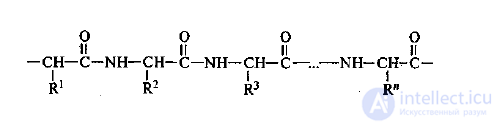
1. The primary structure of a protein molecule represents the joining
of amino acids into a simple linear chain by means of peptide bonds only. The
primary structure of a protein is understood to mean the type, number, and sequence
of amino acid residues in the polypeptide chain.
2. The secondary structure of a protein molecule represents the
spatial arrangement of the polypeptide chain in the form of an α-helix or
β-pleated structure (figure 1). The structure is held together by
the formation of hydrogen bonds between individual regions of the protein
molecule.
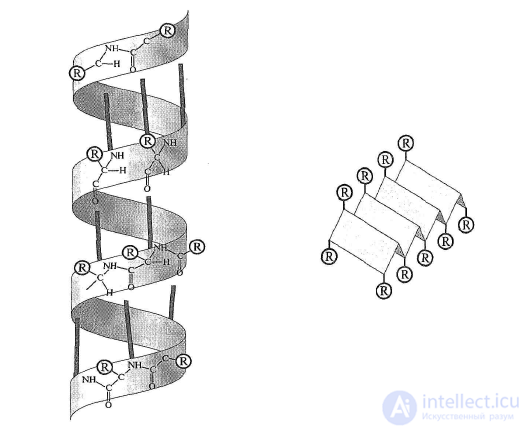
Figure 1 – Diagram of the secondary structure of a protein molecule
(helical and pleated)
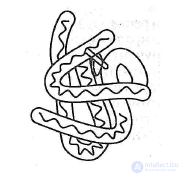
3. The tertiary structure of a protein molecule represents the
specific spatial folding of the α-helix in the form of globules (spheres)
(figure 2) or fibrils (filaments).
Figure 2 – Diagram of the tertiary structure of a protein molecule (globule)
The maintenance of the characteristic spatial tertiary structure of the protein
molecule is achieved through the interaction of the side radicals of amino acids
with one another, forming bonds: hydrogen, disulfide,
electrostatic, and hydrophobic.
4. The quaternary structure of a protein molecule represents the
joining of several separate protein subunits into a single enlarged
structure possessing new properties not characteristic of the individual
subunits (figure 3). The subunits are held together by the formation of
hydrogen bonds, ionic bonds, van der Waals interactions, and
electrostatic interactions of oppositely charged groups of molecules.
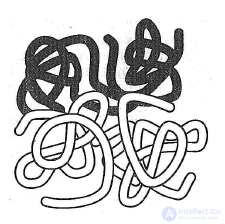
Figure 3 – Diagram of the quaternary structure of a protein molecule
2.3 Classification of proteins
Classification by molecular shape. By the shape of their molecules, a distinction is made between:
- globular proteins – spherical proteins (enzymes, antibodies, many
hormones, myoglobin, hemoglobin, serum albumin), which dissolve well in
water;
- fibrillar proteins – filamentous proteins (proteins of hair, nails, tendons,
ligaments), which are insoluble in water.
Classification by structure and composition. By the structure and composition of the
protein molecule, proteins are divided into two groups (figure 4):
- simple proteins (proteins) – consist only of α-amino acid residues;
- complex proteins (proteids) – contain, in addition to α-amino acid residues,
substances of a non-protein nature.
Complex proteins are subdivided into the following groups:
- lipoproteids – contain lipids in addition to protein;
- glycoproteids – consist of protein and high-molecular-weight carbohydrates;
- chromoproteids – contain, in addition to protein, coloring substances - pigments;
including metals in their composition, for example hemoglobin contains iron;
- nucleoproteids – consist of protein and nucleic acids;
- phosphoproteids – contain phosphoric acid in addition to protein.
Classification by solubility. By solubility, four
types of proteins are distinguished (figure 5):
- albumins – water-soluble proteins;
- globulins – salt-soluble proteins, dissolving in a 5–10 % solution
of sodium chloride;
- glutelins – alkali-soluble proteins, dissolving in a 0.1–0.2 % solution
of sodium hydroxide;
- prolamins – alcohol-soluble proteins, dissolving in a 60–80 % solution
of ethyl alcohol.
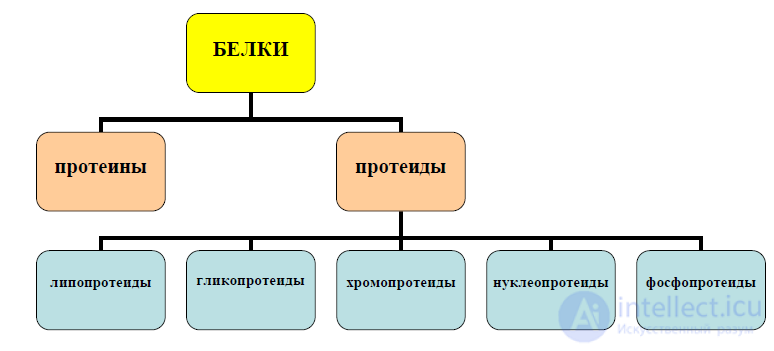
Figure 4 – Classification of proteins by structure and composition
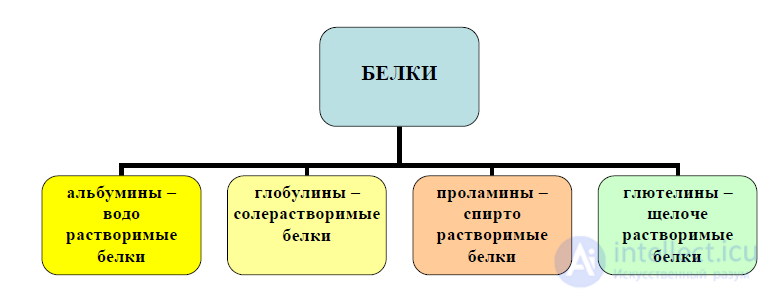
Figure 5 – Classification of proteins by solubility
Classification by functions in the organism. By their functions in the organism, proteins
can be divided into four groups (figure 6):
- structural proteins – are part of the cells, tissues, and organs of the organism;
- enzymes – biocatalysts (accelerators) of biochemical processes;
- hormones – fine regulators of metabolic processes;
- nucleoproteids – regulate protein synthesis in the organism and are
carriers of hereditary information.
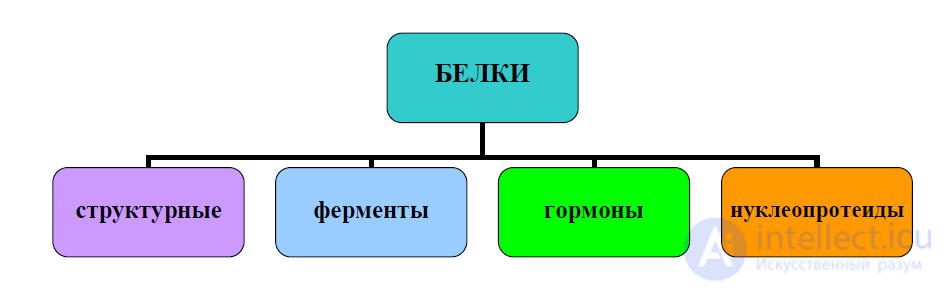
Figure 6 – Classification of proteins by functions in the organism
Classification by origin. By origin, protein substances
are:
- plant proteins – proteins of grain crops, vegetables, etc.;
- animal proteins – proteins of meat, milk, eggs, etc.
2.4 Essential amino acids
The total number of amino acids occurring in nature reaches 200.
Among them a distinction is made between:
- amino acids that are part of proteins (proteinogenic); there are
20 of them;
- amino acids that are not part of proteins (non-proteinogenic).
Proteinogenic amino acids are divided into:
- non-essential (nonessential) – synthesized in the human organism; they
are able to replace one another in the diet, since they convert into each other;
- essential – they are synthesized only by plants and are not
synthesized in the human organism; they must be supplied with food.
The biological value of proteins is determined by the balance of the
amino acid composition in terms of the content of essential amino acids. This group
includes amino acids that are not synthesized in the human organism. The
essential amino acids include: valine, leucine, isoleucine,
phenylalanine, lysine, threonine, methionine, tryptophan. The amino acids arginine and
histidine are essential for the child's organism, and for the adult
organism they are semi-essential.
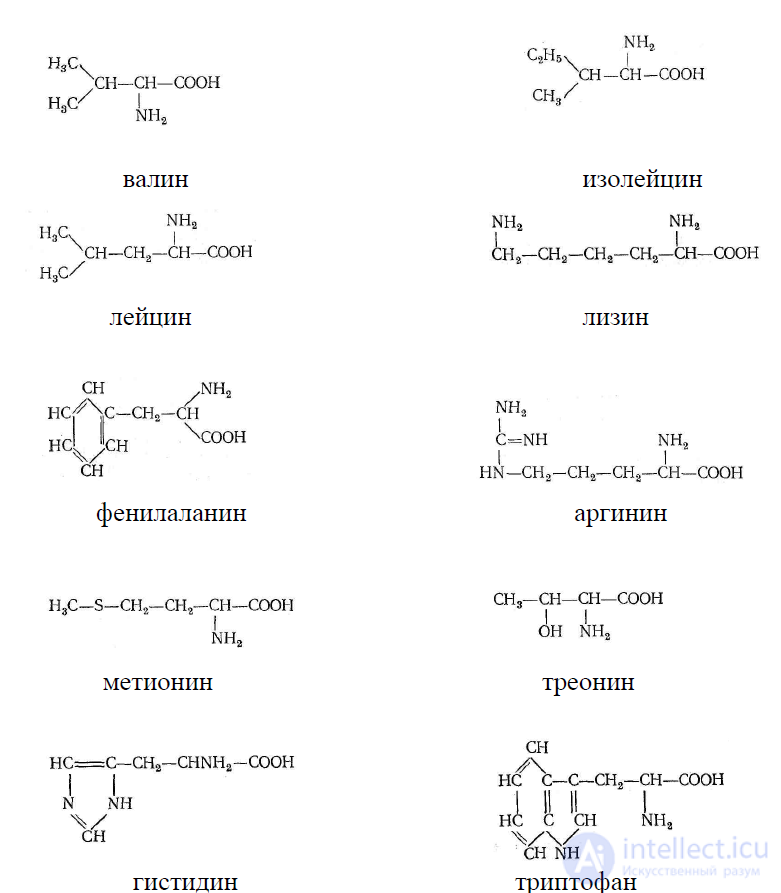
valine isoleucine
leucine lysine
phenylalanine arginine
methionine threonine
histidine tryptophan
2.5 Functions and applications of amino acids
Amino acids are heterofunctional compounds containing two different
functional groups (an amino group and a carboxyl group). This feature
of structure and composition endows them with a number of functions.
1. Structural function – amino acids are the structural
elements of proteins.
2. Mediator function – amino acids regulate the passage of nerve
impulses from cell to cell.
3. Buffer function – amino acids are amphoteric compounds,
i.e. depending on the conditions they exhibit properties of both bases and acids. Owing
to their amphoterism they are able to create and maintain a certain pH value,
which is important for maintaining the pH value of the blood and tissue fluids.
4. Radioprotective function - an amino acid called cysteine
increases the organism's resistance to the negative effects of radiation.
5. Formation of melanoidins. Amino acids, along with proteins, when
heated interact with reducing substances (for example,
reducing carbohydrates) without the participation of enzymes. Nitrogen-containing
brown pigments called melanoidins are formed.
This interaction is called the melanoidin-formation reaction (the
non-enzymatic browning reaction). These substances are formed during the baking of bread,
the roasting of coffee beans, and boiling.
6. Formation of melanins. An amino acid called tyrosine, under
the action of the enzyme tyrosinase, is converted into brown pigments
called melanins (the enzymatic browning reaction). They
determine the coloring of hair, skin, and the iris of the eyes, the dark color of rye
bread, and the darkening of peeled potatoes.
tyrosinase
tyrosine → melanins
7. Medicinal preparations. The amino acid glycine is a medicinal
preparation. It is used to improve mental performance, in
stressful situations and sleep disorders, and in various diseases of the nervous system
(neurosis, vegetative-vascular dystonia, traumatic brain injury, ischemic
stroke, encephalopathy, including of alcoholic origin).
8. Food additives. The salt of glutamic acid – monosodium glutamate –
is a food additive of the flavor and aroma enhancer class. These substances enhance
the natural flavor and aroma of a product, and also restore these properties,
weakened during the storage of the product or during culinary processing. They are added
to food at a stage of the technological process or directly into the food before its
consumption.
2.6 Physiological functions of proteins
In the human organism proteins perform a whole range of diverse functions.
1. Structural function – proteins are part of the nucleus, protoplasm, and
membranes of the cells of all organs and tissues.
2. Energy function – upon the oxidation of 1 g of protein, 4 kcal or
16.74 kJ of energy is released.
3. Protective function – the antibodies formed when foreign substances enter the
organism are proteins.
4. Antitoxic function – proteins form with toxins low-activity
complexes that are excreted from the organism.
5. Function of reproduction of living matter – proteins participate in the processes
of reproduction of living matter, being part of nucleoproteids.
6. Supporting function – proteins are part of bones, cartilage, and tendons.
7. Contractile function – proteins ensure the contraction of muscles.
8. Catalytic function – enzymes – are biocatalysts of a protein
nature.
9. Transport function – some blood plasma proteins ensure
the transfer of nutrients.
10. Regulatory function – many hormones and their derivatives are
proteins.
11. Function of excitation and inhibition – dietary proteins have an effect on
the processes of excitation and inhibition in the cerebral cortex.
12. Blood clotting function – the process of blood clotting, which
proceeds with the participation of plasma proteins, prevents large blood losses.
2.7 Nitrogen balance
To study the organism's requirement for proteins, the nitrogen balance is measured.
The nitrogen balance is the difference between the nitrogen of protein that has entered the organism and
the nitrogen of protein breakdown products excreted from the organism.
In a healthy adult with a complete diet,
nitrogen equilibrium is observed, i.e. the amount of nitrogen from the consumed proteins is equal
to the amount of nitrogen excreted from the organism.
In a young growing organism, plastic processes predominate, muscle mass
accumulates, and hormones, enzymes, and other compounds are formed.
As a result, a positive nitrogen balance is observed, i.e. less nitrogen is excreted from the
organism than enters with food. A positive
nitrogen balance is likewise observed in the organism of a pregnant woman.
With a deficiency of proteins in the diet, as well as in elderly and old people,
the nitrogen balance becomes negative. A negative nitrogen balance
also develops with a deficiency of any essential nutrient (amino acids,
vitamins, minerals), i.e. with an unbalanced diet. With
impaired digestibility of food due to certain diseases, the nitrogen balance
is likewise negative. A prolonged negative nitrogen balance inevitably
leads to a lethal outcome.
2.8 Amino acid score
The absence in food of one or several essential amino acids
leads to disruption of the activity of the central nervous system, incomplete
assimilation of other amino acids, and halts the growth and development of the organism.
The biological value of proteins is calculated using the amino acid score.
The amino acid score is expressed as a percentage representing the
ratio of the content of an essential amino acid in 1 g of the protein under study to its
amount in 1 g of the reference protein.

The amino acid composition of the reference protein is balanced and ideally
corresponds to human requirements for each essential amino acid
(table 2).
Table 2 – Composition of the ideal protein according to the FAO/WHO scale
Table 2 – Composition of the ideal protein according to the FAO/WHO scale
Name of amino acid Content of amino acid in
the ideal protein, mg/1 g of protein
valine 50
leucine 70
isoleucine 40
lysine 55
methionine and cysteine 35
threonine 40
tryptophan 10
phenylalanine and tyrosine 60
Essential amino acids whose score is less than 100 % are considered
limiting, since they limit the biological value of the protein.
The limiting amino acid whose score has the lowest value
is called the first limiting amino acid. The essential amino acid
whose relative amount in a given protein is greater than that of the first
limiting one but less than that of the others is called the second limiting
amino acid. Then comes the third limiting amino acid, and so on. In wheat
protein the first limiting amino acid is lysine, in corn –
methionine, in potatoes and legume crops the limiting ones are methionine and
cysteine.
2.9 Transformations of proteins during technological processing
Denaturation. This is the process of a change in the native spatial structure
of a protein under the influence of external factors: high and low temperatures,
mechanical action, chemical action, physical action, etc.
During denaturation, the quaternary, tertiary, and secondary structures
of the protein are sequentially destroyed, but the primary structure is preserved and the chemical
composition of the protein does not change (figure 7). During denaturation the physical properties of the protein change:
solubility and water-binding capacity decrease, and the biological
activity of the protein is lost. At the same time the activity of certain chemical
groups increases, and the enzymatic hydrolysis of the protein is facilitated. Denatured proteins
are usually less soluble in water, since their polypeptide chains are so strongly
intertwined with one another that access of solvent molecules to the radicals of
amino acid residues is hindered. The process of denaturation is in most cases irreversible.
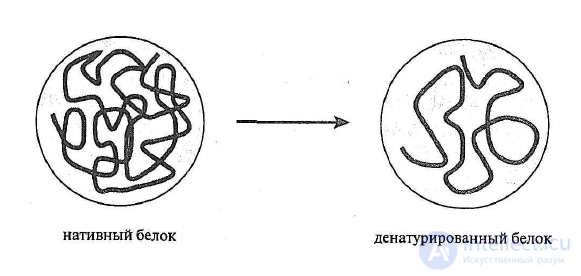
Figure 7 – Diagram of the denaturation of a protein molecule
Thermal denaturation of protein already proceeds at a temperature of 60 °C.
Thermal denaturation of proteins is one of the main physicochemical
processes underlying the baking of bread, cookies, sponge cakes, pastries, rusks,
the drying of pasta products, the production of extrudates and dry breakfast cereals, boiling, the frying
of vegetables, fish, and meat, canning, and the pasteurization and sterilization of milk. This type
of transformation is among the beneficial ones, since it accelerates the digestion of proteins in
the human gastrointestinal tract (facilitating access to them for proteolytic
enzymes) and determines the consumer properties of food products (texture,
appearance, organoleptic properties).
Melanoidin formation (the Maillard reaction). When the amino
groups of proteins and amino acids interact with the carbonyl groups of carbohydrates,
the melanoidin-formation reaction occurs. This is an oxidation-
reduction process of the formation of various intermediate products
(furfural, hydroxymethylfurfural, acetaldehyde, isovaleraldehyde,
diacetyl), which at subsequent stages interact with one another and with
the starting substances. The final products of the reaction – melanoidins – have a
brown color and affect the color and taste of the finished products. The scheme of the
melanoidin-formation reaction is as follows:
reducing carbohydrate + amino acid →
glucosamine → melanoidins
The melanoidin-formation reaction occurs during the drying of malt, during the
boiling of wort with hops in beer production, during the baking of bread, during the boiling
of sugar syrups, and during the processing of vegetables and fruits. The rate and depth of the
melanoidin-formation reaction depend on the composition of the product, the pH level of the medium (a
neutral and slightly alkaline medium are more favorable), the temperature, and the moisture content. The
carrying out of the melanoidin-formation reaction consumes valuable nutritional
and biologically active substances (proteins, vitamins, amino acids, carbohydrates),
the activity of vitamins and enzymes decreases, which on the whole leads to a decrease in the
nutritional, energy, and biological value of the products.
Enzymatic hydrolysis of proteins. The hydrolysis of proteins is carried out by
proteolytic enzymes, which break the peptide bond. The great diversity of
proteolytic enzymes is related to the specificity of their action on protein.
The point of application or action of a proteolytic enzyme is related to the
structure of the radicals located next to the peptide bond. Pepsin cleaves
the bond between phenylalanine and tyrosine, glutamic acid and cysteine
(methionine, glycine), and between valine and leucine. Trypsin cleaves the bond
between arginine and other amino acids, and chymotrypsin – between
aromatic amino acids (tryptophan, tyrosine, phenylalanine) and
methionine. Aminopeptidases act from the side of the N-terminal amino acid,
carboxypeptidases from the side of the C-terminal amino acid. Endopeptidases
break internal peptide bonds, and exopeptidases – act from the end of the
molecule. For the complete hydrolysis of a protein molecule, a set of various
proteolytic enzymes is required.
The hydrolysis of protein under the action of endopeptidases and exopeptidases can be
represented in the form of a scheme:
protein → albumoses → peptones → polypeptides →
oligopeptides → dipeptides → α-amino acids
Review questions
1. What are proteins? Give a general characterization of proteins.
2. What is the energy value of proteins?
3. State the daily requirement of the human organism for proteins.
4. Characterize the spatial structures of proteins: primary,
secondary, tertiary, quaternary.
5. What are the nature and role of chemical bonds in the organization of the spatial
structure of proteins?
6. What are the distinguishing features of the secondary structure of a protein in the form of
a helix and a pleated sheet?
7. What are the distinguishing features of the tertiary structure of a protein in the form of
a globule and a fibril?
8. What underlies the classifications of proteins? What classifications of proteins
are known to you?
9. Into what groups are proteins divided by origin? Give examples.
10. Into what groups are proteins divided by molecular shape? Give examples.
11. Into what groups are proteins divided by structure and composition? Give
examples.
12. Characterize simple proteins.
13. Which proteins belong to the complex ones? Give examples of complex proteins.
14. Into what groups are proteins divided by solubility? Give examples.
15. Into what groups are proteins divided by functions in the organism? Give
examples.
16. Characterize structural proteins.
17. Characterize hormones.
18. Characterize enzymes.
19. Characterize nucleoproteids.
20. What are proteinogenic amino acids?
21. Which amino acids are called essential? List them.
22. List the functions and areas of application of amino acids.
23. Formulate the physiological functions of proteins.
24. What is nitrogen balance? List the types of nitrogen balance.
25. What is the amino acid score?
26. What is a limiting amino acid? What is the first limiting
amino acid?
27. What is protein denaturation? What factors cause the denaturation
of proteins?
28. Explain what the Maillard reaction is. What significance does it have in the production
of food products?
29. Describe the process of enzymatic hydrolysis of protein.
30. List the intermediate products of protein hydrolysis.
31. What are the enzymes that accelerate protein hydrolysis called?

Comments