
Lecture
Key principles of weight-loss diets: reducing caloric intake, balancing nutrients, gradual change, and an individual approach. Types of diets differ in mechanism — from restricting carbohydrates to controlling fats or alternating fasting and feeding phases. Their essence — to create an energy deficit without harming health.
Caloric deficit — the body must receive less energy than it expends. This usually means a reduction of 300–500 kcal per day. For example, a man could consume 1500 kcal per day instead of 2000, and so on.
Monitoring — weighing yourself daily and keeping a log, either through an app or on paper.
Balance — even when restricting calories, it is important to maintain sufficient amounts of proteins, fats, and carbohydrates.
Gradual change — a sharp reduction in calories or the elimination of entire food groups leads to stress and a risk of relapse.
Individuality — the choice of diet depends on health status, activity level, age, and goals.
Sustainability — a diet should be feasible over the long term, not just «for a month».
| Type of diet | Essence | Pros | Cons |
|---|---|---|---|
| Low-carb (keto, Atkins) |
Restricting carbohydrates, emphasis on proteins and fats, instead of calories from carbohydrates, they are obtained from fats the total must not exceed the daily norm |
Rapid weight loss, appetite control | Risk of fiber deficiency, strain on the liver |
| Mediterranean | Vegetables, fish, olive oil, whole foods | Improves heart health, suitable for long-term nutrition | Slow rate of weight loss |
| Intermittent fasting (16/8, 5:2) | Alternating periods of eating and fasting | Convenient schedule, improved metabolism | Can be psychologically difficult |
| Protein-based (Dukan, protein diet) | Main emphasis on meat, fish, eggs | Muscle preservation, rapid weight loss | Kidney overload, vitamin deficiency |
| Low-fat | Restricting fats, emphasis on carbohydrates and proteins | Lowering cholesterol | Often causes hunger |
| Mono-diets (buckwheat, apple) | A single food in the diet | Fast results | Unhealthy imbalance, risk of relapse |
The main goal — to create a safe caloric deficit.
The essence — not in strict prohibitions, but in forming habits: portion control, choosing healthy foods, regular meals.
Effectiveness — any diet works if it reduces caloric intake and suits the person's lifestyle.
A protein diet — is an eating regimen in which the main focus is on protein-rich foods, with a significant restriction of carbohydrates and fats. It is aimed at weight loss and the preservation of muscle mass.
Main principle: increasing the proportion of protein in the diet (meat, fish, eggs, dairy products), while reducing carbohydrates (bread, grains, sweets) and, in part, fats.
Goal: to prompt the body to use fat reserves as a source of energy, while preserving muscle.
Mechanism: when carbohydrates are lacking, the process of ketosis begins — the body starts breaking down fats to obtain energy.

Rapid weight loss due to reduced carbohydrates and the active expenditure of fat reserves.
Preservation of muscle mass thanks to the high protein content.
Reduced appetite — protein takes longer to digest, creating a feeling of fullness.
Suitable for athletes for «cutting» and building muscle definition.
Deficiency of vitamins and fiber due to the restriction of vegetables, fruits, and grains.
Increased strain on the kidneys and liver with prolonged consumption of large amounts of protein.
Possible gastrointestinal problems (constipation, discomfort).
Short-term effect — after coming off the diet, weight may return if nutritional balance is not maintained.
Meat (chicken, turkey, beef)
Fish and seafood
Eggs
Cottage cheese, yogurt, cheese (low-fat)
Low-carbohydrate vegetables (cucumbers, cabbage, lettuce)
Bread, pasta, grains
Potatoes, corn
Sweets, sugar
Alcohol
| Diet | Main principle | Advantages | Drawbacks |
|---|---|---|---|
| Protein-based | High protein, low carbohydrates | Rapid weight loss, muscles preserved | Vitamin deficiency, strain on the kidneys |
| Keto | Minimal carbohydrates, lots of fats | Strong weight-loss effect | Difficult to follow, risk of ketosis |
| Mediterranean | Balance of proteins, fats, carbohydrates | Healthy heart, longevity | Slow results in terms of weight |
Thus, the essence of the protein diet lies in replacing carbohydrates with proteins, forcing the body to expend fats for energy while preserving muscle mass. It is effective for short-term weight loss, but requires caution and a well-managed exit from the regimen.
Short-term options: 3–7 days — used to «jump-start» the metabolism or for express weight loss.
Medium-term programs: 14 days — the optimal period for noticeable weight loss without serious health risk.
Maximum duration: 21 days — the upper limit, after which the diet should be ended and a more balanced diet adopted.
| Duration | Goal | Risks |
|---|---|---|
| 3–7 days | Rapid weight loss, preparing the body | Minimal, but weakness is possible |
| 14 days | Optimal weight loss, muscle preservation | Deficiency of fiber and vitamins |
| 21 days | Maximum result | Kidney overload, risk of ketosis |
Gradual introduction of carbohydrates: start with vegetables, fruits, and porridges cooked in water (buckwheat, oatmeal).
Adding complex carbohydrates: after 3–5 days, include whole-grain bread, brown rice, durum-wheat pasta.
Reducing protein: cut back on the amount of meat and fish, keeping them in the diet but not as its foundation.
Increasing fiber: more vegetables, greens, and fruits to normalize intestinal function.
Controlling fats: add healthy fats — olive oil, nuts, avocado.
Fractional meals: eat 4–5 times a day in small portions to avoid overeating.
Table for transitioning from the protein diet to a full-fledged diet
| Stage | Foods | Goal |
|---|---|---|
| Days 1–3 | Vegetables, fruits, porridges cooked in water | Gentle introduction of carbohydrates |
| Days 4–7 | Whole-grain bread, brown rice, pasta | Energy balance |
| Days 8–14 | Healthy fats, dairy products | Restoration of the microflora |
| After day 14 | Balanced nutrition (proteins, fats, carbs) | Maintaining weight |
Abrupt introduction of sweets → sugar spikes and rapid weight gain.
Complete elimination of protein → loss of muscle mass.
Lack of fiber → digestive problems.
Drink enough water (1.5–2 L per day).
Add foods gradually, every 2–3 days.
Monitor how you feel: weakness or sharp weight fluctuations — a signal to slow down the transition.
After coming off the diet, follow the principle of balanced nutrition: proteins, fats, and carbohydrates in reasonable proportions.
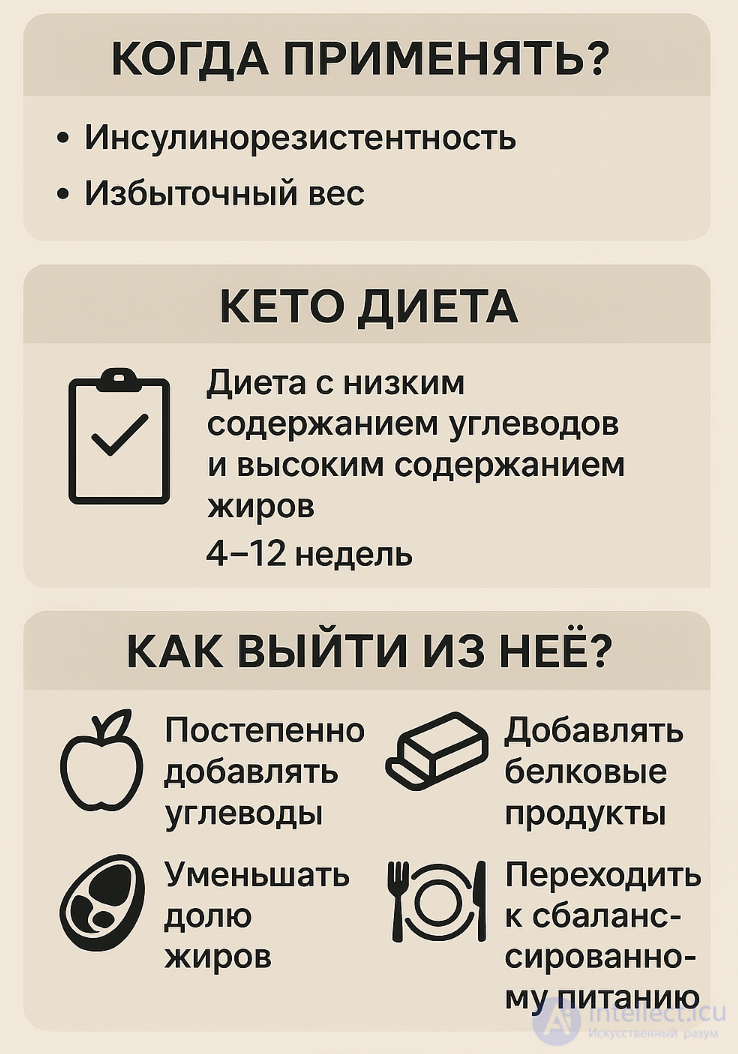
The keto diet — is an eating regimen low in carbohydrates and high in fats, in which the body enters a state of ketosis, using fats instead of glucose as its main source of energy.
An excess intake of glucose from sugar is generally considered more harmful to the body than the use of ketones from fats, since an excess of sugar is directly linked to obesity, type 2 diabetes, and inflammatory processes. However, long-term nutrition on ketones alone also carries risks — disruptions in the lipid profile, vitamin deficiency, and strain on the heart.
Thus, instead of calories from carbohydrates or proteins, they are obtained from fats, and the total must not exceed the daily norm.
How it works: restricting carbohydrates (usually to 20–50 g per day) forces the body to seek an alternative source of energy. In the liver, ketone bodies are formed from fats and become the main «fuel» for the brain and muscles.
Composition of the diet:
Fats: 70–80% of calories (avocado, nuts, oils, fish, meat).
Proteins: 15–20% (eggs, meat, dairy products).
Carbohydrates: 5–10% (low-starch vegetables, greens).
History: The keto diet was originally developed in the 1920s to treat drug-resistant epilepsy in children. Later it began to be used for weight loss and improving metabolism.
Ketosis — is a physiological state, whereas ketoacidosis — is already a pathological state in which the level of ketone bodies in the blood is so high that the body's acid-base balance shifts toward the acidic side. If the development of ketoacidosis is not stopped in time, death may occur.
In a state of ketosis, exactly as many ketone bodies are formed as the body needs to obtain energy, and all of them undergo further breakdown. In a state of ketoacidosis, ketone bodies become excessive, and the body works intensively to eliminate the surplus of ketone bodies through urine, the skin, and the lungs.
The mechanism by which ketosis develops during fasting consists of the breakdown of fats with the release of fatty acids and the subsequent synthesis of ketone bodies. Prolonged fasting can lead to the transition of ketosis into ketoacidosis and to intoxication of the body. The harm of prolonged abstinence from food also lies in the fact that, in order to use ketone bodies as energy, a small amount of glucose is still required. The body synthesizes it in the liver from amino acids formed as a result of protein breakdown. This is why people who fast in order to lose weight often lose muscle mass instead of fat.
Low-carbohydrate diets are built on the following principle: consuming protein provides the substrate for the synthesis of glucose, which is used in the metabolism of ketone bodies formed from broken-down fat. The body loses fat without losing muscle mass. But the rate of glucose formation is lower than the rate of ketone body formation, so they do not manage to be absorbed and ketosis develops.
Low-carbohydrate diets are dangerous for people with latent metabolic disorders that do not manifest under a normal eating regimen. They may develop metabolic acidosis in a severe form.
Positive:
Rapid weight loss due to using fats as fuel.
Stabilization of blood sugar levels.
Possible improvement in brain and cardiovascular function.
Use in medicine: for epilepsy and certain oncological diseases.
Risks and limitations:
Deficiency of vitamins and minerals due to the exclusion of many foods.
«Keto flu» — temporary side effects (weakness, headache, nausea) when transitioning into ketosis.
Possible gastrointestinal and liver problems with prolonged adherence.
Contraindicated for people with kidney or liver diseases and certain metabolic disorders.
| Criterion | Regular diet | Keto diet |
|---|---|---|
| Main source of energy | Carbohydrates (glucose) | Fats (ketone bodies) |
| Proportion of carbohydrates | 45–60% | 5–10% |
| Proportion of fats | 20–35% | 70–80% |
| Purpose of use | Maintaining balance | Treating epilepsy, weight loss, metabolism |
| Risks | Overeating, obesity | Nutrient deficiency, strain on the liver |
Thus, the essence of the keto diet lies in the metabolic switching of the body to using fats as its main source of energy, which can bring both benefits and risks depending on health status and duration of use.
Pros:
Ketones — an alternative source of energy, especially for the brain when glucose levels are low.
The keto diet can improve insulin sensitivity and help with weight loss.
Some people experience improved concentration and stable energy levels.
Cons:
Risks of prolonged ketosis: deficiency of vitamins and minerals, gastrointestinal problems, possible worsening of the lipid profile (an increase in «bad» cholesterol).
May overload the heart and liver if approached incorrectly.
Not suitable for people with certain diseases (for example, chronic kidney disease).
Short-term (4–12 weeks): often used for weight loss and improving blood sugar control.
Medium-term (3–6 months): allows results to be consolidated, but requires careful monitoring of well-being.
Long-term (6–12 months and more): possible, but only under the supervision of a doctor or dietitian, since there is a risk of a deficiency of fiber, B vitamins, and minerals.
Nutrient deficiency: restricting fruits, vegetables, and grains can lead to a lack of fiber, vitamins, and minerals.
Gastrointestinal problems: constipation, discomfort due to low fiber intake.
Increased strain on the liver and kidneys: due to processing large amounts of fats and proteins.
Keto flu: temporary symptoms (fatigue, headache, irritability) when transitioning into ketosis.
Social and psychological limitations: strict eating rules can be difficult to follow over the long term.
Stay gradual: do not increase carbohydrates sharply, otherwise sugar spikes and weight gain are possible.
Start with vegetables: add more greens, root vegetables, and legumes.
Move on to complex carbohydrates: whole-grain porridges (oatmeal, buckwheat), legumes, brown rice.
Avoid fast carbohydrates: it is better to introduce sugar, white bread, and sweets later or to minimize them.
Reduce fats gradually: decrease the amount of oil, fatty meat, and «fat bombs».
Monitor how you feel: changes in energy and digestion are possible, adjust your diet according to your sensations
| Strategy | Advantages | Risks |
|---|---|---|
| Gradual addition of vegetables | Easy GI adaptation, more fiber | Slow rise in energy |
| Introducing whole grains | Stable sugar levels, long-term balance | Weight gain possible with overeating |
| Reducing fats | Lower caloric intake, prevention of liver problems | Loss of the feeling of fullness |
| Abrupt exit | Rapid return to the usual diet | Sugar spikes, weight gain, discomfort |
The carbohydrate diet exists and is used. It is based on alternating days with high and low carbohydrate content. Its effectiveness for weight loss is supported by practice and some studies, but the scientific basis is limited, and results depend heavily on the individual characteristics of the body.
Principle: alternating days of high and low carbohydrate consumption.
Goal: to speed up metabolism, prevent a «stall» in weight loss, and maintain energy during workouts.
Mechanism:
On low-carbohydrate days, the body more actively uses fat reserves.
On high-carbohydrate days, glycogen stores are replenished, which helps maintain physical activity and prevents a strong feeling of fatigue.
| Criterion | What is known |
|---|---|
| Feasibility | The diet is possible, but requires strict control of the diet and planning. |
| Effectiveness for weight loss | Weight loss is noted, especially in people for whom other diets have not produced results. |
| Scientific basis | There is data on the benefits of carbohydrate cycling for weight control, but there are few large-scale long-term studies. |
| Pros | Support for energy during workouts, reduced risk of a «plateau» in weight loss, flexibility in eating. |
| Cons | Difficulty of adherence, possible blood sugar spikes, risk of overeating on «high-carbohydrate» days. |
Effectiveness is partially proven: there are positive reviews and individual studies, but this is not the «gold standard» of nutrition.
Not suitable for everyone: it may be unsafe for people with diabetes or carbohydrate metabolism disorders.
Works better in combination with physical activity: especially strength training, where a reserve of glycogen is important.
Requires caloric control: without this, even alternating carbohydrates will not produce results.

Pros:
Glucose — the main source of energy for the brain and muscles.
It is quickly absorbed and provides an instant burst of energy.
Cons:
An excess of sugar leads to obesity, type 2 diabetes, accelerated skin aging, and inflammatory processes.
Sugar is addictive and overloads the pancreas.
High consumption of fructose (often together with glucose) negatively affects the liver.
The carbohydrate diet is possible and can be effective, especially as a tool for athletes or people for whom other diets do not work. However, it requires discipline and medical supervision. Scientific evidence exists, but it is limited, so it should be regarded as a supplementary method rather than a universal solution.
A weight-loss diet — is not a temporary abstinence from food, but a system of nutrition that helps reduce weight and maintain health. The most important thing — to choose a strategy that you can realistically follow for a long time, rather than only for a short-term result.
Sugar is more harmful in the short term, since its excess quickly causes metabolic disorders.
Ketones are less dangerous with moderate use, but a prolonged keto diet without supervision can be unsafe.
Optimal — a balanced diet that includes both carbohydrates (mainly complex ones, not sugar) and healthy fats.
Comparison of the harm of energy substances on various mono-nutrient diets
| Diet | Main risks | When it is especially harmful |
|---|---|---|
| Glucose from sugar | Obesity, type 2 diabetes, inflammation, addiction | With regular overeating of sweets and low physical activity |
| Ketones from fats | Vitamin deficiency, gastrointestinal problems, high cholesterol | With a prolonged strict keto diet without medical supervision |

Comments