
Lecture
A severe illness substantially alters a person's entire social situation of development, limiting their ability to engage in various activities, narrowing their circle of contacts with others, and leading to a change in the place they occupy in life. As a result, there is a decline in volitional activity, a narrowing of the range of interests, listlessness, apathy, and disruptions of goal-directed activity accompanied by reduced work capacity and an impoverishment and depletion of the entire mental makeup.
The psychological consequences of illness are the consequences of the psychological stress that arises in patients upon receiving a serious diagnosis, together with factors linked to the parameters of a post-traumatic state. Being diagnosed with a severe illness (coronary heart disease, bronchial asthma, diabetes mellitus, hepatitis, cancer, etc.) and the experiences associated with it cause intense psychological distress in every person. One of the consequences is the possible development of post-traumatic stress disorder (PTSD), which leads to a deterioration in the person's social functioning and to various forms of mental maladaptation.
The spectrum of possible psychological changes in those who fall ill is extremely broad: from negative emotional reactions related to changes in the patient's physical state (anxiety, depression, fear, irritability, aggression, etc.) to neurotic and asthenic states developing against the background of the somatic illness (experiences caused by the consequences of the illness, changes in work capacity, family status, and the patient's overall social status; a restructuring of the patient's entire personality, expressed in the formation, under conditions of illness, of new attitudes, protective and compensatory personality formations, and changes in the patient's life orientation and self-awareness.
1. A family member's severe chronic illness is a psychological trauma for the entire family, not only for the person who is ill (the phenomenon of codependency).
2. A series of successive stages of psychological reaction in the patient and family members:
In critical situations involving health disorders, psychological transformations occur in how the individual perceives their own Ego (Self) in all its aspects, through the lens of the phenomenon of «health».
Can post-traumatic stress disorder develop after covid? Yes, just as it can after any other illness.
Post-traumatic stress disorder (PTSD) occurs in people who have lived through a life-threatening situation: a car crash, a robbery, a terrorist attack. But it can also arise in the case of a less acute threat, for example after a surgical operation or an illness. The key condition is a feeling of helplessness. Given the rapid course and variability of covid symptoms, it can well become a cause of stress disorder.
There is not yet complete statistical data on PTSD resulting from coronavirus infection, but the probability of the disorder developing after a mild or moderate form of the illness is low: according to some data, it is observed in only 10-12% of those who have had covid. Those at risk include women (according to statistics, they suffer from this disorder four times more often than men), people who have already lived through a traumatic event, and patients with a psychiatric diagnosis.
At the same time, the risk of PTSD is high among patients who have been admitted to the intensive care unit. There is even a syndrome known as «post-intensive care syndrome», or PICS, which can manifest in three areas: physical (muscle weakness, and in those who were placed on a ventilator, lung problems), cognitive (reduced attention and impaired memory), and psychological (anxiety disorders, depression).
Individual psychological reactions to illness and disability are shaped by a variety of factors: the closed nature of the situation associated with the illness, social stigmas and stereotypes concerning disability, possible uncertainty of the disease prognosis or a negative prognosis, redistribution of roles within the family, and interpersonal relationships with family members and close ones that have changed due to the illness, and so on.
These general, nonspecific features depend to a lesser extent on the nature and severity of the disabling pathology, and are, to a greater extent, determined by the socio-psychological characteristics of the person with a disability (the child with a disability).
The subjective side of the illness has an influence on the dynamics of the disease and the process of medical and social rehabilitation.
Socio-psychological rehabilitation or habilitation of a person with a disability (a child with a disability) affects the personality of the person with a disability (the child with a disability), helps overcome rigid attitudes formed during the early stages of the illness, and contributes to the formation of adequate coping and compliance.
Depending on the structure of the impairment, socio-psychological rehabilitation or habilitation may be predominantly focused on the personality of the person with a disability (the child with a disability), leaving the state of cognitive processes unattended, or, conversely, may place increased emphasis on the correction of cognitive processes (development of attention, etc.). It should be noted that psychological rehabilitation or habilitation is always holistic in nature and cannot act in isolation on any single mental process or trait.
Of course, an equal sign should not be placed between disability and the presence of psychological disorders. The literature notes an ironic remark on this subject: "if you have a disability, you are supposed to have psychological problems as well; and if you claim you have no psychological problems, then you are demonstrating the very psychological problem of denial."
At the same time, the presence of a disability increases the risk of negative emotional reactions developing, which may appear immediately after the illness and/or the assignment of a disability group, or may be delayed under the influence of activity limitations combined with a change in the social situation of development. Such critical periods in the life of a person with a disability sometimes require brief psychological assistance, which can be provided within the framework of psychological counseling.
This particular example illustrates the importance of socio-psychological rehabilitation or habilitation measures for a wide range of service recipients.
The possibilities of socio-psychological rehabilitation and habilitation with regard to a number of pathological conditions, including schizophrenia, intellectual disability, autism spectrum disorders, and others, are described in specialized literature (Yu.F. Polyakov 1985; V.V. Lebedinsky 2003; V.I. Lubovsky 1978; O.S. Nikolskaya, 1980; A.S. Spivakovskaya, 1980; Slutsky 1984; O.Yu. Kazmina, S.N. Enikolopov 2016, among others) and is not the subject of consideration in this informational and methodological letter.
An analysis of 2,400 individual rehabilitation or habilitation programs for persons with disabilities (children with disabilities), with regard to socio-psychological rehabilitation or habilitation measures developed in a number of constituent entities of the Russian Federation, revealed an absence of recommendations for carrying out socio-psychological rehabilitation or habilitation measures. In particular, recommendations regarding socio-psychological rehabilitation measures were absent in 35% of IRPAs (individual rehabilitation/habilitation programs) for adults with disabilities and 1% of IRPAs for children with disabilities. It should be clarified that in the absence of such recommendations, the person with a disability is left without access to all of the aforementioned socio-psychological rehabilitation services, including psychological counseling.
A decrease is also noted in the number of socio-psychological rehabilitation measures recommended in the IRPAs of persons with disabilities in older age groups.
As can be seen from the table, many "symptom complexes" and health-improvement recommendations overlap and coincide with one another: treating cancer, from a psychologist's point of view, involves treating the whole person and, first and foremost, their soul — the primary and secondary spiritual wounds inflicted by everyday life on a person who failed to find the proper application for their abilities, overvalued fictitious goals, and placed relationships with people above relationships with God and with life, thereby choosing a rejection of life. It also involves transforming ancestral (family) scripts, forming the experience of initiations, and closing "unfinished" relationships and issues in a person's life.
Table 1. Psychological Aspects of Oncological Diseases
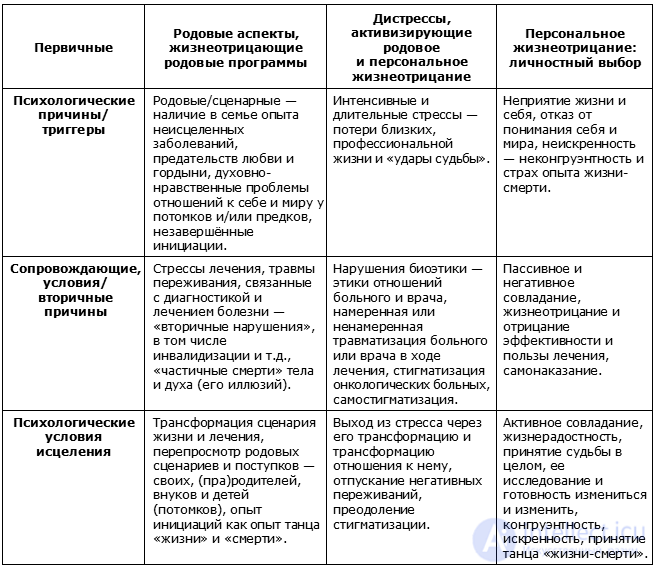
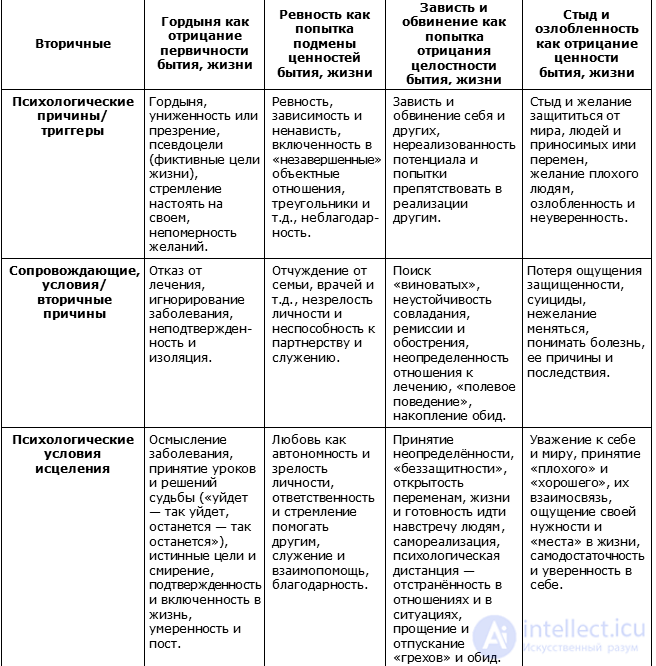
The first task of psychotherapy is to help patients believe in the effectiveness of treatment and their body's ability to resist the disease, as well as to develop the life-affirming aspects of relationships and existence. After that, patients can and should be taught to cope optimally with stressful situations. It is especially important that they change their understanding of themselves and the problems they face. Patients must believe in their own strength and know that they can resolve all their problems more effectively, including with the help of loved ones, both accepting and giving help. The patient's emerging belief in the possibility of recovery and a new attitude toward their problems form a life stance that has room for hope and faith in the future: as a result, the mechanisms that contributed to the transformation of negative experiences into an oncological disorder can be used for the restoration and development of health. The experience of healing from cancer is an important experience on the path of developing wisdom and understanding of oneself and life, an experience of growth in spite of everything, an experience of attentiveness to oneself and the world, an experience of joy and transformation toward happiness («cancer with joy»), an experience of finding true relationships with people and with God, and with oneself. It is therefore no coincidence that this experience is so sought after by patients and is so actively shared and collected by those who have lived through it.

Comments