
Lecture
Counseling can be understood as a complex of phenomena occurring in the course of people's interaction and communication.
C. Rogers identified 6 conditions conducive to positive changes in personality:
Two persons (the client and the counselor) are in psychological contact.
The client is in a state of psychological distress, is vulnerable and anxious.
The counselor is actively engaged in the communication.
The counselor experiences unconditional positive regard for the client.
The counselor experiences empathy, having adopted the client's point of view, and conveys this to the client.
The counselor's empathic understanding and unconditional positive regard are conveyed to the client even at a minimal level of expression7.
The client must be in contact with the counselor and reach a state that makes them receptive to help from outside. And for the counselor's work to succeed, what becomes most essential is a nonjudgmental attitude toward the client and acceptance of them as they are, along with the ability to show empathy and genuineness of behavior. Most specialists increasingly lean toward the conclusion that the main condition for the effectiveness of counseling is a supportive emotional relationship between client and counselor. When such a relationship develops, the specific method the counselor uses becomes unimportant.
The counseling contact is a unique, dynamic process during which one person helps another use their inner resources to develop in a positive direction and to actualize the potential for a meaningful life (George, Cristiani, 1990).
The nature of the contact between counselor and client reflects the characteristics of the client's relationships with other people, the style and patterns of their communication — the client's problems can be seen as if in a mirror (see Document 5: «The Counseling Contact from the Perspective of the Counselor's Theoretical Orientation).
The emotional components of the helping relationship (the therapeutic climate) include creating an atmosphere of mutual trust, the genuineness (congruence) of the counselor, their capacity for empathy, and unconditional positive regard for the client.
If the client does not develop trust, the counselor's work will be ineffective and meaningless. The success of creating a therapeutic climate depends on the counselor's personal qualities and their attitude toward counseling: a genuine interest in people and a real desire to help them are essential. The client must be given every opportunity to speak: they come to the counselor not to listen to lectures and wise advice, but to talk about the oppressive and difficult aspects of their life. The client's problems must be approached without judgment. The counselor should not evaluate, but listen, hear, and understand. When the counselor sincerely and naturally demonstrates an attitude of "acceptance," the client feels understood and worthy of respect.
Genuineness (congruence) is one of the most important elements in creating a therapeutic climate. Genuineness cannot be taught, yet the counselor must be able to behave with clients in such a way that they perceive the entry into their inner world as support rather than a threat. According to C. Rogers (1957), congruence means that in interpersonal relationships the counselor freely and authentically expresses their experience. It is enough for the counselor to remain themselves during the counseling contact. Congruence implies correspondence between statements, feelings, and nonverbal behavior, and spontaneity. A counselor who is open to their own feelings, thoughts, and attitudes, while at the same time free of anxiety, fosters a sense of comfort in the client. At the same time, the counselor's openness in the relationship with the client has its limits. For example, the counselor does not discuss or work through their own problems with the client.
The positive significance of empathic understanding for counseling outcomes is best confirmed empirically. This significance is not disputed by representatives of any orientation. Empathy is an indispensable condition for counseling and psychotherapy. It involves identification with another person, through which mutual understanding between different people becomes possible. The expression of empathy in communication means that the counselor responds sensitively and accurately to the client's experiences, as though they were their own. The counselor's nonjudgmental stance allows clients to accept themselves more fully. When the counselor accurately and carefully identifies the client's various feelings, the client gains the opportunity to hear and understand themselves better.
Having entered another person's world, it is important for the counselor to remain autonomous from the client, that is, to preserve their own selfhood. The counselor's empathic engagement with the client should never be total, but only partial and temporary.
Empathy means the counselor's ability not only to sympathize but also to understand the client. In this sense it represents both an affective and a cognitive skill — affective, because it allows the counselor to identify the client's feelings, and cognitive, because it obliges the counselor to establish the events that give rise to those feelings (George, Cristiani, 1990). Empathic understanding can be shown to the client in many different ways – through silence, reflection of feelings, an apt and timely interpretation, telling a story, an accurate metaphor, and so on. Empathy is not a simple skill. The unique capacity for empathy can develop gradually.
+The concept of «unconditional respect» refers to the unconditional and non-evaluative acceptance of the client as a whole person, identified with emotional warmth and care. Only by respecting clients can one be honest with them and enter into confrontation with them. A positive attitude toward clients is formed on the basis of the counselor's self-respect. If a counselor does not value his own feelings and thoughts and disregards his own past, it is difficult for him to respect the thoughts and feelings of another person. A positive attitude includes warmth, sympathy, care, and appreciation of the client without any striving to control or manage him. While the level of the relationship is linked to the expression of positive or negative feelings toward the client, unconditionality of the relationship implies the constancy of acceptance of the client — that is, an attitude without any "ifs". Unconditionality means that the counselor's basic stance does not waver depending on the client's emotional state and behavior.
Is a person acting correctly if, upon encountering difficulties, he turns to someone for help instead of coping on his own? How can one determine the threshold beyond which turning to a psychotherapist becomes appropriate? Blaise Pascal wrote: «How absurd it is that we wish to find support in beings like ourselves! As feeble as we are, they cannot help us: in the hour of death a person is alone. Therefore, he must also live as though he were alone in the world». Martin Buber's philosophical anthropology naturally and organically convinces us otherwise: «All real life is meeting. The reality of a human being's life is contained in the meeting. Human life and humanity begin to exist in this meeting, for the growth of the inner essence does not occur in a person's relation to himself, but in the relation between one person and another, between people»8. The uniqueness of a person's existence cannot be defined by drawing the boundaries of awareness that reduce it to a simplified unambiguity. A person can be simultaneously free in his uniqueness and unique only thanks to the presence of other people beside him. A person finds himself through others. The other does not turn out to be the creator of the Self, but he is the mirror through which the Self discovers itself. The other turns out to be the initiating principle for the discovery and development of oneself. The other helps the Self to sense its own boundaries and, at the same time, helps it touch infinity through itself. Every meeting serves as a guarantee of our connection with the world. The feeling of loneliness and the feeling of losing oneself, experienced by a person who is deeply going through a life crisis, sharpens the need for the co-presence of the Other.
In psychological counseling this Other becomes the counselor, who finds himself in one and the same situation in a duality of roles: that of another person and that of another – a professional. It is apparently precisely this duality that sets the two basic counseling strategies: in one case directed toward change, in the other – toward psychological support. In the first, the counselor acts in the role of an experienced analyst who examines the object and possesses professional tools; in the other, he is simply a fellow human being who happens to be here, in this world and at this time, nearby. In these two cases different relationships arise, as two different forms of existence. In Martin Buber's philosophical language these two forms of existence – of relation in the world – are called «I – Thou» and «I – It».
When participating in «I – It» relations, we perceive other people while standing at an egocentric point of view. The other, in this case, appears as an object. Many of our encounters take place at the level of «I – It». But every such encounter contains the expectation and hope of an «I – Thou» relationship, through which isolation and loneliness are overcome and our essence is realized. Without them, a person lives in emptiness, alienation, and loneliness. At the level of «I-Thou» relations, the other is perceived by us as a subject with a unique world of feelings and experience. The purpose of existence in the world of «It», in separateness, «is the acquisition of experience and use». The purpose of the relation in the world of «Thou» «is its own essence, that is, the touch of «Thou». For through the touch of every «Thou» we are touched by a breath of eternal life». The world of «It» is one in which one has to live, and «one can quite well live» in it; it fixes the visible, the concrete, and the useful. Moments of «Thou» within it seem «strange, lyrico-dramatic»; «a person cannot live without «It», but whoever lives only with «It» is not a person»9.
+As the counselor's professionalism grows, they may lose the ability to enter into an I-Thou relationship, replacing it with an I-It relationship, since «the development of the functional capacity for acquiring and using experience is usually achieved through a weakening of the human power of relation»10. For a counselor's work to succeed, what matters is not so much having the specialized education needed to make a correct diagnosis, but rather a non-judgmental attitude toward the client and acceptance of them as they are, empathy for the client, and sincerity of behavior. Many specialists in the field of psychological counseling increasingly conclude that the main condition for the effectiveness of counseling is supportive emotional relations between the client and the counselor. If such a relationship develops, it becomes unimportant which particular method the counselor uses. If there is no such contact, then no sophisticated technique will produce results.
It is precisely this «I – Thou» relationship that restores lost trust in the world and helps achieve a balanced, harmonious state for «launching» new resources, for using creative thinking, and for attaining the authenticity of one's existence11. A counselor is unable to help without building an «I – Thou» relationship, yet also becomes helpless by «dissolving» into their own client, failing to distance themselves from the client's problem in time and failing to draw on their professional experience. By harmoniously combining strategies of change-influence and support, the counselor contributes to the creation of a new kind of accord, a unity of the two forms of relation, «I – Thou» and «I – It». It is precisely this simultaneous co-presence and remaining at a distance that promotes healing.
Nonverbal communication. A person's nonverbal behavior is highly significant in the process of communication. In counseling, we also send clients nonverbal messages and "read" their nonverbal reactions. It is extremely important that the counselor notice clients' nonverbal messages, respond to them, and at the same time remain aware of the influence of their own nonverbal behavior on clients. The counselor must control their nonverbal behavior in order to turn it into a tool of counseling.
It is important for the counselor to remember the importance of eye contact. The physical setting should allow the counselor and client to see each other fully. At the same time, it should be remembered that eye contact should not be continuous.
The counselor's posture should be open. Crossed arms and legs are usually interpreted as a defensive, indifferent, and withdrawn posture. From time to time the counselor may lean slightly toward the client, expressing their involvement and participation in the contact (on the other hand, one should not approach the client excessively or too quickly, because this may arouse anxiety or seem like a demand for swift and close contact).
It is important that the counselor be moderately relaxed. Since most clients are anxious in the counseling situation, the counselor's own tension can increase the client's anxiety. Through their nonverbal behavior, the counselor should try to show the client their empathic involvement in the counseling contact.
Listening to the client. At the beginning of a conversation, the counselor's verbal activity should be minimal, so that the client can focus their attention on disclosing their problems and difficulties. The counselor should not so much talk as listen. The ability to listen means expressing genuine interest in another person.
Listening, first and foremost, is a form of feedback to the client's thoughts and feelings, and it encourages the client to keep talking about their life, its difficulties and problems. Proper listening is an active process. The listener needs to show interest and understanding, yet without interrupting the narrator's flow of experience; a counselor listening to a client must be relaxed and observant, so that the confessions heard give rise to an abundant associative flow. The associations that arise serve as certain "keys" to understanding the client's problems.
Listening can serve not only to understand another person, but can also be healing in itself. It is known that when a person fully «speaks out», this brings them relief. An inner feeling that does not express itself in words, in action, that is not objectified outwardly, is doomed to remain inside, never reaching its addressee, since the language of feelings is formed as necessarily directed toward something or someone outside. A consequence of an unexpressed feeling is the phenomenon of alexithymia («feeling without a word», a term introduced by P. Sifneos)12, which accompanies a whole range of psychosomatic illnesses.
Verbal communication. Despite the importance of nonverbal communication in counseling, the most crucial events take place at the verbal level. The essence of a counselor's verbal behavior consists of the ways he responds during the counseling process, which can be defined as the basic techniques: techniques for clarifying the client's problem, generating hypotheses in counseling, techniques of interpretation, etc. (see section 3).
Skills of awareness and expression of feelings. A counselor's awareness of his own feelings and the client's feelings is based on the functioning of emotional intelligence (the ability to be aware of and understand one's own feelings and the feelings of others, as well as the ability to manage one's own feelings and the emotional states of others). At the same time, awareness of feelings can gradually develop and reach the level of a skill so necessary for the professional counselor. The development of this group of skills is facilitated by counselors undergoing special group and individual training in reflection and self-regulation of emotional states. Reflection on one's own feelings and understanding of the client's feelings makes it possible to prevent in time the negative influence of transference and countertransference on the counseling process. Transference (a discovery of S. Freud - one of the fundamental achievements of psychoanalysis) is the inadequate and perseverative experiencing of feelings, drives, fantasies, attitudes, and the engagement of defense mechanisms that arose in the past in relationships with significant others, applied to a current interpersonal interaction. Countertransference is characterized as a response to the client's transference. An additional definition describes countertransference as the counselor's projection of his own problems onto the material presented by the client, whether related to transference or not (see Document 6: "Transference and Countertransference in Counseling").
Confrontation skills. Every counselor is from time to time compelled, for therapeutic purposes, to enter into confrontation with clients. Confrontation in counseling is defined as any counselor response that contradicts the client's behavior. Most often, this opposition is directed at the client's ambivalent behavior: evasions, "games," ruses, excuses, "throwing dust in the eyes," i.e., at everything that prevents the client from seeing and addressing his pressing problems. Confrontation is used to show the client the psychological defense mechanisms he employs in an effort to adapt to life situations, but which nonetheless oppress and limit personal development. At the center of confrontation is usually the client's style of interpersonal communication as it is reflected in the counseling contact. The counselor draws attention to the devices by which the client tries to avoid discussing topics important to the counseling, distorts the urgency of his life situations, and so on.
George and Cristiani (1990) identify three main occasions for confrontation in counseling:
Confrontation aimed at drawing the client's attention to contradictions in his behavior, thoughts, feelings, or between thoughts and feelings, intentions and behavior, etc. Confrontation of this type is intended to help the client see the very contradiction that he had not previously noticed, did not want to, or could not notice.
Confrontation aimed at helping the client see the situation as it actually is, contrary to his own view of it shaped by his needs and his interpretation of it in a way convenient for himself.
Confrontation aimed at drawing the client's attention to his avoidance of discussing certain problems.
Confrontation is a complex technique that requires subtlety and experience from the counselor. It is often perceived as an accusation, and therefore is applicable only when there is sufficient mutual trust, when the client feels that the counselor understands him and cares about him.
+Confrontation must not be used as punishment of the client for unacceptable behavior. Confrontation must not be used to satisfy the counselor's own needs or self-expression. It is necessary to carefully characterize the content of the client's inadequate behavior and its context, but one should not state everything at once (after all, this is not a case presentation to colleagues). Confrontation with a client must never be categorical. It is advisable to use phrases such as "it seems to me," "please try to explain," "if I am not mistaken," which express certain doubts on the counselor's part and soften the tone of the confrontation.
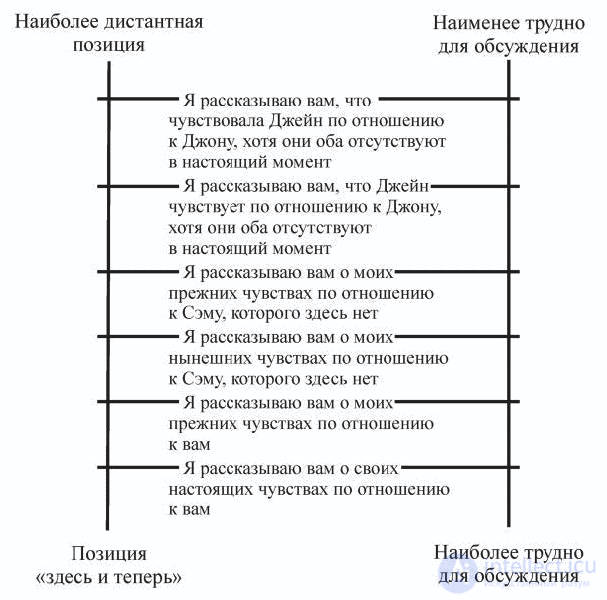
Figure 2. Development of closeness in relationships. Cited from: George, Cristiani, 2002, p. 186
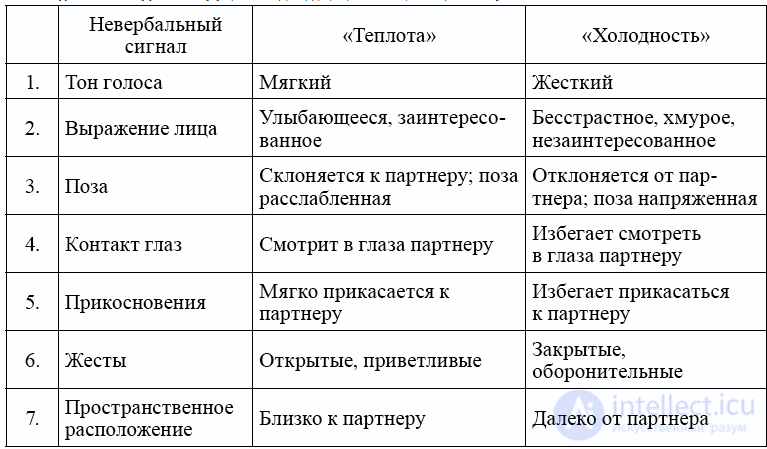
Table 1 Nonverbal Signals of "Warmth" and "Coldness" according to Johnson{ Cited from: George, Cristiani, 2002, p. 190.}
Table 2
Empathy Scale{ Cited from: George, Cristiani, 2002, pp. 192–193.}
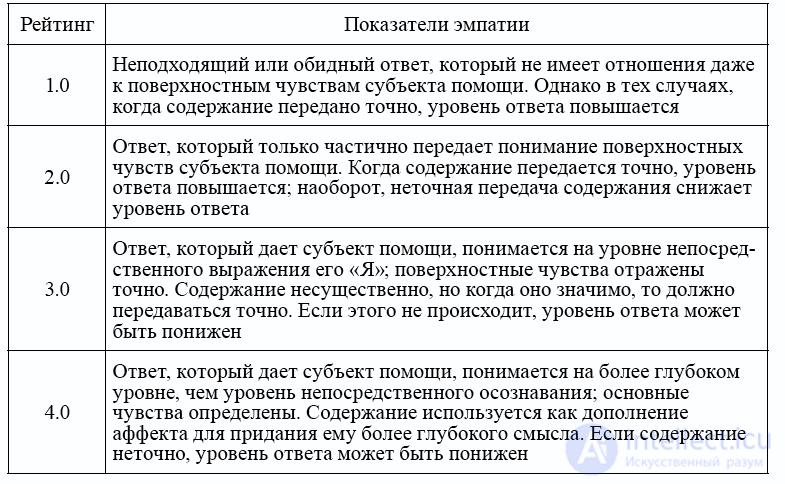
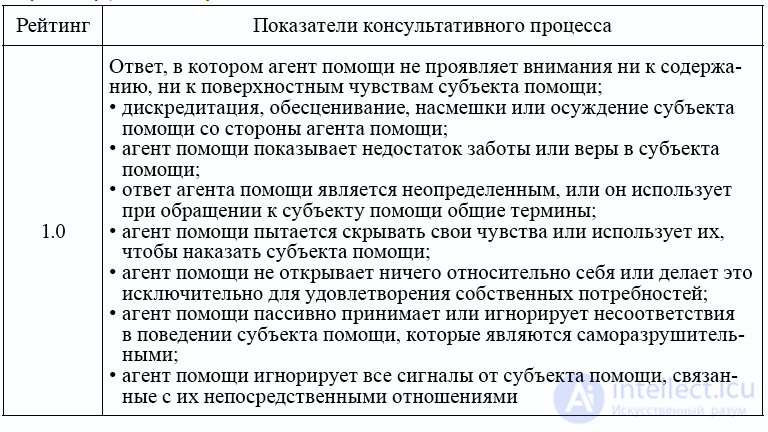
Table 3
Counselor Global Effectiveness Scale{ Cited from: ibid.}
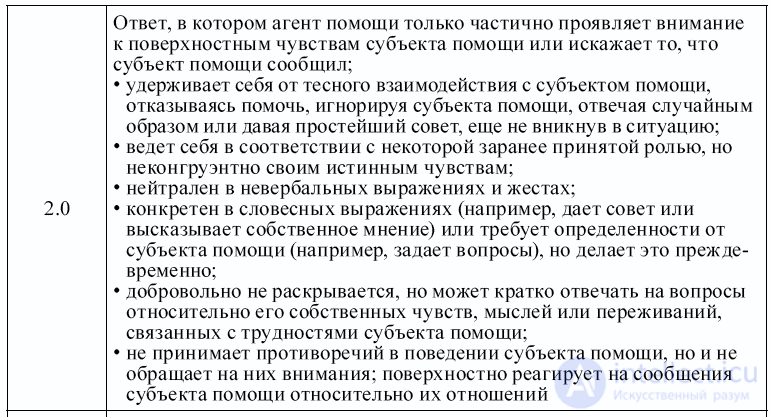
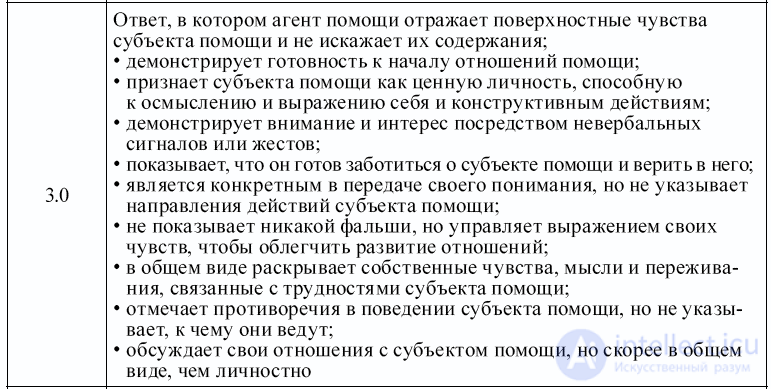
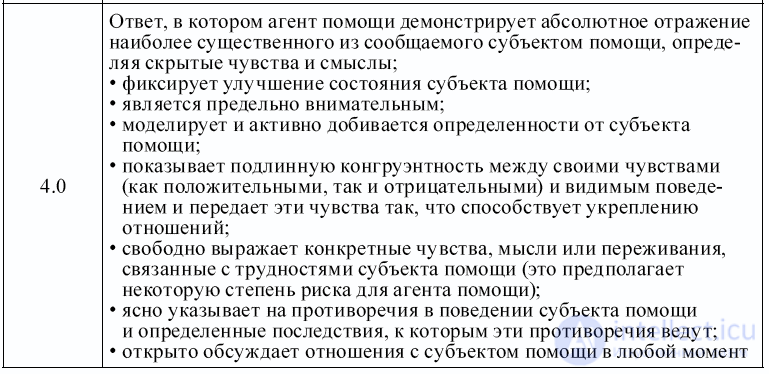
An analysis of many years of diverse counseling work, together with an examination of the features of the therapeutic process, makes it possible at this stage to classify counseling «traps» in a certain way (Figure 3).
Two main types of «traps» can be distinguished:
● «traps of the professional role», associated with the loss or reinforcement of the professional position;
● «technical traps», caused by a disruption of contact with reality.
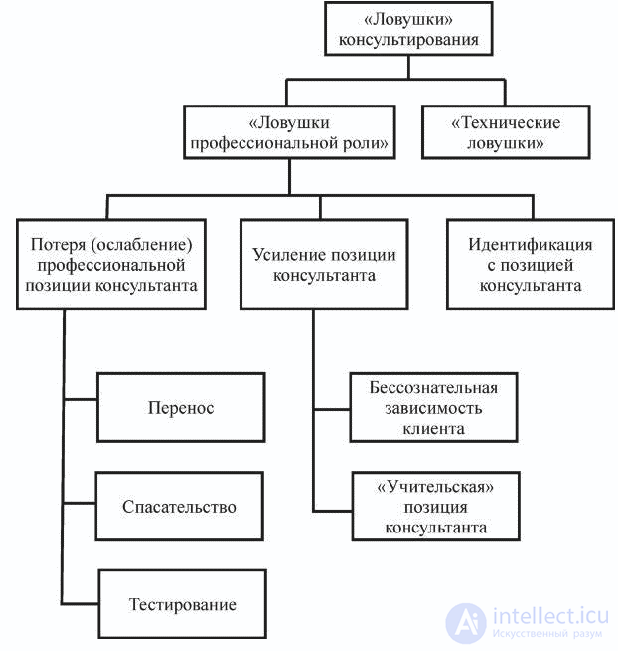
Figure 3. Counseling «traps»
The «traps of the professional role» include:
● loss (weakening) of the counselor's professional position;
● reinforcement of the counselor's position;
● identification with the counselor's position.
The most prevalent and most common of these are the «traps of loss (weakening) of the counselor's professional position.» These include:
● transference;
● rescuing;
● testing.
The «transference trap.» The previous section examined transference and countertransference relations in fairly detailed fashion. Why should they be classified as «traps»? First, transference involves the client's «transferring» feelings, experiences, and behavioral patterns from one figure (usually a parental one) onto another – the figure of the therapist. This «transferring» of feelings is the client's «offer» to the therapist to «play the role» of his or her parent – either a bad one or an ideal one. «Falling under transference,» as many counselors note, is a common phenomenon in therapeutic practice{ There is also a viewpoint (particularly characteristic of depth psychology) that, without transference, therapeutic relationships are in principle impossible.}, and it needs to be noticed, recognized, and brought up for discussion; ultimately, one needs to emerge from under the transference. Second, sustaining the client's transference is generally not helpful. It does little to promote the client's personal growth, the process of separation/individuation{ In M. Mahler's terminology, separation-individuation represents two interrelated processes that gradually unfold in the course of a child's psychic development. Mahler used this term primarily to describe «psychological birth.» Separation reflects the process of emerging from symbiotic unity with the mother and, alongside the formation of representations of the mother as existing «outside the Self,» includes the establishment of object relations. Individuation implies the processes by which the child differentiates and delimits his or her own properties and characteristics, i.e., the processes of differentiating the Self from the object and creating an intrapsychic image of the Self as a series of successive representations (Mahler, Pine, Bergman, 2011).} and maturation. A counseling «trap» can be said to occur when the transference and countertransference relations between client and therapist go unrecognized by the psychotherapist, are not discussed in the counseling work, and are unconsciously continued by the counselor outside therapeutic sessions (for example, the therapist worries excessively about his or her client{ The key word here is «excessively.» In general, it is normal for a therapist to think about and worry about his or her clients. What matters is that this should not grow into excessive, infantilizing care.}, constantly thinks about ways to solve the client's problems, tries to help in various ways, or keeps the client in the therapeutic relationship because of an erotic transference, and so on).
The «rescuing trap» is a widely recognized «trap» described in the psychological literature. Stephen Karpman (cited from: The Art of Psychological Counseling, 2006, pp. 88–97), generalizing Eric Berne's ideas about the variety of roles people play, showed that all roles can be reduced to three basic ones: Rescuer, Persecutor, Victim. These three roles combine into a «drama triangle» (the «Karpman triangle»), which in essence is more of a closed circle.
Each of these roles has its own functions, its own rules of behavior, and its own clear and unchanging attitudes. Thus, the Rescuer always helps, even when not asked; feels guilty if unable to help; allows the Victim to fail and does the Victim's work for them; comforts the Victim and softens problems, difficulties, and hardships for them. The Rescuer's main feelings are righteous anger at the Persecutor and enormous pity for the Victim. The Victim is always powerless, always a slave to circumstances or situations. He or she is helpless, downtrodden, and may be ashamed of his or her powerlessness. The Victim always needs a Rescuer who protects and serves him or her. The Victim's core attitude is: «Poor me, poor me! Unfortunate me, unfortunate me! Why am I so unlucky?! Why do all the blows fall on me alone?! Why is everyone so unfair to me?!». The Persecutor is always harsh, attacking, and accusing; rigid and inflexible; angry and critical. His or her attitudes toward the Victim are: «You alone are to blame for everything! You will be punished! Serves you right!». Inside this «triangle,» according to Karpman, lies the core of the problem, which the participants in the «triangle» avoid addressing (Figure 4).
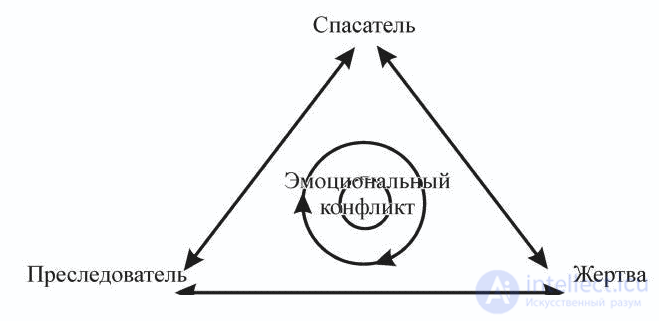
Figure 4. The Karpman Drama Triangle
The most interesting thing about this "drama triangle" is that a person is never permanently in any one of the roles. He moves from one to another depending on the situation or circumstances, never lingering long at any of the "corners of the triangle." It is along this closed trajectory that a person caught in the "triangle" moves. Usually, the "drama triangle" encloses some emotionally charged relationship of the client. This could be a relationship with a partner, a child, parents, a boss, or even with the world as a whole. Moving from one role to another, the client again and again finds someone or something, inviting them to fill whatever position has become vacant. As a rule, the counselor turns out to be a very suitable figure for this.
Here is one such situation. During a session, a client bitterly cries and complains about her unhappy fate. According to her, she has had no luck in life. Her parents do not love her, she lives where she does not want to, works at a job she hates, and men take advantage of her and deceive her. The client's position is the position of the Victim. She casts both her own parents, her partners, and the whole world in the role of Persecutors. And she invites the psychologist into the role of Rescuer.
In order to show the client that she is in a "drama triangle," the counselor consciously takes the position of Persecutor. First he attacks — he talks about how cruel her parents are, how heartless men are, how foolish her bosses are. For a while the client is satisfied. But not for long. Suddenly her delight that the therapist has joined her anger at the world disappears. She begins to defend everyone the therapist has just accused. She becomes the Rescuer. The parents turn out not to be so cruel after all, the men not so heartless, the boss not such a fool. But because the counselor "dared" to attack people close to the client, her anger turns on him. Now she is the Persecutor, and the therapist is the Victim. If the therapist remains in this role and agrees that he is "guilty," then very soon the client herself will move into the role of Rescuer and begin to support the counselor, turning the Persecutor's anger onto herself instead. Such movement around a closed circle, from role to role, is typically characteristic of all the client's relationships, of her very way of life. In the course of counseling, it is important to show the client how she moves around the "drama triangle," how she unconsciously shifts from role to role, in turn blaming, then pitying, then helping, sometimes the very same people. This is not the work of a single session; it must be long and painstaking. For many people the position of "victim," the endless search for a "persecutor," and turning for help to a "rescuer" are all too familiar.
Movement around the "drama triangle" is especially vivid in dependent and codependent relationships — for example, in families with chemically and emotionally dependent members (husbands, wives, children, parents). This is where the "triangle" unfolds in its full "dazzling glory." The very phenomena of alcoholism, drug addiction, gaming and computer addiction, and emotional and sexual attachment play now one role, now another, in the "Karpman triangle." For example, vodka in an alcoholic's family can be the Persecutor: "How I hate it! It has ruined my whole life!" the woman cries to the therapist during a consultation. And it is impossible not to believe her. But at home — in order to avoid insults, accusations, anger, and even physical violence from her cruel sober husband, the woman always keeps a bottle in reserve ("He'll go and buy it anyway! So better I buy it myself and hide it just in case!") — and this is how vodka becomes the Rescuer. Moreover, it "rescues" both the husband from withdrawal symptoms and the wife from her Persecutor husband. And if by chance an unfinished bottle is found somewhere in the house, wives of alcoholics almost never pour out the contents — they feel sorry for it! In that case, vodka becomes the Victim. The entire life of dependent and codependent people is filled with this constant, dynamic game.
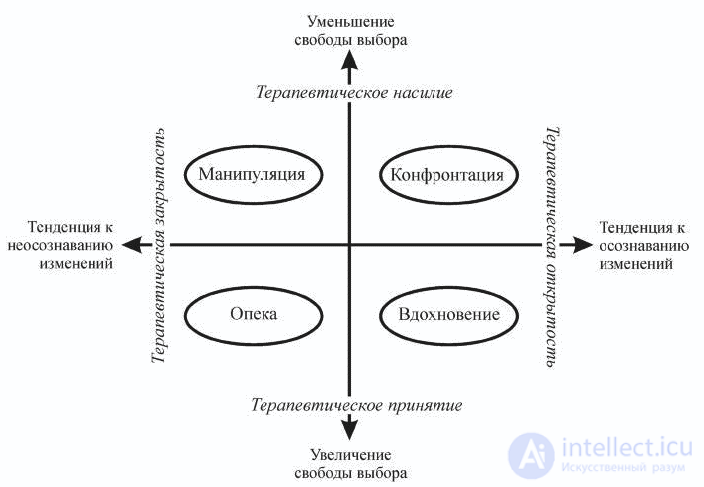
Figure 5. The space of client-therapist relationships{Mastery of Psychological Counseling, 2007, p. 66.}
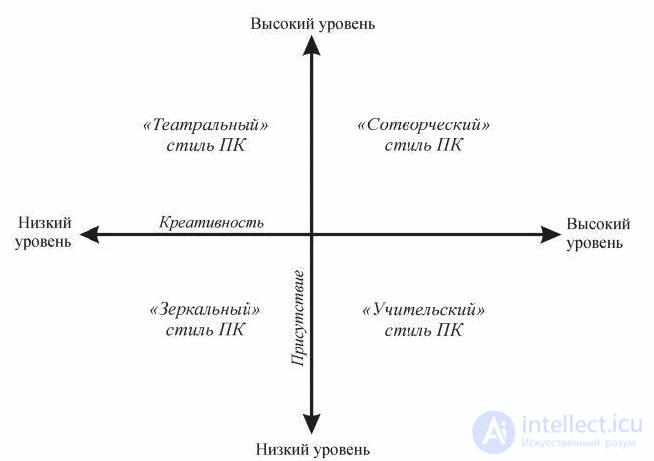
Figure 6. Individual styles of psychological counseling

Comments