
You get a bonus - 1 coin for daily activity. Now you have 1 coin

The Johari Window (Luft and Ingham's Model): Johari Adjectives

Lecture


The Johari Window was created by two American psychologists, Joseph Luft (1916—2014) and Harrington Ingham (1914—1995), in 1955. It is a technique that helps people better understand the relationship between their personal qualities and how they are perceived by others. It is mainly used in personal development groups and corporate training as a heuristic method.
The Johari Window (Luft and Inghams Model): Johari Adjectives

The Johari Window

The Johari Window (Luft and Inghams Model): Johari Adjectives

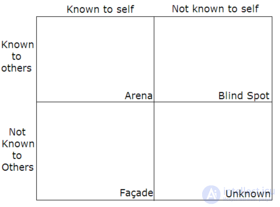
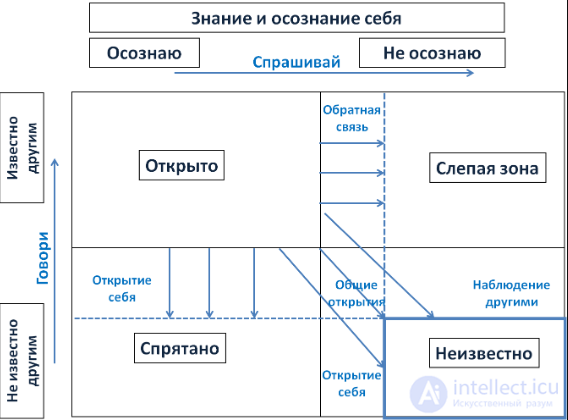
According to the method, every person has four zones: Open, Blind, Hidden, and Unknown.

  • The open zone contains qualities known to the person and recognized by others. Improving relationships between people is directly related to the level of mutual understanding achieved through the exchange of information. The larger this zone, the more information both sides have about the person's qualities, and the more productive the interaction will be.
  • The hidden zone contains qualities known to the person but unknown to others. Enlarging this zone hinders interaction between people. However, it offers the advantage of concealing unfavorable information from others in order to present oneself in a favorable light.
  • The blind zone contains qualities of the person that are known to others but unknown to the person themselves.
  • The unknown zone contains qualities unknown to both the person and others .

Over the course of life, a person, as a rule, strives to expand the open zone and narrow the others. This allows them to be more flexible and free, since different activities require different qualities for successful performance.

By surveying others and through self-testing, one can fill in the Johari window, after which one can consciously work on expanding the open zone in the following ways:

  • Reduce the hidden zone by publicly displaying qualities known to oneself, thereby revealing a previously unknown side of oneself to others.
  • Reduce the blind zone by asking others about yourself and analyzing the feedback.
  • Reduce the unknown zone by compiling a list of qualities you would like to acquire, outlining ways to acquire them, and following through.
  • Reduce the unknown zone (by the reverse method) by finding out from others which qualities, in their opinion, least apply to you (what, in your opinion, am I lacking?), and then acquiring those qualities.

Description of the Window

In this exercise, someone selects several adjectives from a list, choosing those which, in their opinion, describe their personality. The subject's peers are then given the same list, and each selects an equal number of adjectives describing the subject. These adjectives are then placed into a two-by-two grid of four cells.

The philosopher Charles Handy called this concept the Johari House of four rooms. The first room is the part of ourselves that we and others see. The second room contains aspects that others see but that we are unaware of. The third room is a private space that we know but hide from others. The fourth room is the unconscious part of us that neither we nor others see.

The Four Quadrants

Open or Arena

Adjectives chosen by both the subject and their peers fall into this cell (or quadrant) of the grid. These are traits perceived by both the subject and their peers.

Blind

Adjectives chosen not by the subject but only by their peers are placed here. They represent what others perceive but the subject does not.

Facade

Adjectives chosen by the subject but not by their peers fall into this quadrant. These are things that peers are either unaware of, or that do not correspond to reality beyond the subject's own claims.

Unknown

Adjectives that were chosen neither by the subject nor by their peers go here. They represent behaviors or motives of the subject that none of the participants are aware of — either because they do not apply, or due to a collective lack of awareness of these traits.

Johari Adjectives

A participant can use adjectives like these as possible descriptions in the Johari window.

  • able
  • accepting
  • adaptable
  • bold
  • brave
  • calm
  • caring
  • cheerful
  • clever
  • complex
  • confident
  • dependable
  • dignified
  • empathetic
  • energetic
  • extroverted
  • friendly
  • giving
  • happy
  • helpful
  • idealistic
  • independent
  • ingenious
  • intelligent
  • introverted
  • kind
  • knowledgeable
  • logical
  • loving
  • mature
  • modest
  • nervous
  • observant
  • organized
  • patient
  • powerful
  • proud
  • quiet
  • reflective
  • relaxed
  • religious
  • responsive
  • searching
  • self-assertive
  • self-aware
  • sensible
  • sentimental
  • shy
  • silly
  • smart
  • spontaneous
  • sympathetic
  • timely
  • trustworthy
  • warm
  • wise
  • witty

Motivational Equivalent

The concept of meta-emotions, classified as basic emotions, offers the possibility of a meta-emotional window as a motivational analog to the Johari meta-cognitive window.

Therapy Using the Window

One therapeutic goal may be to expand the open square (the arena) at the expense of both the unknown square and the blind spot square, which will lead to greater self-knowledge

Test on the Topic

The «Johari Window» (the Luft and Ingham model):

  • A) Classifies types of insight in group psychocorrection
  • B) Conveys the relationship between the conscious and the unconscious in interpersonal relationships
  • C) Describes the dynamics of group cohesion
  • D) Represents the principle of connecting psychological techniques with the structural dynamics of the group


See Also

  • Assertiveness
  • Shadow - a term in Jungian psychology
  • There are known knowns - a phrase from which its opposite, the unknown unknown, was coined.
  • [[b4720]]
  • [[b8028]]

See also

Comments

To leave a comment

If you have any suggestion, idea, thanks or comment, feel free to write. We really value feedback and are glad to hear your opinion.
To reply

Lectures and tutorial on "Psychological counseling"

Terms: Psychological counseling