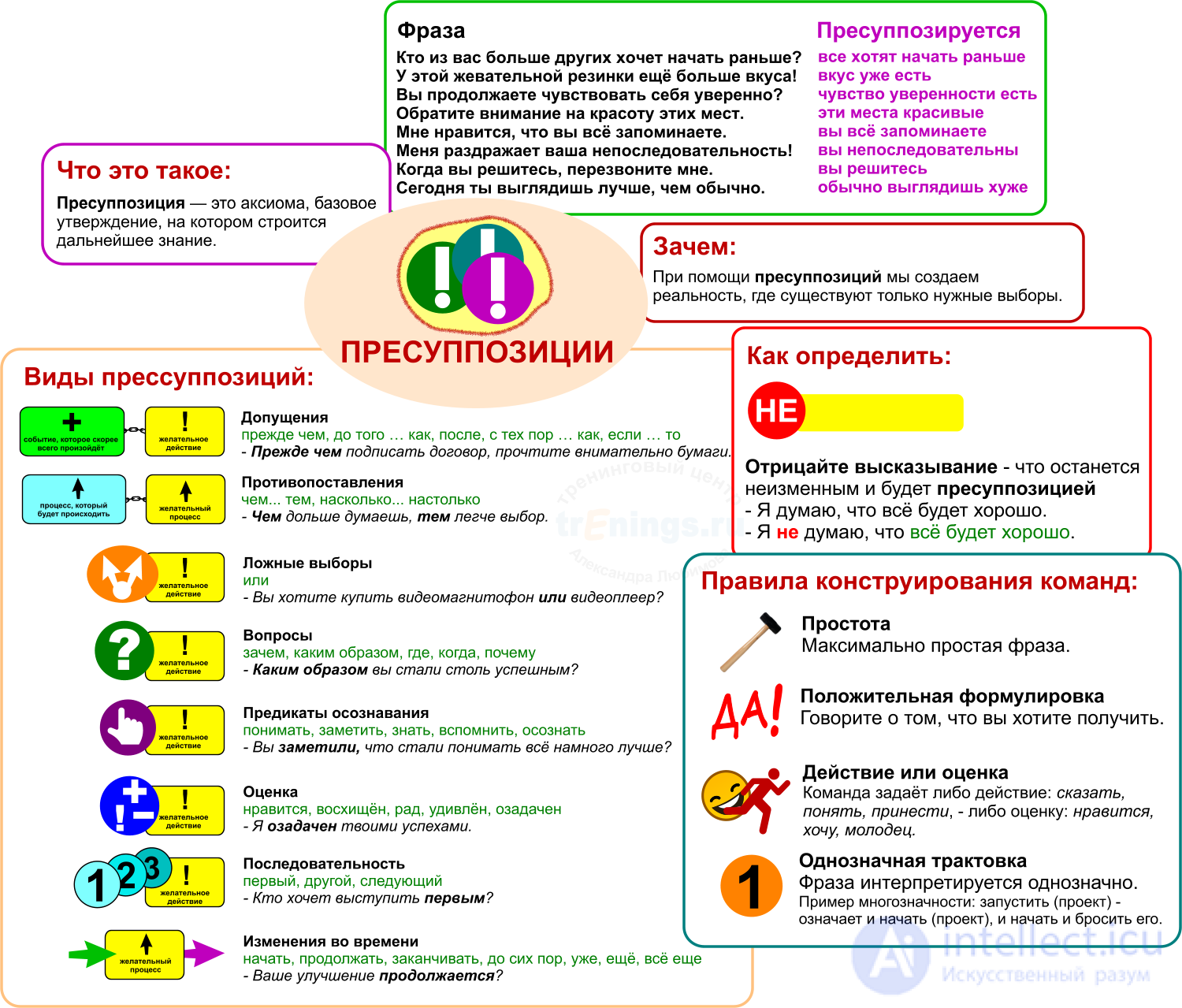
Presuppositions in neuro-linguistic programming (NLP) are axiomatic beliefs used as a tool that, in the opinion of NLP's creators, facilitates achieving the desired effects of the techniques. The significance of presuppositions lies not in their being true (that is, precisely describing objective reality), but in the fact that it is useful to believe them for the most effective performance of certain tasks in NLP.
Presupposition (from Latin prae — ahead, before, and suppositio — placing under, laying) (also presumption ) in linguistic semantics — a necessary semantic component that ensures the presence of meaning in an utterance.
A presupposition can be understood as a component of a text's meaning that constitutes prior knowledge without which the text cannot be adequately perceived. A presupposition may appear from reading another text, or may not be expressed in texts at all, remaining only in the mind of the author .
The concept of presupposition includes both the context and the situation in which a given utterance is made. Presupposition supplements the meaning of a sentence expressed in its words and structure, within a specific speech act .
History of the concept
Logicians and philosophers discovered the need to introduce the concept of presupposition when analyzing statements as early as the 19th century. The German logician G. Frege was one of the first to propose distinguishing between what is asserted and what is presupposed in a given statement. For example, in the sentence "Mozart died in poverty," it is presupposed that the name "Mozart" refers to some denotatum, that a person with that name existed. According to Frege, this presupposition is not part of the statement but merely affects its truth value. If the referent of the name does not exist, the statement does not lose its meaning, but it loses its truth value .
P. Strawson used the concept of presupposition in his critique of Bertrand Russell's theory of descriptions. B. Russell proposed treating sentences with empty descriptions (false presuppositions) as false, which, as P. Strawson showed, contradicts the laws of logic. P. Strawson proposed considering sentences with a false presupposition as lacking a truth value. W. Quine called this state of affairs a "truth-value gap" .
Logicians and linguists split into two camps: those accepting the "truth-value gap" theory and supporters of Russell's "falsity theory." K. Donnellan attempted to reconcile these theories by analyzing the subject-predicate structure of the sentence .
The concept of presupposition (presumption) was introduced into linguistics by O. Ducrot, I. Bellert, C. Fillmore, G. Lakoff, and P. and C. Kiparsky
Presuppositions In linguistics
see Implicature
The concept of presupposition still lacks a generally accepted definition. Types of presuppositions in linguistics are distinguished by different linguists depending on the aspect under consideration — cognitive-pragmatic, cultural-linguistic, logical — although some classifications use a holistic approach to classification .
V. Z. Demyankov, based on research by foreign authors, proposed the following typology of presupposition :
- logical presuppositions
- pragmatic presuppositions
- semantic presuppositions
In cognitive-pragmatic terms, presuppositions can be divided into situational and linguistic :
- broad (general) presupposition — general knowledge that people have about the surrounding world. Information absent from the text is easily reconstructed based on stable relations between objects known to everyone. For example, the sentence "The bird flew out of its nest" can be replaced without loss by "The bird left its nest," since practically everyone knows that birds fly.
- narrow (particular) presupposition — knowledge relating to the given specific situation, possessed by the speakers.
- linguistic presupposition — knowledge embedded in the language itself.
In the same vein, V. V. Krasnykh distinguishes: 1) micro-presupposition (correlated with individual cognitive space), 2) societal, constant presupposition (correlated with collective cognitive space), 3) macro-presupposition (correlated with the cognitive base).
E. V. Paducheva, distinguishing pragmatic and semantic presuppositions, subdivides the latter into :
- factive;
- categorial;
- existential.
A presupposition can be directed toward the justification of an utterance. In this case the additional meaning turns out to be argumentative. For example, "I forgot to visit her," besides reporting the fact itself, contains "I knew that I was supposed to visit." Such a presupposition is called "factive," since it is usually introduced by means of factive verbs (verbs relating to mental activity and psychic processes) .
Categorical presuppositions — restrictions on semantic compatibility — are prepositions concerning the presence of an actant within the domain of applicability of a predicate. For example, in the sentence «but only the dense poplars knew the truth», the presupposition of animacy of the subject of the verb «to know» is violated .
As an existential presupposition — that is, a presupposition relating to the existence and uniqueness of an object — for the sentence «The present King of France is bald» it would be «France currently has a king» .
Unlike semantic presupposition, the additional meaning can also be pragmatic. For example, in the phrase uttered in a queue «You weren't standing here», the implied meaning is — «Take the place that belongs to you» . In the work of E. V. Paducheva , the following definition of pragmatic presupposition is given. «The semantic component P of sentence S is a pragmatic presupposition of S if, in the normal use of S, the speaker considers component P to be true and known to the listener.»
N. D. Arutyunova, in her works, identified a number of different types of presuppositions [10][11]:
- existential,
- pragmatic,
- syntagmatic (the conditioning of one word or sentence by another word or sentence),
- connotative (related to the secondary meanings of words and sentences),
- communicative (the speaker's conception of the addressee's degree of awareness),
- logical.
In addition to those listed above, there are a number of theories and viewpoints both on the nature of various types of presuppositions and on their classification .
Presuppositions in logic
In logic, unlike in linguistics, presupposition is understood not only as a notion of the existence and uniqueness of an object, but also as a special kind of relation between statements alongside implication. Thus, presupposition in logic is understood as :
- a semantic condition for a sentence to have a truth value;
- a special kind of logical relation between sentences;
- a pragmatic condition necessary for communication.
P. Strawson gives the following definition of presupposition: «P presupposes S (that is, S is a presupposition of P) if and only if (1) if P is true, then S is true, and (2) if P is false, then S is true»[12] :
 — presupposes
For comparison, the definition of implication:
— implies 
It can be noted that modus ponens holds for both implication and presupposition, whereas modus tollens (reasoning by contradiction) holds only for implication .
One of the important properties of presupposition is its invariance with respect to negation of the assertion , which is already apparent from the formula of its definition, in which  and
and  enter symmetrically (unlike in implication).
In terms of the truth values of logic, the concept of presupposition can be defined as «P has Q as its presupposition if Q is true whenever P has a truth value.» In linguistics the definition is more intuitive: «P has Q as a presupposition under the following condition: if P is asserted, denied, or questioned, the speaker is compelled to consider that Q» (after Karttunen)[13].
Because in logic presuppositions are themselves sentences, they can have their own presuppositions of the second, third, and so on order. The presence of transitivity in presupposition implies that various mechanisms of logical inference of knowledge must play a major role in the cognitive processes of verbal communication[13].
Presuppositions in neuro-linguistic programming
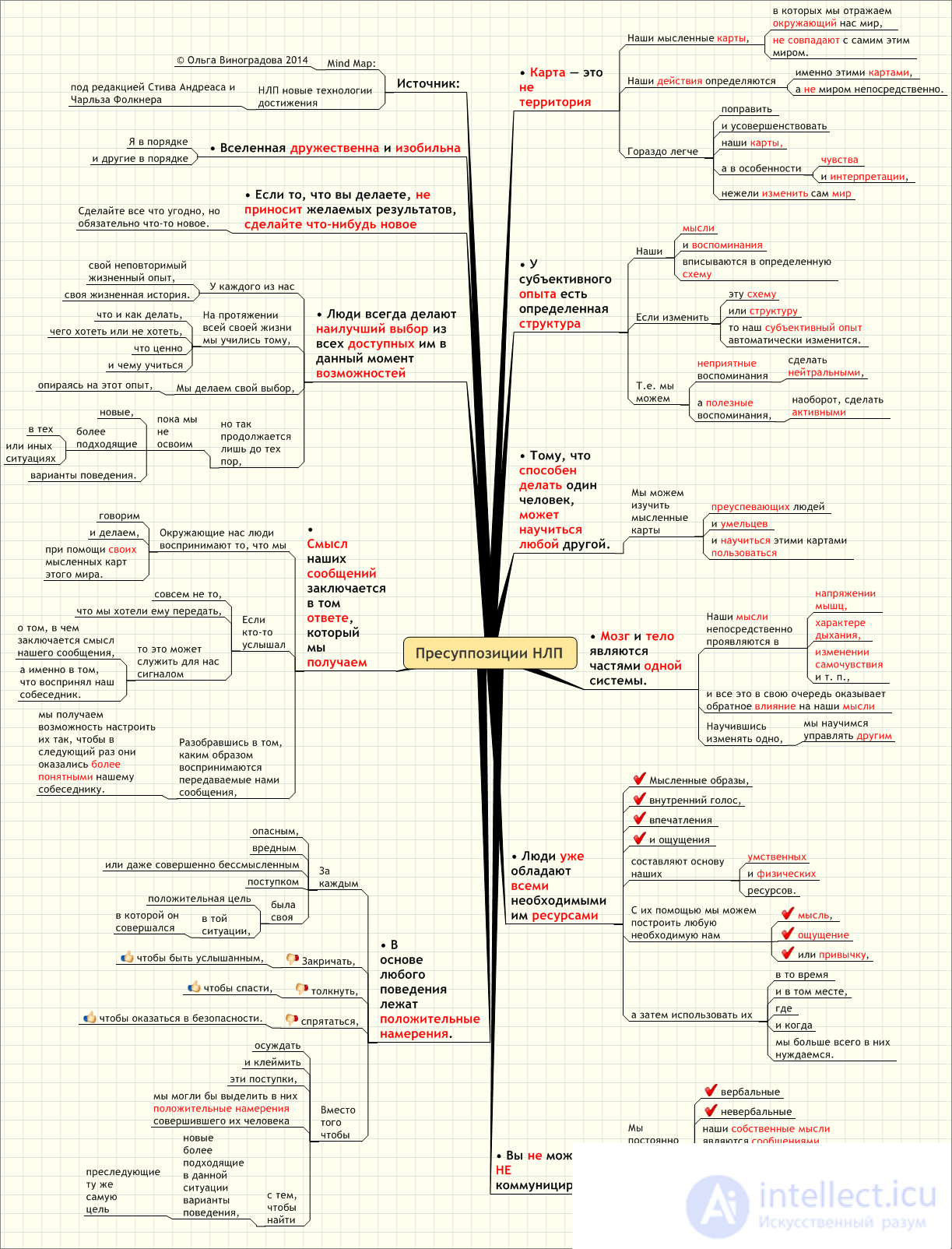
NLP presuppositions are simultaneously the basic principles of neuro-linguistic programming. Presuppositions (for example, «the universe is friendly and full of resources»), or a set of beliefs positively formulated as aphorisms (not necessarily provable), are used in NLP as a basic tool for group and individual work with techniques. The presuppositions are formulated in accordance with the principles underlying NLP. According to Jane Revell, a British NLP trainer, presuppositions «are not a philosophy, or an unshakeable worldview, or a set of rules and regulations. Rather, they are assumptions on the basis of which individuals take subsequent action» .
The map is not the territory ( the relationship between map and territory)
The epistemological principle in NLP is borrowed from the works of Alfred Korzybski (1933) and Gregory Bateson (1972, 1979) and consists in the idea that there is no such thing as «objective experience». The subjective nature of our experiences never fully encompasses the objective world. From the NLP point of view, regardless of whether there is an absolute «objective reality» or not, people do not in fact have access to absolute knowledge of reality, and all they possess is a set of beliefs about reality that they form over the course of their lives.
The presupposition «the map is not the territory» is considered[by whom?] one of the most important when working with people, in order to focus their attention on the fact that beliefs about reality and one's perception of the world (the «map») are not reality itself, or the entire totality of what can be perceived (the «territory»). In other words, NLP does not work with reality, or the «territory», but with subjective perceptions and beliefs about reality, or «maps».
The body and «mind» as a single system
The processes taking place within the human organism and in the course of a person's interaction with the environment are processes within complex systems. The organism, society, and the planet form an ecology of complex systems and subsystems that interact with and mutually influence one another. Such systems generally produce more complex behavior than merely linear processes, and examining phenomena from different points of view can lead to different, equally valid descriptions and understandings of what should be considered important within the system. For example, specialists from different fields, drawing on their own experience and knowledge, may perceive the same problem in their own way and, accordingly, propose different solutions for it. Therefore, before intervening in a situation, it is considered useful to gather information from a variety of perspectives in order to obtain the fullest possible picture of the whole complexity. Since the organism is regarded as a complex system, this principle applies to it as well.
Every behavior is underpinned by a positive intention
This presupposition is borrowed from Virginia Satir's system of beliefs and means that whatever a person does, they are, in fact, striving to fulfill some positive intention (of which they may not be aware). It is assumed[by whom?] that the current behavior displayed by a person represents the best choice available to them at that moment. According to proponents of NLP, finding new alternatives from this point of view can prove useful in helping a person change undesired behavior.
There is no failure, only feedback
In neuro-linguistic programming, communication is not viewed in terms of «success» and «failure». Rather, it is viewed in terms of effectiveness or ineffectiveness. Unsuccessful outcomes that follow certain actions are not a reason for disappointment or despair, but valuable information in the form of feedback that determines the effectiveness of what you are doing. This presupposition is borrowed from the principle of the importance of feedback loops in information theory (William Ross Ashby).
Having a choice is always better than not having one
A significant part of the basic skills of NLP consists in learning to recognize a «stuck» situation and how to see new options, in line with the aphorism that choice begins where there are three possible courses of action. Similarly, it is held that having multiple descriptions (models of processes) is better than having just one. According to systems theory, the element of a system best able to adapt, to influence the other elements, and to accomplish its tasks often turns out not to be the strongest part, but the one displaying the greatest flexibility in the range of responses it can produce.
The meaning of communication lies in the response it elicits
According to the principles of neuro-linguistic programming, in communication the meaning of the message sent lies not in the intention behind the message, but in the response it evokes in the recipient of the message. It is held that if one is guided by this principle, one can become more effective in communication, since it allows one to track, based on the response displayed, the extent to which the intended message is getting through to the client.
Other presuppositions and principles
- People have all the resources they need to succeed. It is asserted that it is useful for a subject to believe that they have everything necessary to bring about change, since, if this is indeed the case, it will help them achieve the desired results.
- Structure matters more than content. If two problems share a similar psychological structure, a similar approach can probably be used for both. Often it is precisely the structure of the problem (how it becomes fixed, what kinds of beliefs reinforce it, how the client thinks about it) that matters most, rather than the details of the situation woven into it. This separation of form and content is also used in contemporary Western psychiatry (among the pioneers of this approach are Karl Jaspers and Kurt Schneider).
- If you always do what you have always done, you will always get what you have always gotten, or in another formulation: «If you're doing something that isn't working, try doing something else» (Bandler). NLP treats tasks as rich subjects for exploration, and the principle of constantly seeking new approaches is inherent throughout its methodology.
- The principle of utilization, or «use whatever works.» A principle borrowed from Milton Erickson, known for his skill in positively utilizing the subjective image of their own defects or limitations formed by the client. NLP operates on the principle that if something helps, it can be used.
- There are no resistant clients, only insufficiently flexible therapists. Resistance also carries communicative meaning. It provides information about the client's inner world, and should often be taken into account and explored as valuable information about the client's psyche. In this respect NLP psychotherapy differs from some other psychotherapeutic approaches, in which resistance is regarded as a factor to be overcome, on the grounds that «the patient is simply not ready for change.» In NLP, however, resistance is considered an unconscious message indicating that the wrong direction of work has been chosen and pointing to the direction in which one should move instead.
- The importance of the result (effectiveness), rather than of the mechanical procedure (effectfulness): if something can be done in ten minutes, an hour should not be spent on it. NLP advocates short-term therapy, meaning that in many cases all that is needed to help a client is to change the way they interpret the situation. The task of psychotherapy is understood as the effective exploration of how a person subjectively understands, represents, and experiences their problem, and how they can be helped to achieve their goals by changing their understanding of all of this.
- Body and mind are elements of a single system. NLP takes into account that the organism (the body) influences the psyche, and the psyche influences the body. A person's psycho-emotional state is expressed in the way they walk, move, breathe, and in their muscular tension.
- NLP is based on sensory observation. Originally, as data for identifying patterns and structures observed in oneself and in other people, NLP takes into account only what can be personally perceived through the senses (external or internal). Perception is regarded as the sole basis for obtaining relevant information about the world. Phenomena such as «mind reading,» or abstract assumptions based on past rather than current experience (for example, individual or cultural stereotypes about how things should be), and reliance on «a priori knowledge» (that is, notions of what the world should be like) are avoided in NLP. Nevertheless, logical reasoning and hypothesis formation can be used as a tool for identifying possible patterns and directions of inquiry, though they always need to be verified through sensory observation.
- Awareness of meaning is not always necessary. Unlike traditional schools of psychotherapy, effective change or learning at the unconscious level is considered more important than conscious understanding. According to NLP, change does not always require interpretation or analysis; what matters is simply a change in the map of beliefs about the world and oneself, whereby what was previously inaccessible becomes possible.
- No pattern should be regarded as universal. NLP holds that the structure, or organization, of personal experience is deeply individual. That is, this structure develops in a unique way over the course of a person's individual life under the influence of various internal and external factors. Therefore, none of the NLP methods should be applied to everyone.
Various formulations of the basic presuppositions
There are various formulations of these axioms of NLP:
According to Richard Bandler
- The map is not the territory.
- Any behavior is motivated by a positive intention; for any behavior there exists a context in which it is valuable.
- The positive worth of a person is absolute, while the value and suitability of internal and/or external behaviors can be called into question.
- The ability to change the process of perceiving reality is often more useful than changing the content of the perceived reality.
- All the distinctions concerning the environment and one's own behavior that human beings are capable of making can, and usefully should, be represented in terms of visual, auditory, kinesthetic, olfactory, and gustatory perception.
- People already have all the resources they need to change.
- Feedback instead of failure — all results and behaviors are achievements, whether or not they allow one to achieve the desired result in a given context.
- The meaning of communication is the response you get
According to Robert Dilts
- The map is not the territory.
- People respond to their own perception of reality.
- Every person has their own individual map of the world. No single map — a reflection of the world — is any more «genuine» or «real» than any other.
- The meaning of communication lies in the response it elicits, regardless of the communicator's intentions.
- The most «wise» and «friendly» maps are those that offer the widest and richest range of possibilities, rather than those that are the most «genuine» or «accurate».
- People already possess (at least potentially) all the resources needed for effective action.
- Any behavior — even the cruelest, most insane, and most unimaginable — represents the choice of the best option available at the moment, given the possibilities and abilities of the person as determined by their model of the world.
- Change occurs when suitable resources are released or activated within a particular context, through enrichment of the given person's map of the world.
- Life and the «mind» are systemic processes.
- The processes occurring within a person and in a person's interaction with the environment are systemic. Our bodies, communities, and the Universe form an ecology of complex systems and subsystems that constantly interact with and influence one another.
- It is impossible to fully isolate any part of a system from the rest of the system. People cannot help but influence one another. Interactions between people form feedback loops such that a person experiences on themselves the results of the impact of their actions on other people.
- Systems are «self-organizing» and strive toward a natural state of equilibrium and stability. There are no defeats — only feedback.
- No reaction, experience, or act has meaning outside its context or outside the response it entails. Any behavior, experience, or reaction can serve as a resource or as a limiting factor, depending on how well it is aligned with the rest of the system.
- Not all interactions in a system occur at the same level. What is positive at one level may turn out to be negative at another. It is very useful to separate one's action from one's own «self», that is, to separate the positive intentions, function, beliefs, and so on that give rise to a given action from the action itself.
- Any behavior (at certain levels) has a «positive intention». It is or was perceived as positive and acceptable in the context in which it developed, and from the point of view of the person who performed the act. It is far easier and more productive to respond to the intention than to the problematic behavior.
- The surrounding circumstances and contexts change. The same action will not always lead to the same result. A certain degree of flexibility is necessary for successful adaptation and survival. The level of flexibility required is proportional to the variability of the rest of the system. As the system becomes more complex, an ever greater degree of flexibility is required.
- If your actions do not produce the expected response, you must vary your behavior until you achieve the desired one .
According to Frank Pucelik's version
- The map is not the territory.
- Difference = beauty.
- Resistance = strength.
- Trust the unconscious.
- You are the most important client.
- 50\50 (demonstrate what you teach\what you talk about).
- Respect.
- The right to make mistakes.
- Communication = manipulation.
According to Michael Hall and Bob Bodenhamer
- The map is not the territory
- People's reactions correspond to their internal maps
- Meaning depends on context
- Mind and body inevitably influence one another
- Individual skills are the result of refining and establishing a sequence for using representational systems
- We attune ourselves to other people's sense of reality by acknowledging their models of the world and joining them in order to establish rapport
- A person's identity and their behavior are different phenomena; we are something more than our behavior
- In a given context, every form of behavior is useful and has value; any form of behavior is driven by some positive intention
- We evaluate behavior and change in terms of context and ecology
- We cannot not communicate; even in trying to avoid communication, we thereby communicate something to others
- The meaning of communication lies in the response it elicits
- The person who sets the frame of the communication controls it
- «There is no failure, only feedback»
- The person with the greatest flexibility has the greatest influence in the system
- There is no resistance, only an absence of rapport
- People have no disorders; their psyche works perfectly well
- People are capable of learning very quickly, sometimes in a single attempt
- It is better to have a choice than not to have one, and the more options for choice there are, the more flexibly we can solve life's problems
- People choose the best of the available courses of action
- We are responsible for how we «manage our own brain», and thereby for our states
See also
- Neuro-linguistic programming
- The Walt Disney Method
- NLP and science
- [[b8776]]
- [[b8777]]
- Representational system
See also


Comments