
Lecture
Reframing (from English "frame") is a term widely used in NLP to describe the procedures it employs for rethinking and restructuring the mechanisms of perception, thinking, and behavior in order to get rid of unsuccessful (and possibly even pathogenic) mental patterns.
A frame around a picture is a good metaphor for understanding the essence and mechanism of reframing. Depending on exactly what falls within the frame, the information about the content of the picture changes, and consequently so does the perception of what is depicted in it.
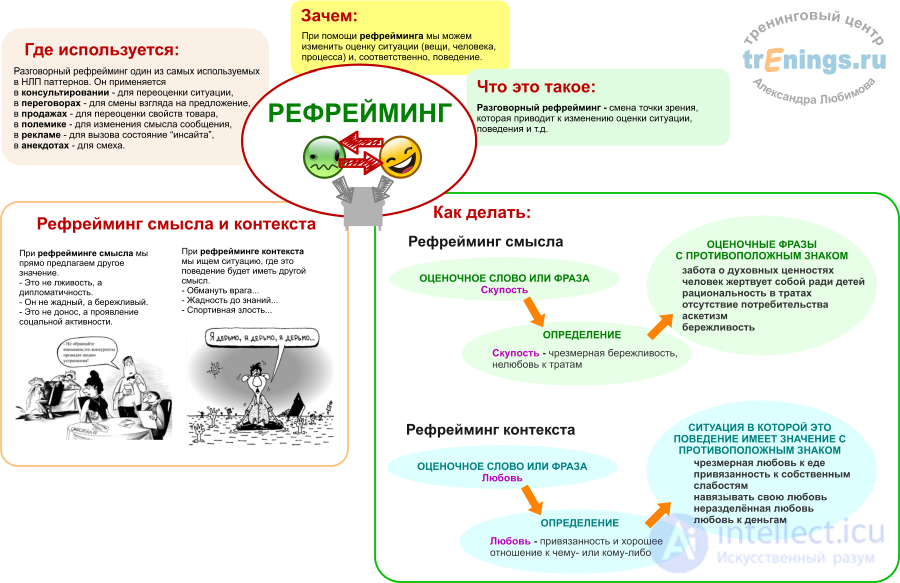
The word «reframing» is a verbal noun from the verb «reframe», meaning «to put the same picture in a new frame», «to put a new picture in the same frame», «to readjust», «to formulate anew».
Many metaphors, fairy tales, and jokes can be viewed as examples of reframing, in which events are placed within a particular «frame».
look at the world through different eyes)
The technology of reframing was developed by Richard Bandler and John Grinder in the 1980s as a result of their careful and systematic observation of the work of Milton Erickson and other psychotherapists.
Proponents of NLP describe reframing as based on the principle that «there is a positive resource in any situation», one that only needs to be seen and used. In their view, reframing is a change in the context or value of the phenomenon under consideration.
Traditionally, two main types of reframing are distinguished: context reframing and content reframing.
NLP also has a more formal variant of reframing known as «six-step reframing». This process consists of 6 steps:
From a technical standpoint, reframing can be carried out in several ways.
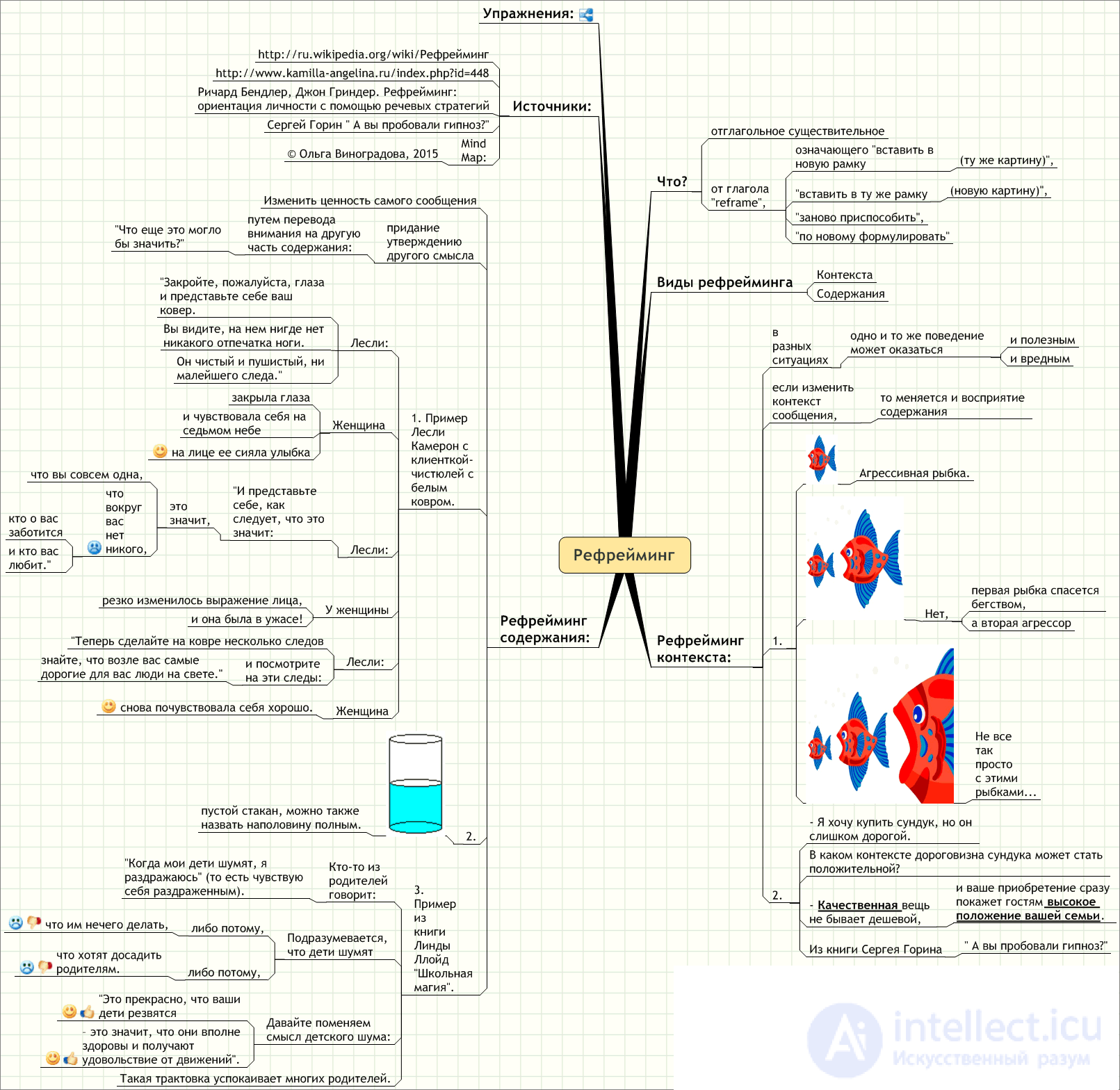
Cognitive reframing can be useful in many respects, for example, when trying to improve memory, reduce test anxiety, and help parents and children cope with disabilities. For instance, people with memory problems were told that their memory could be improved by changing their point of view on their problem. After treatment, their memory improved. Another example is parents with children who have disabilities. Some parents held negative thoughts about their children with disabilities. Cognitive reframing helped these parents view their children and their life experiences in a more positive light.
It has been shown that behavior conducive to cognitive reframing is humor, especially humor based on positivity rather than meanness. For example, in one study participants viewed a series of unpleasant pictures. To cope with these pictures, participants were asked to create a positive joke about the picture, a negative joke about the picture, or not to joke about the picture at all. A positive joke tends to evoke positive rather than negative emotions. The authors concluded that positive humor can represent a form of cognitive reframing in which people shift their point of view on some unfavorable event or circumstance toward a more positive view of the same circumstances.
Cognitive reframing can refer to almost any conscious shift in a person's mental perspective. For this reason, it is often confused with both cognitive restructuring and cognitive distortion. However, there are clear differences between them. Reframing is a general change in a person's thinking, whether positive or negative. Restructuring is an act of therapeutic change in thinking aimed at strengthening the self, meaning that it always has a positive connotation. Thus, cognitive restructuring is a specific case of cognitive reframing. Distortions are exaggerated and usually negative thoughts that are not supported by a rational thought process. If someone suffers from a series of distortions (which can lead to depression, poor decisions, and other negative outcomes), cognitive restructuring may become necessary. Consequently, distortion is a problem that can be addressed through cognitive reframing.
Another important distinguishing feature between cognitive reframing and cognitive restructuring is awareness. Cognitive reframing can occur subconsciously, whereas cognitive restructuring, usually carried out under the guidance of a therapist, is conscious. Because cognitive restructuring is a therapeutic technique, it requires the patient to recognize and consciously change their belief system to a more «positive» one. However, since reframing merely requires some mental shift in framework, there is no need to make any conscious decision to change one's point of view. For example, when a person exhibits hindsight bias, they unconsciously change their belief system in order to preserve pride and self-esteem . Although the need for negative reframing of thoughts is perhaps less common than the need for their positive reframing, there are cases where negatively reframing thoughts is useful. For example, in theater, an actor may need to appear sadder or in a more negative state of mind. To do this, he or she can change their mental state through cognitive reframing, trying to outwardly appear more dysphoric. Another application of cognitive reframing can be seen when someone tries to make their point of view objective, which shifts your perspective to a more neutral and less polarized one regarding a particular situation.

Comments