
Lecture
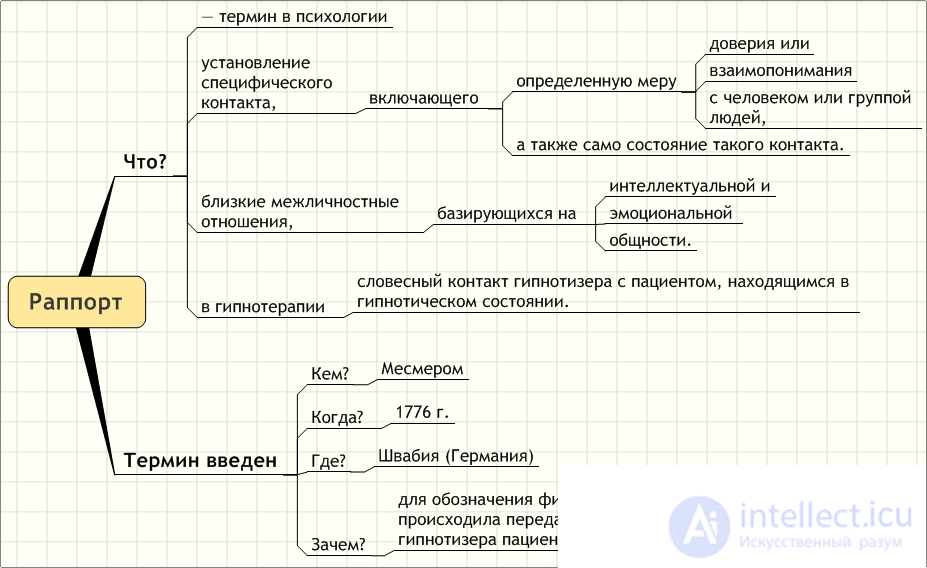
Rapport (French rapport, from rapporter — to return, to bring back) — a term in psychology with several related meanings; it refers to the establishment of a specific kind of contact involving a certain degree of trust or mutual understanding with a person or group of people, as well as the state of such contact itself.
In foreign literature the term rapport is used broadly to mean close interpersonal relationships based on intellectual and emotional commonality .
The term rapport was introduced by Mesmer to denote the physical contact through which the transfer of «magnetic fluid» from the hypnotist to the patient occurred during «mesmerization».
To achieve the benefits of interpersonal understanding in fields such as education, medicine, or even sales, several methods for building rapport between people have been demonstrated. These methods include coordination, showing attentiveness to the other person, building commonality, and managing the other person's self-perception (also called «face management»).
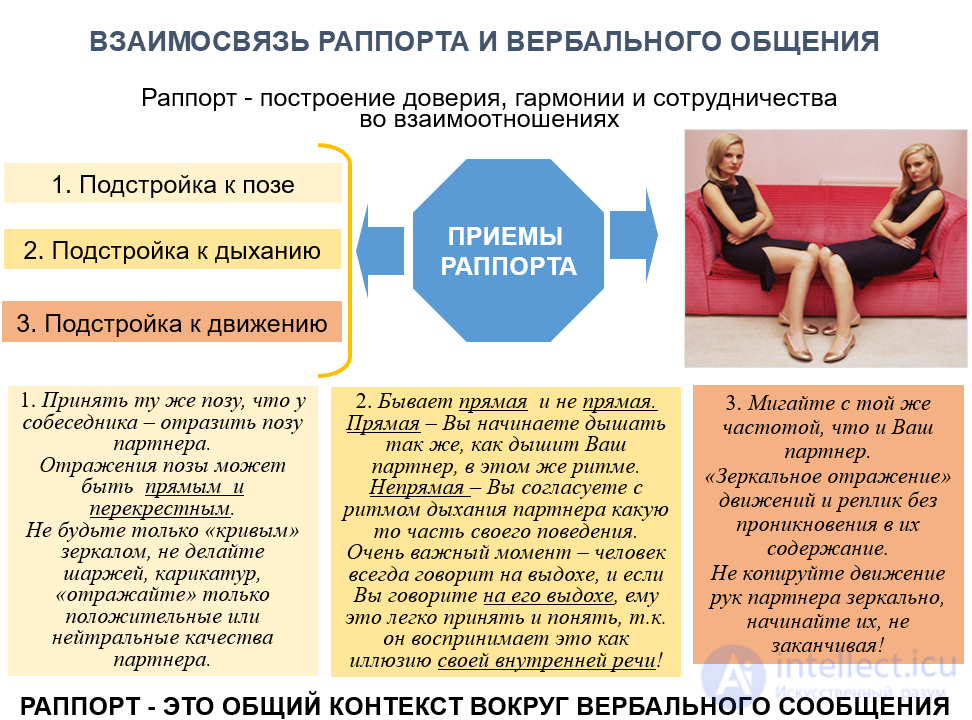
fig. THE RELATIONSHIP BETWEEN RAPPORT AND VERBAL COMMUNICATION
Coordination, also called «mirroring» , means achieving a shared rhythm with another person or coordinating verbal or nonverbal behavior.
Another way to build rapport is to show attentiveness to one another. This attentiveness can take the form of nonverbal attentiveness, such as looking at the other person, nodding at appropriate moments, or physical proximity, as seen in research on teachers' «immediacy» behavior in the classroom. This attentiveness can also be demonstrated through reciprocal nonverbal behavior, such as smiling or nodding, similar to coordination, or through mutual sharing of personal information about the other person, which signals awareness of and attention to their needs.
Commonality is a method of intentionally seeking something in common with a person or client in order to create a sense of camaraderie and trust. This is done through references to shared interests, dislikes, and experiences. [10] By sharing personal information or disclosing personal preferences or information, interlocutors can create commonality and thereby improve rapport.
Another way of building rapport is what is often called «positive face management» [11], but it can also simply be called positivity. According to some psychologists [11], we need to be seen in a positive light, known as our «face». By managing each other's «face», enhancing it when necessary, or reducing negative impact on it, we can build rapport with others. [11]
A number of benefits of building interpersonal interaction have been proposed, all of which revolve around smoother interaction, improved cooperation, and improved interpersonal outcomes, although the specifics vary depending on the domain.
In healthcare, rapport between provider and patient is often referred to as the «therapeutic alliance» or «therapeutic relationship», and it is a measure of the quality of cooperation between provider and patient, frequently used as a predictor of therapy outcomes or patient adherence to treatment.
In education, rapport between teacher and student predicts student engagement in the course, their retention in the course, the likelihood of retaking a course in that subject area, and is sometimes used to predict course outcomes. Some have argued that teacher-student rapport is an important element of what makes a teacher effective, or the ability to manage interpersonal relationships and create a positive, prosocial atmosphere of trust and reduced anxiety. [13] Student-student relationships, on the other hand, although largely beyond the teacher's control, also predict reduced anxiety during the course, a sense of support in the classroom, and improved participation in classroom discussions.
In negotiations, rapport is useful for achieving mutually beneficial outcomes , since partners are more likely to trust each other and be willing to cooperate and reach a positive outcome. However, others have found that interpersonal rapport in negotiations can lead to unethical behavior, especially in deadlock situations, where interpersonal rapport can prompt negotiators to behave unethically. [14]
In its modern sense, denoting the special verbal contact existing during a hypnosis session between the hypnotist and the hypnotized subject, the term rapport has been in use since the early 20th century .
Hypnotic rapport is a selective contact with the hypnotist. The selectivity and unusual nature of this contact lies in the fact that a person immersed in hypnotic sleep, despite general deep inhibition of the cerebral cortex and insensitivity to influences from other sources, retains a focus of excitation (the «guard post», in I. P. Pavlov's terms) tuned to the hypnotist's voice. For example, a hypnotized person may, without reacting to other sounds and without emerging from the state of hypnotic sleep, answer the hypnotist's questions. From a physiological standpoint, such a focus of excitation was regarded as the zone (point) of rapport. According to the classification developed by E. S. Katkov in the 1950s on the basis of I. P. Pavlov's teaching, the rapport zone arises at the second stage of hypnotic trance, together with manifestations of light catalepsy and inhibition of the second signaling system, and is finally formed with the onset of the third and final stage, when the second signaling system is completely switched off, with the exception of the rapport zone itself.
Hypnotic rapport can be either isolated, when any speech other than that of the hypnotist is ignored, or generalized, when, after the rapport zone has been formed, contact with the hypnotized person can be transferred to someone else and carried out not only by the hypnotist but by any person present .
In psychoanalysis, the establishment of rapport, understood as mutual agreement, an emotional bond between the client and the psychoanalyst, is considered a necessary condition for effective psychoanalysis to take place . At the same time, the relationship between the concepts of rapport and transference is viewed differently by different psychoanalysts, with rapport regarded now as a prototype of transference, now as a variety of it, an optimal level .
Thus, Jung believed that:
…a closed rapport is needed, so closed that the physician cannot take his eyes off the heights and depths of human suffering. This rapport consists above all in constant comparison and mutual comprehension, in the dialectical confrontation of two opposing psychic realities. If for some reason these mutual impressions fail to align, the therapeutic process will be ineffective.
In NLP, rapport is understood more broadly, as the establishment of a relationship of trust between two (or more) people, as well as that trust itself .
Establishing rapport between the client and the communicator is the most important task of NLP as a psychotherapeutic practice. Achieving rapport can be a lengthy process, but rapid establishment of rapport is also possible; the duration of the procedure may depend on the communicator's skill. Rapport can be achieved both at the conscious and at the unconscious level. The main method for establishing rapport in NLP is pacing (matching) the client's primary representational systems, reflecting them in communication and nonverbal behavior. Nonverbal pacing to the client's representational systems involves matching breathing rate, posture, gestures, eye movements, and so on. Verbal pacing is based on repeating characteristic features of the client's verbal behavior.
Establishing rapport can be considered important not only for psychotherapeutic practice, but also for other kinds of interpersonal communication. Thus, establishing rapport between doctor and patient can not only increase satisfaction with treatment and reduce the risk of medical negligence, but, according to some studies, can also speed up recovery and reduce the need for painkillers .

Comments