
Lecture
Psychological counseling is an important area of psychology aimed at helping people resolve a variety of problems and difficulties related to their emotional and psychological well-being. The methods and techniques of psychological counseling represent a set of tools and strategies that psychologists use to support clients in resolving personal and interpersonal problems, as well as to help develop their potential and self-awareness.
Psychological counseling is based on theories and practical approaches developed within the field of psychology and can be applied in various contexts, including clinical counseling, family and interpersonal counseling, and counseling in educational institutions and organizations. The main methods of psychological counseling include: conversation, interview, observation, active and empathic listening. In addition to the basic methods, psychological counseling also uses special methods developed within individual psychological schools that rely on a specific methodology and distinct theories of personality.
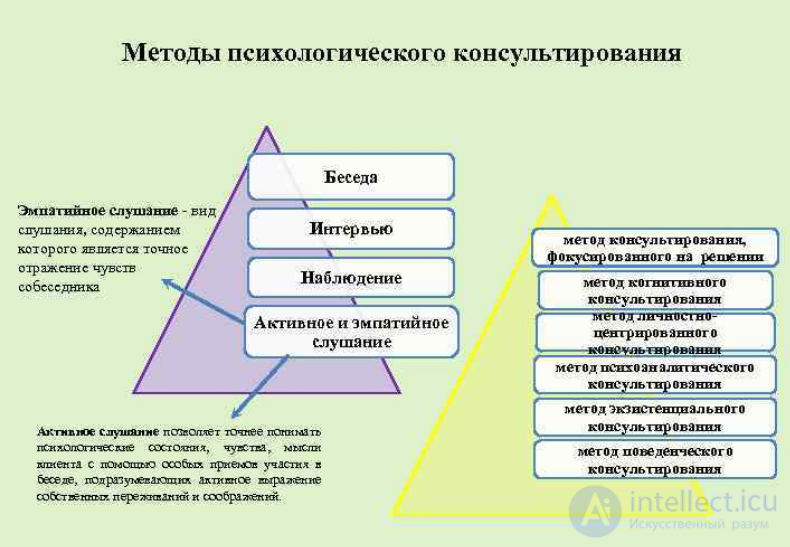
Conversation
A counseling conversation differs from what is usually encountered in everyday life, and mastering it at a professional level is a true art. A professional conversation is built from various techniques and methods used to achieve the desired effect. An important role is played by techniques of conducting dialogue, affirming the client's opinions, encouraging statements, and the brevity and clarity of the psychologist's speech, among others. The correct use of these techniques promotes the establishment and development of contact between client and counselor and the effectiveness of psychological influence.
Conversation is the primary psychodiagnostic and psychotherapeutic tool. Its goals and functions in psychological counseling are related to gathering information about the subject's mental state and establishing contact with the client. Conversation can perform psychotherapeutic functions and help reduce the client's anxiety. The counseling conversation serves as a way of accessing the client's existing psychological problems and is the background and accompaniment of all psychotechniques.
Mastery of such techniques and methods, and the enrichment of the counselor's range of statements and ideas, is largely determined by the professional's experience and familiarity with various theoretical works on psychotherapy and counseling, as well as by their professional communication with colleagues.
Interview
A conversation can be structured in nature, conducted according to a plan or program drawn up in advance. Such a structured conversation is called the interview method.
Types of interview:
standardized – has a stable strategy and clear tactics;
partially standardized – relies on a stable strategy and more flexible tactics;
freely guided diagnostic interview – based on a stable strategy but with entirely free tactics that depend on the characteristics of the client, the relationship, and so on.
Observation
Observation is the deliberate, systematic, and purposeful perception of mental phenomena aimed at studying their specific changes under certain conditions and uncovering the meaning of these phenomena, which is not given directly. The counselor must have skills in observing the client's verbal and nonverbal behavior. A good knowledge of the various types of nonverbal languages serves as the initial basis for understanding nonverbal behavior (see Documents 1, 2, 3).
Active listening
Active listening aims to accurately reflect the speaker's information. This method promotes more accurate mutual understanding between partners, helps create an atmosphere of trust and emotional support, and also serves to expand the client's awareness of the problem situation. Active listening involves the use of a number of techniques:
an interested attitude toward the interlocutor, demonstrated by the posture of an interested listener and a benevolent gaze directed at the interlocutor;
clarifying questions: «Did I understand correctly that …?», «Do you mean that…?»;
receiving an answer to one's question;
repeating what the interlocutor said: «You are saying…»;
rephrasing the interlocutor's thought: «In other words, …»
supportive reactions: «uh-huh reactions», «Yes, yes», encouraging the interlocutor to express their thought: «that's interesting», «go on, go on»;
summarizing: «Overall, you mean…?», «So, it turns out…», «We talked about…», «It can be concluded…».
The "active listening" method is a mandatory method of psychological counseling, and mastering all of its techniques is one of the requirements for the professional skills of a psychologist-counselor. Novices often underestimate the importance of using this method, and the task of accurately reflecting the information communicated by the client is replaced by the counselor's desire to come up with their own interpretation of the motives behind the client's actions and personality traits, as well as a striving to give the quickest possible assessment of the client's personality as a whole. Using the "active listening" technique of "repetition" allows the client to feel reassured that they are being listened to and understood attentively. In addition, this same technique gives the client the opportunity to "hear themselves" from the outside and better understand themselves and the situation.
5. Empathic listening is a type of listening whose content is the accurate reflection of the interlocutor's feelings. It is used in situations where the interlocutor needs to share their experiences and is themselves the initiator of the conversation. Empathic listening involves:
avoiding evaluations and interpretations of the interlocutor's hidden behavioral motives (instead of the usual statement containing reproach and judgment: "It's your own fault that this happened to you. You have a difficult personality"
one could say instead: "Are you upset? Does your quick temper, your intolerance, irritate you?...");
accurately reflecting the interlocutor's experience, feeling, and emotion, while demonstrating understanding and acceptance of them.
Important characteristics and means of effective communication (during counseling) are:
- empathy - compassion, understanding of another person on the level of feelings, experiencing the same emotional states that the other person is experiencing;
- reflection (awareness of how one is perceived by one's communication partner, the ability to analyze one's own mental states, actions, and deeds),
- identification (likening oneself to, identifying oneself with another person, mentally placing oneself in the other person's position or situation).
The method as a set of psychotechniques developed within individual psychotherapeutic and personality theories:
- the person-centered counseling method,
You will become more closely acquainted with a number of these methods further below in Section 4: "Theoretical Approaches and Models of Psychological Counseling."
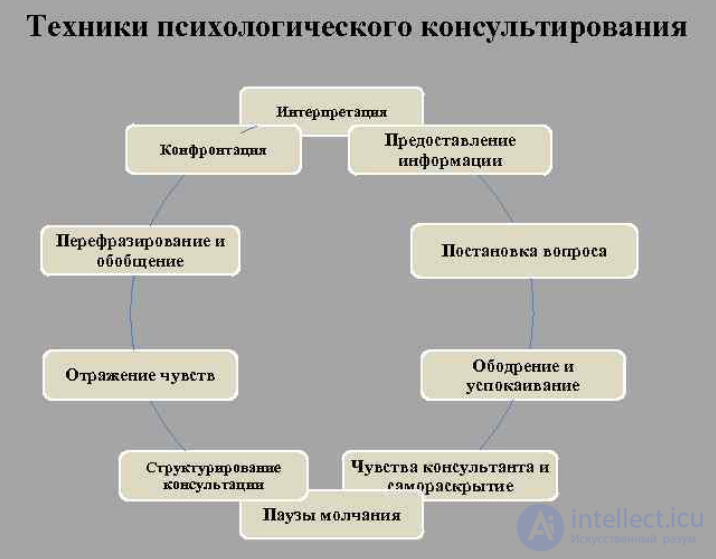
psychological counseling techniques
The method "Let's think together!"
Before the psychologist sits an adolescent or older student with a passive attitude. To neutralize the student's drive to obtain a ready-made piece of advice and to activate their behavior, the psychologist begins the consultation with the following words: "Let's try to solve your problem together! I can't offer you a ready-made solution — we will discuss issues related to your problem and search for a solution together. It would be great if we could have a conversation between equals. In analyzing your problems, I too may experience difficulties, just as you do. However, I do have professional knowledge and life experience. I will try to help you. But the decision needs to be made by you yourself."
The method "Psychological contact"
The atmosphere of the conversation should predispose the student to communication and help them genuinely feel psychologically equal to the adult. If, on the other hand, the psychologist begins the conversation with the words "Well, what's happened to you again?" spoken in a "teacher's voice," with a strictly formal facial expression, the client will "trigger" a relationship pattern of the "teacher-student" type, and a genuine psychological conversation will not take place. To establish an initial, emotionally positive psychological contact, it is advisable to ask the adolescent or older student a few neutral questions (about a new music group, a film, etc.). From the very first minutes of the meeting, it is necessary to show that the counselor sees in their young conversation partner not only a client, but above all an interesting interlocutor.
Documents 1 - 3.
Document 1. Nonverbal languages of communication
Nonverbal means of communication include body movements, intonational characteristics of the voice, tactile influence, and spatial organization.
According to American psychologist Mehrabian, 55% of information is perceived at the level of nonverbal visually perceived signals (posture, gestures, gait, facial expressions, the distance at which people communicate), 27% is absorbed at the level of aurally perceived nonverbal signals (intonation, tempo, expressiveness of speech; timbre, force of stress, loudness of voice) and psychophysiological accompaniments of speech (sighing, laughter, crying, tears, etc.). Thus, 82% of the information conveyed to a communication partner does not depend on what we say. And only 18% is actual linguistic information, i.e., the content of the message.
Table 1.
|
Kinesics (expressive movements) |
Prosodics and extralinguistics |
Tactesics |
Proxemics |
|
Posture Gestures Facial expressions Gait Visual contact (gaze) Direction of movement Length of pause Frequency of contact |
Intonation Loudness Timbre Pauses Sighing Laughter Crying Coughing
|
Handshake Kiss Pats |
Orientation and angle of communication
Distance |
Kinesic means – visually perceived movements of another person.
Prosodics – the rhythmic-intonational aspects of speech: pitch, loudness of the voice tone, timbre of the voice, force of stress.
The extralinguistic system – pauses and psychophysiological manifestations.
Tactesics – the dynamic touching of partners with one another.
Proxemics – the orientation of partners at the moment of communication and the distance between them.
Table 2. Norms of approach to a person
|
Communication distance |
Distance |
|
Intimate |
0 – 45 cm |
|
Personal |
45 – 120 cm |
|
Social |
120 – 400 cm |
|
Public |
400 – 750 cm |
Table 3. Psychological meaning of the angle of communication
|
Angle of communication |
Position in the relationship |
|
facing |
competing position |
|
corner position |
friendly |
|
on one side of the table |
cooperation |
|
diagonally |
independent position |
Document 2. Main characteristics of the Ego states «Parent», «Adult», «Child» (according to E. Berne)
Table 4. Main characteristics of the Ego states
|
|
Parent |
Adult |
Child |
|
Characteristic words and expressions |
Everyone knows that… You must never… You must always… I don't understand how they allow this… etc. |
How? What? When? Where? Why? Perhaps… Probably… |
I'm angry with you! Great! Excellent! Disgusting! |
|
Intonations |
Accusing, Condescending, critical |
Connected with reality |
Very emotional |
|
State |
Haughty, Overly correct, very proper |
Attentiveness, seeking information |
Clumsy, depressed, oppressed, playful |
|
Facial expression |
Frowning, dissatisfied, worried |
Calm, maximum attention |
Dejection, surprise |
|
Postures |
Hands on hips, pointing finger. Arms crossed on the chest. |
Leaning toward the interlocutor and orienting toward them |
Spontaneous movement (pacing, clenching fists). |
In this document, we present to your attention an excerpt from the book Flemming Funch's «Transforming Communication», containing exercises, procedures, techniques, and recommendations for developing observation skills6.
The facilitator observes, calculates, and acts. That is, a session is a repeating cycle:
Observation here is one of the key components.
The facilitator needs to use all available perceptions. This means that ideally you are a body language expert and a clairvoyant. If that's not the case, don't despair, just aim to become one in the future.
Simply by looking at a person and listening to them, you can learn a great deal about them, if you know what to pay attention to. This is one of the reasons why I personally don't keep detailed notes during a session and don't engage in other distracting rituals. For me, it is far more valuable to look at the person and observe what is happening.
Some of the body language elements you can observe are:
Some auditory indicators you can listen for are:
With the help of these various indicators, you can find out, for example:
The client's body can answer most of your questions. They may not be aware of this, and you may well notice more than they do.
The more information you get from the person, the better you can assess what to do next. And often the information you gain through direct observation is better than what the person tells you.
Exercise
Observe several other people. Write down everything you can notice about their body language, way of breathing, gestures, and so on. Listen to how they speak, and write down the peculiarities of their manner of speech.
To find out what is happening with a person, the best tool is their body. The state of the body reflects their overall state. This information is very useful, both for the person themselves and for the facilitator.
It is best if the person is in a harmonious relationship with their body and feels what is happening with it. But even if that's not the case, the facilitator can gather a lot of information.
A person's external body language speaks more eloquently than any words. By observing posture, eye movements, breathing, and skin color, one can learn about what the person is doing in their mind. The same information can be obtained by listening to the peculiarities of their tone of voice. And all this simply by observing and listening to the person. If you add a bit of extrasensory perception, it just becomes much easier.
Body language is a big topic, and mastering it to perfection requires a great deal of experience and training. Here we will give only some of the most useful things to notice.
If you don't know what certain body movements mean, you can simply notice moments of change. For example, if a client was sitting completely still and suddenly starts fidgeting or darting their eyes around — that's a change. Or if they changed their breathing rate — that's a change.
Say you asked the client to close their eyes and return to a past incident. At first they just sit still, their eyes not moving. But suddenly you see their eyes moving under their eyelids, their head twitching slightly, and their breathing quickening. This most likely means they have found the incident. Interestingly, they themselves may not have noticed this. Subconsciously the incident is right in front of them, but consciously they may not acknowledge it. So, if they haven't started talking on their own, ask them “What is it?” or “What do you see?”
When we are working with incidents, the body often shows what is in the incident, and how the person relates to it. If their pupils are moving, it means there is something to look at in the incident. If they suddenly start breathing quickly and heavily, it means something exciting or difficult is happening.
If the client leans forward, they are most likely in the incident, directly participating in the events. If they lean back, they are most likely viewing the incident from a distance.
You cannot say for certain what is happening based on body movements alone. But they give you an excellent clue. Especially if you notice changes in response to your instructions. If you ask: “Is there another viewpoint in this incident?”, and the client suddenly leans back, this most likely means an external viewpoint, observation from a distance.
There is a whole set of signals that indicate which perceptions a person is using. To simplify this, body perceptions can be divided into “visual,” “auditory,” and “kinesthetic.” That is, pictures, sounds, and sensations. What the person is mainly perceiving right now, as well as what they mainly hold in their mind. What is in the mind mainly consists of combinations of pictures, sounds, and sensations. When a person is searching for something in their mind, their body can reflect the type of this information — whether it is mainly pictures, sounds, or sensations.
Sensations have a low frequency, they are slow and deep. Auditory perceptions have a higher frequency, they are faster and more mobile. Visual perceptions have the highest frequency, they are fast and changeable. These features are largely noticeable in body language.
A person breathes shallowly, with the upper part of the chest, when processing visual information. He breathes deeply and slowly when processing kinesthetic information. And somewhat moderately, when processing auditory information.
When processing visual information, a person often looks up, straightens up, and makes gestures in the air. When processing auditory information, a person often looks to the side, tilts the head to the side, and crosses the arms. When processing kinesthetic information, a person often looks down and slouches.
When processing visual information, a person speaks faster and in a higher tone of voice than when processing auditory information. When processing kinesthetic information, he speaks in a lower, slower tone of voice.
You may be more or less of a specialist in interpreting all these bodily reactions. But you don't need to know them completely in order to conduct elementary processing. If you notice changes and reactions, and notice when the client looks happy and satisfied and when not, you can conduct your sessions just fine.
But if you know body language very well, you can work wonders with it. People will confidently claim that you are reading their minds, when in fact you are simply looking at them.
Observe several people. Notice signs of visual, auditory, and kinesthetic information processing in their body language.
1. What is psychological counseling?
2. What does counseling psychology study?
3. What goals does psychological counseling pursue? What tasks does it solve?
4. What are the differences between psychological counseling and other fields of applied psychology?
5. Who most often seeks help from a counseling psychologist, when, and for what reason?
6. What types of psychological counseling exist and what are their features?
7. What are the methods of psychological counseling?
1. Counseling psychology is a field of knowledge containing …
2. Counseling psychology became substantively and organizationally distinct …
3. Psychological counseling is …
4. The process of psychological counseling differs from psychotherapy and teaching, above all, …
5. The goal of psychological counseling is …
6. Among the forms of psychological counseling are …
7. Match the following:
|
Criterion for distinguishing types of counseling |
Types of counseling |
|
A. By the nature of motivation |
1. Single and multiple counseling |
|
B. By the criterion of combination with other methods of psychological help |
2. Counseling without additional testing and with additional testing |
|
C. By the nature of the communication means used |
3. Age-related, psychological-pedagogical, interpersonal, family, professional, business, crisis counseling, psychological counseling on issues of well-being and health status |
|
D. By the number of meetings |
4. Isolated and combined psychological counseling |
|
E. By the nature of the tasks being solved |
5. Counseling by personal request and counseling as a result of a referral or summons |
|
F. By the criterion of the use of psychodiagnostic tools |
6. In-person and telephone counseling |
8. Techniques of active listening do NOT include:
9. Empathy is the process of:
10. Exclude the odd one out: The methods of psychological counseling include:
Psychological counseling plays a significant role in improving people's emotional and psychological well-being. It helps resolve personal and interpersonal conflicts, as well as develop personal resources and potential.
The methods and techniques of psychological counseling are diverse and may include approaches such as cognitive-behavioral therapy, gestalt therapy, psychoanalysis, and many others. The choice of a particular method depends on the client's needs and character.
Effective counseling requires the psychologist's professional training and empathy toward the client. Understanding the client's individual characteristics and context is a key aspect of successful work.
Psychological counseling is applied in various fields, including psychotherapy, family counseling, work with children and adolescents, as well as in a business context for stress management and improving work performance.
Psychological counseling continues to develop and adapt to modern challenges, including the impact of digital technologies and changes in social and cultural norms.
Overall, the methods and techniques of psychological counseling have a profound and positive effect on the lives of many people, helping them achieve psychological stability, improve the quality of their relationships, and attain personal and professional goals. This field of psychology continues to evolve and remains relevant in the modern world.

Comments