
Lecture
Positive counseling can be defined as an alternative approach to traditional counseling methods. Positive counseling, on the one hand, involves specific counseling techniques, and on the other hand, calls for their flexible application, oriented toward the uniqueness and distinctive culture of each particular counseling encounter, while also meeting the requirements of brevity. Positive counseling also involves teaching patients self-help methods.
Positive psychotherapy (since 1977) is a psychotherapeutic method developed by Nossrat Peseschkian and his colleagues in Germany since 1968. It can be characterized as a humanistic, psychodynamic psychotherapy based on a positive understanding of human nature.
Positive psychotherapy is an integrative method that combines humanistic, systemic, and psychodynamic elements. Today there are centers and training programs in roughly twenty countries around the world. It should not be confused with positive psychology.
The concept of positive psychotherapy and its development involve satisfying basic human needs in harmony with one's environment, and the full involvement of specific people in this process.
The term «positive psychotherapy» was introduced in 1972 by the well-known German psychotherapist and doctor of medicine Nossrat Peseschkian (N. Peseshkin) to name his own psychotherapeutic concept and strategy, aimed at harmonizing a person's life, increasing the realism of their worldview, and working through both the negative and positive aspects of their problems. He understands positivity as wholeness, unity in diversity, and the overcoming of any one-sidedness both in relation to a person's inner picture of the world and to their life in society. Proceeding from the original meaning of the Latin word «positum», the term «positive» means «factual», «real», «present». What actually exists is not only illnesses and disorders, not only failed attempts to solve problems, but also the abilities and capacities inherent in every person, which can help them find new, different, and perhaps better solutions.
The task of the positive counselor is to help the client see, beyond the weak and problematic aspects of their current life situation, its strong and resourceful sides, and to help the client find alternative possibilities and solutions that had previously been blocked.
Peseschkian proclaims a cross-cultural approach in psychotherapy, whose distinguishing feature is an integrativeness that accepts and reconciles various culturally specific images of the person and normative ideas about their behavior.
Most interpersonal conflicts represent a clash of very different cultural and behavioral orientations. The positive counseling approach is especially relevant in conditions of intolerance, which is, in essence, non-positivity.
In the counseling process, it is important, without attacking the client's system of value orientations, to show the one-sidedness of their position. In this respect, the use of metaphors, fairy tales, and stories in counseling encourages a person's imagination and intuition, and helps mutual understanding between counselor and patient.
Positive counseling is the acceptance of a person as they are, without any striving to remake them according to a predetermined pattern imposed from outside. The principle of interaction between client and counselor in positive counseling is equality of positions. Positive counseling is characterized by open, respectful cooperation, which excludes suppression and encourages the patient's initiative. This method cultivates a finer sensitivity to any forms of suppression and violence – especially to those which we ourselves unconsciously approve of and support. Positive counseling is largely aimed at working with a person's worldview, and one of its tasks is overcoming stereotypes, rigidity, and errors of thinking.
Traditionally, the counseling scheme consists of: 99% talking about the problem and only 1% solving it. This approach considers it important to understand not where the problem came from, but what is maintaining the current state, what is preventing change. What to do about it – that is the question a psychologist of this approach seeks to answer.
Another important distinction of counseling in this approach from others lies in the ability to question whether the problem is indeed a problem, and not something else. Perhaps the client is dealing with an achievement, which could well be regarded as a certain ability.
Peseschkian's positive psychotherapy has a number of shared postulates and principles.
Postulate 1. Analyzing the causes of the illness or problem leads to the emergence or intensification of feelings of guilt and hopelessness, which are destructive to psychotherapy. Blaming one's loved ones, in turn, hinders cooperation. Therefore, the main priority task of counseling becomes the search for and realization of resources for overcoming the problem.
Postulate 2. Quality of life depends on a person's worldview and their attitude toward events that occur. A person is not free to rid themselves of all problems, but can change a «black» vision to a more «dialectical» one.
Postulate 3. Confrontation or struggle with a problem is in most cases ineffective. Every problem has its own positive aspect. Accepting this aspect and seeking a compromise is the path to a solution.
Postulate 4. The framework of any psychotherapeutic concept is always narrower than the individual characteristics and experience of specific patients. An adopted concept can impose unrealistic and ineffective solutions due to dogmatic belief and logical «beauty». Effective solutions are suggested by the experience and intuition of the patient themselves, their family, and the psychotherapist.
From the postulates listed above, a number of strategic principles of positive counseling follow.
An emphasis on resources and the positive dynamics of the problem.
The use of the patient's experience, worldview, interests and emotions, as well as those of the psychotherapist.
A non-theoretical, non-normative view of the problem, relying on the person's subjective concept of «health–illness».
Economy and brevity (what can be done with small means, do not do with large ones).
A predominant orientation toward the patient's future. The past cannot be changed, the present is already underway, and only the future can be changed.
Cooperation and transparency, implying the transfer of responsibility for decision-making to the patient.
Technical flexibility and adaptation to the specific patient.
The central concept revealing the essence of the new view of psychotherapy and counseling is the concept of resource. Positive psychotherapy has convincingly shown that any theoretical postulates, principles, and models can be changed depending on the goals, tasks, conditions of the situation, and the characteristics of the patient and the psychotherapist themselves.
It is precisely for the purpose of identifying and actualizing resources to overcome a problem, as well as for the most therapeutic framing of questions, that the solution-focused conversation method was developed.
Until 1977 this method was called Differential Analysis. Then, in 1977, Nossrat Peseschkian published his work «Positive Psychotherapy», which was published in English as «Positive Psychotherapy» in 1987. The term «positive» comes from the original Latin expression «positum or positivus», meaning fact, actual, real, concrete. The goal of positive psychotherapy and positive psychotherapists is to help the patient and client see their abilities, strengths, resources and potential.
Three basic principles, or pillars, of positive psychotherapy:
1. The principle of hope implies that the therapist wants to help patients understand and see the meaning and purpose of their disorder or conflict. Accordingly, the disorder will be reframed in a «positive» way (positive interpretations).
A few examples: a sleep disturbance is the ability to remain vigilant and manage with little sleep; depression is the ability to react to conflicts with the deepest emotionality; schizophrenia is the ability to live in two worlds at once, or to live in a world of fantasy; anorexia nervosa is the ability to manage with few meals and to identify oneself with the world's hunger.
Thanks to such a positive outlook, a change of viewpoint becomes possible not only for the patient but also for those around them. Consequently, illnesses have a symbolic function, which must be recognized by both the therapist and the patient. The patient learns that the symptoms and complaints of the illness are signals meant to bring their four qualities of life into a new balance.
2. The principle of balance: despite social and cultural differences and the uniqueness of each individual, it can be observed that when solving their problems, all people resort to typical forms of resolving them. Thomas Kornbichler explains: «With the help of the Balance Model of positive psychotherapy (an innovative modern approach to dynamic psychotherapy), Nossrat Peseschkian formulated a vivid model for overcoming conflicts across different cultures».
3. The principle of consultation: the five stages of therapy and self-help. The five stages of positive psychotherapy represent a concept in which therapy and self-help are closely interrelated. The patient and their family together receive information about the illness and an individual solution to this problem.
Positive psychotherapy emphasizes mobilizing existing abilities and potential for self-help, rather than focusing primarily on eliminating existing disorders. Therapy begins with the developmental possibilities and abilities of those involved (Peseschkian N. ), following the approach of Maslow , who introduced the term «positive psychology» to emphasize the importance of focusing on the positive qualities in people. Symptoms and disorders are viewed as reactions to conflicts, and the therapy is called «positive» because it recognizes the integrity of the people involved, encompassing both the pathogenesis of illness and the salutogenesis of joys, abilities, resources, potentials, and possibilities. (York K., Peseschkian N. ).
The term «positive» in positive psychotherapy is based on the concept of «positive sciences» (based on Max Weber, 1988), which means describing an observed phenomenon without judgment. Nossrat Peseschkian uses the term positum in a broader sense, meaning that which is available, given, or actual. This positive aspect of illness is just as important for understanding and clinically treating the ailment as the negative aspect. Therapy is aimed at mobilizing existing abilities and potential for self-help and focuses on the developmental possibilities and abilities of those involved, rather than simply viewing them as a «set of symptoms». Peseschkian believed that symptoms and disorders are a reaction to conflicts, and the therapy is called «positive» because it proceeds from the idea of the wholeness of those involved as a given.
The concept of positive psychotherapy is based on a humanistic view of human nature , which emphasizes the goodness and potential inherent in every person. According to PPT, people have two basic capacities: to love and to know, and through education and personal development they can develop these capacities and their unique personality. Therapy in this context is seen as a tool that promotes further growth and learning for the patient and their family.
In positive psychotherapy, disorders are reframed in a positive light. Depression, for example, is viewed as «the capacity to respond to conflicts with deep emotionality»; fear of loneliness is viewed as «the striving to be with other people»; alcoholism is reframed as «the capacity to supply oneself with warmth (and love) not received from others»; psychosis is viewed as «the capacity to live in two worlds at once»; and heart disorders are viewed as «the capacity to take something very close to heart».
The positive process associated with PPT leads to a shift in perspective for all parties involved, including the patient, their family, and the therapist/physician. Instead of focusing exclusively on the symptom, attention is directed to the underlying conflict. In addition, this approach makes it possible to identify the «real patient» , who is often not the one seeking treatment, but rather a member of their social environment. the potential function and psychodynamic significance of their illness for themselves and those around them, and to recognize their abilities, not just their pathologies.
The Balance Model is widely known and can be applied in various fields, including therapy, self-help, and family therapy. It can be compared to Freud's concept of libido, Adler's life goals, and Jung's four functions of perception, attitude, sensation, and intuition . The Balance Model offers a structural representation of the personality and makes it possible to identify areas in which a person may be lacking. By addressing these areas, a new balance can be achieved, leading to synthesis within the therapy.
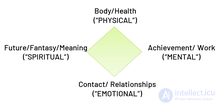
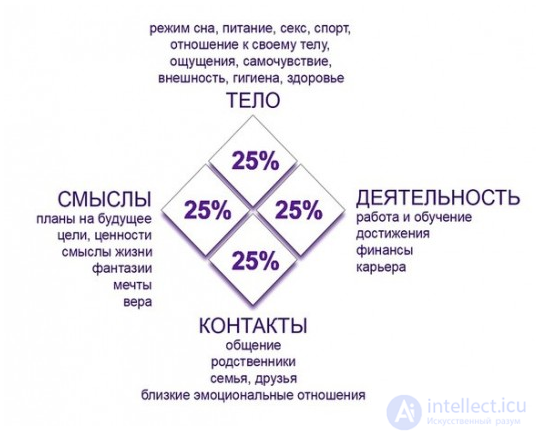
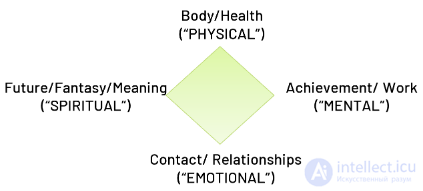
The Balance Model in positive psychotherapy, developed by Nossrat Peseschkian
The Balance Model is based on the concept that there are essentially four areas of life in which a person lives and functions, and which significantly influence a person's overall satisfaction, self-esteem, and ability to cope with difficulties. These areas serve as key indicators of a person's personality at any given moment and encompass the biological-physical, rational-intellectual, social-emotional, and imaginative, value-oriented aspects of daily life. Although all people possess potential in each of these areas, some may be more prominent or neglected depending on differences in upbringing and environment. Life energies, actions, and reactions are influenced by, and connected to, these four areas:
The goal of the Balance Model is to restore equilibrium between the four spheres of life. In psychotherapeutic treatment, the goal is to help the patient identify their own resources and use them to achieve a dynamic balance. In particular, this entails prioritizing a balanced distribution of energy, with each area receiving a dynamically equal share (25%), rather than an equal amount of time. Prolonged one-sidedness can lead to conflicts and illness, among other negative consequences.
Assessing the impact of early childhood experiences on the patient is an important and complex task of psychodynamic psychotherapy. In PPT, the concept of model dimensions, also known as "examples," "role models," or "forms of love," is used as a tool to describe the pattern of family concepts that shape individual experience and development. Early upbringing and environment influence the unique development and expression of the basic capacities for love and knowledge, as described by Nossrat Peseschkian. The Balance Model illustrates the means of the capacity to know and the means of the capacity to love.
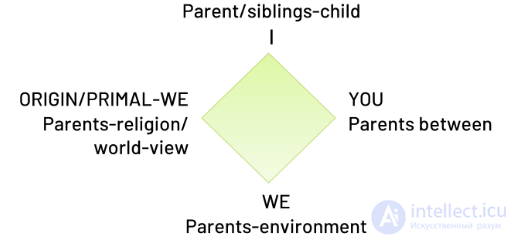
The four model dimensions of positive psychotherapy
The use of the four model dimensions in PPT expands the analytic theories of the self and object relations theories of Kohut and Kernberg by introducing not only the "I" dimension, but also the "You," "We," and "Primary We" dimensions. The "You" dimension represents the relationship between the patient's parents or primary caregivers with each other, while the "We" dimension encompasses the experience of the parents/primary caregivers with other people. The "Primary We" dimension, unique to PPT, describes the relationships between the patient's primary caregivers, such as parents and grandparents, and their life philosophy or religious beliefs. Including these four relational dimensions,
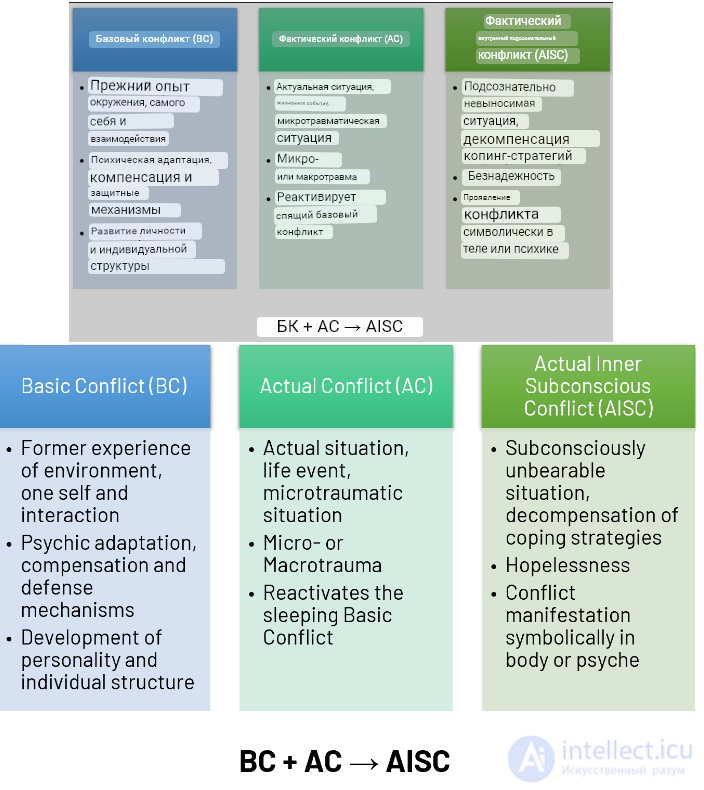
Peseschkian's psychodynamic model of conflict (see figure) emphasizes the differentiation of the content that is the focus of disagreement from its inner evaluation. The model distinguishes between an actual conflict arising in a burdensome situation, a pre-existing basic conflict, and an unconscious inner conflict that produces physical and/or mental symptoms. The term «conflict» (from the Latin confligere, meaning to clash or struggle) refers to an apparent incompatibility between inner and outer values and concepts, or to inner ambivalence. Emotions, affective states, and physical reactions can be understood as signal indicators of an inner conflict of values and of the distribution of actual abilities. This is why PPT asks the content-related question: what causes or triggers this emotion?
At the first consultation (session), the client describes their problem, and the PPT therapist listens, asks clarifying questions, and conducts a full assessment using the balance model and the imitation model:
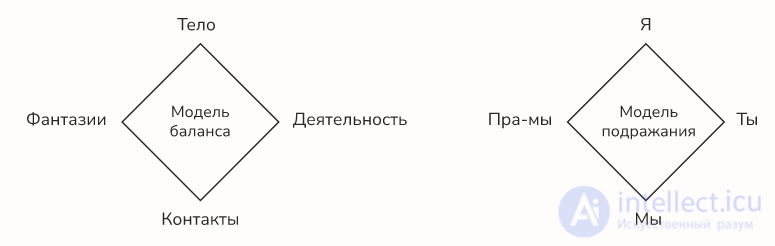
A person's current life problem (the Actual Conflict) is described through 4 spheres: how the body reacts to the situation, how the person acts in the situation, how they communicate, and what the whole situation means to them (what they fantasize or dream about, what they think about the future). If the 4 spheres are out of balance, the person experiences discomfort and negative emotions. To analyze the causes of the imbalance, parental attitudes are identified using the imitation model: how the parents (or significant adults) related to themselves, to each other, to strangers, to faith, what they said about the future, about traditions, and what they dreamed about. The imitation model makes it possible to understand the origin of negative emotions and the causes of a person's behavior.
Therapeutic work is built on the conscious, optimal development of new skills according to a 5-step model: observation, understanding, encouragement, verbalization, and broadening of goals.
Peseschkian's concept of «microtrauma» refers to the accumulation of small, repeated psychic traumas that cause microstress, or «trifles, or small things» ., and can provoke inner conflicts. These microtraumas differ from major life events or macrotraumas. They are considered conflict content and are linked to the actual abilities that people possess, which allow them to form relationships but can also become a source of conflict. In an actual conflict, when coping mechanisms are overloaded, an old unconscious basic conflict can arise, pitting primary emotional needs such as trust, hope, or tenderness against secondary abilities or social norms such as orderliness, punctuality, fairness, or openness. When a previous compromise that worked to resolve the basic conflict is no longer effective, an inner conflict arises, leading to symptoms that are seen as attempted solutions.
These conflict reactions can be represented using the balance model.
When certain abilities, morals, ideas, or principles are consistently applied without adapting to current circumstances, this can lead to disorders. If family concepts or compromises reached in the past continue to repeat themselves, an unconscious inner conflict may arise that can cause psychological, psychosomatic, or physical disturbances. These symptoms serve as a way for the patient to unconsciously express something and carry a special meaning for each individual. The goal of PPT is to strengthen forgotten areas and underdeveloped abilities within the therapeutic relationship and in everyday life, enabling patients to effectively
resolve conflicts and achieve inner and outer balance.

Comments