According to V.V. Stolin, a client's spontaneous complaints can be structured as follows:
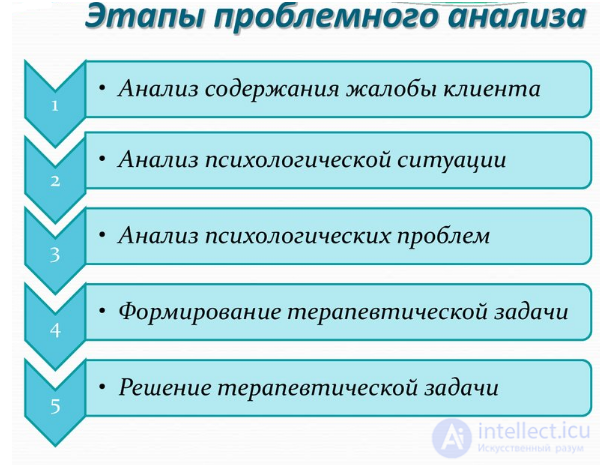
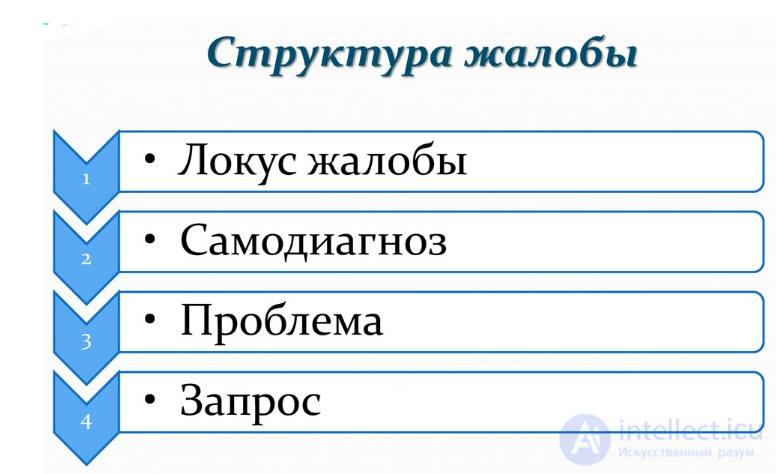
I. The locus of the complaint, which is divided into:
— subject (who is being complained about),
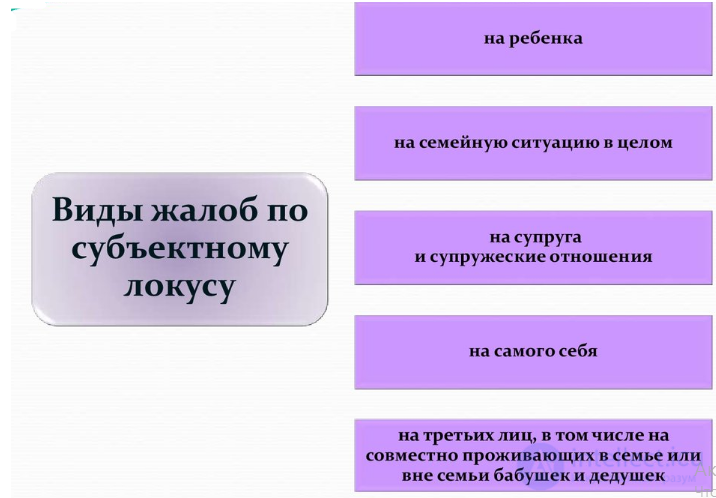
— object (what is being complained about). By subject locus, five main types of complaints (or their combinations) are encountered:
- a) about the child (his or her behavior, development, health...);
- b) about the family situation as a whole (in the family «everything is bad,» «everything is wrong»);
- c) about the spouse (his or her behavior, characteristics) and the marital relationship («there is no mutual understanding, no love,» etc.);
- d) about oneself (one's own character, abilities, characteristics, etc.);
- e) about third parties, including grandparents living within or outside the family.
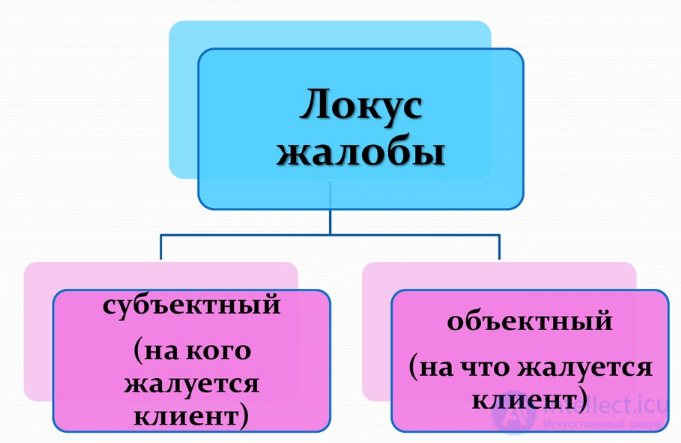
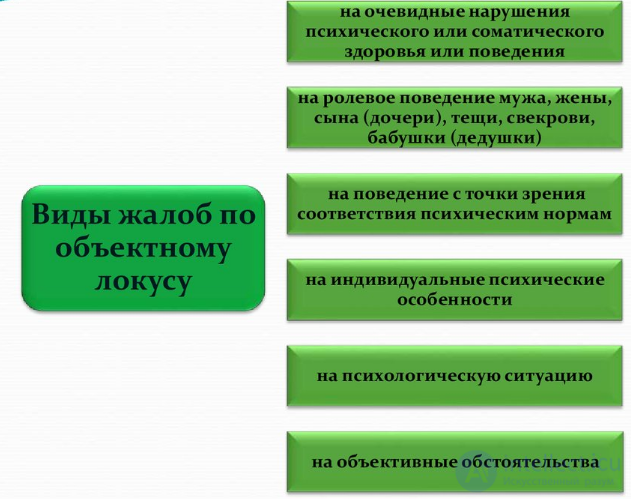
By object locus, the following
types of complaints can be distinguished:
- a) violation of psychosomatic health or behavior (enuresis, fears, obsessions);
- b) role behavior (inconsistency with sex, age, status) of the husband, wife, children, mother-in-law, mother-in-law/sister-in-law, etc.;
- c) behavior in terms of conformity to psychological norms (for example, norms of a child's mental development);
- d) individual psychological characteristics (hyperactivity, slowness, «lack of willpower,» etc. in a child; lack of emotionality, decisiveness, etc. in a spouse);
- e) the psychological situation (loss of contact, closeness, understanding);
- f) objective circumstances (difficulties with housing, work, time, separation, etc.).
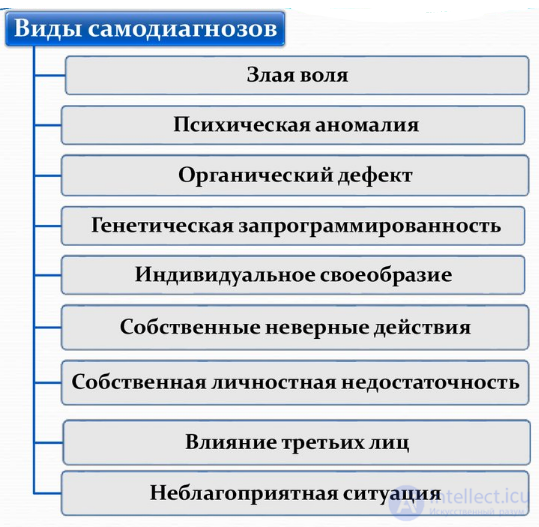
II. Self-diagnosis — this is the client's (patient's) own explanation to the psychologist or psychotherapist of the nature of a particular disturbance in family life (at work, etc.), based on his or her ideas about themselves, the family, and human relationships. Self-diagnosis often expresses the client's attitude toward the disorder or its presumed source. The most common self-diagnoses are:
- a) «Evil will» — the negative intentions of the person identified as the cause of the disturbances, or (as a variant) an indication that this person fails to understand certain truths or rules and is unwilling to understand them;
- b) «Mental abnormality» — classifying the person in question as mentally ill;
- c) «Organic defect» — characterizing the person in question as congenitally deficient;
- d) «Genetic predetermination» — explaining certain behavioral manifestations by the influence of negative heredity (in relation to a child, usually heredity from a divorced spouse or a spouse with whom the client is in conflict; in relation to a spouse, from relatives with whom there is a conflictual relationship);
- e) «Individual peculiarity» — understanding certain behavioral features as a manifestation of stable, established personality traits (rather than of specific motives in a given situation);
- f) «One's own mistaken actions» — evaluation of one's own present or past behavior (including as a parent or spouse);
- g) «One's own personal inadequacy» — anxiety, insecurity, passivity, etc., and, as a consequence, improper behavior;
- h) «Influence of third parties» — parents, spouse, grandparents, teachers — both present and past;
- i) «Unfavorable situation» — divorce, a school conflict, fear for the child; overload, illness, etc. — for oneself or one's spouse;
- j) «Referral» («I was referred to you by...», followed by naming an official body, the school principal, or another authority figure).
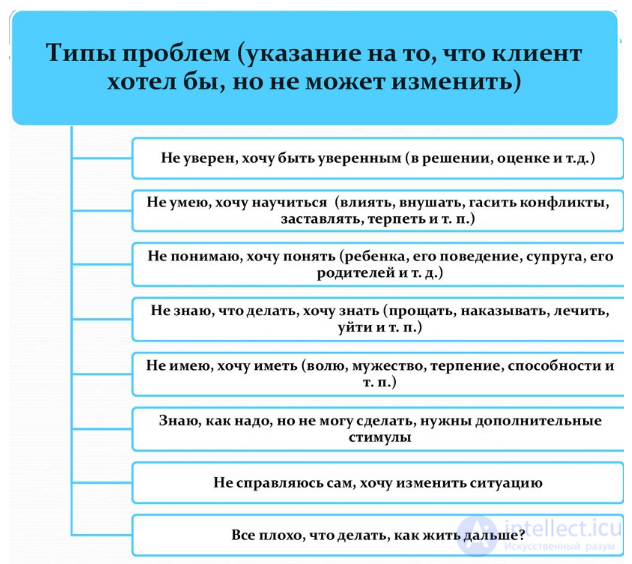
III. The problem — this is an indication of what the client would like to change but cannot.
The same authors identify the following most common problems:
- 1) I am not confident, I want to be confident (in a decision, an assessment, etc.).
- 2) I do not know how, I want to learn (to influence, to persuade, to defuse conflicts, to compel, to be patient, etc.).
- 3) I do not understand, I want to understand (the child and his or her behavior; the spouse, his or her parents, etc.).
- 4) I do not know what to do, I want to know (whether to forgive, punish, treat, leave, etc.).
- 5) I do not have, I want to have (willpower, courage, patience, abilities, etc.).
- 6) I know how it should be done, but I cannot do it — additional incentives are needed.
- 7) I cannot cope on my own, I want to change the situation.
In addition, global formulations are also possible: «Everything is bad, what should I do, how should I go on living?
It is necessary to distinguish between the client's problem and the object locus of the complaint, formulated as a problem belonging to the person being discussed. If the issue is that the husband, wife, or child does not understand, does not know how, etc., this does not mean that the client wants to understand or find out something, and so on.
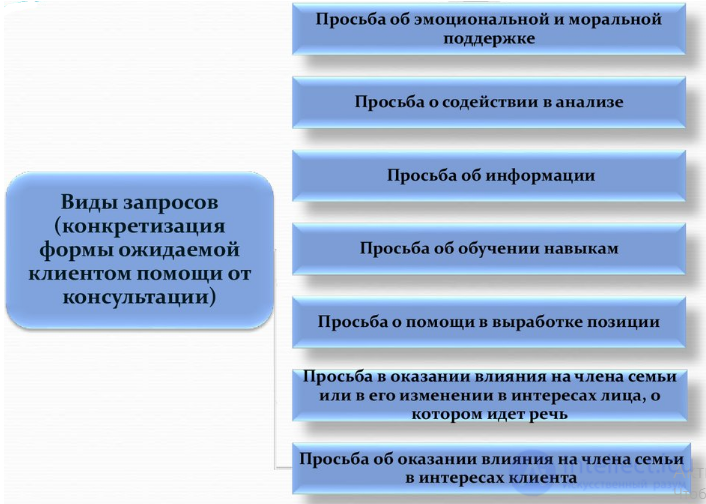
IV. The request — the specification of the form of help the client expects from the consultation. Usually the problem and the request are related in meaning. For example, if the client formulates the problem as: "I don't know how, I want to learn," then the request will most likely be "teach me." However, the request may also be the same as the problem.
The following types of requests can be distinguished:
- 1) A request for emotional and moral support ("I'm right, aren't I?", "I'm a good person, aren't I?", "My decision is correct, isn't it?").
- 2) A request for assistance in analysis ("I'm not sure I understand this situation correctly, could you help me figure it out?").
- 3) A request for information ("What is known about this?").
- 4) A request for skills training ("I can't manage this, teach me").
- 5) A request for help in forming a position ("What should I do if he's cheating on me?", "Can I punish my child for this?").
- 6) A request to exert influence on a family member or to change them in the interests of the person being discussed ("Help him get rid of these fears", "Help him learn to communicate with other kids").
- 7) A request to exert influence on a family member in the client's own interests ("Make him more obedient", "Help me break his stubborn will", "Make him love and respect me more").
A spontaneously presented complaint has a certain storyline, that is, a sequence in which life's conflicts are recounted
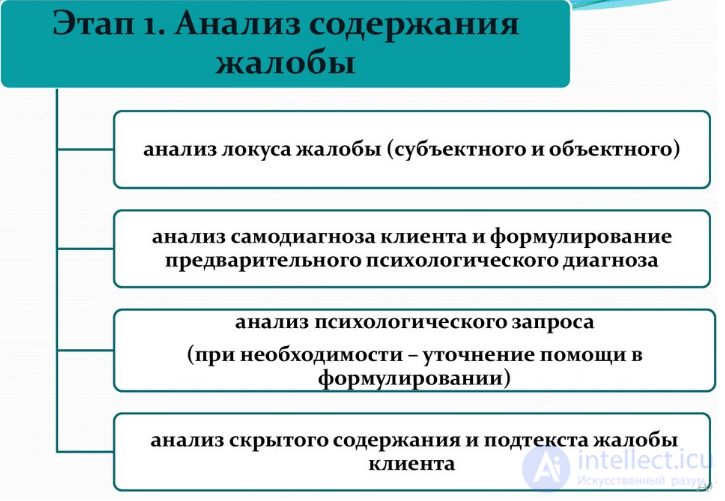
The overt and covert content of a complaint can be analyzed according to the same parameters described above. Sometimes there is no covert content in a complaint. When it is present, it does not coincide with the overt content. The discrepancy may involve the locus. For example, the locus of the complaint is the child and their behavior, while the covert content is the position and behavior of the father, who does not take a sufficiently active part in raising the child.
The discrepancy may also involve the self-diagnosis: the text offers an explanation of the disturbances in terms of the person's own mistaken actions, while the covert content, conveyed through intonation, facial expressions, body language, and gestures, points to other causes (for example, the interference of third parties who brought about these mistaken actions).
The discrepancy may concern the problem. For example, it is openly stated: "I don't know, I want to know." Meanwhile the covert content is: "I don't know how, I want to know how."
Finally, a discrepancy is observed in the analysis of the request: the overt content of the request is a request for help: "What should I do if he's cheating on me?", while the covert content is a request to exert influence in one's own interests: "Help me keep him."
It should be noted that covert content is not unconscious repression, but merely content left unsaid.
It is tactically correct, even at the first meeting, to make attempts to translate covert content into overt content (by formulating questions accordingly). As a rule, clients' reaction in this case is positive.
Unlike covert content, the subtext of a complaint may be unconscious or repressed, so revealing it to the client at the first meeting may disrupt the contact.
See also
- Learned helplessness
- Fundamental attribution error
- Locus of control


Comments