
Lecture
Many professions have their own principles and requirements, adherence to which is mandatory for practitioners. In a number of countries, for example, there exist codes of ethics for psychologists that govern the professional's conduct. There are certain principles of behavior for a counseling psychologist, following which ensures the ethicality of professional practice and is a guarantee of the effectiveness of psychological intervention.
The following principles help restore a sense of lost control and activate internal resources:
a benevolent attitude,
nonjudgmental acceptance,
equality of positions,
the principle of not giving advice, making promises, or imposing decisions,
respect for the values and the right to self-determination of the person seeking help,
an ecological (sustainable) distribution of responsibility in the counseling process,
maintaining confidentiality,
the client's motivation to receive psychological help,
emotional acceptance and the creation of emotional support,
a focus on the positive, resourceful aspects of the personality,
a distinction between personal and professional relationships.
A benevolent attitude toward the client
Observing this rule allows the client to feel calm during the session. A benevolent attitude implies the ability to listen attentively, to provide the necessary psychological support, and to try to understand the client, while excluding judgment.
A nonjudgmental attitude toward the client
Following this rule helps relieve the client's psychological tension and anxiety and allows them to attune themselves to the process of self-disclosure during counseling. Each of us has difficulties in life. The well-known psychotherapist R. May (1967) admitted: «Frankly, I have never encountered a client whose problems I did not also see, at least potentially, in myself». Therefore, one of the most important points in counseling that the counselor should communicate to the client is that having problems is a normal phenomenon. Recognizing this is the first step toward resolving them. A prolonged inability to solve one's problems can seriously complicate one's life.
Maintaining equality of positions
A mandatory condition for providing psychological help is communication between the counselor and the client as two people who respect one another. Suppression, directives, moralizing, and manipulation are not acceptable in counseling.
The inadmissibility of advice and imposing decisions
Whatever the psychologist's life and professional experience may be, every person's life is unique and unpredictable. No one can know a client's situation and inner motives better than the client themselves. Moreover, by giving advice, the counselor takes full responsibility for what happens in the client's life, which does not foster the development of the client's personality.
Respect for the client's values and right to self-determination
During their work, a psychologist must take into account the life principles and ideals held by the client. A critical attitude toward these on the counselor's part may cause the person who has come for a session to withdraw and become unwilling for further self-disclosure.
If the client's values are an obstacle to normal functioning, they can be reconsidered by the person in the course of in-depth psychological work carried out jointly with the counselor.
Distribution of responsibility in the counseling process
From the very beginning of interacting with the client, the psychologist strives to inform and agree with the client on the distribution of responsibility for the psychological work being conducted. The psychologist is responsible for organizing and providing the psychotechnical means of the session, while the client takes on responsibility for the choices they make during the counseling process and for the decisions they take. In addition, achieving the client's set goals sometimes requires additional independent work, occasionally including homework assignments.
Confidentiality
Any information disclosed by the client to the psychologist may not be passed on without the client's consent to any public or state organizations, or to private individuals, including relatives or friends.
There are exceptions to this rule specifically stipulated by law. For example, a situation in which the psychologist learns during a session of something that poses a serious threat to someone's life.
The client's motivation An important condition for the effectiveness of counseling is the client's own desire to solve the problem. Seeking a psychologist at someone else's insistence is of little effectiveness, and counseling under compulsion is simply unacceptable.
Creating emotional support
Acceptance and emotional support help the client cope with their feelings, recognize their personal strengths and weaknesses, and regain control over their life. The creation of emotional support is facilitated by the counselor's professional attitudes and skills, the counselor's capacity for empathy, for understanding another person's feelings, and the ability to offer encouragement at the right moment.
Focusing on the positive, resource-based aspects of personality
One important condition for client change is the positive nature of feedback. To this end, it is important for the counselor to continually develop the ability to notice the strengths of other people's personalities and to promptly reflect what has been noticed in a clear verbal form.
The people around us are capable of exerting influence through their subjective opinion of us alone, and to such a significant extent that it changes our behavior, emotional state, and our own self-image. How difficult it can sometimes be for a person to withstand a negative image of themselves in the eyes of others. And how intensely and creatively their development begins to proceed when they are surrounded by people who notice at least something positive in them! For individuals in a state of personal crisis who are experiencing their own helplessness in overcoming difficulties, psychologists recommend communicating more often with people who are able to notice their strongest positive traits and who believe in their personal development.
This principle is based not only on numerous empirical observations by counseling psychologists but also has experimentally proven foundations (see Document 4: «Placebo, Pygmalion, and the Double-Blind Method»).
Separation of personal and professional relationships
Effective resolution of the client's problems requires maintaining an objective and detached position. This becomes quite difficult in the case of establishing close personal relationships between counselor and client. Therefore, it is advisable to avoid shifting to friendly relations with clients or providing professional help to one's own friends and close relatives.
Another important task for the counselor is timely shifting of attention from professional tasks and problems to the current course of events in personal life. The counselor must ensure that their clients' problems do not become their own personal problems, which happens to many beginning counselors who make the mistake of becoming excessively concerned about their clients. One of the counselor's key skills is the ability to devote themselves fully to the client during the session and to immediately «switch off» after the client leaves, so that the client independently plans their life between sessions.
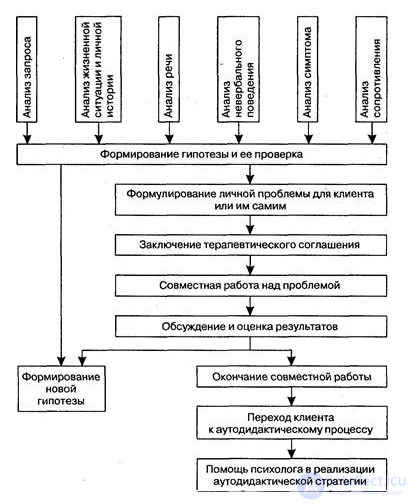
General diagram of the main stages of the counseling psychologist's work
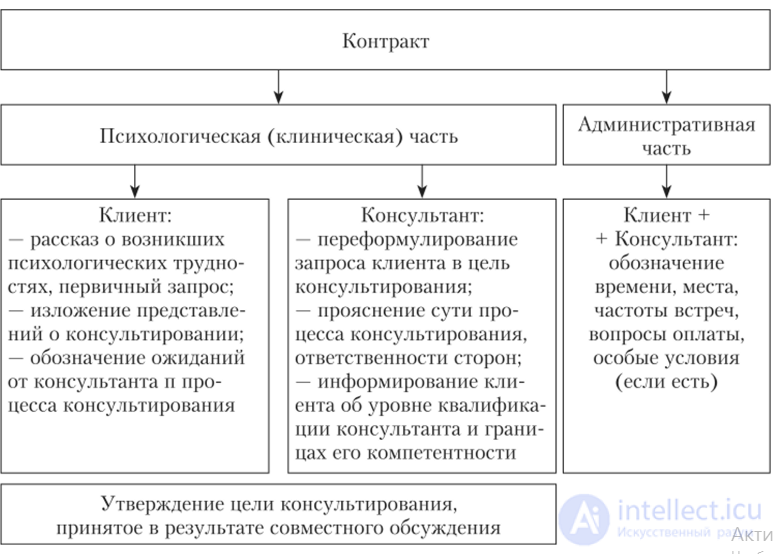
Fig. 4.2 Diagram of the structure of the contract and the stages of its conclusion

Comments