
Lecture
In the process of psychological counseling, several stages can be conventionally distinguished, the content features, duration, and psychotechnical support of which will, in each specific counseling situation, be determined by the nature of the client's problem and request, and by the theoretical orientation and counseling models the counselor employs. However, all counseling situations share a certain common logic in their development and are subject to the need to use certain universal tools that the counselor must be aware of.
Yu. E. Aleshina, analyzing the experience of foreign and domestic colleagues, identifies 4 general stages of the psychological counseling process: 1) getting acquainted with the client and beginning the conversation; 2) questioning the client, formulating and testing counseling hypotheses; 3) corrective intervention; 4) ending the conversation22. In this case, the total duration of a 1-hour session is distributed among the stages as follows: 1) beginning of the conversation —5—10 minutes; 2) questioning the client —25—35 minutes; 3) corrective intervention —10—15 minutes; 4) ending the conversation —5—10 minutes. Many specialists point to approximately the same duration for a single session (1 hour).
G.S. Abramova identifies 5 stages: 1) establishing contact, 2) gathering information, 3) becoming aware of the desired outcome, 4) developing alternative solutions; 5) summarizing, transitioning from learning to action. V.Yu. Menovshchikov proposes a somewhat different staged model: stage 1 - establishing contact (primary diagnosis), 2 - investigating and becoming aware of the task (secondary diagnosis), 3 - sorting through hypotheses, 4 – decision, 5 - exiting contact23.
R. Kociunas, drawing on the experience of his foreign colleagues, presents an eclectic model of the structure of the counseling process that reflects the universal features of psychological counseling or psychotherapy of any orientation. This model distinguishes the stages of 1) exploring the problem, 2) «two-dimensional definition of the problem», 3) identifying the problem, 4) planning, 5) action, 6) evaluation and feedback (see Document 9: «Structure of the counseling process»).
Unlike other authors, R.S. Nemov identifies the preparatory stage as the first stage of psychological counseling, during which the counseling psychologist prepares to conduct the session and familiarizes themselves with the client through the prior appointment record kept in the registration log, as well as through any information about the client that can be obtained, for example, from the psychological counseling service employee who took the client's request for a session24 (see Document 10: «Main Stages of Conducting Psychological Counseling According to R.S. Nemov»).
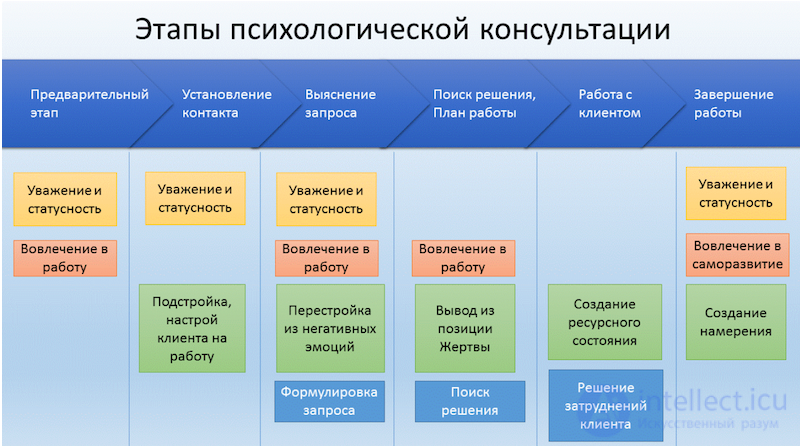
Summarizing various approaches to examining the process of psychological counseling, a number of its main stages can be identified:
+Each counseling situation has its own unique features, determined by the content of the client's life situation, their experiences, their personal characteristics, their readiness to change, the nature of the relationship that develops with the counselor, the counselor's professional experience, the counselor's own theoretical orientation, etc. Therefore, the content and duration of each of the listed stages of the psychological counseling process may vary from case to case. However, the counselor needs to know the general logic of the development of the counseling process and the helping relationship.
Not a single theoretical orientation or school of psychological counseling reflects all possible situations of interaction between counselor and client. Therefore, let us consider the most general model of the structure of the counseling process, called the eclectic model (B. E. Gilland and colleagues; 1989). This systemic model, covering six closely interrelated stages, reflects the universal features of psychological counseling or psychotherapy of any orientation.

1. Problem exploration. At this stage, the counselor establishes contact (rapport) with the client and achieves mutual trust: it is necessary to listen attentively to the client speaking about their difficulties, and to show maximum sincerity, empathy, and care, without resorting to evaluation or manipulation. The client should be encouraged to examine the problems that have arisen in depth, and their feelings, the content of their statements, and their nonverbal behavior should be noted.
2. Two-dimensional definition of problems. At this stage, the counselor strives to accurately characterize the client's problems, establishing both their emotional and cognitive aspects. The clarification of problems continues until the client and counselor reach a shared understanding; problems are defined in concrete terms. An accurate definition of problems allows their causes to be understood and sometimes indicates ways of resolving them. If difficulties or ambiguities arise in defining the problems, it is necessary to return to the exploration stage.
3. Identification of alternatives. At this stage, possible alternatives for solving the problems are identified and openly discussed. Using open questions, the counselor encourages the client to name all possible options that they consider suitable and realistic, helps to put forward additional alternatives, but does not impose their own solutions. During the conversation, a written list of options can be compiled to make them easier to compare. Alternatives should be found that the client could use directly to solve the problems.
4. Planning. At this stage, a critical evaluation of the chosen alternative solutions is carried out. The counselor helps the client determine which alternatives are suitable and realistic in light of prior experience and current readiness to change. Drawing up a plan for a realistic solution to the problems should also help the client understand that not all problems are solvable. Some problems require too much time; others can only be partially resolved by reducing their destructive, disorganizing effect on behavior. The plan for solving the problems should specify what means and methods the client will use to test the realism of the chosen solution (role-playing, a "rehearsal" of actions, and so on).
5. Activity. At this stage, the consistent implementation of the problem-solving plan takes place. The counselor helps the client build their activity with consideration for circumstances, time, and emotional costs, as well as an understanding of the possibility of failure in achieving the goals. The client must come to understand that partial failure is not yet a catastrophe and that they should continue implementing the plan for solving the problem, linking all actions to the ultimate goal.
6. Evaluation and feedback. At this stage, the client, together with the counselor, evaluates the degree to which the goal has been achieved (the extent to which the problem has been resolved) and summarizes the results attained. If necessary, the solution plan may be refined. When new or deeply hidden problems arise, a return to previous stages is necessary. This model, reflecting the counseling process, only helps to better understand how specific counseling occurs. The real counseling process is significantly broader and often does not follow this algorithm. The division into stages is conditional, since in practical work some stages merge with others, and their interdependence is more complex than in the scheme presented. Here it should once again be emphasized, as mentioned above, that in the counseling process what matters is not so much the schemes (although a general idea and understanding of the course of counseling are essential) as the professional and human competence of the counselor. It is made up of many elements, which will be discussed below. Let us list the general rules and attitudes of the counselor that structure the counseling process and make it effective:

Comments