
Lecture
It is difficult to unambiguously outline the boundaries of the application of psychological counseling, since the word “counseling” has long become a generic concept for various types of consultative practice. In fact, counseling as a form of professional activity is applied in virtually any sphere in which psychological knowledge is used. Among the types of psychological counseling one can distinguish vocational counseling, psychological-pedagogical counseling, developmental counseling, counseling for managers, and much more. The broadest field of application of psychological counseling is helping those who seek assistance with their personal and family problems. This area includes many separate directions: crisis counseling, counseling of married couples, joint counseling of children and parents, premarital counseling, psychological assistance to those going through divorce, and so on.
Individualandgroup forms of psychological counseling are distinguished. Family counseling is a particular form of group psychological counseling.
The content and goals ofindividual psychological counselingare determined by the client's request.
The content and goals of group psychological counseling are determined by the members of the group, most of whom are normally functioning people. Group counseling addresses the task of examining the system of actually existing relationships between people and uses mechanisms of managing the group process in order to actualize the personal resources of those seeking help in resolving difficult life situations. The group offers support and empathy to participants facing a crisis situation and is used as a means or catalyst for various personal processes and achievements. Group counseling is characterized by an orientation toward growth and the development of participants' inner resources.
Very often the methods used in group psychotherapy and in group counseling are the same. Because of this circumstance, numerous discussions arise among theorists and practitioners of group work concerning the differentiation of these two types of group work. Despite differing views on this question, one can still identify the main difference between group therapy and group counseling, which lies in their goals. Counseling groups are focused on growth, development, expansion, prevention, and self-awareness, drawing on the positive aspects and personal resources that a person already possesses.
Group psychotherapy is usually focused on restoration, treatment, and reconstruction of the personality1. It represents a process of relearning that involves both the conscious and the unconscious. The goal of therapy groups may be the transformation of personality structure. Participants in such groups may be suffering from serious emotional problems or a deep neurotic conflict and may need treatment rather than preventive or developmental work.
Types of psychological counseling are distinguished based on various criteria.
* By number of meetings, single-sessionandmultiple-sessioncounseling are distinguished. The number of meetings between a counseling psychologist and a client is most often not limited to one or two. More extended counseling is required in cases where the client's problem is so complex that it is practically impossible to work through it in one or two sessions; when the client has not just one but several different problems; when the proposed solution to the problem cannot be immediately and fully implemented independently by the client and requires additional support from the counselor.
* By the nature of motivation, counseling by personal request(at the wish of the person seeking help) and counselingresulting from a summons or referralare distinguished.
* By the criterion of using psychodiagnostic tools – counseling without additional testing and with additional testing.
* By the criterion of combination with other methods of psychological assistance, isolated and combinedpsychological counseling are distinguished (for example, combined with socio-psychological training in the intervals between consultations).
* By the nature of the communication means used in the counseling process, one can distinguish in-person and telephone counseling2.
* By the nature of the tasks being solved, a distinction is made between developmental counseling,psychological-pedagogical counseling, interpersonal psychological counseling, family counseling, vocationalcounseling,business psychologicalcounseling,crisis counseling, and psychological counselingon issues of well-being and health status.
Comparison of types of psychological consultative assistance
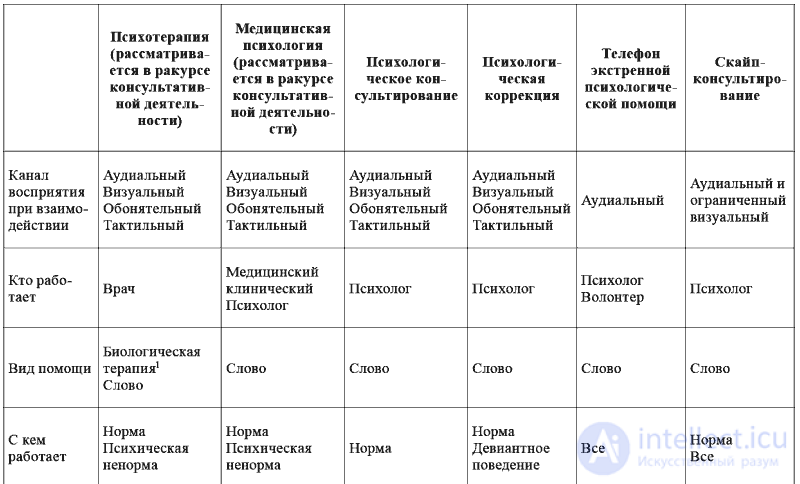
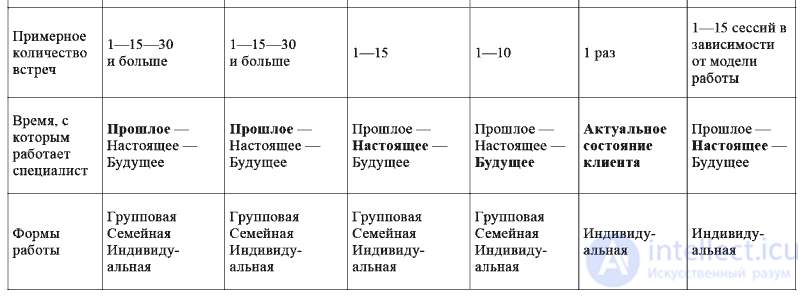
A specific counseling model is often chosen depending on the overall theoretical orientation –
Among counseling models are
At the current stage of development of the theory and practice of psychological counseling, one can note the emergence of a number of new counseling models: brief positive counseling3, counseling using neuro-linguistic programming psychotechnology, personal reappraisal counseling4and others.
Counseling models can be specified in accordance with life situations causing mental maladaptation. Thus, special models of counseling for problems of alcoholism, drug addiction, domestic violence, learning difficulties, and so on have been developing recently.

Comments