A conversation with a psychologist should help a person resolve problems and build interpersonal relationships with others. A problem faced by many people who seek help from a psychologist is that they have practically no one with whom to speak frankly about what troubles and worries them. Being attentively listened to and understood by the counselor is extraordinarily important, and this in itself leads to certain positive changes.
A calm and thoughtful conversation with a specialist allows a person to learn and understand a great deal that is new about themselves and the people around them, and helps broaden their understanding of the reality surrounding them.
No less important is another outcome of the counseling conversation - understanding one's own role and participation in the life situation taking place, and the client's acceptance of responsibility for it.
In the process of psychological counseling, the counselor may in turn face the following tasks.
1. Clarifying the problem the client has encountered.
2. Informing the client about the essence of the problem that has arisen for them.
3. Studying the client's personality in order to determine their ability to cope with the problem on their own.
4. Clearly formulating recommendations for the client regarding the client's possibilities for resolving the problem.
5. Providing the client with ongoing assistance in the form of additional practical recommendations, psychological techniques, and exercises to develop the necessary abilities or to work out new behavioral models in the process of the client resolving their life problem.
6. Informing the client about elementary, vitally necessary psychological knowledge and skills, the mastery and correct use of which is possible for the client themselves without special psychological training.
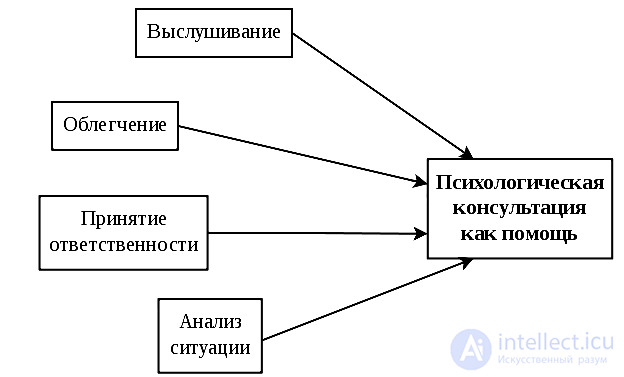
Yu. E. Alyoshina defines the main goal of psychological counseling as providing psychological assistance:
1. Listening to the client, as a result of which their understanding of themselves and their own situation should expand, and food for thought should arise.
2. Relief of the client's emotional state, that is, thanks to the work of the counseling psychologist, the client should feel better.
3. The client's acceptance of responsibility for what is happening to them. In the course of counseling, the focus of the client's complaint should be shifted onto the client themselves; the person must feel their own responsibility and fault for what is happening - only in this case will they genuinely try to change themselves and change the situation, otherwise they will merely wait for help and changes to come from those around them. The minimum program here is to show the client that they themselves, at least in part, contribute to their problems and to their relationships with people having such a complex and negative character.
4. The psychologist's help in determining exactly what and how can be changed in the situation.
The goals of psychological counseling can also be viewed from a different angle. M.P. Gusakova[53] points out that the goals and objectives of counseling can be outlined by areas of being conventionally called «moving away from», «moving toward» and «going beyond». This idea seemed interesting to us. Let us reflect on this thesis as we understand it.
Undoubtedly, regarding the first two options, a psychologist may draw associations with achievement motivation and avoidance of failure[54]; with the definitions of freedom proposed by E. Fromm as «freedom from» and «freedom for»; the third option is connected with a certain transcendence, a going beyond the ordinary. How might such a view relate to the goals of counseling?
«Moving away from» (illness, conflicts, failures, problems of interaction with society, difficulties in one's relationship with oneself, etc.).
Very often clients who come for help point to the existence of some problem in their life: «I can't find a job», «my relationship with my life partner isn't working out», «I want to get rid of my fear».
A natural desire is to get rid of what troubles and burdens a person. It is precisely in this that the client sees the goal of working with a psychologist. All other areas seem to them not significant enough to spend their resources on: time, effort, and money.
However, it is not uncommon for a person's life as a whole to remain unchanged even after the troubling situation has been successfully resolved. It is possible that the client does not need this and simply needs to resolve the issue at a local level. Sometimes this is possible, but it happens that the problem itself is so deeply woven into the internal interconnections of a person's life that resolving this particular difficulty without touching other layers of life rarely proves possible.
Even Sigmund Freud described «flight into illness» as one of the basic concepts of psychoanalysis. Freud viewed illness as a way of resolving an intrapersonal conflict through the formation of symptoms of illness. Resolving an intrapsychic conflict by forming a neurotic symptom is a convenient and desirable way out for a person who does not want to, or cannot, carry out the difficult and painful work of overcoming a conflict situation that demands a significant expenditure of physical or emotional strength. This view of the situation remains relevant today as well.
However, despite the obvious connection between any symptom of the client
[55], their way of life, and their way of thinking, a person is far from always ready to change their entire life, habits, attitudes, and so on.
This stance: «Of course I am ready and willing to change, but in such a way that my life doesn't have to change» – is usually defined by a psychologist as resistance.
 Figure 1.1 Focusing attention on a local problem when working with an «away from» goal
And yet, a goal consisting merely of «just getting a job» or «just fixing the relationship with my husband» will be more than enough for some people. And this step, which may look very small from the psychologist's point of view, will be significant for the client.
It must be remembered that freedom of choice has never been abolished. The client alone feels what they are ready for at each stage of their life's Path.
Thus, the goal of the work in this case is to resolve a certain problem at a local level, without a deep examination of other areas of the client's life.
«Toward» (inner harmony, mutual understanding with other people, external well-being, happiness, success, and so on).
People often come to realize that merely «moving away from» a problem is not quite enough. It is unclear where one will end up. Will resolving the problem at a local level really make a person happy?
Sometimes clients form requests such as: «I want to change my life,» «I want to feel confident in myself when interacting with everyone,» «I want to gain the ability to enjoy life,» and so on. Regardless of the specific wording, what matters here is that the client does more than simply acknowledge that their «problem point» is connected to their life as a whole. They are willing to broaden their view, shift the focus of attention from the painful point to other areas, and include other spheres of life in the transformation.
That is why forming an image of the desired future and of the desired state or skill takes first place here. (We will discuss strategies for working with desired outcomes in more detail in Chapter 3.)
Life, as it were, unfolds across time: past – present – future, and cause-and-effect relationships are built up. Undoubtedly, we cannot avoid turning to the past in order to understand our starting points and assess our resources, or working with the present. But the future nonetheless becomes central.
Sometimes this is enough. Indeed, it embodies a broader view of the world compared to the previous case. However, it does not always involve working through one's life at a deeper level: the level of meanings and values.
Thus, the goal of the counseling work in this case is to achieve the desired state as each particular client understands it (with a possible change in various areas of their life).
 Figure 1.2 Exploring the desired state when working with a «toward» goal
«Going beyond» (limits, established views on life, habits, the traditional understanding of one's place in the world, and so on).
Figure 1.2 Exploring the desired state when working with a «toward» goal
«Going beyond» (limits, established views on life, habits, the traditional understanding of one's place in the world, and so on).
In this case, an attempt is made to approach life as the integral story of a person, whose events, closely intertwined with one another, can convey something very important.
This integral context, encompassing past and future, the individual and the people connected to them, history and culture as a whole, has been called in psychology the «life path of the personality»[56].
With this approach, every life event (illness, health, or personal development) acquires its meaning and place above all in relation to this broad context. The customary distinctions between health and ill health, between maturity and infantility of the personality, become blurred. What remains significant is only the possibility or impossibility of the individual's carrying out their life path (Gusakova, ibid.).
Such a view is connected not only with building cause-and-effect relationships (although that, too, is very important). Life is a nonlinear process, and sometimes these connections are very difficult, sometimes impossible, to identify. In order to «go beyond,» one must adopt the position of an observer, not merely to reconsider habitual attitudes, but also to examine one's life from the standpoint of its fullness of meaning.
Has it ever happened that the meaning of some (especially unpleasant) event was not clear to you? You kept asking yourself again and again: why did this happen to me? what for? It seems that the event happened «unexpectedly» and «suddenly»; it is not logical and does not fit into your life at all. Moreover, analyzing the specific situation may yield no results until the events preceding, accompanying, and following it (both those we regarded as significant and the seemingly minor, insignificant ones) come together into a single picture. These events may lack «logical,» cause-and-effect connections. They may be contradictory and carry different messages. But taken all together, these events carry a certain meaning, which it becomes possible to «read.» One way to do this is to try to understand what Life is teaching and what Lesson needs to be learned.
The «Life as Teacher» context qualitatively changes the angle from which an event is viewed, helping to find new meanings and to start acting with renewed strength and greater awareness.
What can this or that event teach us? Acceptance or, conversely, action, activity, or something else… It can help form some skill. All of this broadens the view of the problem, which then comes to be seen through the lens of the Life Path.
In psychological counseling, work in this case will take place from the observer's position[57], as the position of the most integrated, encompassing perception of one's life. It involves awareness of one's own views and attitudes toward the world, responsibility, values, and belief system, and identifying one's worldview.
 Figure 1.3 Exploring the holistic context of a person's life path, their values and meanings, when working with the goal of «going beyond»
This may bear little resemblance to «ordinary» counseling, since it resembles a philosophical conversation, which in fact it is (as the dialogue is conducted within an existential paradigm). Moreover, as we rightly understand, such work cannot happen quickly, since it touches the deep levels of the psyche's existence as the capacity for active reflection of reality, or the totality of mental processes and phenomena.
And yet it is precisely through such profound transformations, in which basic attitudes change, that a person's entire life undergoes change. He becomes wiser, more mature, aware of life from various angles, resilient to external influences, and stronger.
Thus, the goal of work in this context is a reassessment of values, and a turn toward meanings and the person's worldview.
It is evident that these three goals can transition into one another. Although most often (especially at the beginning of sessions) the client will be ready to work with the current problem without delving deeply into it.
And now, having discussed the possible goals, think about yourself.
Since you plan to make psychological counseling your profession, it goes without saying that you will attend personal therapy (since it is a mandatory part of training and self-development). What goals are you personally ready to set for working with your own personal counselor?


Comments