
Lecture
The counselor's position is an important condition for the effectiveness of interaction with the client and for creating a favorable psychological atmosphere for actualizing the personal resources of the person seeking help. Three main possible positions of the counselor in relation to the client can be distinguished:
- the position of equality,
- the “one-up” position,
- the “one-down” position.
The most traditional and, most importantly, effective position in counseling is the position of equality and partnership with respect to the client. It contributes to the client feeling like a full partner in the counseling process and therefore working actively and productively on an equal footing with the psychologist. The client has no reason to hide or distort any information about themselves, since the counselor is open and neither evaluates nor judges them. The counselor themselves is also less vulnerable in this position with respect to the client, since the more authoritative a person is and the more unapproachable a position they occupy, the more demands and expectations are placed on them, and the harder it is to meet them.
The «one-up» position is encountered far less often in counseling, since it imposes far greater demands and responsibility on the counselor. Although an authority figure occupying the “one-up” position is taken more seriously and listened to more closely. Yu.E. Aleshina notes: «It is precisely in unquestionable authority that the secret of success of many hypnotists lies — both genuine professionals and charlatans alike. Their position and aura of fame ensure their successful influence»13.
The psychologist's position during the session and their behavior should not be something frozen or unchanging. A good professional is able, when necessary, to take the “one-up” position, speaking about something with unshakeable knowledge and authority, or the “one-down” position, playing along with the client in an effort to raise their self-esteem and emphasize their knowledge and authority.
Each of the three main counselor positions can be correlated with the three «Ego» states according to E. Berne (see Document 2 in Section 1: «Main Characteristics of the Ego States of the «Parent», the «Adult», and the «Child» (according to E. Berne)»). The dominant, power-holding «one-up» position corresponds to the «Parent» Ego state, the position of equality – to the «Adult», and the «one-down» position – to the «Child». The more psychologically mature state is that of the Adult, in which an adequate, realistic perception of what is happening becomes possible, based on facts and weighed conclusions and interpretations of the problem, along with optimal conscious self-control.
Positions in communication can be distinguished not only in terms of the distribution of control and power in the interaction, but also in terms of their content. Thus, the following can additionally be identified:
- a benevolent position of accepting the partner,
- a neutral position,
- a hostile position of rejecting the partner.
The benevolent position of accepting the partner corresponds to the principles of psychological counseling. Although in some situations the counselor may also adopt a neutral position. For example, a neutral position becomes a necessary condition in a whole range of family counseling situations, when a family, a married couple, or a parent-child pair comes to see the psychologist. In this case, in order to successfully work through the presented problem situation, it is important for the counselor to maintain a neutral position, without taking the side of any one family member.
In addition to the types of counselor positions already discussed, positions can also be identified that are defined by the strategic goals and methods used by the psychologist during counseling. As noted above, two main orientations of the counselor can be distinguished among counseling strategies:
toward support,
toward change.
The counselor's choice of one strategic orientation or another in each specific counseling case should be very flexible and should be determined not only by the counselor's professional stereotype, but also by the nature of the request, the content of the problem, and the individual characteristics of the client. However, restricting the orientation solely toward change, or solely toward support, is rarely effective. A good counselor is able to find a compromise and combine these two orientations in counseling (see Document 7: «A Practical Study of the Impact of Positions in Counseling»).
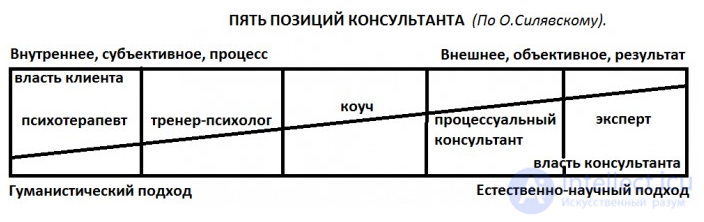
counselor positions according to O. Silyavsky
Alongside interaction positions in counseling, various perceptual positions of the counselor are also distinguished, on which the understanding, interpretation, and ways of coping with the problem situation depend. Let us give a description of the three main perceptual positions in the process of interaction.
The first perceptual position – your individual point of view, your own reality – what you feel, what you think, based on your own experience. It allows you to remain yourself.
The second perceptual position – the other person's point of view: how they see, hear, and perceive everything. Perceiving another person's point of view does not necessarily mean sharing it. This position allows for a more accurate understanding of the other person.
The third perceptual position (metaposition) – the ability to see yourself and those present from the outside. This perceptual position is the most objective one; it enables the counselor to give advice to themselves.
Effective counseling requires mastery of the art of using and managing all three perceptual positions.
+Psychologist Flemming Funch adds one more position to the three main perceptual positions discussed above – that of someone who is not an active participant in what is happening and receives information about it from a distance (see Document 8: "Perceptual Positions," based on Flemming Funch's book).
Thus, the counseling contact is largely determined by the counselor's skill in managing the process of their own perception and the position they adopt in interacting with the client.

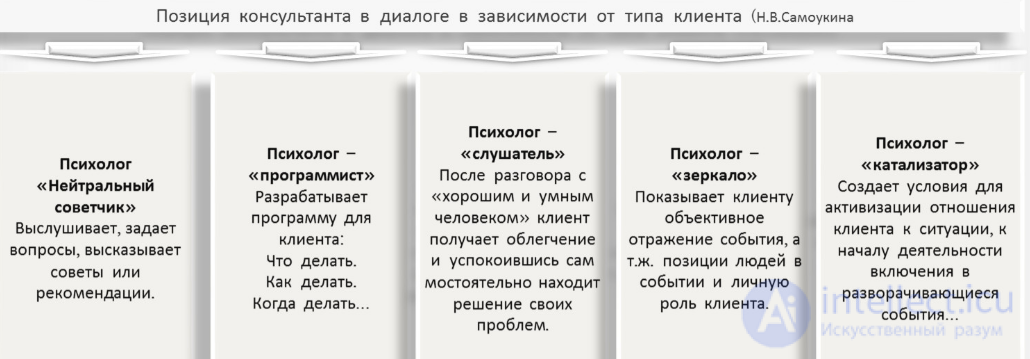
counselor's positions according to N. Samoukina

Comments