
Lecture
Bio-inspired robotic locomotion, is a fairly new subcategory of bio-inspired design. It is about studying concepts derived from nature and applying them to the design of real engineering systems. In particular, this field is dedicated to creating robots inspired by biological systems. Biomimicry and biodiversity are sometimes confused. Biomimicry copies from nature, whereas bio-inspired design learns from nature and creates a mechanism that is simpler and more efficient than the system observed in nature. Biomimicry has led to the development of another branch of robotics called soft robotics. Biological systems are optimized to solve specific tasks according to their habitat. However, they are multifunctional and are not designed for only one specific function. Bio-inspired robotics studies biological systems and looks for mechanisms that can solve a problem in engineering. The designer must then try to simplify and improve this mechanism for the specific task of interest. Bio-inspired roboticists are usually interested in biosensors (such as the eye), bioactuators (such as muscles), or biomaterials (such as spider silk). Most robots have a locomotion system. This article therefore presents various modes of animal locomotion and presents several examples of corresponding bio-inspired robots.
Biolocomotion, or animal locomotion, is usually divided into the following categories:
Surface locomotion can include terrestrial and arboreal locomotion. We will discuss terrestrial locomotion in detail in the next section.
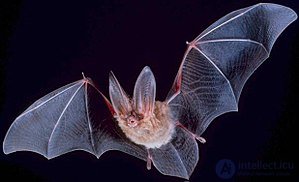
Locomotion in the bloodstream or cell-culture media, swimming, and flight. There are many swimming and flying robots designed and built by roboticists. Some of them use miniature motors or conventional MEMS actuators (e.g., piezoelectric, thermal, magnetic, etc.) , while others use animal muscle cells as motors.
Many animals and insects move on land with or without legs. In this section we will discuss legged and limbless locomotion, as well as climbing and jumping. Foot anchoring is the basis of terrestrial locomotion. The ability to increase traction is important for moving without slipping on surfaces such as smooth rock and ice, and is especially important when moving uphill. There are numerous biological mechanisms for obtaining purchase: claws rely on friction-based mechanisms; gecko feet on van der Waals forces; and the feet of some insects on fluid-mediated adhesive forces.
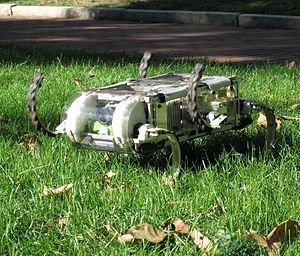
Legged robots can have one two, four, six, or many legs depending on the application. One of the main advantages of using legs instead of wheels is more efficient movement over rough terrain. Bipedal, quadrupedal, and hexapedal locomotion are among the most favored types of legged locomotion in bio-inspired robotics. Rhex, a robust hexapedal robot and Cheetah , are to date two of the fastest robots. iSprawl is another hexapedal robot inspired by cockroach locomotion, developed at Stanford University. This robot can move at up to 15 body lengths per second and reach a speed of up to 2.3 m/s. The original version of this robot had a pneumatic drive, while the new generation uses a single electric motor for locomotion.
Terrain involving topography at various length scales can be a challenge for most organisms and biomimetic robots. Such terrain is easily overcome by limbless organisms, such as snakes. Some animals and insects, including worms, snails, caterpillars, and snakes, are capable of limbless locomotion. A review of snake-like robots is presented by Hirose et al. [18]These robots can be divided into robots with passive or active wheels, robots with active tracks, and undulatory robots using vertical waves or linear extensions. Most snake-like robots use wheels that have high friction when moving sideways but low friction when moving forward (and can be prevented from rolling back). Most snake-like robots use either lateral undulation or rectilinear motion and have difficulty climbing vertically. Choset recently developed a modular robot that can mimic several snake gaits but cannot perform concertina movements. [19]Researchers at the Georgia Institute of Technology recently developed two snake-like robots called Scalybot. These robots focus on the role of the snake's ventral scales in adjusting frictional properties in different directions. These robots can actively control their weight distribution, change their frictional properties, and move effectively across various surfaces. Researchers at CMU have developed both scalable and conventionally controlled snake-like robots.
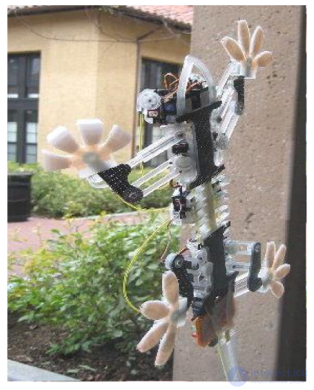
Climbing is a particularly challenging task because mistakes made by the climber can cause it to lose its grip and fall. Most robots are built around a single function observed in their biological counterparts. Geckobots [23] typically use van der Waals forces, which act only on smooth surfaces. Stickybots, use directional dry adhesives that work best on smooth surfaces. Spinybot and the RiSE robot are among the insect-like robots that use spines instead. Legged climbing robots have several limitations. They cannot handle large obstacles, since they are rigid and require a lot of space to maneuver. They usually cannot climb both smooth and rough surfaces, and cannot handle vertical-to-horizontal transitions.
One of the tasks commonly performed by a wide variety of living organisms is jumping. Bharal, hares, kangaroos, grasshoppers, fleas, and locusts are among the best jumping animals. A miniature 7-gram jumping robot inspired by locusts, capable of jumping up to 138 cm, was developed at EPFL. The jump event is triggered by the release of spring tension. The miniature robot with the highest jump, inspired by locusts, weighs 23 grams, and its highest jump of up to 365 cm belongs to TAUB (Tel Aviv University and Braude Engineering College). It uses torsion springs as an energy store and includes a wire-and-latch mechanism to compress and release the springs. ETH Zurich reported building a soft jumping robot based on the combustion of methane and nitrous oxide. Thermal expansion of the gas inside the soft combustion chamber sharply increases the chamber's volume. This causes the 2 kg robot to jump 20 cm. After landing, the soft robot, inspired by a roly-poly toy, reorients itself to an upright position.
To make their robot sufficiently efficient, the scientists based its shape on the moon jellyfish (Aurelia aurita) at the larval stage. Whereas previous jellyfish-robot designs employed various thrust mechanisms, the team has now decided to use hydraulic networks to propel the machine.
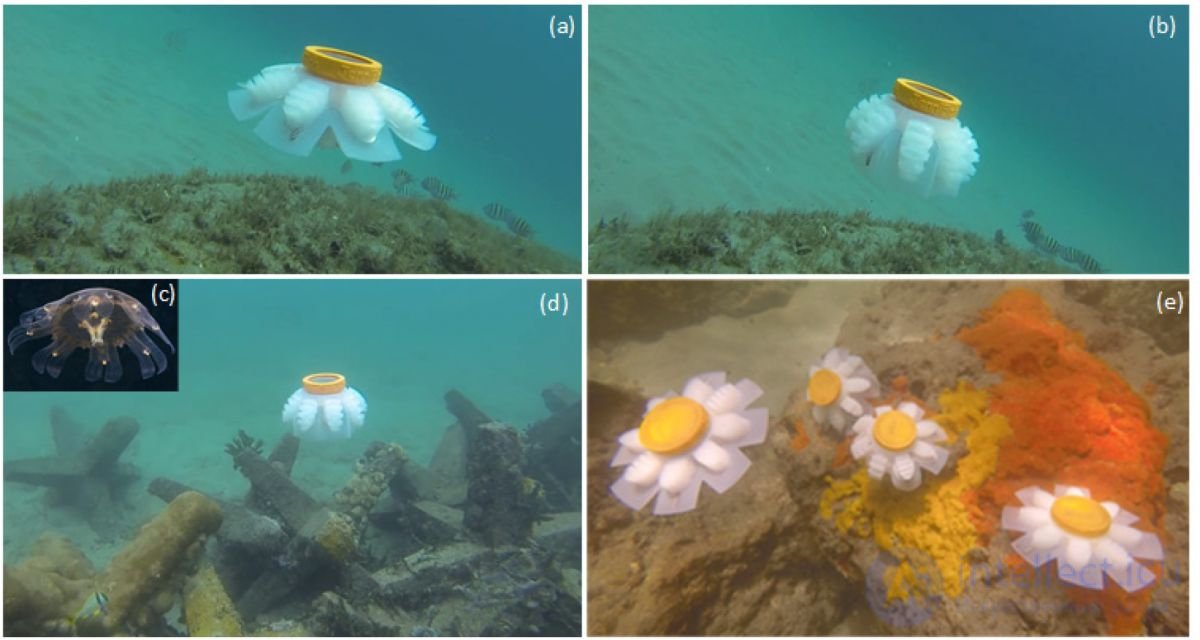
«The robot's main application is the exploration and monitoring of delicate ecosystems, which is why we use hydraulic-network actuators to prevent unintended damage. Moreover, living jellyfish are themselves buoyant. To mimic this property, we used water to fill the hydraulic-network actuators while swimming», — says Dr. Engeberg.
To enable the jellyfish to maneuver, the team used two pump impellers and pumped eight tentacles. The pump impeller design provided an open water flow, in which water from the environment was pumped into the soft actuators to reproduce a swimming stroke. When the pumps were switched off, the elasticity of the silicone material in the tentacle actuators compressed the actuators to expel water back out during the relaxation phase. The new design also helped eliminate propellers, simplifying control and size, and reducing development cost.
The team 3D-printed five different jellyfish robots, using silicone rubber for the actuators. All the robots were made with differing stiffness in order to test the effect of this property on thrust efficiency. The scientists also tested the robot's ability to compress when passing through narrow openings, using circular holes in acrylic plates for this purpose.
«It turned out that the robots could swim through openings as small as their own nominal diameter. We plan to build environmental sensors, such as sonar, into the robot's control algorithm along with a navigation algorithm. This will help it find openings and determine whether it can swim through them».
It is estimated that some fish can achieve a movement efficiency of more than 90% while swimming. In addition, they can accelerate and maneuver far better than any artificial boat or submarine, and produce less noise and water disturbance. Many researchers studying underwater robots would therefore like to replicate this type of locomotion. Well-known examples include the G9 robotic fish from the University of Essex School of Computer Science and a robotic tuna built by the Field Robotics Institute for the analysis and mathematical modeling of thunniform locomotion. AquaPenguin, designed and manufactured by the German company Festo, mimics the streamlined shape and the movement of penguins' front «flippers». Festo has also created the AquaRay and AquaJelly models, which mimic the movements of a manta ray and a jellyfish, respectively.
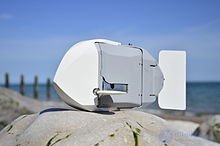
In 2014, iSplash- II was developed by doctoral student Richard James Clapham and Professor Huosheng Hu at the University of Essex. It was the first robotic fish able to outperform a real carangiform fish in terms of average maximum velocity (measured in body lengths per second) and endurance, the duration of sustaining maximum velocity. This build achieved a swimming speed of 11.6 BL/s (i.e., 3.7 m/s). The first build, iSplash -I (2014), was the first robotic platform to apply carangiform-style swimming motion, which was found to increase swimming speed by 27% compared to the traditional approach using a posterior confined-wave form.
Modular robots can usually perform several tasks and are especially useful for search-and-rescue or exploration missions. Some of the robots featured in this category include a salamander-style robot developed at EPFL, which can walk and swim , a snake-inspired robot developed at Carnegie Mellon University, which has four different modes of terrestrial locomotion, and a cockroach-inspired robot that can run and climb over a variety of complex terrain.
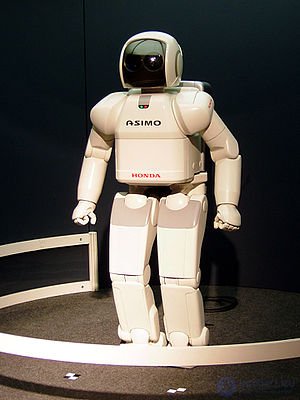
Humanoid robots are robots that resemble humans or are inspired by the human form. There are many different types of humanoid robots for applications such as personal assistance, reception, work in industry, or companionship. This type of robot is also used for research purposes and was originally developed to create better orthotics and prosthetics for people. Petman is one of the first and most advanced humanoid robots, developed at Boston Dynamics. Some humanoid robots, such as Honda Asimo, are overactuated. On the other hand, there are humanoid robots, such as the one developed at Cornell University, that have no actuators and passively descend a gentle slope.
Collective animal behavior has interested researchers for several years. Ants can build raft-like structures to survive on rivers. Fish can sense their environment more effectively in large groups. Swarm robotics is a fairly new field, and its goal is to create robots that can work together and exchange data, form structures as a group, and so on.
Soft robots are robots made entirely of soft materials and moving under pneumatic pressure, like octopuses or starfish. Such robots are flexible enough to move through a very confined space (such as inside the human body). The first multi-gait soft robots were developed in 2011, and the first fully integrated, autonomous soft robot (with soft batteries and control systems) was developed in 2015

Comments