
Lecture
Behavior-based robotics ( BBR ), or behavioral robotics is an approach in robotics that focuses on robots that are able to exhibit complex behavior despite having little internal state to model their immediate surroundings, mainly by incrementally adjusting their actions through sensory-motor connections.
Behavior-based robotics differs from traditional artificial intelligence by using biological systems as its model. Classical artificial intelligence usually uses a set of steps to solve problems, following a path based on internal representations of events, compared to the behavior-based approach. Behavior-based robotics relies not on pre-set calculations to resolve a situation, but on adaptability. This advance has allowed behavior-based robotics to become common in research and data collection.
Most behavior-based systems are also reactive, meaning they don't need internal representations programmed in for what a chair looks like or what surface the robot is moving over. Instead, all information is gathered from the robot's sensor inputs. The robot uses this information to incrementally adjust its actions according to changes in the environment.
Behavior-based robots (BBR) typically display more biological-like actions than their computationally intensive counterparts, which are very deliberate in their actions. BBR often makes mistakes, repeats actions, and appears confused, but can also display the anthropomorphic quality of persistence. Because of these actions, BBR is often compared to insects. BBR is sometimes considered an example of weak artificial intelligence, although some argue that they are models of intelligence as a whole.
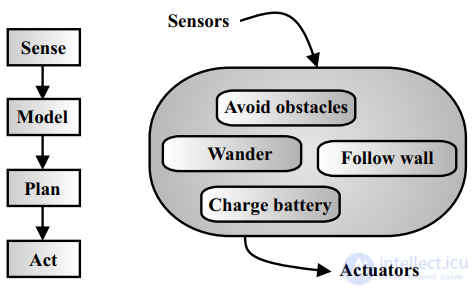
Figure 3.1: Comparison of information flow in classical AI (left side) and BBR (right side).
Any number of behaviors can be involved for a BBR, and the figure shows only an example involving four behaviors.
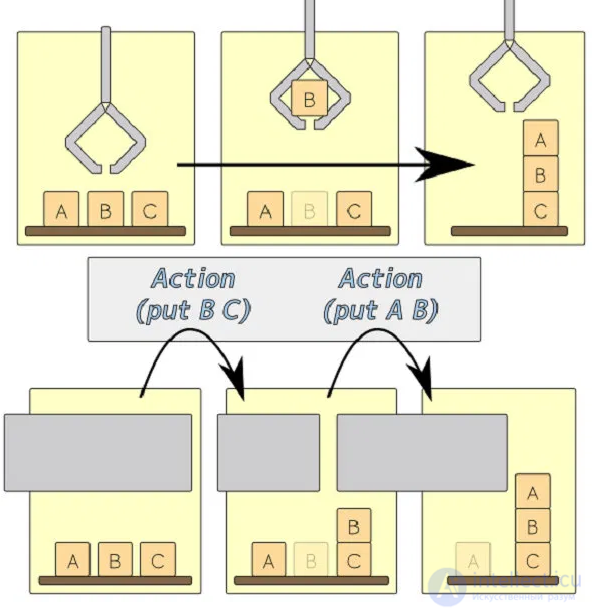
As can be seen from the left side of Fig. 3.1, classical AI is heavily oriented toward high-level reasoning, that is, toward the advanced cognitive procedures exhibited by humans and possibly some other mammals. Attempting to imitate such complex biological systems proved too difficult as a starting point for research in robotics: classical AI had great success in many of the subfields it spawned (for example, pattern recognition, path planning, and so on), but made little progress toward the goal of creating truly intelligent machines capable of operating autonomously. For a comprehensive introduction to classical AI,
BBR, shown in the right panel of Fig. 3.1, represents an alternative to classical AI in which intelligent behavior is built bottom-up, starting from
simple behaviors, many of which can be executed simultaneously in a given
robot's "brain," suggesting which actions the robot should take.
Most behavior-based robots are programmed with a basic set of functions to get them running. They are given a behavioral repertoire that dictates which behavior to use and when; obstacle avoidance and battery charging can become the foundation that helps robots learn and succeed. Rather than building models of the world, behavior-based robots simply react to their environment and the problems within it. They use internal knowledge drawn from their past experience, combined with their base behaviors, to solve problems.
The behavior-based robotics school owes much to work done in the 1980s at MIT by Rodney Brooks, who, together with students and colleagues, built a series of wheeled and walking robots using a subsumption architecture. Brooks's papers, often written with lighthearted titles such as « Planning is just a way of avoiding figuring out what to do next », the anthropomorphic qualities of his robots, and the relatively low development cost of such robots popularized the behavior-based approach.
Brooks's work builds - by accident or by design - on two earlier stages of the behavior-based approach. In the 1950s, W. Grey Walter, an English scientist engaged in neurological research, built a pair of vacuum-tube-based robots that were exhibited at the Festival of Britain in 1951 and which have simple but effective behavior-based control systems.
The second milestone is Valentino Braitenberg's 1984 book « Vehicles: Experiments in Synthetic Psychology » (MIT Press). It describes a series of thought experiments demonstrating how simple wired sensor/motor connections can lead to some complex behaviors, such as fear and love.
Later work in BBR belongs to the BEAM robotics community, which was based on the work of Mark Tilden. Tilden was motivated by reducing the computational power required for walking mechanisms compared to Brooks's experiments (which used one microcontroller per leg), and further reducing the computational requirements down to logic chips, transistor-based electronics, and analog circuit design.
Another line of development involves extending behavior-based robotics to multi-robot teams. The main focus of this work is on developing simple, general-purpose mechanisms that lead to coordinated group behavior, whether explicit or implicit.
In general, a behavior-based robot is first trained in the most fundamental of all behaviors, namely those related to survival. In animals, survival obviously takes priority over any other activity: whatever the animal (possibly a human) is doing, it suspends that activity if its life is in danger.
What does survival mean in the case of a robot? To function, a robot must, of course, remain structurally intact and have a non-zero energy level in its battery. Thus, examples of survival-related behaviors are collision avoidance and battery charging. However, it is even more important, especially for large robots, to avoid causing harm to people. Thus, the goal of collision avoidance is often to protect the people near the robot, rather than to protect the robot itself. Indeed, one can imagine a situation in which a robot would be required to sacrifice itself in order to protect a person (to some extent, this is already what robots used by bomb-disposal units do today). These ideas were beautifully summarized by the great science-fiction writer Isaac Asimov in his three laws of robotics, which are formulated as follows:
Before implementing a behavior, one must, of course, choose a behavioral architecture, that is, the overall structure for the implementation. Unlike researchers in many other scientific fields, a robotics researcher has considerable freedom in choosing the models and methods used. This is because in robotics, anything that works (reliably) is, by definition, correct. Although, for example, biological organisms can serve as a source of inspiration for implementing robot behaviors, there is absolutely no need to follow biology precisely. This state of affairs is sometimes an advantage and sometimes not. One problem is that there is no single standard testing method against which a new method could actually be compared. In practice, however, the number of commonly used behavioral architectures is rather limited. For example, in connection with evolutionary robotics, a (continuous-time) architecture is typically used.
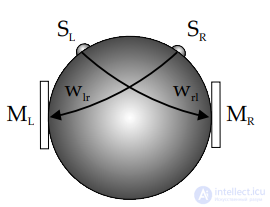
Figure 3.2: A Braitenberg vehicle equipped with an elementary pursuit system.
artificial neural networks, although other architectures are certainly used as well. For hand-coded behavior, that is, behavior that is fully specified by hand, neural networks are rarely used simply because they are very difficult to build by hand due to the distributed nature of the computations. Instead, other architectures are used, and here architectures based on simple if-then-else rules combined with logical state variables will be considered. This architecture is particularly well suited to hand-coding behavior and can also be represented in the form of finite-state machines. First, however, we will briefly discuss behavior implemented as very simple neural networks.
Even very simple networks can make a robot exhibit some form of basic intelligent behavior. This was noted in particular by Valentino Braitenberg. He informally described how intelligent artificial creatures can be built up gradually, starting from very simple ones. The term «Braitenberg vehicle» will be used here to refer to an artificial creature with a direct sensor-to-actuator mapping, although Braitenberg actually described far more complex creatures with memory, shape, pattern recognition, and so on.
As an example, consider a creature with two light sensors (for instance, infrared) positioned in its direction of travel, and two actuators (for instance, wheels), one on each side of its body. If the sensors are connected to the actuators as shown in Fig. 3.2, the creature will be a pursuer, that is, it will tend to move toward a detected object, since the left sensor (SL) activates the motor (MR) driving the right wheel.
Using the equations for a differentially driven robot and neglecting the motor model (i.e., assuming that the torques generated by the robot's brain are applied directly to the wheel axles), the equations of motion can be written as

where wlr and wrl are the (positive) weights connecting the sensors to the motors. This robot's ability to pursue a target is, to put it mildly, limited and depends on the values of the connection weights. If the connection weights are made too large, the robot will spin, and if the weights are too small, it will have trouble turning.
Nevertheless, with the right choice of connection weights, a simple pursuer can be built using just two neurons. Strictly speaking, the connections between the sensors and the actuators are not neurons at all, but input elements, since they only relay signals from the input and thus perform no computation.
In the case just described, training the neural network would be very simple: it would come down to setting the values of just two weights. However, neural networks used to control robots are usually much more complex and often recurrent. As mentioned above, such networks are very difficult to build by hand, and instead they are most often used in connection with artificial evolution, a topic that will be covered in the next chapter

Comments