
Lecture
Это продолжение увлекательной статьи про беспилотный летательный аппарат.
...
/ data-auto-open loading="lazy" alt="Unmanned Aerial Vehicle (UAV, Drone). The Quadcopter">
Manned and unmanned aircraft of the same type generally have identical physical components. The main exception is the crew cabin and the environmental control system or life-support systems. Some UAVs carry a payload (such as a camera) that weighs significantly less than an adult human, and as a result the aircraft can be significantly smaller. Despite carrying a larger payload, armed military UAVs are lighter than their manned counterparts with comparable armament.
Small civilian UAVs have no life-critical systems and can therefore be built from lighter but less durable materials and shapes, and can use less reliable electronic control systems. The quadcopter design has become popular for small UAVs, although this configuration is rarely used for manned aircraft. Miniaturization means that less powerful propulsion technologies can be used that are not feasible for manned aircraft, such as small electric motors and batteries.
UAV control systems are often different from the control systems of manned vehicles. For remote human control, a camera and video link almost always replace the cockpit windows; radio transmission of digital commands replaces the physical cockpit controls. Autopilot software is used on both manned and unmanned aircraft, with different feature sets.
The main difference between the aircraft is the absence of a cabin area and its windows. Tailless quadcopters are a common form factor for rotary-wing UAVs, while tailed mono- and twin-rotor copters are common for manned platforms. [60]
Small UAVs mostly use lithium-polymer (Li-Po) batteries, while larger vehicles often use conventional aircraft engines or hydrogen fuel cells. The scale or size of the aircraft is not a determining or limiting factor for a UAV's power supply. The energy density of modern Li-Po batteries is far lower than that of gasoline or hydrogen. The record for a UAV (built of balsa wood and Mylar skin) crossing the North Atlantic belongs to a gasoline-powered model airplane or UAV. Maynard Hill, in the account "In 2003, one of his creations flew 1,882 miles across the Atlantic Ocean on less than a gallon of fuel," holds this record. See: [61]Electric power is used, since less work is required for flight, and electric motors are quieter. In addition, with the right design, the thrust-to-weight ratio of an electric or gasoline engine driving a propeller can allow it to hover or climb vertically. The Botmite aircraft is an example of an electric UAV capable of climbing vertically. [62]
A battery elimination circuit (BEC) is used to centralize power distribution and often contains a microcontroller (MCU). More expensive switching BECs reduce platform heating.
UAV computing capabilities have followed the development of computing technology, starting with analog control and evolving into microcontrollers, then systems on a chip (SoC) and single-board computers (SBC).
System hardware for small UAVs is often called a flight controller (FC), flight controller board (FCB), or autopilot.
Position and motion sensors provide information about the state of the aircraft. Exteroceptive sensors deal with external information, such as distance measurements, while exproprioceptive sensors correlate internal and external states. [63]
Non-cooperative sensors can detect targets autonomously, so they are used to provide separation and collision avoidance. [64]
Degrees of freedom (DOF) refer to both the number and the quality of sensors on board: 6 DOF implies 3-axis gyroscopes and accelerometers (a typical inertial measurement unit - IMU), 9 DOF refers to an IMU plus a compass, 10 DOF adds a barometer, and 11 degrees of freedom typically adds a GPS receiver. [65]
UAV actuators include digital electronic speed controllers (which control motor rotation speed) linked to motors/engines and propellers, servomotors (mainly for fixed-wing aircraft and helicopters), weapons, payload actuators, LEDs, and speakers.
UAV software is called the flight stack or autopilot. The purpose of the flight stack is to acquire sensor data, control the motors to keep the UAV stable, and facilitate communication with ground control and mission planning. [66]
UAVs are real-time systems that require a fast response to changes in sensor data. As a result, unmanned aerial vehicles rely on single-board computers to perform their computing tasks. Examples of such single-board computers include Raspberry Pis, Beagleboards, etc., hardened boards such as NavIO, PXFMini, etc., or systems built from the ground up, such as NuttX, preemptive RT Linux, Xenomai, the Orocos Robot Operating System, or DDS-ROS 2.0.
| Layer | Requirement | Operations | example |
|---|---|---|---|
| Firmware | Time-critical | From machine code to processor execution, memory access | ArduCopter-v1, px4 |
| Middleware | Time-critical | Flight control, navigation, radio control | Cleanflight, ArduPilot |
| Operating system | Computationally intensive | Optical flow, obstacle avoidance, SLAM, decision-making | ROS, Nuttx, Linux distributions, Microsoft IoT |
Open-source stacks for civilian use include:
Because UAV software is open source, it can be customized for specific applications. For example, researchers at the Technical University of Kosice replaced the default PX4 autopilot control algorithm. [67] This flexibility and these collaborative efforts have led to the emergence of a large number of different open-source stacks, some of which are forks of others - for example, CleanFlight, which is a fork of BaseFlight and from which three other stacks have been created.
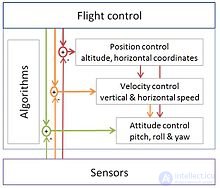
UAVs use open-loop, closed-loop, or hybrid control architectures.
UAVs can be programmed to perform aggressive maneuvers or land/perch on inclined surfaces [69], and then take off again toward more convenient communication locations. [70] Some UAVs can control flight using different flight models [71] [72], for example VTOL designs.
UAVs can also perch on a flat vertical surface. [73]
Most UAVs use radio for remote control and for exchanging video and other data. Early UAVs had only a narrowband communication channel. Downlinks appeared later. These bidirectional narrowband radio links carried command and control (C&C) data and telemetry data on the state of the aircraft's systems to the remote operator. For flights over very long distances, military UAVs also use satellite receivers as part of satellite navigation systems. In cases where video transmission is required, UAVs implement a separate analog video radio link.
Most modern UAV applications require video transmission. Thus, instead of two separate channels for C&C, telemetry, and video traffic, a broadband channel is used to transmit all types of data over a single radio channel. These broadband channels can use quality-of-service techniques to prioritize C&C traffic and reduce latency. These broadband channels typically carry TCP/IP traffic, which can be routed over the Internet.
The radio signal on the operator's side can originate from:
As the performance and reliability of mobile networks have increased over the years, drones have begun using mobile networks for communication. Mobile networks can be used for drone tracking, remote piloting, over-the-air updates [80], and cloud computing. [81]
Modern network standards explicitly account for drones and therefore include optimizations. The 5G standard requires reducing user-plane latency to 1 ms when using ultra-reliable low-latency communication. [82]
продолжение следует...
Часть 1 Unmanned Aerial Vehicle (UAV, Drone). The Quadcopter
Часть 2 - Unmanned Aerial Vehicle (UAV, Drone). The Quadcopter
Часть 3 Autonomy - Unmanned Aerial Vehicle (UAV, Drone). The Quadcopter
Часть 4 - Unmanned Aerial Vehicle (UAV, Drone). The Quadcopter
Часть 5 Basic principles - Unmanned Aerial Vehicle (UAV, Drone). The Quadcopter
Часть 6 - Unmanned Aerial Vehicle (UAV, Drone). The Quadcopter
Часть 7 Capabilities - Unmanned Aerial Vehicle (UAV, Drone). The Quadcopter
Часть 8 - Unmanned Aerial Vehicle (UAV, Drone). The Quadcopter
Часть 9 Applications of unmanned aerial vehicles - Unmanned Aerial Vehicle (UAV,

Comments