
Lecture
Almost every day, in the life of every person, the problem of choice arises. For example: to go or not to go somewhere, to do or not to do something, to speak or stay silent, and so on. Questions of this kind are undoubtedly present in our lives. Each person answers them in their own way, guided by various facts, the knowledge and experience they have, and, importantly, the opinions of other people whom they trust or to whom they are attached. A classic example of one person's influence on another person's decision-making is the interaction between any parent and their child, when the child is simply unable to make a decision and, as a result, relies entirely on the opinion of the parents.
The problem of making a choice can be inseparably linked to the problem of stupor. A stupor situation can arise when none of the alternatives has yet been adopted as the final choice. In this case a person may experience stiffness or a slowing of thoughts, feelings, and movements, which can be considered negative consequences.
Undoubtedly, at some point in the future, as modern technology and science develop, humanoid robots too will become an integral part of human society. At the same time, it can be said with almost one hundred percent certainty that, as humanoid robots improve and their functionality becomes more complex, they too will face the problem of choice under conditions of social attachment, which is currently characteristic of all people.
According to modern definitions, attachment is a feeling of closeness based on deep affection and devotion to someone or something; the seeking and establishing of emotional closeness with another person [2, 7].
The founder of attachment theory is the well-known English psychiatrist and psychoanalyst, a specialist in developmental psychology, family psychology, psychoanalysis and psychotherapy, John Bowlby. In his book "The Emotion Machine," Marvin Minsky analyzes Bowlby's work and that of a number of other psychologists and builds a series of abstract models of how the human brain works, including how attachment can influence people's goals and actions. An undeniable advantage of Minsky's analysis is the maximal generality of the proposed models. At the same time, Minsky does not give any specific recommendations for applying these models.
Modern robotics is moving toward modeling robots' attachment to their owners and determining robot behavior depending on this attachment. In this direction, the following well-known projects can be noted: the Japanese robot dog Aibo, the robot seal pup PARO, and the robot dinosaur PLEO [3-6].
This article proposes a mathematical model of robot attachment, an algorithm for decision-making by a robot under conditions of attachment, and also examines the stupor situation within the framework of the proposed model. The model and algorithm are built on the basis of the following pseudo-emotional characteristics of the robot.
Pseudo-emotional characteristics of the robot and attachment
It is known from the theory of human psychology that emotions are a bodily response to some stimulus. For robots, we will call this stimulus a plot, and let it have the following definition.
Let t be time.
We will call the function S(t) a plot if it has the following properties:
1. Domain of definition of S(t): t ∈ [t0, T0], 0 < t0 < T0 < ∞.
2. 0 < S(t) < ∞ for any t ∈ [t0, T0].
3. S(t) is a continuous and one-to-one function on [t0, T0].
The function f(t), satisfying the relation f(t) = a(S(t), t)S(t), where a(S(t), t) is an arbitrary function, will be called the function of the robot's internal experiences (the domains of definition of f(t), a(S(t), t) and S(t) coincide).
The function of the robot's internal experiences M(t) will be called the robot's pseudo-emotion if it satisfies the conditions:
1. Domain of definition of M(t): t ∈ [t0, T0], 0 < t0 < T0 < ∞.
2. M(t) is differentiable on (t0, T0), and is a continuous and single-valued function on [t0, T0].
3. M(t0) = 0 and M(T0) = 0.
4. In the domain of definition there exists a unique point z, such that: z ≠ t0, z ≠ T0 and 
By pseudo-upbringing of the robot, or simply pseudo-upbringing, we will mean the relatively stable attitude of the robot toward the plot.
We will call the elementary pseudo-upbringing of the robot r(t) on the plot S(t) the function of the form:

We will assume that, over time, the robot forgets the pseudo-emotions it once experienced. Past pseudo-emotions have less and less effect on its current pseudo-upbringing. Along with this, the past elementary pseudo-upbringing generated by the robot's previously experienced pseudo-emotions is likewise forgotten.
Based on this, let us introduce the following definition:
The pseudo-upbringing of the robot R(t) (the robot's pseudo-upbringing during the action of a pseudo-emotion) on the plot S(t) will be called the function of the form:

where t is the current time, t > ti, 0 ≤ θi+1(t) ≤ 1. The current time satisfies the relation t = τ + ti, where τ is the elapsed time of the current pseudo-emotion since it began, ti is the time the robot has been operating (undergoing pseudo-upbringing) before the current pseudo-emotion appeared, and Ri(ti) is the pseudo-upbringing acquired by the robot by time ti. The subscript i means that, before the current pseudo-emotion begins acting, the robot has already experienced i pseudo-emotions. In addition, we will assume that the pseudo-upbringing process is continuous in the sense that one pseudo-emotion is immediately followed by another, generated by the next plot with sequence number i + 1.
We will call the coefficient θi(t) the memory coefficient of past events, or the memory coefficient.
By the pseudo-upbringing process we will mean the process of change in the value of the robot's pseudo-upbringing function. At the initial moment of time, the value of the robot's pseudo-upbringing function is zero.
Thus, we will assume that the value of the pseudo-upbringing function Ri(t) shows the robot's attachment to a given subject, associated with the effect on the robot of the sequence of plots S1(t)...Si(t). If the robot is affected by n different subjects, each characterized by a sequence of stimuli:  , where k is the subject's sequence number, mk is the number of plots of influence from the k-th subject, then the values of the pseudo-upbringing functions
  show the robot's attachment with respect to each of the influencing subjects. Going forward, we will assume that the robot's memory coefficients may differ depending on each specific influencing plot.
Let us consider a simplification of the proposed model; for this we introduce several definitions.
A forgetful robot will be one for which the pseudo-upbringing process is characterized by:

In this case, if at the moment any pseudo-emotion ends the memory coefficient of past events θi(t) = θ, the robot will be called a uniformly forgetful robot.
Pseudo-emotions M1(t), ..., Mn(t) that produce the same elementary pseudo-upbringing q, that is, r1(T0) = ... = rn(T0) = q, will be called equivalent pseudo-emotions. In this case we will say that a pseudo-upbringing process is taking place on equivalent pseudo-emotions with elementary pseudo-upbringing q.
Thus, taking the above into account, we can obtain the following result.
For a uniformly forgetful robot with a memory coefficient of past events θ, whose pseudo-upbringing process takes place on equivalent pseudo-emotions with elementary pseudo-upbringing q, the value of the pseudo-upbringing function at the moment the i-th pseudo-emotion ends is calculated as

Decision-making by a robot under conditions of social attachment
Suppose that the robot faces a problem of choice, consisting of the following: the robot must make some decision regarding its future actions or behavior. In doing so, the robot must take into account its social connections and social attachment to its owner when making the decision. For example, when two people simultaneously give the robot two mutually exclusive commands, the robot must decide in favor of one command or the other depending on its attachment to each of the human owners of the robot.
Suppose n different subjects act on the robot with sequences of stimuli-plots:  . Thus, by some point in the robot's operating time, it has developed pseudo-upbringings
  with respect to each of the stimuli, that is, with respect to each of the influencing subjects.
Taking  as a measure of the robot's attachment with respect to each of the influencing subjects, we can formulate a simple rule for the robot's decision-making in favor of one subject or another: the decision is made in favor of the subject for whom the maximum pseudo-upbringing has formed. This raises the question of what the robot should do if the maximum pseudo-upbringing has formed with respect to several subjects at once. In what order should it respond to the influences, or perhaps leave some influences simply without a response? We will call this situation a stupor situation.
Decision-making by the robot and the stupor situation
Suppose that, of the n subjects acting on the robot, with respect to p subjects the robot has, at the moment of decision-making, developed the maximum pseudo-upbringing, that is

Suppose the robot is uniformly forgetful with respect to each of the influencing subjects, with a memory coefficient of past events  , and the pseudo-upbringing process with respect to each of the influencing subjects takes place on equivalent pseudo-emotions with elementary pseudo-upbringing q. Then the stupor situation will look as follows:
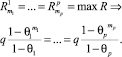
Dividing the proposed relation by q, we obtain the stupor condition for a uniformly forgetful robot with a pseudo-upbringing process on equivalent pseudo-emotions:
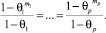
As can be seen from the stupor condition, regardless of the memory coefficients  , when m1 = ... = mp = 1 the stupor condition is always satisfied. This case is trivial, so from now on, when considering the stupor condition, we will assume that m1, ..., mp are not simultaneously equal to one.
It is reasonable to assume that, rather than looking for ways to overcome a stupor situation once it has occurred, one should look for a way never to fall into this situation in the first place. It is clear that the robot will never enter a stupor if, for  and given
  , the resulting stupor condition is never satisfied. The memory coefficients of past events for which the stupor condition is not satisfied for any natural values of
  will be called anti-stupor memory coefficients.
Let us show that anti-stupor memory coefficients exist. Consider the situation where a stupor arises with respect to two subjects. The stupor condition in this case looks as follows:

Suppose that  and
and  hold. Thus we obtain the relation:

Transforming, we obtain: 
From the resulting relation we can conclude that, when m1 and m2 are not simultaneously equal to one, the stupor condition is never satisfied. Let us prove this.
Consider the left-hand side of the equality. The possible values that the left-hand side takes, as m1 increases without bound, are: 2, 4, 8, 16, ... At the same time, the right-hand side of the equality, as m2 increases without bound, tends from 2 toward 4, without ever reaching 4. Thus, when m1 and m2 are not simultaneously equal to one, the stupor condition will never be satisfied.
In a similar way, it can be shown that, for three subjects, the memory coefficients 
 and
and  are likewise anti-stupor coefficients.
Thus, knowing the memory coefficients of a uniformly forgetful robot, one can predict how the robot is likely to behave when making decisions. Whether it will fall into a stupor, or whether such a situation is in principle impossible.
Conclusion
This article presents a model of decision-making by a robot under conditions of social attachment, based on the introduced pseudo-emotional characteristics. The model is fairly simple, yet at the same time does not sacrifice generality, which is an undeniable advantage. To apply the model to a specific domain situation, it is sufficient to define just two functions: the plot function and the pseudo-emotion function, which is both an advantage and a drawback. The advantage lies in the fact that there are only two such functions. On the other hand, determining the specific form of these functions independent of the domain is not possible.
In addition, the stupor situation was considered within the framework of the proposed robot decision-making model. The condition for a stupor to occur was formulated. It was shown that, for a certain class of robots, the stupor situation can be fairly easily predicted or simply avoided.
1. Bowlby, John. Attachment. – M. : Gardariki, 2003. – 477 p.
2. Psychological dictionary [Online resource]. – Available at: http://mirslovarei.com/content_psi/privjazannost-1351.html (accessed: 01.07.2012).
3. Raduzhnaya, Anastasia. Will a robot ever become a human's friend? [Online resource] – Available at: http://robotor.ru/2011/05/24/robot-as-dog/ (accessed: 02.07.2012).
4. Robot PARO [Online resource]. – Available at: http://roboting.ru/954-robot-paro.html (accessed: 02.07.2012).
5. Robot dinosaur PLEO [Online resource]. – Available at: http://www.icases.ru/buy_pleo.html (accessed: 02.07.2012).
6. Robot dog AIBO [Online resource]. – Available at: http://www.prorobot.ru/04/robot-dog-aibo.php (accessed: 02.07.2012).
7. Ushakov's Explanatory Dictionary [Online resource]. – Available at: http://ushakovdictionary.ru/ (accessed: 01.07.2012).
8. Chernikov, K.V. Sound as a plot for modeling robot emotions // Investigated in Russia: electronic journal. – 2010. – No. 83. – P. 968-974. – URL: http://zhurnal.ape.relarn.ru/articles/2010/083.pdf (accessed: 02.07.2012)
9. Chernikov, K.V. The SoundSelectBot program – a program modeling the alternative choice of an emotional robot: certificate of state registration of a computer program. No. 2011615160, 30.06.2011.
10. Marvin Minsky. THE EMOTION MACHINE. Commonsense Thinking, Artificial Intelligence, and the Future of the Human Mind. – New York : SIMON & SCHUSTER, 2006. – 372 pp.

Comments