
Lecture
In acoustic sensors the primary information signals are acoustic.
Recall that acoustic waves – are pressure oscillations propagating in air (gases), in a liquid or in a solid medium. It is known that acoustic waves propagate considerably more slowly than radio waves: in air, for example, at a speed of about 340 m/s, in water – about 1.5 km/s, in solids – 3-6 km/s. And this has its positive sides.
By oscillation frequency acoustic waves are subdivided into:
infrasound (frequency below 16 Hz);
sound (frequency range from 16 Hz to 20 kHz), which is perceived by the human ear;
ultrasound (from 20 kHz to 1 GHz);
hypersound (above 1 GHz, up to 1013 Hz).
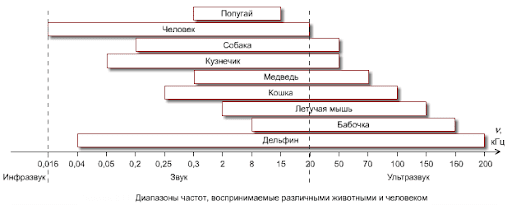
A sound, elastic wave. Characteristics: speed, frequency range, pitch, timbre, loudness. Infrasound and ultrasound.
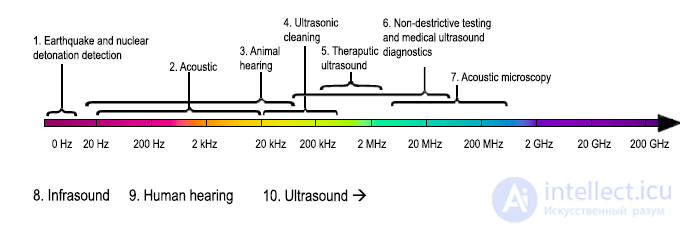
Spectrum of sound vibrations. 1 — earthquakes, lightning and detection of nuclear explosions; 2 — acoustic range; 3 — Animal hearing; 4, Ultrasonic cleaning; 5. Therapeutic application of ultrasound; 6 — Non-destructive testing and medical ultrasound diagnostics; 7 — Acoustic microscopy; 8 — Infrasound; 9 — Audible range; 10 — Ultrasound
Infrasound in water (e.g., in seas and oceans) can propagate for hundreds of kilometres. Perceiving it, sea creatures "hear" the approach of a storm in advance. Hypersound and ultrasound scatter and are absorbed strongly, and therefore attenuate much faster.
Ultrasonic waves are usually divided by frequency into three ranges:
low-frequency (16–100 kHz, wavelength in air 3-20 mm, in water 15-90 mm);
medium frequencies (0.1-10 MHz, wavelength in air 0.034–3.4 mm, in water 0.15-15 mm);
high-frequency (10–1000 MHz, wavelength in air 0.34-34 µm, in water 1.5–150 µm).
Acoustic waves of natural origin are, as a rule, complex, carrying oscillations of different frequencies. Their frequency composition is usually characterized by a frequency-amplitude spectrum – the dependence of the intensity or amplitude of the oscillations on frequency. Musical sounds mostly have a discrete spectrum, others – a continuous spectrum. Sound noise has a very broad continuous frequency spectrum.
The intensity of acoustic waves, like all other kinds of waves, is characterized by the average energy they carry per unit time through a unit area perpendicular to the direction of propagation, and is measured in W/m2. A specific characteristic of the intensity of acoustic waves is the amplitude of the pressure oscillations (Pa). In the region of sounds that a human hears, a logarithmic measure of loudness is also used – the so-called "sound pressure level". It is expressed in decibels (dB) and is calculated by the formula
 (4.1)
(4.1)
where p– is the amplitude of the pressure oscillations in pascals, and  – is the so-called "threshold of hearing", i.e. the minimum amplitude of sound oscillations that the human ear is able to hear.
In acoustic sensors the Doppler effect is often used – the change in the frequency of the oscillations perceived by an observer when the source of the waves and the observer move relative to each other or relative to the medium in which the waves propagate. If the observer is stationary relative to the medium of propagation, and the source of acoustic waves approaches the observer at a speed of  , then the frequency of the oscillations perceived by the observer is given by the formula
 (4.2)
(4.2)
where f0 – is the oscillation frequency at the source of the acoustic waves,  – is the speed of propagation of the acoustic waves in the medium. The frequency of the acoustic waves we perceive from a source that is approaching us is higher, and from a source that is receding from us – lower. From the magnitude of the frequency shift one can determine the speed of motion of the source of acoustic waves relative to the observer.
The frequency we perceive is higher when we approach the source, and lower when we move away from it.
Since acoustic waves – are pressure oscillations, elements sensitive to rapid oscillations of external pressure are used to perceive them. As a rule, these are light membranes or diaphragms, which convert oscillations of the pressure of air, liquid or a solid body into mechanical oscillations, which in turn are then converted into electrical signals or into signals of another nature.
Sensors sensitive to sound waves propagating in air or in gases are usually called microphones; sensors sensitive to acoustic waves that propagate in water or in liquids – hydrophones; and sensors of acoustic waves in solid bodies – stethoscopes. Doctors, for example, have for many centuries used mechanical stethoscopes to listen to sounds inside the human chest arising from heart contractions, the passage of air through the airways, etc.
The main parameters of acoustic sensors are: the frequency and dynamic ranges, sensitivity, directivity pattern and frequency response (FR).
Microphones
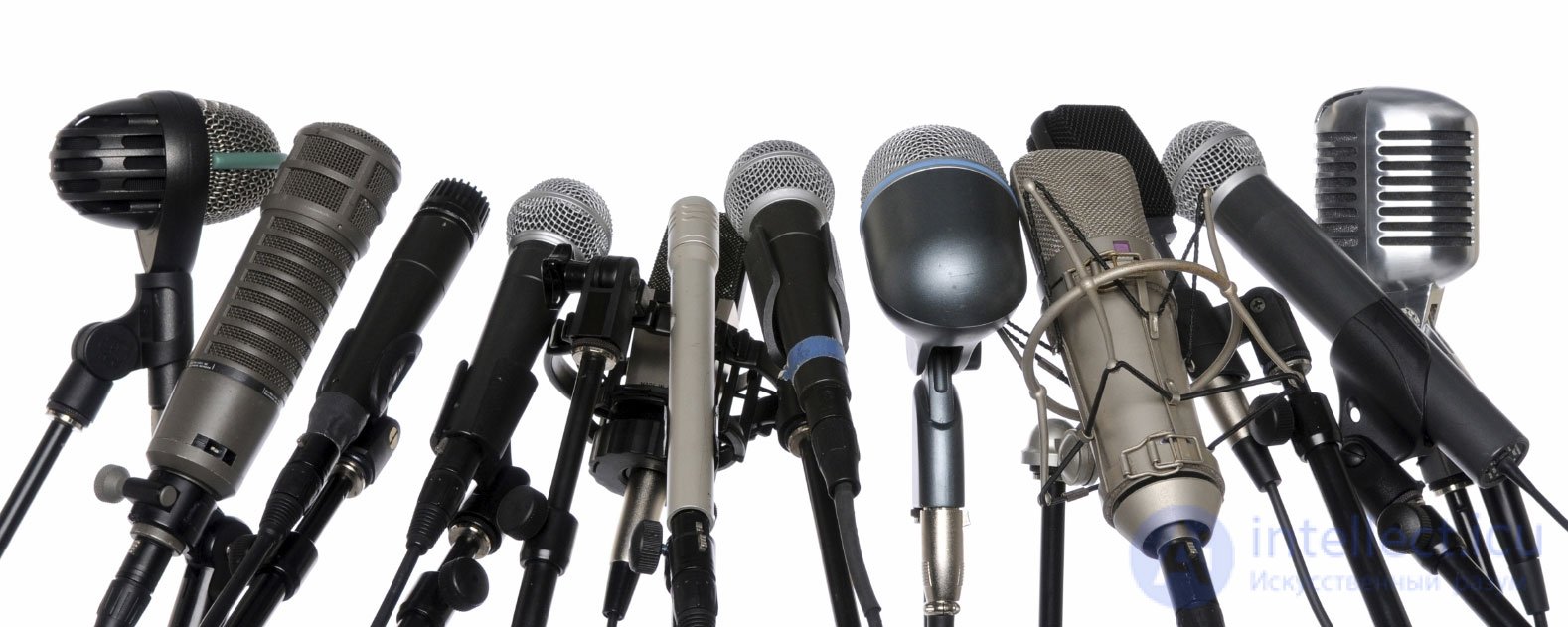
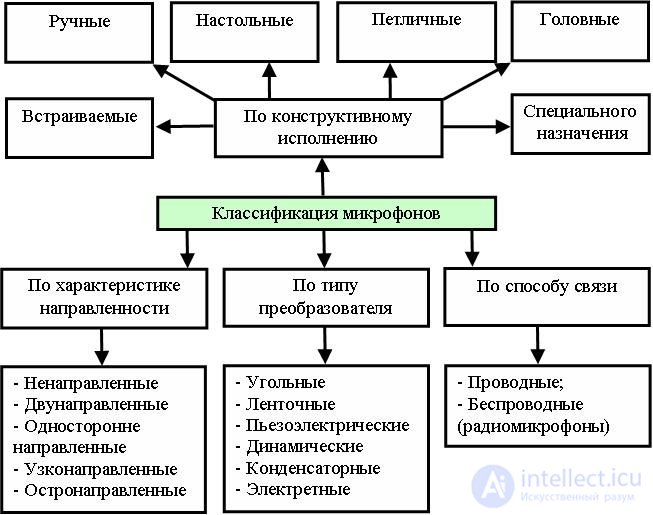
The first microphones were resistive. To convert mechanical oscillations into an electrical signal they used carbon (graphite) powder, whose electrical resistance decreased with increasing pressure. Since then the set of operating principles of acoustic sensors has expanded considerably. Nowadays the following are used: electrostatic (capacitor, capacitive), fibre-optic, piezoelectric, piezoresistive, and other types of such sensors.
Hydrophones
Unlike microphones, hydrophones must be resistant to the high static pressures characteristic of great depths. They are used in hydroacoustics for listening to acoustic signals and noise propagating in liquids, for measuring the parameters of these signals, and as component elements of receiving hydroacoustic antenna arrays. The most common are electrodynamic, piezoelectric and magnetostrictive hydrophones. Magnetostrictive hydrophones use the so-called "inverse magnetostriction effect" in ferromagnets – a change in magnetic induction under changes of external pressure, which leads to the appearance of an alternating EMF in the winding.
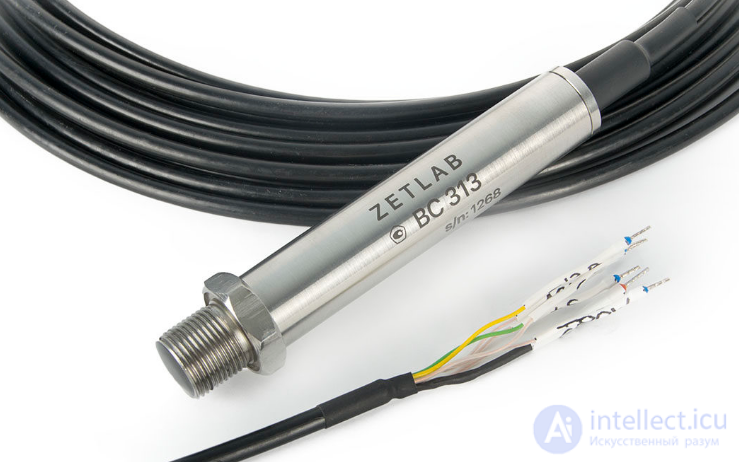
Design variants of submersible and flush-mounted hydrophones
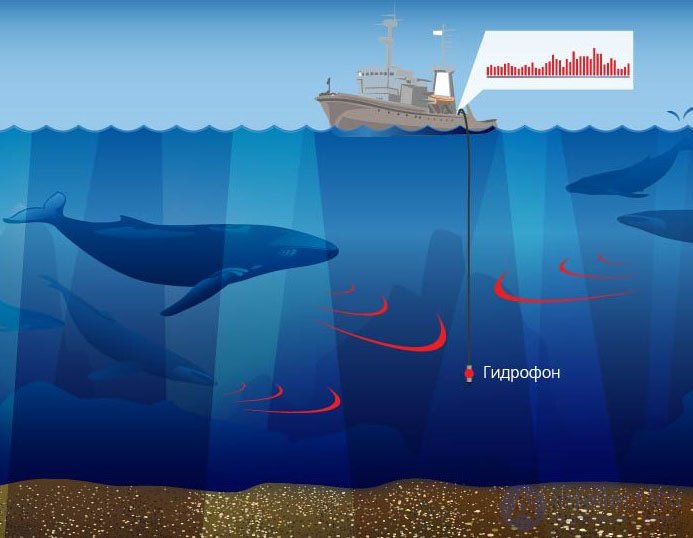
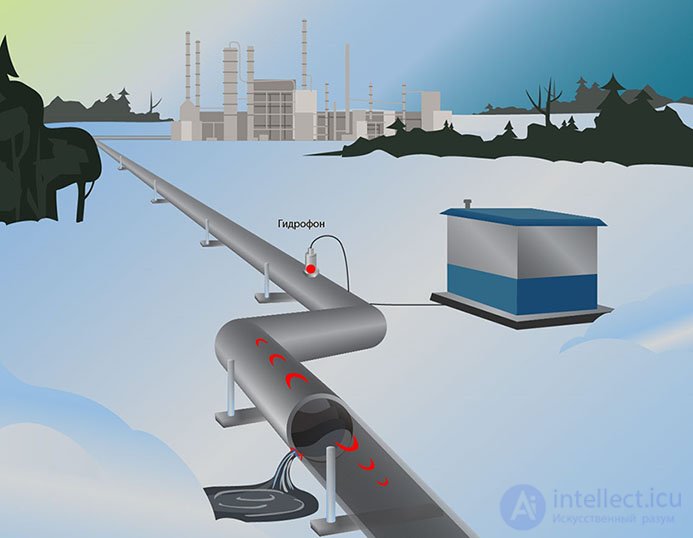
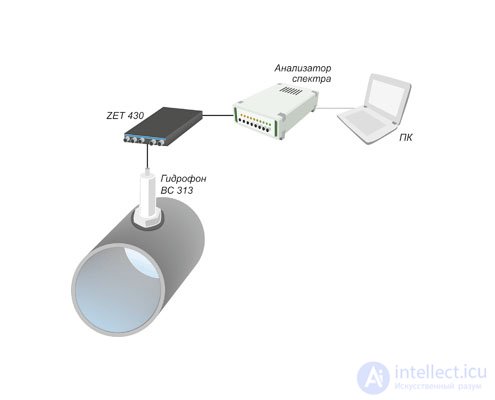
Stethoscopes
In stethoscopes the acoustic oscillations of the outer surface of a solid body are converted into corresponding oscillations of the pressure of a gas or liquid. Through a sound-conducting tube they are transmitted to an element sensitive to acoustic oscillations. In order to increase sensitivity, the contact area of the stethoscope with the solid body is enlarged, while the walls of the sound-conducting tube gradually narrow, so as to concentrate the acoustic pressure oscillations on a small area and increase their amplitude. The narrowing, as a rule, follows an exponential law.
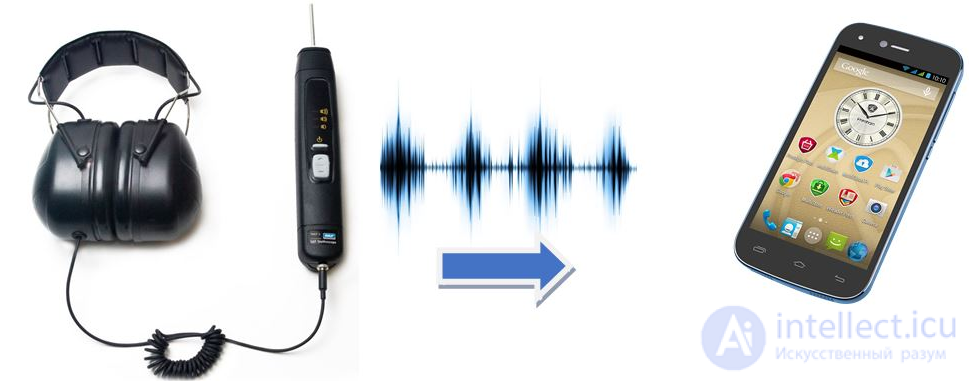
SKF electronic stethoscope
Surface microphones
The ability of a stethoscope to collect sound from a large surface and concentrate it on a small area of the sensing element led to the creation of the so-called surface microphones. In essence – these are stethoscopes. They have a flat input membrane, an internal volume of gas for concentrating sound, and an acoustic sensing element.
Intelligent electronic stethoscopes have opened for us a "sound window" into the mysterious world of underground nature. With their help one can listen to and record the natural sounds of mountains, awakening volcanoes, gushing geysers, floating icebergs, etc. It turns out that they possess not only an unusual, distinctive acoustic beauty and harmony. With their help one can learn much that is new about the properties and about the "inner life" of these objects, to foresee in good time the descent of mountain avalanches, volcanic eruptions, the collapse of an iceberg, and so on.

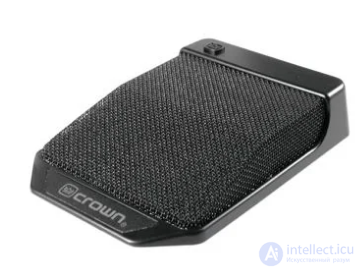
Eavesdropping devices
Among intelligent acoustic sensors there are also devices for the covert eavesdropping of conversations. Let us note straight away that this is lawful only with the permission of a court or a prosecutor.
There exist many different eavesdropping devices; let us consider just one variant, when a conversation is taking place inside a room or a car behind closed windows – for listening to it, so-called "laser microphones" have been developed, the principle of operation of which is disclosed in Fig.4.1
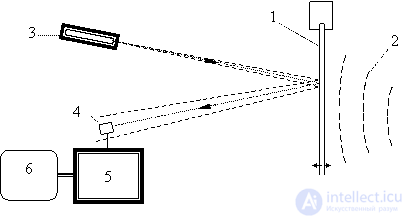
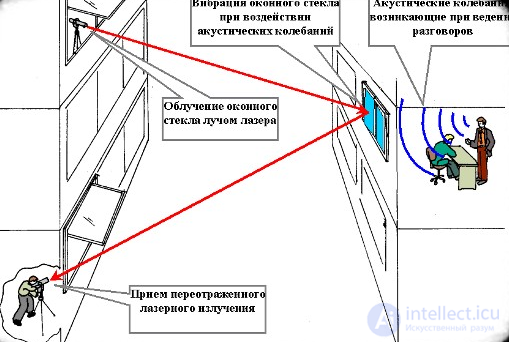
Fig. 4.1. Functional diagram of a laser microphone
Sound waves 2, reaching the glass 1, cause it to vibrate at the corresponding sound frequencies. Here the glass window pane plays the role of the membrane – the sensing element of the sensor, which converts sound signals into mechanical oscillations. At a considerable distance from the glass (up to 100–200 m) a laser 3 is set up, whose invisible (usually infrared) modulated beam is directed onto the glass. At approximately the same distance, within the cone of the laser beam reflected from the glass, a receiving station is placed, consisting of one or several photodetectors 4, an electronic unit 5 and a sound generator 6 (headphones or a loudspeaker). When the glass vibrates, the phase of the light oscillations falling on the photosensitive element at the receiving point changes. The signals from it are amplified, filtered, detected and recorded in the electronic unit, and can also be listened to through headphones 6."
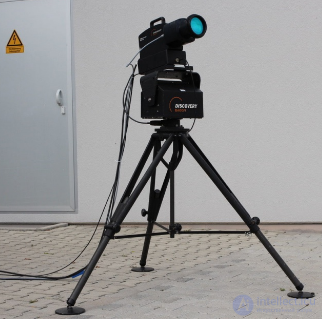
 Optical-acoustic (laser) microphone
Up to now we have mostly considered passive acoustic sensors, "passive" in the sense that acoustic signals arrive at them "from the outside", and the sensors merely perceive them. However, active acoustic sensors have also been developed and are widely used. Of these we shall briefly consider echo sounders and diagnostic ultrasound devices.
Echo sounders,
Preference in echolocation is usually given to ultrasonic (hereafter US) waves, since they
US waves of medium and high frequencies are absorbed quite strongly and attenuate quickly in air and gases. Therefore, for echolocation in air, predominantly low-frequency US waves are used.
. Echo sounders are the name given to all sensors that operate on the principle of perceiving sounds reflected from objects located at a distance, i.e. on the principle of an echo (from the Greek "echo" – reflected sound, an echo, a response).
In sonar, the names "sonar" and "echolocator", "echo sounder", "sonar" have become practically synonymous.
The transmitter and receiver of US waves are, as a rule, housed in a single casing together with the electronics needed for measurements and with elements that provide directivity – concentrating the transmitted and received US waves in a particular sector of space.
Propagating in water, the waves encounter objects present in it, and are reflected and scattered by them. Part of the reflected and scattered US waves, in a significantly weakened form, return back to the acoustic antenna array. Let  – be the minimum range that the sonar "sees" or "hears". The US wave travels to objects located at that distance and back in a time
 (4.3)
(4.3)
Here  – is the speed of propagation of US waves in water. The duration of the probing US pulse must not exceed this time, since otherwise signals reflected from the nearest targets will not be received.
Let  – be the maximum range that the sonar "sees" or "hears". The US wave travels the distance to the farthest objects and back in a time
 (4.4)
(4.4)
The period between the sending of probing US pulses must not be less than this time, since otherwise signals reflected from the most distant targets will likewise not be received. Thus, the range of distances to objects detected by the sonar (from  to
to  ), the maximum duration of the probing US pulses
  and the minimum period of their emission
  are unambiguously related to one another.
One of the applications of echolocation, not in water this time but in air, is the US detection of the presence of an object in a monitored zone and measurement of the distance to it. This becomes especially important under difficult conditions of dense fog, smoke, dust and so on, when optical methods "work" poorly. But for US waves none of this is an obstacle. Piezoelectric transducers are most often used as the source of ultrasound.
From the measured delay time  the distance to the object is calculated
 (4.5)
(4.5)
where  – is the speed of propagation of ultrasound in air.
As in sonar, the pulse duration  determines the minimum distance to an object that can be measured,
 (4.6)
(4.6)
The probing frequency  determines the maximum distance that can be measured
 (4.7)
(4.7)
The wavelength depends on the frequency of the probing US waves 
 (4.8)
(4.8)
and the resolution of the sensor determined by this, i.e. the minimum size of objects whose presence can still be detected. In air, at a frequency above 340 kHz the wavelength is less than 1 mm.
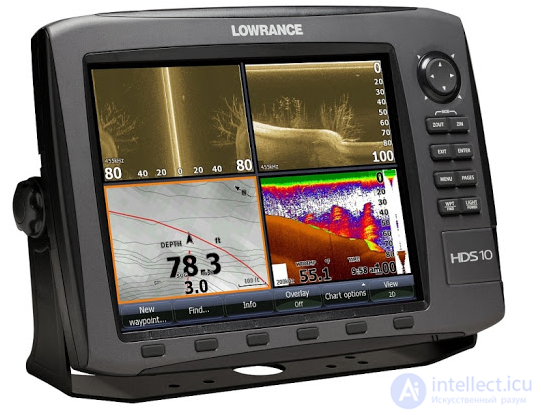
Fig. An echo sounder for summer fishing,
Ultrasound examinations in medicine.
One of the important types of echolocation is ultrasound examination of the internal organs of the human body, which is widely used in medicine. The speed of propagation of US waves in human body tissues is about 1540 m/s, i.e. close to the speed in an aqueous medium. But because of the acoustic heterogeneity of the human body, at the boundaries between organs and tissues of different density and elasticity, partial reflection, scattering and refraction of US waves occurs. The greater the difference in density, the higher the amplitude of the reflected US wave. This makes it possible to determine, and then reconstruct in the form of an image, the spatial boundaries between organs, tissues and various structural elements of tissues, their shape, size, relative position, and local features. Using high-frequency US waves (1-15 MHz), a high resolution can be achieved – down to 0.1 mm. When reflected from moving objects (respiratory movements of the chest, of the diaphragm, contractions of the heart, pulsation of the arteries, the movement of blood through the vessels, etc.), the frequency of the reflected US wave changes (the Doppler effect). By measuring the magnitude of the frequency change, one can calculate the corresponding speed of motion and visually distinguish areas of the internal organs that are moving at different speeds – even quite slowly (less than 1 cm/s).
Modern methods of ultrasound in medicine are aimed primarily at improving the image, adapting it to the physiology of the researcher's perception, increasing the resolution of the sensors, and raising the frequency of the ultrasonic waves.
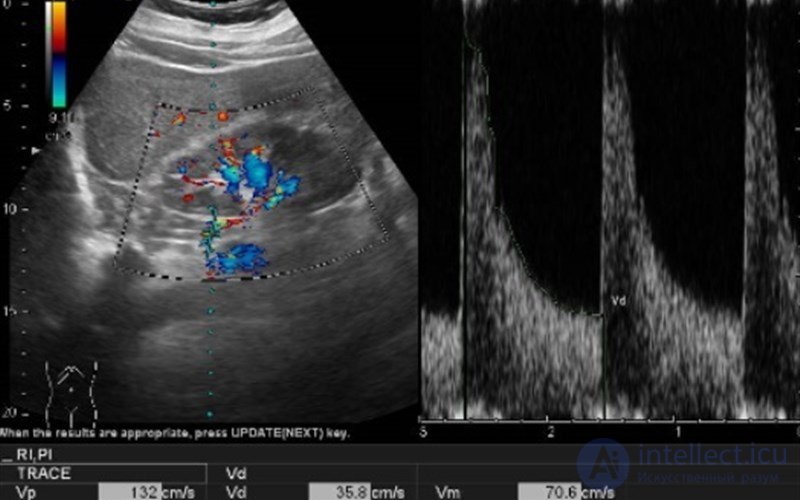
US surveys for seismic exploration
A method known as spectral seismic profiling (SSP) is known. It consists in the fact that a pulsed acoustic probing signal is sent vertically down into the earth from a mobile SSP sensor. Then its "response", stretched out in time, is "listened to" and recorded – weak secondary acoustic waves excited by this signal in the earth's crust. They are received by a piezoelectric film sensor, which (this is fundamentally important!) has no natural resonant frequencies of its own. After amplification and filtering of the echo signals, an intelligent sensor performs their spectral analysis. In the spectrum of the resulting seismic response, layers of the subsurface located at greater depth correspond to progressively lower frequencies in the spectrum. The sensor is then moved a certain distance horizontally in the given direction of the "cross-section", and the measurements are repeated. The results of many successive measurements are combined together to build an "SSP cross-section" of the geological structure.
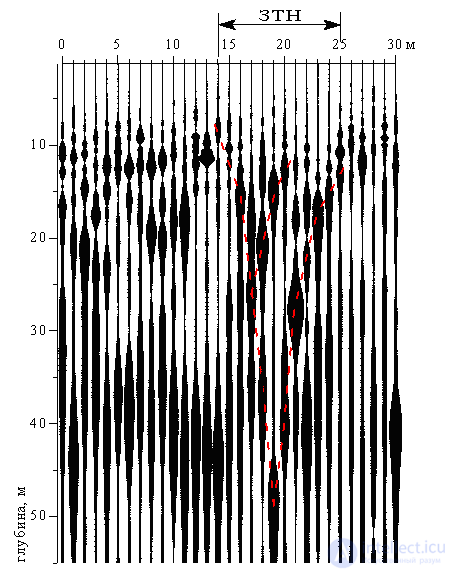
Spectral seismic profiling cross-section at the crossing of a Zone of Tectonic Disturbance
In 1993 it was found that, using spectral seismic exploration (the method of spectral seismic profiling (SSP)), it became possible to identify zones of tectonic disturbance (ZTD). A ZTD appears on SSP cross-sections as a funnel-shaped (V-shaped) object.

Comments