
Lecture
Quantum technologies represent an innovative direction in science and engineering, based on the laws of quantum mechanics. These technologies find application in computing, communications and sensing, providing unprecedented accuracy and measurement sensitivity.
They promise revolutionary changes in computing, communications, sensing and cryptography.
One of the key areas of quantum technologies is quantum computing. Unlike classical computers, which operate on bits taking the value 0 or 1, quantum computers use qubits — elements capable of being in a superposition of these states. This allows quantum computers to perform complex computations many times faster than their classical counterparts. Quantum algorithms, such as Shor's algorithm for factoring numbers or Grover's algorithm for searching unstructured databases, demonstrate a significant performance gain in solving specific problems.
Another promising area is quantum cryptography, based on the laws of quantum mechanics to ensure absolutely secure transmission of information. One of the best-known methods — quantum key distribution (QKD), for example the BB84 protocol, which makes it possible to detect any interference in the communication channel. This makes quantum cryptography especially valuable for protecting data in the era of quantum computing, when traditional cryptographic methods may become vulnerable.
Quantum communications are developing toward the creation of global information-transfer networks protected from interception. Quantum networks already exist, such as the Chinese quantum satellite “Mozi”, which enabled the first successful intercontinental encrypted communications. In the future, such technologies may lead to the creation of a quantum internet — a global network with the highest level of security.
Quantum sensors and metrology are also an important part of quantum technologies. The use of quantum effects makes it possible to create sensors with unprecedented accuracy, for example for measuring magnetic and gravitational fields, which finds application in geology, medicine and even in navigation systems.
Despite their enormous prospects, quantum technologies face a number of challenges. Key problems include the stability of quantum states (decoherence), the need for extremely low temperatures for most quantum systems to operate, as well as the difficulty of scaling quantum devices. Nevertheless, leading global companies such as IBM, Google, Microsoft, as well as startups and research laboratories, are actively developing quantum processors and algorithms, gradually bringing us closer to a new technological era.
Thus, quantum technologies represent a rapidly developing field capable of changing many areas of science and engineering. They open new horizons for humanity in computing, security and sensing, and their development over the coming decades may lead to a genuine technological revolution.
Quantum mechanics — is a fundamental theory of physics describing the behaviour of particles at the microscopic level. Unlike classical mechanics, in which the motion of particles obeys Newton's laws, quantum mechanics uses probabilistic descriptions. Its main principles include the superposition of states, the Heisenberg uncertainty principle and the quantization of energy.
Quantum mechanics arose in the early 20th century thanks to the work of Max Planck, Albert Einstein, Erwin Schrödinger, Werner Heisenberg and other scientists. It explains such phenomena as the photoelectric effect, the discreteness of atomic energy levels and the tunnelling effect.
One of the central principles of quantum mechanics is wave–particle duality. This principle means that quantum objects, such as electrons and photons, can exhibit both wave-like and particle-like properties depending on the conditions of the experiment.
An example of this phenomenon is the double-slit experiment, in which electrons, passing through the slits, form an interference pattern characteristic of waves. However, when an attempt is made to determine through which slit the electron passed, its behaviour becomes purely particle-like and the interference disappears. This demonstrates a key feature of quantum mechanics: observation affects the state of the system.
The state of a quantum system is described by the wave function  , which contains all the available information about the system. The wave function obeys the Schrödinger equation, and the square of its modulus
  determines the probability of finding the particle at a given point in space at a particular moment in time.
The wave function can be in a superposition of states, which means the simultaneous existence of the system in several possible states until the moment of measurement. This explains, for example, the paradox of Schrödinger's cat, in which a quantum system (a cat in a box) is in a superposition of the states “alive” and “dead” until the moment of observation.
Collapse of the wave function — is the process by which a quantum system instantaneously transitions from a superposition of states into one definite state at the moment of measurement. Before measurement, the system is described by a probability distribution of possible outcomes, but after measurement it takes on one specific value.
This process remains one of the most mysterious features of quantum mechanics. There are several interpretations explaining the collapse, including the Copenhagen interpretation, according to which the wave function does not objectively exist before measurement, and the many-worlds interpretation, which holds that all possible outcomes are realized in different branches of the universe.
Quantum sensors use the unique properties of quantum systems for ultra-precise measurements of physical quantities such as time, magnetic fields and gravity.Quantum sensing is a field of science and technology based on the use of quantum effects to increase the sensitivity and accuracy of measurements. Unlike classical sensors, quantum sensors use phenomena such as superposition, entanglement and quantum tunnelling, which makes it possible to achieve unique characteristics in measuring instruments. These technologies find application in medicine, geophysics, metrology, the military field and other areas requiring extremely precise measurements.
The basic principles, such as entanglement, superposition and quantum correlations, make it possible to significantly increase the accuracy of sensors compared with classical analogues.
The main properties of quantum systems that make them promising for sensing include:
Quantum superposition – the ability of quantum particles to be in several states at once. This property is used in atomic interferometers to increase the accuracy of measuring gravitational and inertial parameters.
Quantum entanglement – a phenomenon in which the state of one particle instantly affects the state of another, regardless of the distance between them. Entanglement makes it possible to create ultra-sensitive sensors with high accuracy and a low noise level.
Quantum tunnelling – the ability of particles to pass through potential barriers that they could not overcome in classical physics. This property is used, for example, in scanning tunnelling microscopes for studying surface structure at the atomic level.
Coherence of quantum states – the ability to maintain a coherent (consistent) state of a quantum system over an extended period of time. This is a key parameter for quantum magnetometers and gravimeters.
Quantum non-destructiveness of measurements – methods that make it possible to measure the properties of a system without significantly affecting its state. This is especially important for high-precision measurements in biomedical and metrological applications.
Thanks to these unique properties, quantum sensing opens up new horizons in the field of precision measurement, making it possible to register the smallest changes in physical quantities with unprecedented accuracy.
Feedback in quantum systems makes it possible to minimize errors and improve measurement accuracy.
Feedback plays a key role in the development of science and technology, including the field of quantum measurements. In quantum mechanics, measurement accuracy is limited by fundamental principles such as the Heisenberg uncertainty relation. However, modern feedback methods make it possible to minimize errors and improve the stability of quantum systems.
Quantum measuring devices, including quantum clocks, use feedback principles to correct errors and maintain high accuracy. Thanks to active control methods, such as adaptive correction of phase noise or the use of quantum entanglement, exceptional measurement accuracy can be achieved.
Quantum clocks use the oscillations of atoms for precise time measurement, surpassing traditional atomic clocks.
Quantum clocks are devices that use quantum effects for ultra-precise time measurement. They are based on transitions between the energy levels of atoms or ions, which makes it possible to achieve stability exceeding the capabilities of traditional atomic clocks.
One of the best-known examples is clocks based on single ions (for example, the aluminium ion Al+), as well as optical lattice atomic clocks that use cold strontium or ytterbium atoms. These devices operate in the optical range, which gives higher accuracy compared with traditional caesium atomic clocks that use microwave transitions.
Quantum clocks are already finding application in fundamental physics, navigation, global positioning and the synchronization of complex networks. Thanks to their high stability, it becomes possible to refine physical constants and test the general theory of relativity.
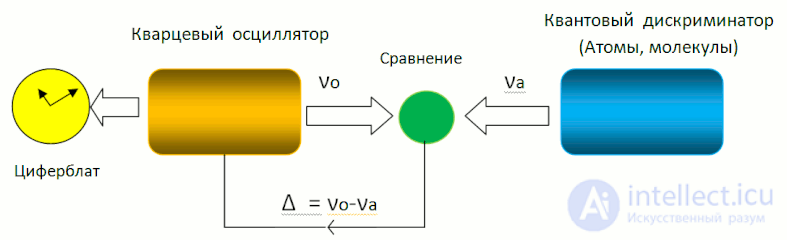
Operating principle of atomic clocks
The clock consists of several parts:
The quartz oscillator is a self-oscillator whose resonant element is the piezoelectric modes of a quartz crystal. The electromagnetic oscillations it generates have a fixed frequency, usually equal to, 10 MHz, 5 MHz or 2.5 MHz, with the possibility of tuning within small limits (±10−6, for example by changing the temperature of the crystal). Usually the long-term stability of a quartz resonator is low, at around 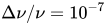 . To improve its stability, the oscillations of atoms or molecules are used: for this, the oscillations of the quartz oscillator at frequency
  are continuously compared, by means of a frequency-phase comparator, with the frequency of the atomic line νa
 , registered in the quantum discriminator. When a difference in phase and frequency of the oscillations appears, the feedback circuit adjusts the frequency of the quartz oscillator to the required value, thereby increasing the stability and accuracy of the clock to the level
 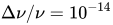 .
.
These clocks are based on quantum computing, which makes it possible to achieve high stability and accuracy.
Quantum logic, which underlies quantum computing, is also used to improve the accuracy of quantum clocks. Such systems use methods of quantum coherence and entanglement to minimize external noise and measurement errors.
Quantum clocks based on quantum logic rely on the manipulation of single ions in electromagnetic traps. In such devices, an auxiliary ion is used to read out the transition frequency of the main ion, which makes it possible to compensate for environmental disturbances. This makes them among the most accurate measuring instruments available today.
The future of quantum clocks is linked to the integration of quantum computing technologies, which will open new horizons in precision timekeeping, navigation and fundamental physical research.
Measuring gravitational forces is essential in geophysics and fundamental physics. Gravimetry studies the Earth's gravitational field and its variations related to geological and physical processes. This branch of science plays an important role in geophysics, navigation and fundamental research into gravity. Traditional gravimetry methods use pendulum instruments and spring accelerometers, but modern technologies increasingly turn to quantum effects to improve measurement accuracy.
Used to isolate charged particles for the purpose of studying them in detail.A Penning trap — is a device used to confine charged particles using a combination of static magnetic and electric fields. It makes it possible to study the properties of individual particles and ions, which is important for high-precision measurements in quantum gravimetry. Thanks to the high degree of isolation of particles from external disturbances, the Penning trap is used in experiments in precision metrology.
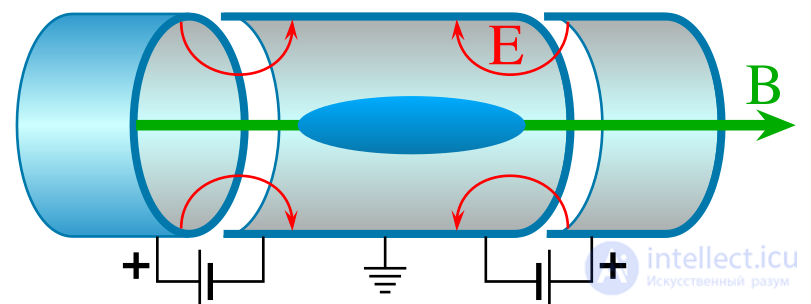
Diagram of a Penning trap with cylindrical electrodes and a uniform magnetic field with induction B, directed parallel to the axis of the device
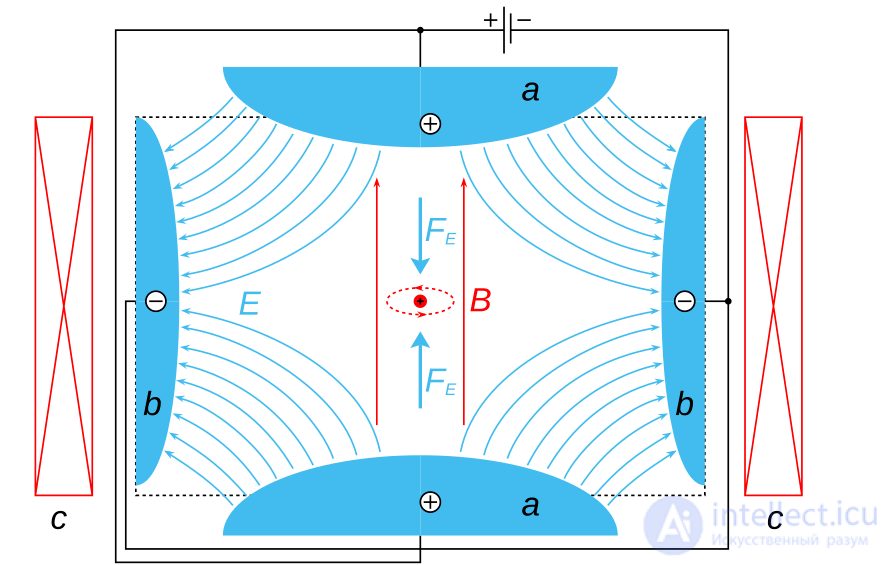
Diagram of the magnetic and electrostatic fields in a Penning trap
Different types of particles have special quantum properties, which is important for quantum measurements.Fundamental particles are divided into bosons and fermions depending on their spin characteristics. Bosons (for example, photons and Higgs bosons) obey Bose–Einstein statistics and can occupy the same quantum state. Fermions (electrons, neutrons, protons) follow the Pauli exclusion principle, which forbids them from being in the same quantum state. In quantum gravimetry, ultracold atomic clouds consisting of bosons are used, since they can form coherent quantum states.
A special state of matter in which particles behave coherently, used to create precise gravimeters.
A Bose–Einstein condensate (BEC) — is a special state of matter that arises at ultra-low temperatures, when a large number of bosons begin to behave as a single quantum whole. In quantum gravimetry, a BEC is used to create high-precision atomic sensors of the gravitational field, since the coherence of this state makes it possible to register even small changes in the gravitational potential.
Makes it possible to measure microscopic changes in the gravitational field.Interference — is the phenomenon of the superposition of waves, leading to the amplification or attenuation of their amplitude. In quantum mechanics, interference is observed for the wave functions of particles, which is used in atomic interferometers. In gravimetry, measuring the phase shifts of interfering atomic waves makes it possible to determine variations in the gravitational field with high accuracy.
Used in quantum gravimetry to analyze phase changes of light waves.A Mach–Zehnder interferometer — is an optical arrangement in which a light beam is split into two rays that travel different paths and then interfere. In quantum gravimetry, an analogous principle is applied to atomic waves: separated atomic packets pass through different gravitational potentials, and their interference pattern carries information about the local gravitational field.
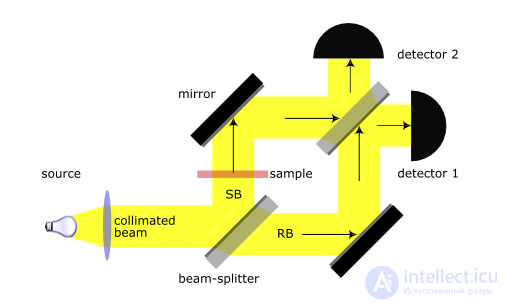
Diagram of a Mach–Zehnder interferometer
At the input of the interferometer is a semi-transparent mirror that splits the light flux into two beams. They are brought back together after reflecting off two opaque mirrors at a fourth mirror. The mirrors of the interferometer form a parallelogram. To carry out research, a vessel with the gas under study and compensators are placed in one arm of the interferometer.
In integrated optics, electro-optical modulators of the Mach–Zehnder interferometer type are widely used; they can modulate the intensity of light independently of its polarization at frequencies up to tens of GHz. The planar design of such a modulator consists of a waveguide, part of which branches, splitting the electromagnetic wave into two. Electrodes are placed on the sides of the newly formed waveguides (arms), after which the waveguides are brought together into one. By applying a voltage to the electrodes, it is possible to change the refractive index of the electro-optical crystal from which the waveguides are made. Interference between the waves propagating in the arms of the modulator leads to modulation of the intensity of the radiation.
Uses quantum effects for the precise measurement of changes in the gravitational potential.A quantum gravimeter is an instrument that uses the principles of quantum mechanics, such as atomic wave interference, to measure gravitational acceleration. Such devices offer high accuracy and stability compared with classical methods. The main applications of quantum gravimeters include monitoring of underground structures, GPS-free navigation and fundamental tests of general relativity.
A quantum gravimeter with a volume of 1 cm3 and based on the use of a Mach–Zehnder interferometer has been created.
Gravitational waves are disturbances of spacetime that propagate at the speed of light. Detecting them requires the application of complex physical principles and high-precision instruments. Let us consider the key concepts underlying modern gravitational-wave detectors.
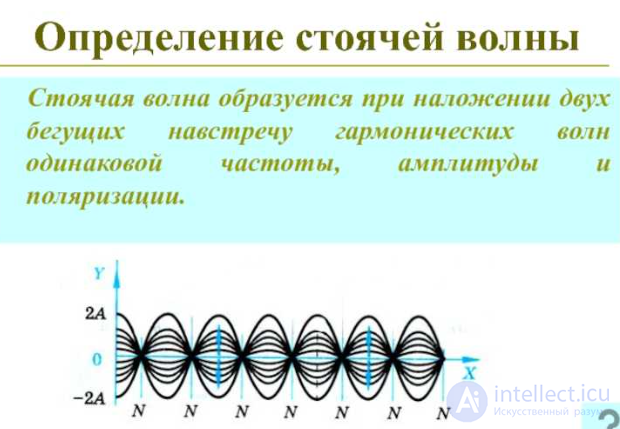
A key principle in the operation of interferometric detectors.Standing waves arise from the superposition of two counter-propagating waves of the same frequency and amplitude. They are characterized by alternating nodes and antinodes, at which the oscillation amplitude is either minimal or maximal. In the context of gravitational-wave detectors, standing waves can be used in optical resonators to amplify the signal.
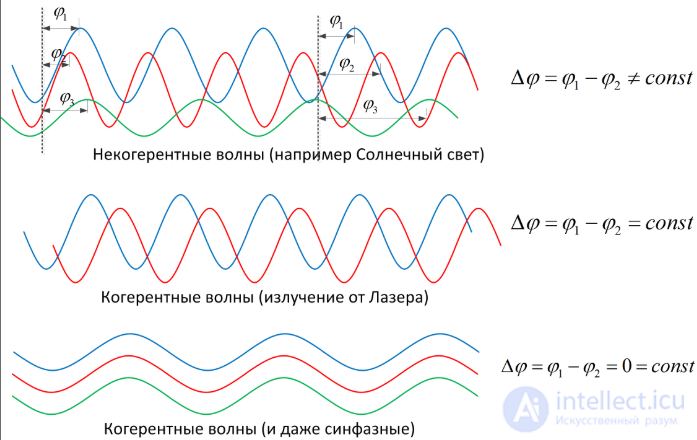
Allow the effect of gravitational waves to be amplified for their detection.Coherence of waves means their consistency in phase and frequency. In gravitational-wave detectors, coherent light waves make it possible to increase measurement accuracy by minimizing noise and ensuring interference effects.
Used in gravitational-wave detectors to measure microscopic displacements of mirrors.The Michelson interferometer plays a key role in gravitational-wave detectors. It consists of a light source, a semi-transparent mirror (a beam splitter) and two mirrors located at the ends of perpendicular arms. Gravitational waves change the length of these arms, causing a shift in the interference pattern. It is precisely this effect that is used in modern observatories such as LIGO and VIRGO.
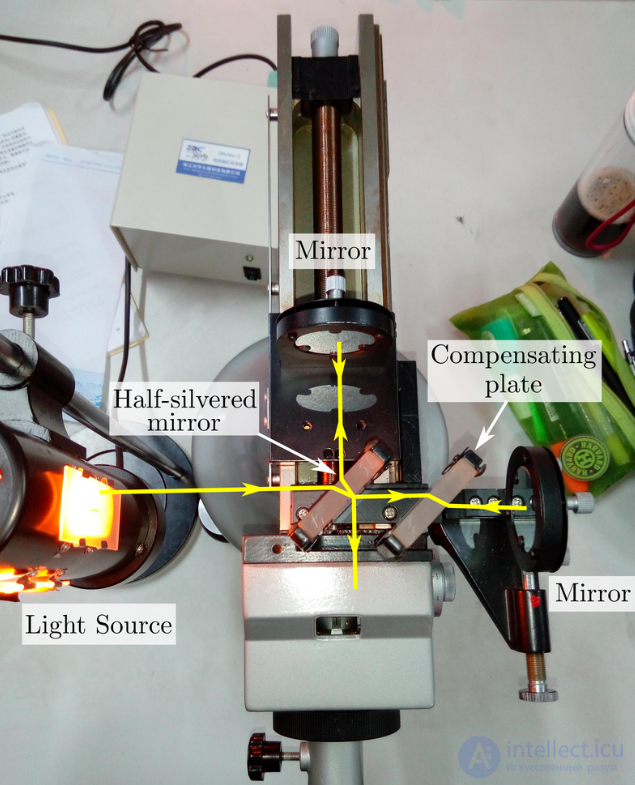
This image shows a simple but typical Michelson interferometer. The bright yellow line indicates the path of the light.
Makes it possible to amplify the detected signal.Resonance is the phenomenon of amplification of oscillation amplitude when the external driving frequency coincides with the system's natural frequency. In gravitational-wave detectors, optical resonance is used to increase the light path inside the interferometer, which increases the sensitivity of the instrument.
Used to increase sensitivity to gravitational waves.An optical resonator is a system of mirrors between which light is reflected multiple times. This makes it possible to increase the length of the light's path and thereby increase the detector's sensitivity to small changes in the length of the interferometer's arms.
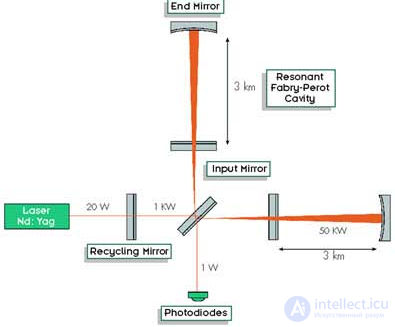
Used in modern laser interferometers.The Fabry–Pérot resonator is a special case of an optical resonator consisting of two partially reflecting mirrors. It is used in gravitational-wave detectors to amplify the power of the laser radiation, which improves interferometric sensitivity.
They detect gravitational waves that arise from the collision of black holes and neutron stars.
LIGO (Laser Interferometer Gravitational-Wave Observatory) and VIRGO are the world's largest gravitational-wave observatories. They use Michelson interferometers with Fabry–Pérot optical resonators in the arms. These facilities are able to detect changes in the length of the interferometer's arms on the order of one thousandth of the diameter of a proton, which makes them among the most sensitive scientific instruments in existence.
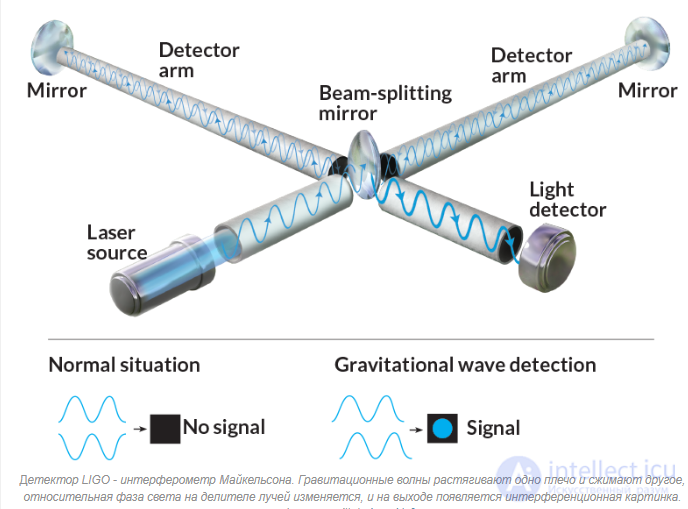
Thanks to the work of LIGO and VIRGO, the existence of gravitational waves, predicted by Albert Einstein in the general theory of relativity, was confirmed for the first time. This discovery opened a new era in astronomy, making it possible to study the cosmos not only through electromagnetic radiation but also through gravitational waves.
Special defects in the diamond crystal lattice used for quantum thermometry.
Colour centres in diamonds are defects in the diamond crystal lattice that give it a particular colour. These defects form when carbon atoms in the lattice are replaced by other atoms or groups of atoms, which changes the electronic properties of the diamond. Depending on the type of defect, a diamond can take on various colours — from yellow and blue to red and green.
One of the most interesting types of colour centres is centres associated with defects in carbon–carbon bonds, such as NV centres (Nitrogen-Vacancy centres). These are defects in which a carbon atom in the lattice is replaced by a nitrogen atom, with the adjacent bond to carbon missing (a vacancy). These centres exhibit quantum properties, such as the ability to manipulate spin, which opens up prospects for using diamonds in quantum technologies, including quantum thermometers.
Makes it possible to measure temperature with high precision thanks to quantum effects.
A quantum thermometer is a device for measuring temperature based on the principles of quantum mechanics, in particular on the use of quantum defects in solids, such as colour centres in diamond. These thermometers work by exploiting the sensitivity of quantum systems to changes in temperature, which affect their quantum states, such as spin, energy or phase.
One of the most promising ways of implementing a quantum thermometer is the use of NV centres in diamonds. In these centres, a change in temperature causes a change in the frequency of the resonance transitions, which makes it possible to measure temperature very precisely. These defects have a number of advantages, such as high resistance to external influences and the ability to operate at room temperature, which makes them ideal for use in complex and extreme conditions.
The operating principle of a quantum thermometer based on NV centres is that when a magnetic field acts on the colour centre, its energy and frequency change, and this change depends on temperature. For precise measurements, spectroscopy and optical probing methods are used, making it possible to determine temperature with high precision at the level of individual molecules or atoms.
Diamond-based quantum thermometers offer unique advantages over classical temperature measurement methods. They are able to operate at very low temperatures (including regions close to absolute zero), and they also provide the ability to measure temperature with a precision unattainable by traditional thermometers. Thanks to these qualities, quantum thermometers are finding application in such fields as the study of quantum materials, biomedicine, nanotechnology and space research.
High precision: Quantum thermometers can measure temperature with a precision down to nanokelvins, which significantly exceeds the capabilities of traditional thermometers.
Operation in extreme conditions: These devices can function under conditions of low temperatures or high magnetic fields, where ordinary thermometers are not suitable.
Nanoscale measurements: Quantum thermometers are able to measure temperature at the level of individual atoms or molecules, which is important for research at the nanoscale.
Minimal invasiveness: Quantum thermometers can be used to monitor temperature in living organisms or sensitive systems without significantly affecting the process itself.
Quantum magnetometers are devices that use quantum effects to measure magnetic fields with extreme precision. They find applications in various fields of science and technology, such as medicine, geophysics, materials research and others. To understand the operating principle of quantum magnetometers, it is necessary to consider several important concepts and phenomena that underlie them.
A quantum property of particles that determines their magnetic properties. Spin is a fundamental quantum property of elementary particles, such as electrons. It represents the intrinsic angular momentum of a particle and can be described as a quantized quantity taking on certain values. For an electron, the spin can be directed up or down relative to a certain axis, which is determined by quantum numbers.
Makes it possible to register weak magnetic fields.The measurement of spin is an important element of quantum magnetometers. The spin of a particle is mainly measured through its interaction with a magnetic field. When a particle, for example an electron, is placed in a magnetic field, it orients itself relative to that field. By measuring the direction of the spin, it is possible to determine the characteristics of the magnetic field acting on the particle.
The Stern–Gerlach experiment (1922) is one of the key experiments confirming the existence of spin. In this experiment, a beam of atoms is subjected to a non-uniform magnetic field, which causes the beam to split into two components. This phenomenon confirms the quantization of spin: particles with half-integer spin (for example, electrons) can have only two possible states: "up" or "down" relative to the direction of the field.
The foundations of superconducting quantum magnetometers.Superconductivity is a state of a material in which its resistance becomes zero below a critical temperature. The Meissner effect consists in the fact that a superconducting material expels magnetic fields from its internal structure, creating what is known as "magnetic exclusion". This effect plays an important role in quantum magnetometers, since it makes it possible to isolate the influence of an external magnetic field on the system.
Paired electrons in superconductors, involved in tunnelling. A Cooper pair is a pair of electrons that form a bound state in a superconductor. The electrons in Cooper pairs move with opposite spins, which allows them to form a stable state despite their mutual repulsion. This phenomenon underlies superconductivity and can be used to create superconducting quantum magnetometers.
Tunnelling is a quantum effect in which a particle can pass through a potential barrier even if its energy is insufficient to overcome that barrier according to classical laws. In the context of quantum magnetometers, tunnelling can be used to measure magnetic fields through their influence on tunnelling effects, which makes it possible to achieve high sensitivity.
Used in SQUIDs for ultra-sensitive magnetic measurements.The Josephson effect is a phenomenon in which a superconducting current can pass through a thin layer of insulator or normal material separating two superconducting materials. This effect is used in quantum magnetometers to measure changes in magnetic flux, which leads to the high sensitivity of such devices.
A superconducting quantum interferometer, one of the most sensitive magnetometers.A SQUID (Superconducting Quantum Interference Device) is a superconducting quantum interference device. A SQUID uses the Josephson effect and tunnelling to measure extremely weak magnetic fields with extreme precision. A SQUID consists of two superconducting materials separated by a thin layer of insulator, and has the unique ability to measure magnetic fields with a precision of up to 10⁻¹⁴ tesla, which makes it one of the most sensitive magnetometers.
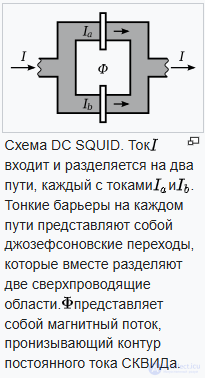
Used to detect weak magnetic fields with high precision.A quantum magnetometer is an instrument that uses quantum effects to measure magnetic fields. These devices can operate on the basis of various phenomena, such as the Josephson effect, tunnelling, and the use of particle spin properties. Quantum magnetometers offer high sensitivity and precision, which makes them indispensable in scientific research, medical diagnostics (for example, in magnetic resonance imaging) and geophysical measurements. They are based on quantum principles that make it possible to measure such subtle effects as changes in the magnetic field caused by biological processes or the motion of particles at the atomic level.
Quantum magnetometers are developing alongside improvements in superconducting materials, quantum technologies and measurement methods. This field has enormous potential, especially in the context of developing technologies and the creation of new, more sensitive instruments for research purposes.
This category can include quantum inertial sensors, electric field sensors and other developments that use the principles of quantum mechanics for precision measurements.
Quantum Inertial Sensors Quantum inertial sensors use the principles of quantum mechanics to measure accelerations, angular velocities and other inertial quantities. They are often used in navigation, especially in conditions where GPS signal is unavailable or unreliable, for example underwater or in space.
An example of such a sensor is the quantum gyroscope, which uses the interference effect between light waves to measure angular velocity. These sensors can be extremely precise and independent of external magnetic fields and other interference typical of classical gyroscopes.
Quantum Electric Field Sensors Such sensors use quantum states, such as the spins of electrons or atoms, to measure electric fields with high precision. For example, in some cases the phenomenon of quantum tunnelling is used, or deviations in the quantum states of particles are measured, which can change depending on the influence of an external electric field.
These sensors can be useful in various fields, from creating more precise medical devices to improving protection and detection systems.
Quantum Sensors for Magnetic Fields and Other Physical Quantities Some quantum sensors use changes in the quantum states of atoms or molecules to measure magnetic fields. For example, atomic magnetometers can detect magnetic fields with a precision far exceeding the capabilities of classical magnetometers.
These sensors can be used in geophysics, as well as in medicine for diagnostics (for example, in magnetic resonance imaging).
One of the main challenges for quantum sensors is the need to maintain their operation under strictly controlled conditions. For example, most quantum sensors require very low temperatures or a vacuum, which makes their operation complex and expensive. In addition, quantum sensors can be sensitive to external noise, which requires the development of technologies to protect against such influences.
With the development of quantum computing technologies and the improvement of methods for controlling quantum systems, further refinement of quantum sensors can be expected. In the future, such sensors may become the basis for new breakthrough technologies that will be used in such fields as high-precision navigation systems, disease diagnostics, the study of the Earth's structure, and even in the field of space research.
Thus, quantum sensors have the potential to significantly change approaches to measuring physical quantities, offering more precise, sensitive and versatile tools for science and technology.
Quantum sensors are opening up new horizons in science and technology, providing previously unattainable levels of precision and sensitivity. Their development will lead to significant breakthroughs in fundamental physics, geophysics, medicine and other fields.

Comments