
Lecture
The device used to measure the level of humidity is called a hygrometer, or simply a humidity sensor. In everyday life, humidity is an important parameter, and often not only for ordinary daily life, but also for various technology, for agriculture (soil moisture), and for many other things besides.
In particular, our well-being depends a great deal on the level of air humidity. People who are sensitive to weather, as well as those suffering from hypertension, bronchial asthma, or cardiovascular diseases, are especially sensitive to humidity.
In conditions of very dry air, even healthy people experience discomfort, drowsiness, itching and skin irritation. Dry air can often trigger respiratory illnesses, ranging from acute respiratory infections and colds all the way to pneumonia.
At industrial facilities, air humidity can affect the preservation of products and equipment, and in agriculture the influence of soil moisture on fertility is unambiguous, and so on. This is exactly where the use of humidity sensors — hygrometers comes to the rescue.
The device used to measure the level of humidity is called a hygrometer,
or simply a humidity sensor. In everyday life, humidity
is an important parameter, and often not only for ordinary
daily life, but also for various technology, and for agriculture
(soil moisture), and for many other things besides.
In particular, our well-being depends a great deal on the level of air humidity. People who are sensitive to weather
are especially sensitive to humidity, as are those suffering from hypertension, bronchial asthma, or
cardiovascular diseases. In conditions of very dry air, even healthy people experience discomfort, drowsiness, itching and
skin irritation. Dry air can often trigger respiratory illnesses, ranging from acute respiratory infections and
colds all the way to pneumonia.
At industrial facilities, air humidity can affect the preservation of products and equipment, and in agriculture
the influence of soil moisture on fertility is unambiguous, and so on. This is exactly where the use of humidity sensors — hygrometers comes to the rescue.
Some technical instruments are initially calibrated for a strictly required humidity value, and sometimes, in order to carry out precise
adjustment of an instrument, it is important to have an accurate value of the humidity in the surrounding environment.
Humidity can be measured in several possible units:
– To determine the humidity of either air or other gases, measurements are taken in grams per cubic metre, when it is
a question of the absolute humidity value, or in RH units, when it is a question of relative humidity.
– To measure the humidity of solids or of liquids, measurements as a percentage of the mass of the samples under study are suitable.
– To determine the humidity of poorly miscible liquids, the units of measurement will be ppm (how many parts of water
per 1,000,000 parts of the weight of the sample).
Some technical instruments are initially calibrated for a strictly required humidity value, and sometimes, in order to carry out precise adjustment of an instrument, it is important to have an accurate value of the humidity in the surrounding environment.
Humidity can be measured in several possible units:
To determine the humidity of either air or other gases, measurements are taken in grams per cubic metre, when it is a question of the absolute humidity value, or in RH units, when it is a question of relative humidity.
To measure the humidity of solids or of liquids, measurements as a percentage of the mass of the samples under study are suitable.
To determine the humidity of poorly miscible liquids, the units of measurement will be ppm (how many parts of water per 1,000,000 parts of the weight of the sample).
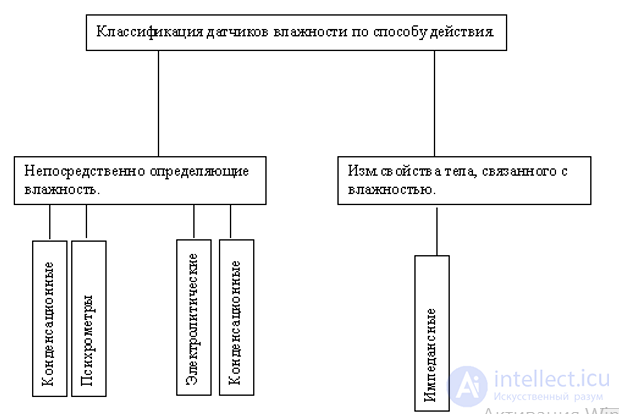
By operating principle, hygrometers are divided into:
capacitive;
resistive;
thermistor-based;
optical;
electronic.

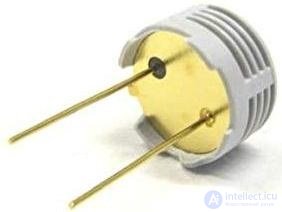
Capacitive hygrometers, in the simplest case, are capacitors with air as the dielectric in the gap. It is known that the dielectric permittivity of air is directly related to humidity, and changes in the humidity of the dielectric lead to changes in the capacitance of the air capacitor.
A more complex variant of a capacitive humidity sensor contains, in the air gap, a dielectric whose dielectric permittivity can change substantially under the influence of humidity on it. This approach improves the sensor's quality compared to simply having air between the capacitor plates.
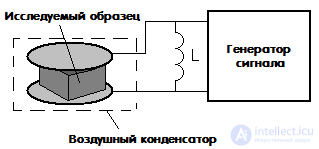
The second variant is well suited for taking measurements of water content in solids. The object under study is placed between the plates of such a capacitor — for example, the object might be a tablet — and the capacitor itself is connected to an oscillating circuit and to an electronic generator, while the natural frequency of the resulting circuit is measured, and from the measured frequency the capacitance obtained when the test sample is introduced is “calculated”.
Of course, this method also has certain drawbacks: for example, at a sample humidity below 0.5% it will be inaccurate; in addition, the sample being measured must be cleaned of particles with a high dielectric permittivity, and the shape of the sample during the measurement process is also important — it must not change over the course of the study.
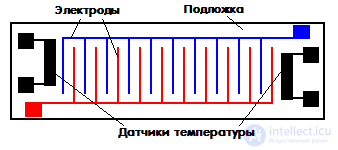
The third type of capacitive humidity sensor is the capacitive thin-film hygrometer. It includes a substrate onto which two comb-shaped electrodes are deposited. The comb-shaped electrodes act, in this case, as the plates. For the purpose of temperature compensation, two additional temperature sensors are also built into the sensor.
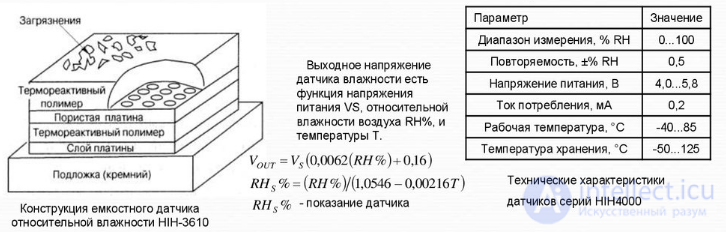
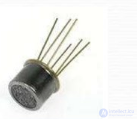
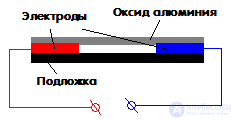
Such a sensor includes two electrodes deposited on a substrate, with a layer of material deposited on top of the electrodes themselves — a material distinguished by a fairly low resistance that nevertheless changes considerably depending on humidity.
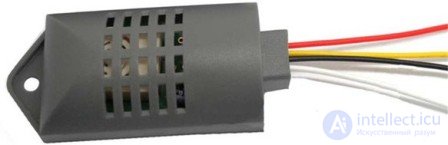
Aluminium oxide can serve as a suitable material in the device. This oxide readily absorbs water from the surrounding environment, and its resistivity changes noticeably as a result. Consequently, the total resistance of such a sensor's measuring circuit will depend significantly on humidity. Thus, the magnitude of the flowing current will indicate the level of humidity. The advantage of sensors of this type is their low cost.
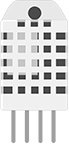
We have two versions of the DHTxx sensor series. They look somewhat similar and have the same pinout, but have different characteristics. Here are the details.
The DHT22 is the more expensive version, which naturally has better characteristics. Its temperature measurement range is from -40°C to +80°C with an accuracy of ±0.5 degrees, whereas the DHT11's temperature range is from 0°C to 50°C with an accuracy of ±2 degrees. The DHT22 sensor also has a wider humidity measurement range, from 0 to 100% with an accuracy of 2-5%, while the DHT11's humidity measurement range is from 20 to 80% with an accuracy of 5%.
 |
 |
|
| DHT11 | DHT22 | |
|---|---|---|
| Operating voltage | 3 to 5 V | 3 to 5 V |
| Maximum operating current | 2.5 mA max | 2.5 mA max |
| Humidity measurement range | 20-80% / 5% | 0-100% / 2-5% |
| Temperature measurement range | 0-50°C / ± 2°C | -40 to 80°C / ± 0.5°C |
| Sampling rate | 1 Hz (one reading per second) | 0.5 Hz (one reading every 2 seconds) |
| Body size | 15.5 mm x 12 mm x 5.5 mm | 15.1 mm x 25 mm x 7.7 mm |
| Advantage | Ultra-low cost | More accurate |
Although the DHT22/AM2302 is more accurate and works over a wider range of temperatures and humidity, there are three things in which the DHT11 far outperforms the DHT22. It is cheaper, smaller in size, and has a higher sampling rate. The DHT11's sampling rate is 1 Hz, i.e. one reading every second, while the DHT22's sampling rate is 0.5 Hz, i.e. one reading every two seconds.
The operating voltage of both sensors is from 3 to 5 volts, while the maximum current used during conversion (when data is requested) is 2.5 mA. And the best part is that the DHT11 and DHT22/AM2302 sensors are “interchangeable”, meaning that if you build your project with one sensor, you can simply unplug it and use the other sensor instead. Your code may need to be changed slightly, but at least the circuit will stay the same!
Now let's move on to more interesting things. Let's take apart both the DHT11 and the DHT22/AM2302 sensors and see what is inside.
The housing consists of two parts, so to open it you just need to take a sharp knife and split the housing apart. Inside the housing, on the sensor side, are the humidity sensor and the NTC temperature sensor (thermistor).
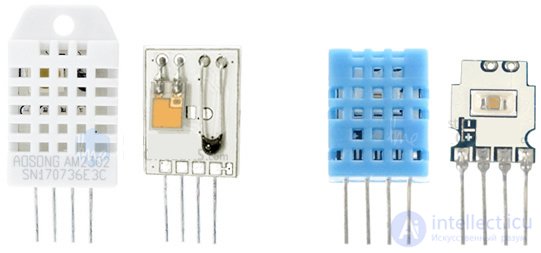
Figure 2 – Inside the DHT11 DHT22/AM2302 temperature and humidity sensors
The humidity-sensitive component, which is of course used to measure humidity, has two electrodes with a moisture-retaining substrate (usually a salt or a conductive plastic polymer) sandwiched between them. As the substrate absorbs water vapour, it releases ions, which in turn increases the conductivity between the electrodes. The change in resistance between the two electrodes is proportional to the relative humidity. Higher relative humidity decreases the resistance between the electrodes, while lower relative humidity increases this resistance.
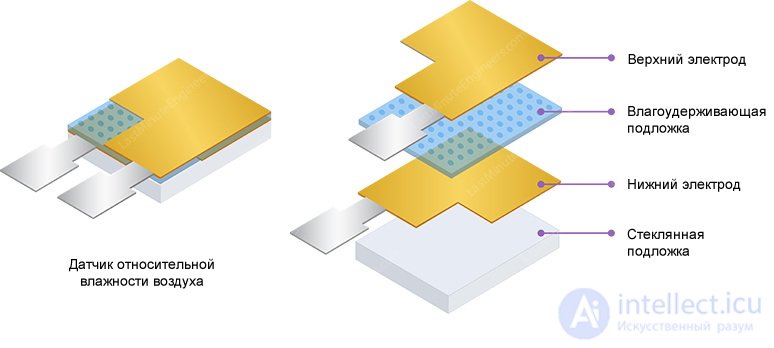
Figure 3 – Internal structure of the humidity sensor in the DHT11 and DHT22
In addition, these sensors have an NTC temperature sensor (thermistor) for measuring temperature. A thermistor is a thermal resistor – a resistor whose resistance changes depending on temperature. Technically, all resistors are thermistors – their resistance changes slightly with temperature, but this change is usually very small and difficult to measure.
Thermistors are made so that their resistance changes sharply with a change in temperature, and a change of one degree can amount to 100 Ω or more! The term “NTC” stands for “Negative Temperature Coefficient” (negative temperature coefficient), meaning that resistance decreases as temperature rises.
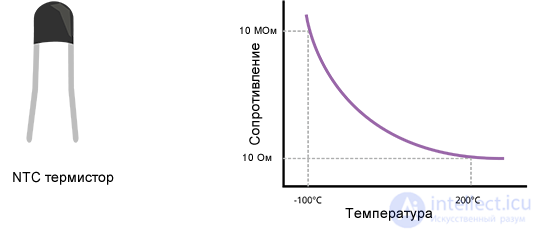
Figure 4 – Graph of NTC thermistor resistance versus temperature
On the other side, there is a small circuit board with an 8-bit chip in a SOIC-14 package. This chip measures and processes the analogue signal using stored calibration coefficients, performs an analogue-to-digital conversion, and outputs a digital signal carrying the temperature and humidity data.
The DHT11 and DHT22/AM2302 sensors are quite easy to connect. They have four pins:
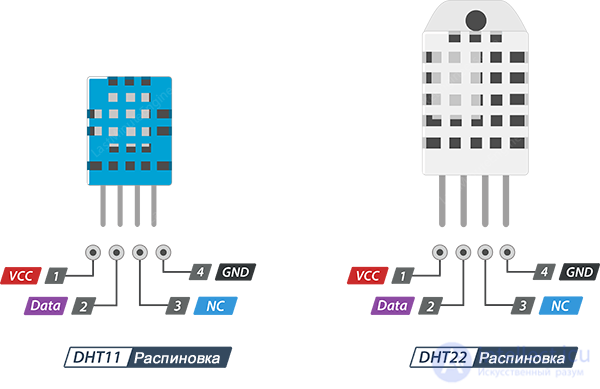
Figure 5 – Pinout of the DHT11 and DHT22/AM2302 temperature and humidity sensors

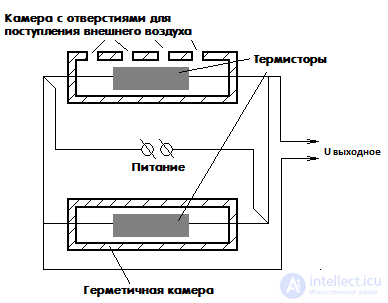
A thermistor hygrometer consists of a pair of identical thermistors. As a reminder, a thermistor — is a non-linear electronic component whose resistance depends strongly on its temperature.
One of the thermistors included in the circuit is placed in a sealed chamber with dry air. The other is placed in a chamber with openings through which air of the particular humidity that needs to be measured enters. The thermistors are connected in a bridge circuit; a voltage is applied to one of the bridge's diagonals, and the reading is taken from the other diagonal.
When the voltage at the output terminals is zero, the temperatures of both components are equal, and consequently so is the humidity. When a non-zero voltage is obtained at the output, this indicates a difference in humidity between the chambers. Thus, the humidity is determined from the value of the voltage obtained during measurement.
An inexperienced researcher might reasonably wonder why the thermistor's temperature changes when it interacts with humid air. The reason is that as humidity increases, water begins to evaporate from the thermistor's body, and as it does so the body's temperature decreases; the higher the humidity, the more intensely evaporation occurs, and the faster the thermistor cools.
This type of sensor is the most accurate. The operation of the optical humidity sensor is based on the phenomenon associated with the concept of the “dew point”. At the moment the temperature reaches the dew point, the gaseous and liquid phases are in a state of thermodynamic equilibrium.
So, if you take a piece of glass and place it in a gaseous medium where the temperature at the time of the study is above the dew point, and then begin to cool this glass, then at a specific temperature value, water condensate will begin to form on the surface of the glass — this water vapour will begin to transition into the liquid phase. This temperature is precisely the dew point.
So, the dew-point temperature is inseparably linked to, and depends on, parameters such as humidity and pressure in the surrounding environment. As a result, by having the ability to measure the pressure and the dew-point temperature, it becomes easy to determine the humidity as well. This principle serves as the basis for the operation of optical humidity sensors.
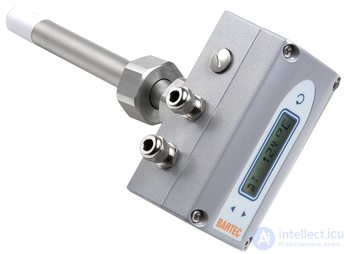
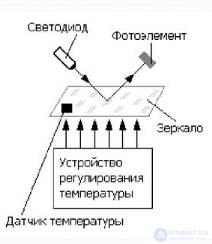
The simplest circuit for such a sensor consists of an LED shining on a mirrored surface. The mirror reflects the light, changing its direction, and directs it onto a photodetector. In this case, the mirror can be heated or cooled by means of a special high-precision temperature control device. This device is often a thermoelectric pump. Naturally, a temperature sensor is mounted on the mirror as well.
Before measurements begin, the mirror's temperature is set to a value that is deliberately above the dew-point temperature. The mirror is then gradually cooled. At the moment the temperature begins to cross the dew point, droplets of water immediately begin to condense on the mirror's surface, and the light beam from the LED refracts because of them and scatters, which leads to a decrease in the current in the photodetector's circuit. Through a feedback loop, the photodetector interacts with the mirror's temperature regulator.
Thus, relying on the information received in the form of signals from the photodetector, the temperature regulator maintains the temperature on the mirror's surface at exactly the dew point, and the temperature sensor accordingly indicates the temperature. Thus, with known pressure and temperature, the key humidity indicators can be determined precisely.
The optical humidity sensor has the highest accuracy, unattainable by other types of sensors, plus the absence of hysteresis. The drawback — the highest price of all, plus high power consumption. In addition, care must be taken to keep the mirror clean.
The operating principle of an electronic air humidity sensor is based on the change in concentration of an electrolyte coating some electrically insulating material. There are such instruments with automatic heating tied to the dew point.
The dew point is often measured over a concentrated lithium chloride solution, which is very sensitive to minimal changes in humidity. For maximum convenience, such a hygrometer is often additionally equipped with a thermometer. This device has high accuracy and low error. It is able to measure humidity independently of the ambient temperature.
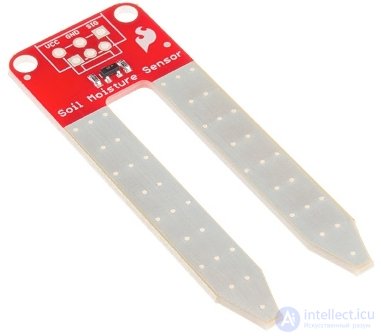
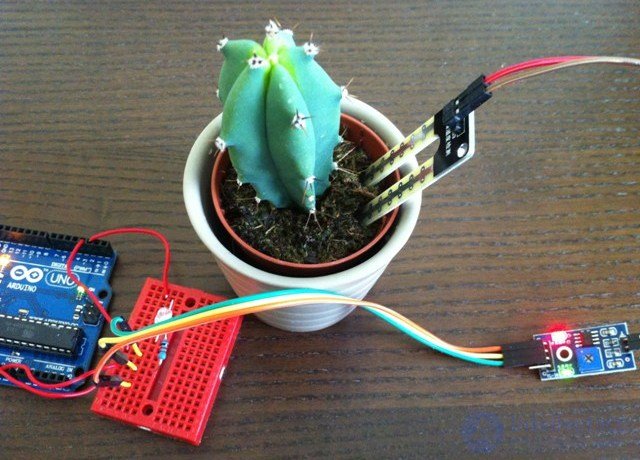
Simple electronic hygrometers in the form of two electrodes, which are simply stuck into the soil to monitor its moisture level via the degree of conductivity depending on that moisture, are also popular. Such sensors are popular among Arduino enthusiasts, since it is easy to set up automatic watering of a garden bed or a potted plant, for cases when watering by hand is not possible or convenient.

Before buying a sensor, think about what you will need to measure — relative or absolute humidity, of air or of soil — what measurement range is anticipated, whether hysteresis matters, and what accuracy is needed. The most accurate sensor is the optical one. Pay attention to the IP protection rating and to the operating temperature range, depending on the specific conditions in which the sensor will be used, to see whether the parameters suit you.

Comments