
Lecture
The following definitions are given for measuring instruments:
A measure of a physical quantity - a measuring instrument intended for reproducing and (or) storing a physical quantity of one or several specified sizes, whose values are expressed in established units and known with the required accuracy;
A measuring instrument (sensor) - a measuring instrument intended for obtaining values of the measured physical quantity within an established range;
A measuring transducer - a technical device with standardized metrological characteristics, serving to convert the measured quantity into another quantity or a measurement signal convenient for processing, storage, further conversions, indication or transmission;
A measuring setup (measuring machine) - a set of functionally combined measures, measuring instruments, measuring transducers and other devices, intended for the measurement of one or several physical quantities and located in one place
A measuring system - a set of functionally combined measures, measuring instruments, measuring transducers, computers and other technical means, located at different points of the monitored object, etc., for the purpose of measuring one or several physical quantities characteristic of that object, and generating measurement signals for various purposes;
.
By method of indication
An indicating measuring instrument — a measuring instrument that only allows the reading of the values of the measured quantity
A recording measuring instrument — a measuring instrument in which recording of readings is provided. Recording of values can be carried out in analogue or digital form. Self-recording and printing recording instruments are distinguished
By method of measurement
A direct-action measuring instrument — a measuring instrument, for example, a pressure gauge, an ammeter, in which one or several conversions of the measured quantity are carried out and its value is found without comparison with a known quantity of the same kind
A comparison measuring instrument (comparator)— intended for the direct comparison of the measured quantity with a quantity whose value is known
By form of presentation of readings
An analogue measuring instrument — a measuring instrument whose readings or output signal are a continuous function of changes in the measured quantity
A digital measuring instrument — a measuring instrument whose readings are presented in digital form
It is advisable to carry out the classification of sensors according to the information-physical criterion, in particular, according to the physical nature of the primary information signals arising in them.
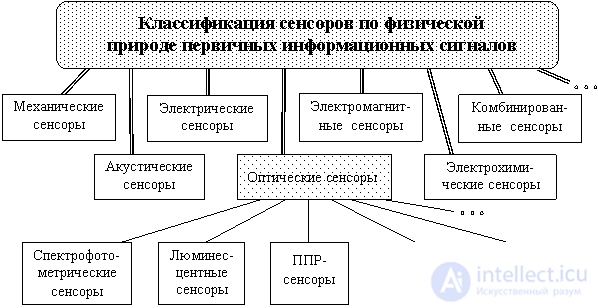
Until relatively recently, people mainly used simple sensors, providing only "raw", primary, unprocessed information about the objects and processes being observed. The decoding and processing of this information, and its comparison with other data, was performed by the people themselves, who also assessed its significance and degree of importance.
With the development of technology and the growth of requirements from applied fields (industry, scientific research, medicine, technology), sensors also began to perform, at first simple, and over time increasingly complex, processing of information, which led to the emergence of an entire field of intelligent instruments.
An intelligent measuring instrument – is a sensor that includes a microcomputer as part of its design and, thanks to this, is capable of performing fairly complex processing of primary information. It can account for all nonlinearities and necessary corrections; output data in the form most convenient for the user; actively act on the object under observation, perceiving and analyzing the changes this causes. The instrument can perform self-monitoring and self-diagnostics; accumulate and organize data; maintain an information link with the outside world; change its operating modes, adapting to changing conditions; switch to performing other functions, etc.
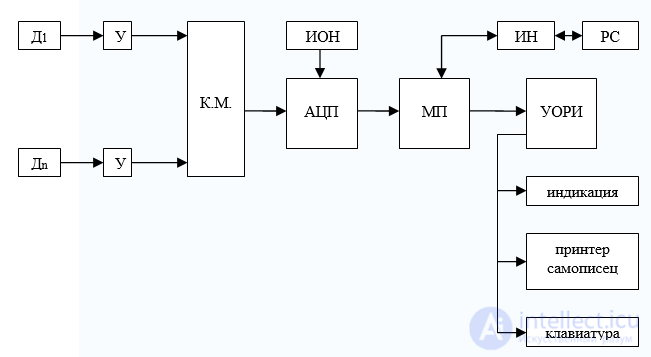
Here:
D1---------DK Primary measuring transducers “k – channels”. A measuring transducer – an element (sensor) directly acted upon by the measured physical quantity. The primary measuring transducer is the first transducer in the measuring chain of the measuring instrument.
A1------Ak Analogue measuring transducers —amplifiers, converting one analogue quantity (analogue measurement signal) into another, amplified copy of the analogue quantity.
SW Switch provides sequential connection of signals from the amplifier outputs to the ADC input.
ADC Analogue-to-digital measuring transducer — a measuring transducer intended for converting an analogue measurement signal into a digital code;
REF Reference voltage source. Intended for generating the reference voltage in the ADC comparator.
MP Microprocessor. Intended for controlling the instrument and primary processing of information.
IF Communication interface, providing information exchange between the microcontroller and the personal computer PC.
PC Personal computer. Intended for processing information, entering initial parameters, displaying and recording measurement results, and generating control commands.
DIRD Display, input and recording device of the instrument itself. (Analogue or digital indication, printer or chart recorder, keyboard).

Comments