
Lecture
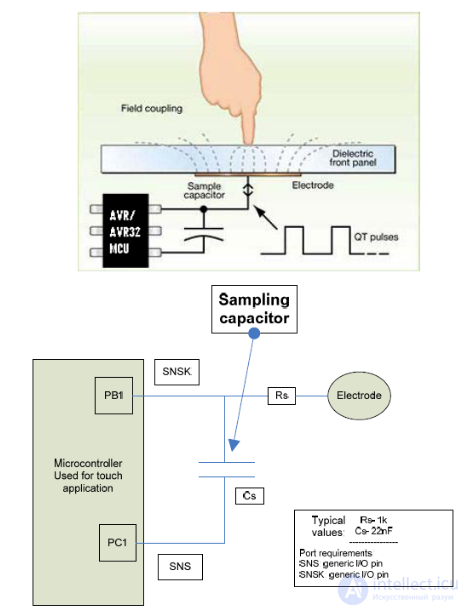
QTouch Technology Placing a finger on the touch surface represents an external capacitance that affects the charge flow at that point. This is registered as a touch. QTouch® microcontrollers can also be configured to detect finger proximity rather than an absolute touch. For simple and convenient development of touch functions, the Atmel® QTouch® Composer package is fully integrated into the Atmel Studio environment. This simplifies design by bringing together the Atmel Studio application-development tools and the QTouch Composer touch-function configuration tools. A QTouch® sensor can control one or several keys. If several keys are used, each key can be set to an individual sensitivity level. Keys of different sizes and shapes can be used to meet both functional and aesthetic
requirements.
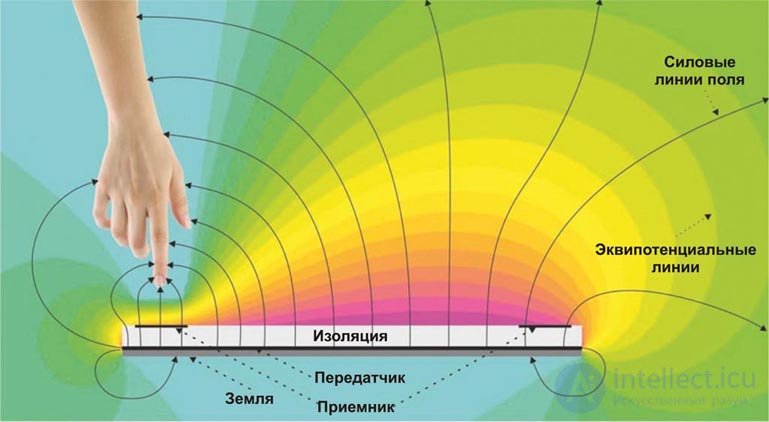
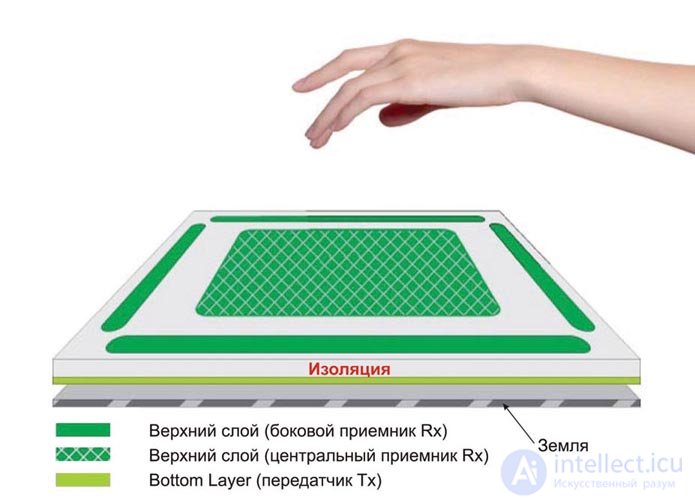
In this new class of HMI, hand movement within a volume located above a two-dimensional array of sensors causes distortions of the electric field (Figures 1 and 2), measured by a specialized receiving device. Using electric-field sensors instead of video cameras opens the way to creating embedded gesture-recognition applications that can be used in practically every industry – from automotive and aerospace to consumer electronics.
 |
|
| Figure 1. | The HMI generates an electric field and uses sensors to capture its disturbances caused by the movement of a conductive object, which, in particular, is the human hand. |
 |
|
| Figure 2. | This HMI subsystem requires only a simple array of electrodes to generate a relatively low-frequency electric field and measure its current state. |
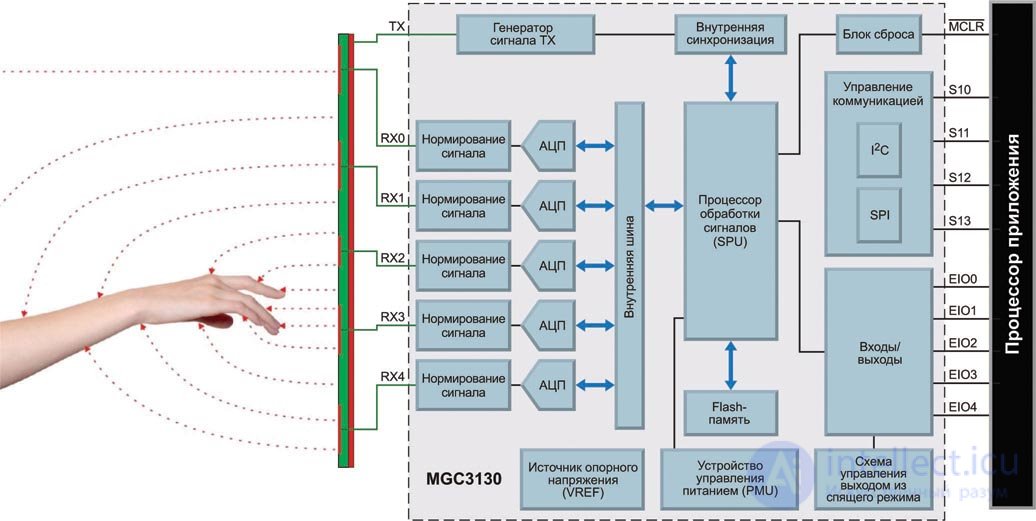
Microchip Technology debuted the most impressive example of this new class of devices in November 2012, introducing the MGC3130 chip (Figure 3), which performs a complete set of 3-D gesture-recognition functions based on GestIC technology, which became Microchip's property with the acquisition of Ident Technology. The GestIC device, connected to a kit of inexpensive external electrodes, contains an analog signal-processing chain that measures the changes in the electric field caused by hand movement and recognizes the movement of hands in a three-dimensional region above the electrodes. Digital processing of the information is then performed using a signal processor built into the chip, in order to determine which of about a dozen pre-programmed gestures the recorded movements correspond to.
 |
|
| Figure 3. | Microchip's MGC3130 chip, based on GestIC technology, contains a set of specialized analog sensor-signal-processing chains, a signal processor, and gesture-recognition programs stored in flash memory that convert hand movements into known gestures. |
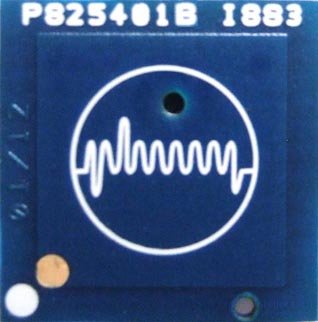
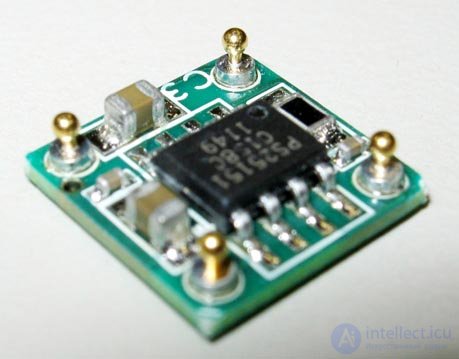
Microchip, with its GestIC system, is not the only player in the electric-field sensor market. A little over a year ago, Plessey Semiconductors introduced a similar sensor, originally aimed at use in personal medical equipment. Recently the company began mass shipments of inexpensive devices that could seriously affect the development of the consumer electronics market (Figure 4). By embedding these Plessey sensors into embedded systems, developers will be able to produce their own 3-D HMI products using rich sets of accumulated recognition algorithms.
  |
|
| Figure 4. | The PS25401B contactless solid-state electric-potential sensor from Plessey Semiconductors in its package (left) and with the lid removed (right). |
Cameras have become an almost obligatory feature of mobile devices, and will undoubtedly be used ever more widely in gesture-recognition systems. At the same time, industrial adoption of multi-sensor solutions combining several distinct detection technologies is beginning.
For example, Microsoft recently demonstrated a gesture-recognition system called Digits, which combines a camera and a MEMS motion sensor. Digits performs a high-level analysis based on sophisticated software, forming an extremely detailed software model of hand motion that allows tracking of the most subtle gestures. GestIC cannot yet do anything like this.

Comments