
Lecture
Это окончание невероятной информации про .
...
selected in accordance with the patient's past experience. Thus, the name of the number 8 was restored from the word «Вова» (Vova — a pet form of Volodya, the name of the patient's son; the letter В (V) resembles the shape of the digit 8, and it is also the first letter of the word «восемь» (vosem, "eight")). The same supports were used in working out the name of the digit 7, which resembles the letter С (S) (Сима — Sima, the name of the patient's wife), and the name of the digit 4, which is linked to the letter Ч (Ch), which resembles it. The patient remembered this digit through the word «чех» (chekh, "a Czech") («This is my friend, a Czech»). The digit 9 was linked in training to the handwritten letter Д, which it resembles and with which its name also begins, etc. Recognition and naming of numbers for which methods of mediated naming were available was restored significantly faster than the naming of numbers for which it was not possible to find external means, emotionally close to the patient, that could mediate the process of naming. Such «difficult» numbers turned out to be 5,10 and 3. However, their naming too was restored in the patient as the naming of other numbers of the natural sequence within the first ten was restored. At first they were named by the patient only «from the sequence», and later also outside it, i.e., in isolation.
Example. The patient is given numbers separately (outside the sequential numerical series), first for recognition by ear, and then for naming.
Teacher. Find the number 7.
Patient. Aha... с... с... Сима (Sima)...с... may I, like this (draws С)..семь (syem', "seven")..there (correctly finds the number 7).
Teacher. Where is the number 8?
Patient. Во... во... Вова (Vova)... this, right?
Teacher. Yes. Patient. Вова (Vova)... this is В (V) (draws В — 8)... well, of course, there (correctly finds the given number).
Teacher. And where is the number 5?
Patient. What?
Teacher. Five.
Patient. Пать... пьять... (pat'...p'yat'...) there is nothing there (points to his head, shrugs his shoulders, "I don't understand").
Teacher. School. Top students. What grade do they get? (the patient was a teacher).
Patient. Aha... there (writes 5 and finds the given number).
The protocol shows an expanded process of recognizing the given number, mediated by external means. The patient carries out the same series of sequential operations when naming numbers: first the patient tries to find a name, from which he extracts the first letter, then he relates the letter he has written to the given number (its graphic image), and only then names the number. Let us give an example.
Excerpt from the protocol
The patient is asked to name the numbers 8, 7, 4, 1, 5, 6, 9.
Patient. This is Вова (Vova), right?
Teacher. Yes.
Patient. Вова (Vova)... Во... Во... this is (writes the letter В)... aha, восемь (vosem', "eight")... eight... And this I know, this is Сима (Sima), this is симь... right?
Teacher. No, not quite like that. (The patient is surprised.)
Patient. What? Симь... Сима... ссемь. And this... yes... выхожу... один я на дорогу (vykhozhu odin ya na dorogu — "I go out alone onto the road")... один (odin, "one")... one. And this is difficult... т... т... no... п, п. School... this is пать... пять (pyat', "five"). Next ш... ш... aha, the letter ш (sh)...шесть (shest', "six"). And this is difficult (9) дед... дес... no, I can't, де... де...десять (desyat', "ten"), right?
Teacher. No.
Patient. Дес... no, I can't.
After 5—7 sessions using this method the patient already named these same numbers significantly faster and in a less expanded manner.

Consolidation of the number names thus worked out was carried out with the help of special exercises: reading poems devoted to counting, drawing figures and objects that resemble digits. The patient rather quickly learned to name and recognize the numbers of the first ten. The process of recognition and naming became more abbreviated, but for a long time it remained mediated, voluntary, and slow. After the relative restoration of the ability to name the first 10 numbers, work moved on to restoring the naming of the numbers of the second ten. At this stage of training the method described above proved highly effective. With the help of a table (see Table 1) the patient was led to an understanding of the word-formation rule — the naming of the numbers of the second ten. It is explained to the patient that the names of these numbers are based on the names of the numbers of the first ten, but with the common word «-дцать» (-dtsat') added to them, which is an old Russian word for «десять» (desyat', "ten"). Each such name directly indicates by how many units this number exceeds ten: один-на-десять (odin-na-desyat', literally "one-onto-ten"), два-на-десять (dva-na-desyat', "two-onto-ten"), where «на» (na) means «more» or «add» — one plus ten, and so on. The patient is then given a scheme for reading (pronouncing, naming) the number. All numbers of the second ten are read in reverse order, beginning with the naming of their second part — from the smaller number to the larger, i.e., from the units to the ten (<- 19, 18, 15 etc. The patient learned to name the numbers of the second ten very quickly. Already at the fifth session he independently named all the numbers of this ten, using the reading scheme, i.e., relying on the arrow indicating the direction of naming.
Excerpt from the protocol
At the beginning of training. The patient is asked to name the numbers in sequence without relying on the table or the arrow indicating the direction for reading the number. 11 « This... one...no». 17« This I know... С (S)...Сима (Sima)... семь (syem', "seven")... and then... no, I can't».
After 2 weeks. The patient is given numbers under which an arrow is drawn:
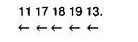

The patient correctly named all the numbers of the second ten, accompanying the word formation with a simultaneous movement of the index finger in the direction of the arrow.
Later the patient was taught to name the tens using Table 3.
Excerpt from the protocol
The naming of the numbers 20, 30 is being practiced.
Teacher. Tell me, how many tens are in this number (20)?
Patient. Two.
Teacher. Say it in full.
Patient. Two tens.
Teacher. What word should replace the word «ten»? Look at the table.
Patient. ...Пать... двадцать (dvadtsat', "twenty").
Teacher. Once more — what is this number called?
Patient. Двадцать.
Teacher. And this (30)?
Patient. This is... (looks at the table, at its first part — the second is covered) so, три де... тридцать (tridtsat', "thirty").
The working-out of the names of other round numbers proceeded in the same way.
Only after the naming of round numbers had been worked out was it possible to teach the patient the method of naming the numbers of the subsequent tens — the third, the fourth, and so on. Training was conducted with the help of Table 1 (see above).
The naming of numbers was restored quickly, but for a long time this process retained an expanded, voluntary, and conscious character. The patient often resorted to the supports he had learned in naming numbers even several years later.
Example (after 2 years). The patient named all numbers quickly and correctly. However, when naming the numbers 8 and 2, as well as the numbers 4 and 7, he resorted to the «old» method of naming.
12 150 30 1105 __________8____________________987
+ + + + Вова (Vova) (laughs) В... восемь (vosem', "eight") 227, but I'm not sure,
I don't feel it on my tongue
Teacher. Try once more to read this number. Patient. 287. . no, it seems that's not it again. Teacher. Name the individual digits: 9, 8.
Patient.__________9____________ ______8________
д... два...нет...девять (devyat', "nine")...сот» «Вова (Vova)... aha...987»
104025948
+ + +
The same difficulties, though now to a lesser degree (a significant decrease in erroneous answers, an increase in response speed to close to normal), were still present in subsequent years. And only after 3 years of restorative learning did these errors practically disappear in the patient: the patient correctly named all digits and numbers, but the process of naming remained at a voluntary level.
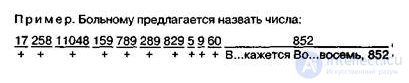
The protocols clearly show the results of the restoration of the process of naming numbers. The patient rather quickly assimilated the method of word formation given to him from outside and used it until the end of training. The naming of numbers became a significantly more abbreviated and automated process, but complete interiorization and automation of this process did not occur: the patient often resorted to one or another supporting means when naming; often, before naming a number aloud, the patient would, as it were, «feel out» the needed word-name with his articulatory apparatus, uttering this word in a whisper, searching for the necessary sounds.
In parallel with the restoration of the naming of numbers, the patient was trained to recognize numbers by ear. All the means used in restoring the process of sound discrimination were employed for this purpose. (FOOTNOTE: Tsvetkova L. S. Aphasia and Restorative Learning. Moscow: Prosveshchenie, 1988, Tsvetkova L.S. Neuropsychological Rehabilitation of Patients. Moscow: Moscow University Press, 1985.) Training in the naming of numbers should not proceed in isolation from their recognition by ear. The most effective means of restoring the perception of number by ear, from its earliest stages onward, was work with a tape recorder (the «tape-recorder method»). In this work the patient successively carried out a whole series of exercises: a) reading the names of numbers while simultaneously listening to the sound of these words, b) finding numbers given orally, c) dictation of numbers (from the tape recorder), d) analysis of errors in naming numbers by the method of comparing two recordings on magnetic tape — a recording of the naming of numbers made by the teacher, and a recording of the patient naming the same numbers in the same order.
The restoration of recognizing numbers by ear, like the process of naming, relied on an expanded system of external means and on the sequential performance of the operations of a program:
1. Listen to the name of the number.
2. Repeat it.
3. Extract the first sound from it and name it.
4. Name the number you heard.
5. Write down this number.
6. Find it among the cards with numbers marked on them.
Articulated pronunciation, as the main component of the process of recognition, remained a necessary means of recognizing a number by ear until the end of training. It is true that the process of recognition became shorter and somewhat automated, the articulatory act became less pronounced and proceeded significantly faster in time, and the repetition of the whole word heard was reduced to «feeling out» the first sound, by which the recognition of the whole word and its meaning took place. At the end of training the patient said the following about his way of recognizing numbers by ear: «I recognize numbers only if I feel the letters. Now I already grasp a number whole from hearing it, even a four- or five-digit one, but in order to write it I have to shift it onto my tongue».
Analysis of the material showed that the errors of recognition were the same as in naming. They mainly concerned those sounds or combinations of sounds that were difficult for kinesthetic discrimination. Numbers whose names began with the sounds (or sound clusters) два... (dva..., as in двадцать, "twenty"), две... (dve..., as in двенадцать, "twelve", двести, "two hundred"), во... (vo..., as in восемь, "eight", восемнадцать, "eighteen", etc.), со... (so..., as in сорок, "forty"), се... (se..., as in семнадцать, "seventeen", семьдесят, "seventy", etc.) were recognized and named with difficulty, as were numbers with the following sound combinations in the middle of the word: ян (yan, as in девяносто, "ninety"), ят (yat, as in девятьсот, "nine hundred"), мъд (m'd, as in семьдесят, "seventy"), мн (mn, as in семнадцать, "seventeen", восемнадцать, "eighteen") and others. Therefore, even at the end of training, errors related to the difficulty of differentiating kinesthetically close sounds, and especially consonant clusters, occurred in the patient's number dictations.
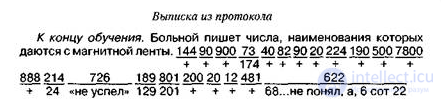
In the excerpt from the protocol we tried to reproduce more of those records in which the patient made errors. The average number of errors by the end of training decreased to 9% out of 500 numbers presented (Fig. 2). In experiments in which the patient was asked to write dictation with his tongue clenched, i.e., with inner speech excluded, the number of errors increased twofold, and the time taken to write the number dictation — threefold.
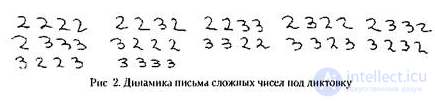
The restoration of the process of naming numbers continued, as is evident from the protocols, throughout the whole of restorative learning, but it was the central task only at the first stage; at the subsequent — second and third — stages it played a secondary role in training. After the relative restoration of the process of naming numbers by means of the assimilated method of mediated naming, it was necessary to teach the patient awareness of the place-value structure of number. The excerpts from the protocols already given, taken from different periods of training, show that the patient's understanding of the place-value structure of number was restored, although before training it had been grossly defective. Before training in the recognition and naming of numbers, understanding of the place-value structure of number was impaired. Let us give a corresponding example.
Excerpt from the protocol
The patient is given the number 18 and asked to show where the tens are and where the units are.
Patient. Here: this...as you said... един... един... (edin...edin..., attempting единицы — "units") probably, here (points to the ten), and here this is...
Teacher. Hundreds?
Patient. Yes, probably...
The number 104 is given, and the same task.
Patient. This is hard...here... I can't.
Teacher. Where are the units? (after lengthy deliberation the patient points to 4). Where are the hundreds?
Patient. Here (points to 0).
Teacher. And where are the tens?
Patient. You know, I don't understand.
After three weeks of training in the naming of numbers, he was again given these tasks.
Excerpt from the protocol
The patient is given the number 108.
Teacher. Where are the units?
Patient. Here (points to the hundred).
Teacher. And where are the hundreds?
Patient. A-ah, here is a hundred, and here — eight units... but the zero, I don't know, what this is...
The patient is given the number 104.
Teacher. Where are the units? (The patient points correctly.) And where are the hundreds? (Uncertainly, but he performs the task correctly.)
Patient. I know a hundred... a hundred... but the zero... what to do?
Teacher. Analyze the composition of this number. Tell me, where are the units here?
Patient. (Hesitating, points to the digit 4.) And this is a hundred... hundreds (correctly points to 1)... I know it's four, but the zero I don't know.
The patient had difficulty evaluating the meaning of zero within the composition of a number. The place-value structure of two-digit and three-digit numbers had already been assimilated by the patient on the basis of previous work with number. Excerpt from the protocol
The patient is given the two-digit numbers 19, 25, 98, 15, 44, 33.
Teacher. Show where the tens are and where the units are in these numbers.
The patient performed the task correctly.
Teacher. How many digits are in a number that begins with hundreds?
Patient. Three.
Teacher. Compose a number that would have hundreds, tens, and units.
The patient performs the task correctly: 105, 240, 333, and others.
The restoration of awareness of the place-value structure of number in our patient proceeded in accordance with the restoration of the process of naming numbers. The use of Tables 1 and 2, which indicated the method of forming the words that name numbers, greatly helped the restoration of understanding of the place-value structure of number. Exercises in which the patient was required to find the needed place values in a given number, to name these place values, to construct (from cards) a number according to a spoken scheme (put a card in the units place, find the place for the hundreds, say which place value is in the empty spot, etc.), exercises with a place-value grid, and reading numbers written not only horizontally but also vertically, etc., all helped to consolidate knowledge of the place-value structure of number.
Example.
Teacher. Name the missing place values in the numbers 5-24, -25, -0, 4-57, etc.
The patient performs the task correctly.
Teacher. Compose the number 1025.
The patient performs the task quickly and correctly.
Teacher. Replace the hundreds place with the digit 5.
The patient performs the task just as quickly.
Teacher. Read the new number.
The patient correctly reads the number 1525.
Teacher. Name the missing place values in the following numbers:
-025, 1-5, 10-56-.
Patient. Here there is no thousand, and here... these are hundreds and tens, and so, that means... units, tens... there's no unit of thousands, and here units are simply missing...
Very useful for this patient proved to be a method of analyzing number, in which he began from the end, dividing a large number into parts by successively separating off three digits at a time (division into classes), and then again, from the end, named the place values, having memorized the sequence units — tens — hundreds — units of thousands — tens of thousands. By the end of training this expanded method of analyzing the place-value structure of number became abbreviated, and the patient thoroughly assimilated the name and place of each place value. The restoration of knowledge about number — its name, its correlation with the quantity denoted by a given number, the place-value structure of number — made it possible to move on to the restoration of calculation operations in the patient described.
The restoration of calculation operations proceeded jointly, and only against the background of the restoration of the concept of the inner composition of number, of the mobility of the numbers that jointly make up the original, given number. In order to restore awareness of the complex interactions among numbers, the method described above was applied, which included the method of object numbers, representing a series of operations that the patient had to assimilate and perform independently. He was given a certain quantity of objects (within the first ten), which he had to divide into equal or unequal parts in every possible combination. A card with the corresponding number was placed next to the total quantity of objects. A corresponding number was also placed next to each part singled out. A record was then made reflecting the interaction between the quantities expressed by the numbers. For example, the patient divided 8 sticks into 2 equal parts — of 4 each — and wrote 8 = 4 and 4, or 8 = 4 + 4. The patient worked with each quantity (and the corresponding number accordingly) until he had established every possible combination of numbers. After the stage of material action (relying on real objects), the patient was transferred to training relying on the writing of the number (materialized action), i.e., with an abstract number, and again sought out the most varied combinations of different numbers within a single given one. This method had a broad effect; its result was the restoration of the patient's understanding of the inner content of the operation of multiplication, as well as the restoration of the operation of addition.
Let us give examples that illustrate the results of the restoration of understanding of the composition of number and of the operation of multiplication.
Excerpt from the protocol
The patient is given the number 10 and asked to find, among the other numbers lying in front of him, those from which the number 10 can be composed.
Patient. Repeat it, I didn't understand what I'm supposed to do.
Teacher. Here is the number 10. What numbers does it consist of?
Patient. What numbers, I still don't understand, 10 and 10.
The patient is given examples to solve: 5 + 5 = ;2 + 8=;12-2 = . The patient solved the examples correctly.
Teacher. So what numbers make up the number 10?
Patient. Aha, this must be 5 and 5, 2 and 8, right? But still I don't really understand.
Teacher. Solve the example: subtract 4 from 11. (The patient slowly solves the example, uncertainly writes 7.) How did you solve the example?
Patient. I don't know, intuitively. Teacher. What did you do with the number 4?
Patient. Nothing.
Teacher. Tell me, is this way of writing the example 11-4 = equivalent to this one (11 - 1)-3 = ?
Patient. No... and in general I don't understand at all what you're doing.
Teacher. Solve the example 7><4 = (The patient thinks for a long time.)
Patient. It seems... 21... no, 28, right? I've forgotten everything.
Teacher. Don't try to remember, just solve it. How else can this example be written?
Patient. I don't know.
Teacher. It can be done like this: 7 + 7 + 7 + 7 = ?
Patient. No, that's addition, but here multiplication is needed.
Excerpt from the protocol
Teacher. Write down what numbers the following numbers consist of: 5, 2, 3, 6, 8, 9,10. (The patient performs all the tasks correctly). And how else can the number 10 be obtained?
Patient. 20 - 10 = 10, 15 - 5 = 10, 2 x 5 = 10, 30 : 3 = 10 and others.
The patient is asked to solve the multiplication example 15x5 in expanded form. The patient writes: (15+15) + (15+15) + 15 = 75
30_____30
Teacher. And how can the correctness of the solution be checked?
Patient. For this you need 75 : 5 = 15.
Special attention was devoted to the restoration of multiplication and division. The fact is that, owing to the disintegration of the structure of number, the patient had difficulty understanding the relationships between numbers in division and multiplication. He had lost his understanding of the inverse relationship of division to multiplication. This was precisely why the patient often checked multiplication by division, using the divisor in the sense of the dividend (5 x 6 = 30; the patient performed the check 30 : 6 = 5 as 6: 30 = 5). Training in these types of arithmetic operations was conducted starting from the maximally expanded form of the operation. The patient quickly grasped and assimilated the inner content of the operations of multiplication and division; by the end of training they were performed at the level of whispered speech, in an abbreviated manner.
The same defects in the awareness of the inner structure of an arithmetic operation were found in the patient in subtraction crossing a ten. At the beginning of training the patient could not break down the operation of subtraction into successive component operations. This defect, together with others — impaired awareness of the direction of counting, speech defects, and others — constituted the difficulties in performing subtraction.
Mental arithmetic was practically inaccessible to the patient. He repeated the given example with difficulty; in solving it, he constantly tried to say the example aloud, and having made the calculations, he returned again and again to the beginning of the solution, tried to record the data obtained with the help of his fingers, and after several such attempts refused to perform the task. If the example was given in written form, the difficulties of the calculation operation decreased, but only as far as retaining the initial and intermediate data was concerned, while the difficulties of the solution process itself remained the same. Even when the patient did manage to correctly carry out some calculation operations, the time taken to solve them was immeasurably longer than normal. Let us give some excerpts from the protocols that illustrate the defects described in the patient's calculation operations.
Excerpt from the protocol
After the patient refused mental arithmetic, he was asked to solve the given examples in writing, but to break down the whole process of solving into successive links.
Teacher. Solve it the way you are used to doing all your calculations. Remember what you do first, what you do next, and write it all down... (The example 45 - 18 is given.) It turned out that the patient could not break down subtraction into successive operations.
Patient. ...I don't know any of the operations, I can't grasp them, I'm doing something, that's certain, but what and how — I can't write it down. I do it just... intuitively.
Teacher. But you know how such examples are usually taught to be solved at school.
Patient. Writes: 45 - 18 = 25 - 3... no, not like that, 25 + 3 = 25... no, 22 (pause).
Teacher. Well, and then?
Patient. I don't know what to do next.
Solving the examples 72 : 8 = , 63 : 7= , 56 : 8 = took the patient 5 min 45 sec, and he solved the example 66 - 17 = in 2 min 40 sec. He explained his difficulties as follows: «I didn't know where to put the little unit, I keep being drawn to add it, I really don't know what to do in such cases».
We conducted special, lengthy training of the patient in subtraction and addition crossing a ten. The task of training was the restoration of mental arithmetic. For this purpose, in this case too, as before, we applied the method of programmed instruction. The patient was given a card on which all the successive operations of subtraction crossing a ten were recorded. At first the card showed the solution of a specific example, and later this card was replaced by another, on which the solution of subtraction examples was shown in generalized form (the same was done with addition). 2) - 3) - 2) - 3) -
45-18 = 27 A-B=X
(D(2) (1)(2)
1)15-г 3=18 1)B=D + C
(1) (1) 2)45-15 = 30 2)A-P-U
(2) (2)
3) 30 - 3 = 27 3) U - S = X
In the upper corner of the card there was a marking that fixed the patient's attention on the fact that only successive subtraction was performed in the second and third links. This card constituted the program of the action.
It was necessary to create conditions for the assimilation and interiorization of this method of solving examples. For this purpose, training was conducted first at the level of materialized action (i.e., all operations were written down), then at the level of loud speech, and later the operation of counting was transferred to whispered speech and to the level of performing the operation «in the head».
At the beginning of assimilating the method, the patient solved four examples in an average of 10 min. However, the errors disappeared immediately, from the very first session. By the end of the first stage of training the time for solving four examples had decreased to 2,5 min. After the patient learned to solve arithmetic examples quickly and without errors relying on the materialized scheme, individual operations began gradually to be transferred to the level of loud speech. First the first operation was excluded from the card, and the patient had only to say it aloud, while performing the other two operations in writing, relying on the card. Later, in the same way, the second, and then the third operation were excluded. And then the patient solved the example already at the level of loud speech without relying on materialized means; only the given example remained written down. In the same gradual way and in the same sequence, the process was also transferred from the level of loud speech to the level of solving in a whisper.
The result of training using this method proved extremely effective. This patient (like all the other patients who suffered from this form of acalculia and underwent training with us) relearned mental arithmetic thanks to the method of counting given to him from outside and assimilated by him. The time for the calculation operation decreased several-fold and approached the norm, and the number of errors also decreased significantly. It should only be noted that we did not achieve complete automation and interiorization of the mode of action: the patient's mental arithmetic proceeded with obligatory articulation (in a whisper) of the given system of operations, albeit in an abbreviated form. A check of the durability of the assimilated method of mental arithmetic, conducted 13 months after training, showed not only the stability of the method but also its generalization: the patient used equally successfully both the system of counting he had assimilated and the method that had been part of his past experience and which resurfaced in him after training, and only thanks to it.
Examples. The patient is given the arithmetic examples: 35 - 16, 96 - 49, 64 - 26, 46 - 23. He must solve them, writing down all the operations in sequence, saying them aloud, and using the scheme-card.
Patient. Thirty-five minus... sixteen. So. First — what is sixteen. 16 — this equals fifteen plus one (writes it down). Now 35 - 15 = 20. And again we subtract 20 - 1 = 19.
The examples were solved in 8 min 5 sec without errors. The examples 61 -19, 134 - 79, 120 - 63, 93 - 58 were solved in 5 min 3 sec by the same expanded method relying on the materialized form of the operation.
In the next regular course of training the patient learned to solve examples relying on the written record of only one operation, while the other two were said aloud by him. Solving four examples under these conditions took 3 min 30 sec, and later the patient solved subtraction and addition examples mentally in an average of 10—12 sec.
We have described a specific case of the restoration of the concept of number and of calculation operations in a patient with primary parieto-occipital acalculia. The disorders of counting and the methods of their restoration set out here are characteristic of all the patients with primary acalculia whom we studied. The difference lay only in the greater or lesser severity of the symptoms of acalculia and in the presence or absence of speech defects in counting. There were no fundamental differences concerning the very structure of acalculia and the methods of overcoming it among our patients.
Thus, the analysis carried out of the structure of the disorder of counting arising from lesions of the parietal and parieto-occipital regions of the cortex of the left hemisphere, and of the methods of its restoration, allows us to conclude that this form of acalculia is substantially different from the disorder of counting in the link of optical and acoustic perception described above. In both cases, intellectual activity (counting) is impaired on the side of its operations, while other components of intellectual activity remain intact — the motivational sphere of the activity, orientative-investigative activity, control over one's current actions, and comparison of the results obtained with the initial data. In the case of primary (parietal) acalculia, those counting operations that constitute the core of this type of activity are impaired. In the case of the optical and sensory forms of acalculia, on the other hand, the operations impaired are those that play a secondary role in the course of counting and that are common to many types of mental functions in whose structure optical and acoustic perception are involved (writing, reading). Here counting is impaired nonspecifically.
In both cases, different tasks of restoration were set, and different methods of restorative training in counting were required.
A special case is presented by «frontal» acalculia, which is at one and the same time both primary and secondary. Moreover, the mechanisms underlying primary parietal acalculia and primary frontal acalculia are different. In order to better clarify this problem, a comparative analysis of these two forms of primary acalculia was carried out with the aim of clarifying their mechanisms, which is important for understanding acalculia and for developing methods of restorative learning.
Everything set out above has helped to confirm that primary parieto-occipital and frontal acalculia differ sharply in all respects. The difference was found both in the impairment of the concept of number and in the course of the calculation operations.
Часть 1 3.2. Methods of Restoring Counting in Lesions of the Parietal and Parieto-Occipital Regions of the
Часть 2 - 3.2. Methods of Restoring Counting in Lesions of the

Comments