
Lecture
Learning elements: subject and objectives; historical background; the main categories, methods, and structure of social psychology, and its relationship to other sciences
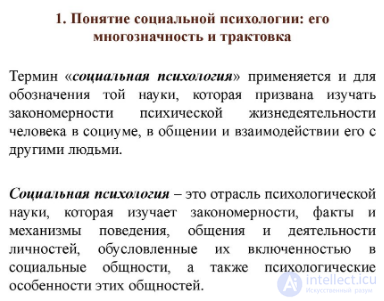
The subject of social psychology is the study of interaction between people, the impact of social factors on the psyche of the individual and the group, and the formation and functioning of social norms, stereotypes, and attitudes.
The main objectives of social psychology include:
Studying the mechanisms of social perception: how people perceive one another and social situations.
Analyzing the formation and change of social beliefs and stereotypes: how society shapes ideas about different groups of people.
Studying social influence: how some people affect others, including issues of social agreement and conformity.
Researching social relationships and interactions within groups and communities.
Studying aggression, conflict, and cooperation in social contexts.
Historical background of social psychology:
Social psychology has a rich history, and its development has been shaped by scientific and philosophical movements of various eras. Some key historical antecedents include:
The Enlightenment: The ideas of Enlightenment thinkers about freedom, equality, and reason influenced interest in questions of social interaction and decision-making.
Theories of social Darwinism: In the late 19th century, theories of social Darwinism concerning the rise and survival of the fittest influenced the study of competition and cooperation in society.
Freudian psychoanalysis: Sigmund Freud's ideas about unconscious processes and the influence of childhood on personality had an impact on the understanding of the psychological aspects of social relations.
Main categories, methods, and structure of social psychology:
Social perception: How people perceive and interpret social events and other people.
Social beliefs and stereotypes: How opinions and ideas about social groups are formed and changed.
Social influence: How some people can influence others through conformity, persuasion, and authority.
Social relationships: How relationships between people form and develop, including friendship, love, and conflict.
Social groups and communities: How groups form and function, their structure, and their influence on the individual.
The methods of social psychology include observation-based research, experiments, surveys, analysis of archival data, and the use of various statistical methods.
The relationship of social psychology to other sciences:
Social psychology is interconnected with many other scientific disciplines, including sociology, anthropology, personality psychology, cultural psychology, and economic psychology. It is also widely applied in education, marketing, management, and social work to understand and manage social processes and interactions.
1. The regularities of people's activity, behavior, and communication, determined by the factor of their inclusion in social groups, as well as the psychological characteristics of these groups, are the ... of social psychology.
2. The concept of «social psychology» came into wide use in connection with the appearance of scholarly works by the following authors:
3. The founder of symbolic interactionism is:
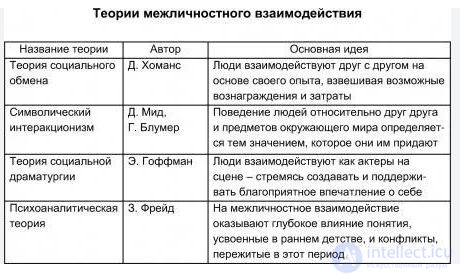
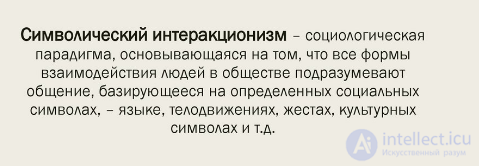
4. Foreign social psychology as an independent science took shape:
5. Humanistic psychology contributed to the development of social psychology, paying particular attention to the study of the problems of:
6. The creator of the theory of instincts of social behavior is:
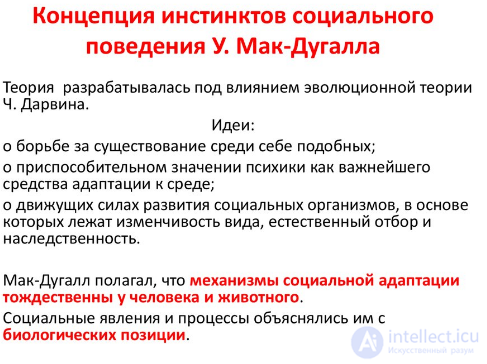
7. The theory that first examined the influence of natural and social factors on the formation of the human being is:
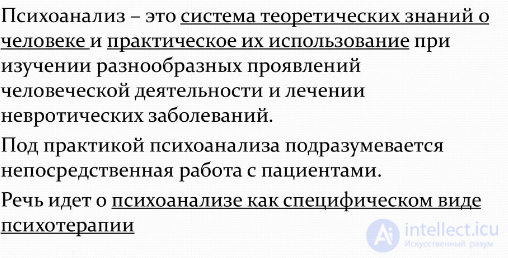
8. The method of social psychology used to diagnose emotional, direct relationships within a small group is called:
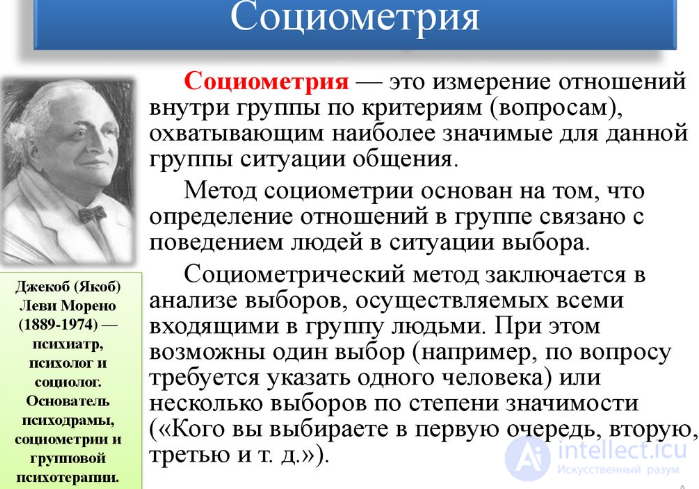
9. G.M. Andreeva distinguishes two large groups of socio-psychological methods:
10. For social psychology, the study and understanding of socio-psychological phenomena and processes is:
11. In social psychology, «group» and «mass phenomena» are the ... of research.
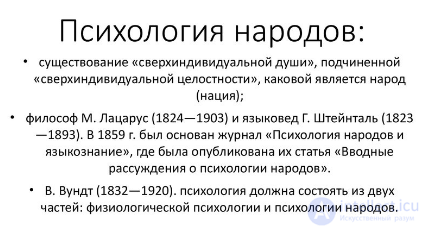
12. One of the founders of the theory of "Psychology of Peoples" is:
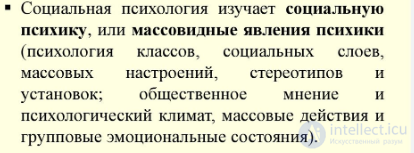
13. Social psychology studies:
14. The creators of the theory of "Mass Psychology" are:
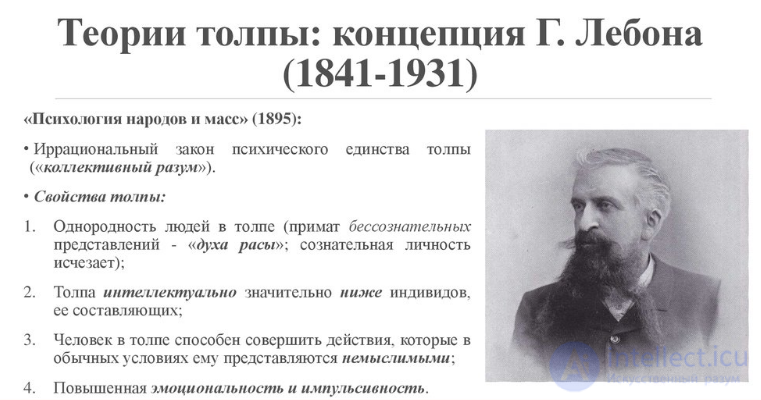
15. The theory of "Mass Psychology" used as its universal principle for explaining social phenomena the principle of:
Learning elements: the concept of communication as a socio-psychological phenomenon, its aspects, types, and functions; communication as an exchange of information (communicative aspect); communication as interaction (interactive aspect); communication as people's perception of one another (perceptual aspect)
Communication is a complex socio-psychological phenomenon that represents interaction between people through the exchange of information, words, gestures, symbols, and other means of communication. Communication plays a key role in our everyday life and is one of the primary means of interaction and communication in society. It can have different aspects and functions:
The communicative aspect of communication: This aspect of communication is connected with the transmission of information and messages. Within this aspect, communication is viewed as a process of exchanging messages, ideas, opinions, and information between people. It includes verbal and nonverbal communication, such as language, gestures, facial expressions, and so on.
The interactive aspect of communication: Here communication is viewed as interaction between people. It covers aspects related to social roles, norms, expectations, and conflicts that may arise in the process of communication. The interactive aspect of communication includes the ability to listen, ask questions, and respond to the emotions and needs of other people.
The perceptual aspect of communication: This aspect of communication is connected with perceiving and understanding other people. It includes the ability to understand the emotions, mood, and needs of other people based on their behavior and expressions. The perceptual aspect of communication allows one to better understand the interlocutor and adapt one's communication to their needs.
Types of communication:
Verbal communication: This is the exchange of information using words and language. It includes conversations, dialogues, discussions, and so on.
Nonverbal communication: This is the exchange of information without the use of words, such as facial expressions, gestures, intonation, and body language.
Written communication: This is the exchange of information in written form, for example through email, messages, or letters.
Symbolic communication: This is the exchange of information using symbols, signs, and signals, such as road signs, traffic light signals, and so on.
Functions of communication:
Informational function: Communication serves to transmit and receive information, and to exchange knowledge and experience.
Emotional function: It allows people to express and share emotions, feelings, and moods.
Social function: Communication promotes social integration and strengthens social ties and relationships.
Motivational function: It can stimulate action and motivate and inspire people.
Communication is an important element of social life and influences the formation of our views, values, and relationships with those around us.
1. The mechanism of social perception characterized by conscious or unconscious likening of oneself to another person, or of another person to oneself, is:
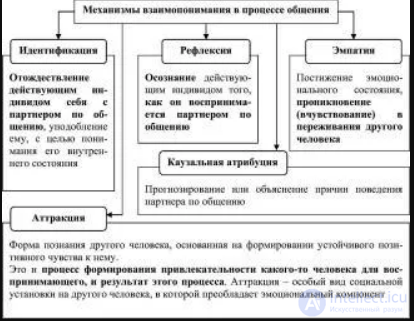
2. The mechanism of knowing another person, based on the formation of a stable positive attitude toward them, is:
3. Socio-psychological influence on other people through the unconscious, spontaneous induction of a certain emotional state in a person is:
4. A method of socio-psychological influence that ensures the uncritical perception and/or assimilation of some information is:
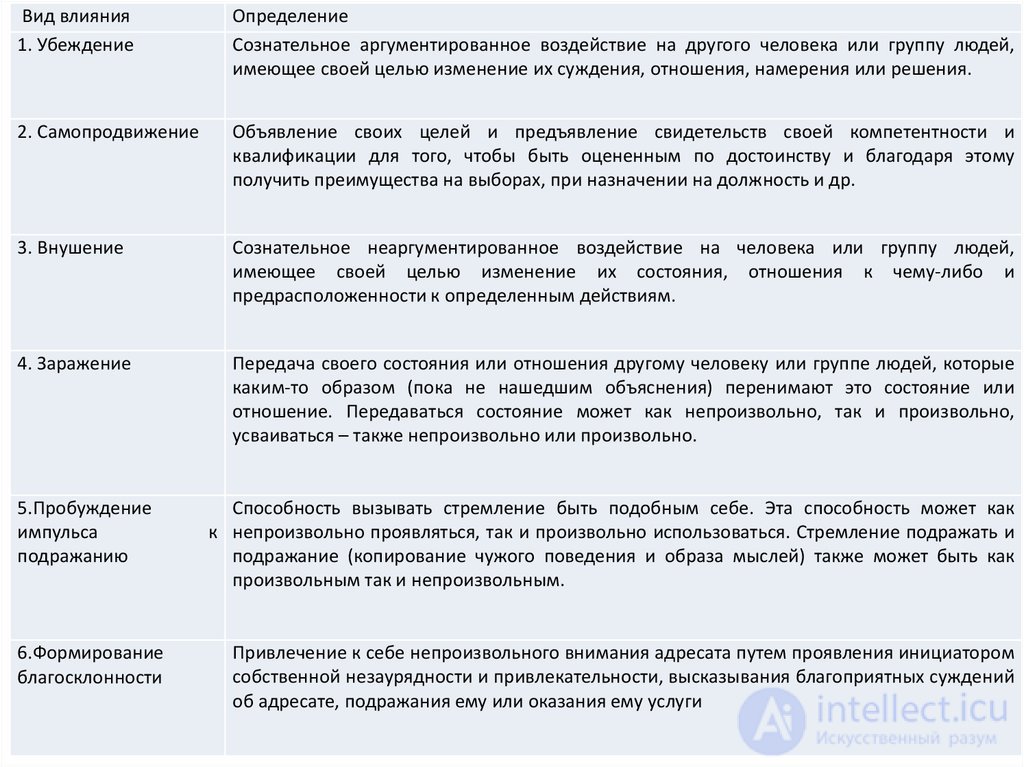
5. The communicative barriers to understanding other people or groups include:
6. The complex, multifaceted process of establishing and developing contacts and connections between people, which includes the exchange of information and the development of a joint strategy of interaction, is:
7. A strategy of interaction in conflict characterized by negotiation between the parties to the conflict and a readiness to make mutual concessions is:
8. Nonverbal means of communication include:
9. The mechanism of social perception consisting in interpreting the actions and feelings of another person (or group) by attributing causes underlying those feelings and actions is:
10. The level of communication at which a simple exchange of remarks occurs to keep a conversation going is called:
11. In the structure of communication the following aspects are distinguished:
12. The level of communication that involves deep self-disclosure of the essence of another person is called:
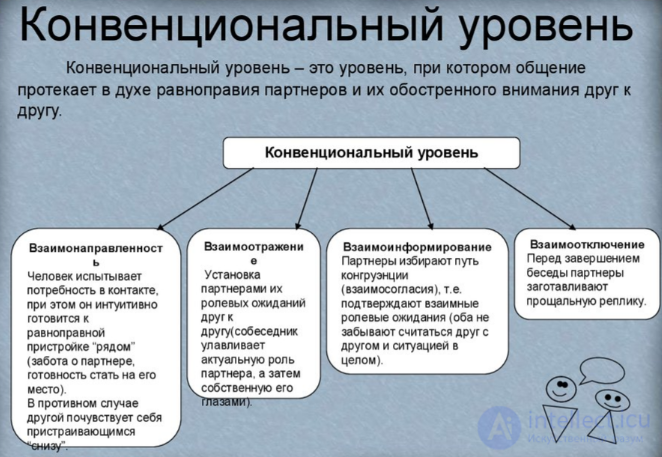
13. A strategy of interaction in conflict in which a person seeks to satisfy their own interests at the expense of another is called:
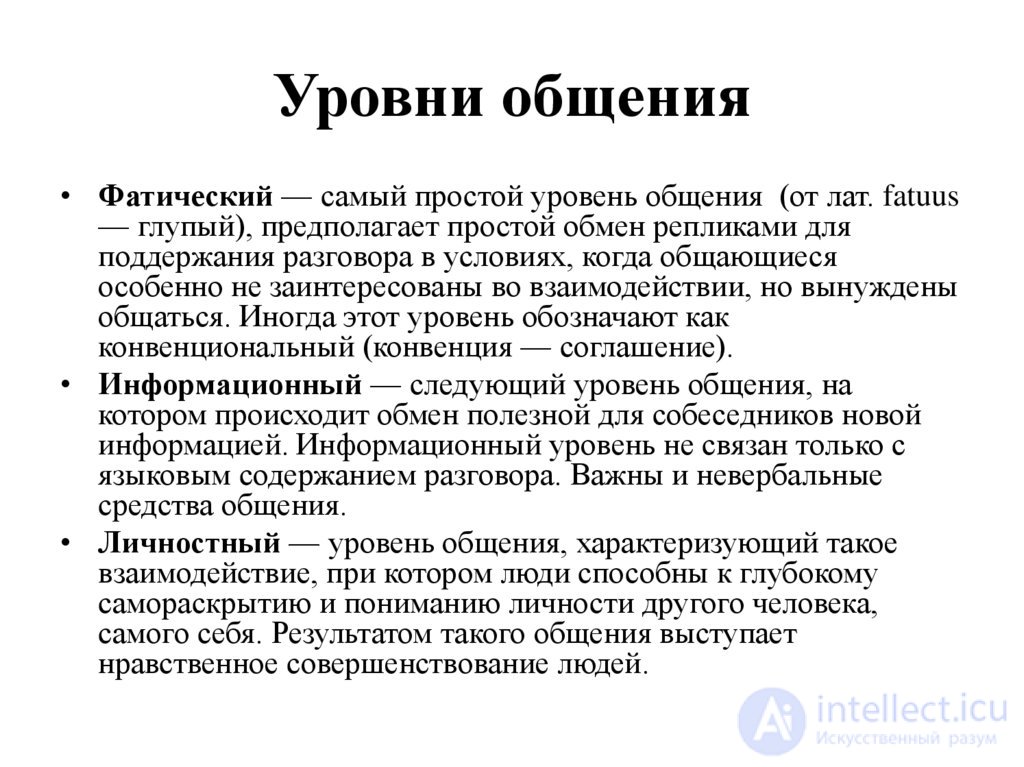
14. Social perception includes:
15. The style of interpersonal communication whose purpose is to reinforce a connection with one's own group, one's attitudes and values, and to raise self-esteem and self-respect — is the ... style:
Learning elements: the concept of personality in social psychology; the process of personality socialization, its stages, and the main institutions of socialization
Personality in social psychology is a complex psychological concept that describes the unique characteristics and qualities of an individual, their internal and external traits, as well as their abilities and features in the context of social relations and interactions. Personality is formed through interaction with the environment, including social, cultural, and psychological aspects. It may include such components as character, values, interests, beliefs, emotions, and so on.
The process of personality socialization:
The socialization of personality is the process by which an individual learns to adapt to the sociocultural environment, and to accept and internalize the social norms, values, roles, and expectations of society. This process begins in early childhood and continues throughout life.
The stages of the socialization process may include:
Primary socialization: This stage begins in early childhood and involves mastering the basic skills and values that are formed within the family and immediate environment.
Secondary socialization: At this stage a person begins to interact with a broader social environment, such as school, friends, and other social institutions. Here they learn to adapt to a wider range of norms and roles.
Tertiary socialization: Adults may continue to learn and adapt to new social environments and roles throughout their lives.
The main institutions of socialization:
Family: The family is the primary institution of socialization and plays a key role in shaping a child's basic values, norms, and roles.
Education: School and other educational institutions help children and young people acquire educational and social skills, and teach them sociocultural norms.
Religious institutions: Religious communities influence the spiritual and moral development of the individual and shape religious beliefs and values.
Mass media: Television, the internet, newspapers, and other media can have a strong influence on the formation of a person's worldview and cultural perceptions.
Work and professional associations: Work and professional activity contribute to the formation of a person's social and professional roles.
The socialization of personality helps individuals integrate into society, adopt its values and standards of behavior, and fulfill social roles, which contributes to the stability and cohesion of society as a whole.
1. The process and result of assimilating, as well as actively reproducing, the social experience of the society to which an individual belongs is:
2. The state of readiness of an individual or group to react in a certain way to particular phenomena of social reality is:
3. The social function of a personality corresponding to accepted norms, a way of behaving that depends on a person's status or position in society, in the system of interpersonal relations, is:
4. The process of changing a person's values, norms, and relations that have become inadequate to the environment is called:
5. The mechanism of socialization in which disturbances may arise when a child is raised by a single parent is called:
6. The main factors in personality development (according to G.M. Andreeva) are:
7. Value orientations, as a component of a person's worldview, are determined mainly by ... factors.
8. The influence of society on a person's attitudes, ideas, values, ideals, and behavior is called:
9. According to the sociogenetic approach, personality is formed under the influence of:
10. The differences between men and women that determine the set of expected behavior patterns are designated as:
11. It was believed that aggression is generated mainly by a strong drive toward death, or the death instinct, by:
12. A feature of socialization at the current stage of society's development is:
13. According to A.V. Petrovsky, the stages of personality socialization include:
14. Actions that benefit other people but have no obvious benefit for the people performing them are called ... behavior.
15. The concept of social attitude was a subject of research in the psychological school of:
Learning elements: the concept of the small group as a socio-psychological phenomenon; types and classifications of groups, phenomena of group influence on its members; intergroup conflict
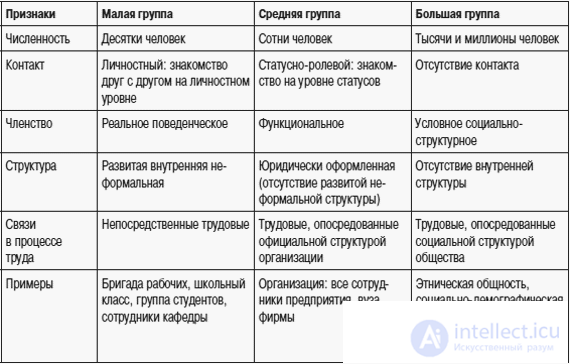
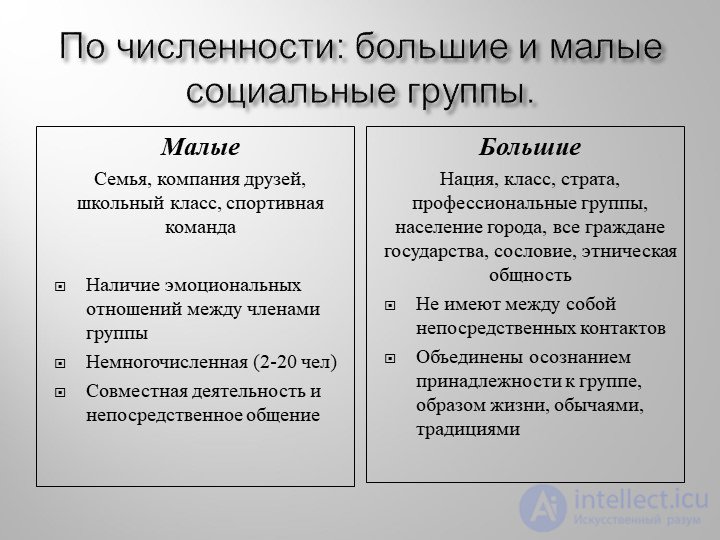
A small group is a limited number of people united by common goals, interests, interactions, and interdependence. In social psychology, small groups are studied as an important social phenomenon, since they have distinctive characteristics and influence the behavior and psychology of their members.
Types and classifications of groups:
By size:
By goals and objectives:
By duration:
Phenomena of group influence on its members:
Social influence: A group can exert pressure on its members so that they conform to the group's norms and expectations. This can manifest through conformity and public opinion.
Group dynamics: Groups have their own unique dynamics, which include interaction, communication, leadership, and conflict.
Group identity: Members of a group may develop their own unique identity, based on their belonging to the group and its values.
Social facilitation: The presence of other people can enhance performance and task completion (positive social facilitation) or impair the performance of skill-based tasks (negative social facilitation).
Groupthink: Groups can push their members toward decisions and opinions they would not have adopted individually, due to the pressure of conformity.
Intergroup conflict:
Intergroup conflict is a conflict between two or more groups that may arise due to competition for resources, differences in values, dissatisfaction, or other factors. This conflict can lead to hostility, stereotyping, bias, and even violence between groups. Resolving intergroup conflicts requires efforts toward mediation, cooperation, and mutual understanding between groups.
1. The type of interaction characterized by the achievement of individual or group goals and interests under conditions of confrontation between people is:
2. The effect of intergroup perception consisting in a negative evaluation of the members of another group and the results of their activity is:
3. A group that has an officially assigned structure imposed from outside is called a ... group.
4. A relatively stable set of people connected by a system of relations regulated by common values and norms is:
5. A group whose goals, opinions, and values a person shares, and which they use as a reference point when evaluating themselves and others, is called a ... group.
6. Random groups, in which people are united only by common emotions and experiences, are called ... groups.
7. The type of leader who puts forward and defends the group's values, goals, norms, and rules, and is responsible for handling the official tasks assigned to the group by the administration, is a ... leader.
8. The uncritical acceptance by a person of someone else's opinion, and yielding to real or imagined pressure from a group or leader, is:
9. Standards of behavior accepted in a given community that regulate people's relations are called:
10. In Russian psychology, a highly organized prosocial group of people possessing integral psychological characteristics and parameters favorable to individual development is called:
11. The clash of an individual, who holds a particular status, with circumstances incompatible with their expectations is called:
12. The process of forming a special type of bond within a group, which turns an externally imposed structure into a psychological community of people living by its own laws, is called:
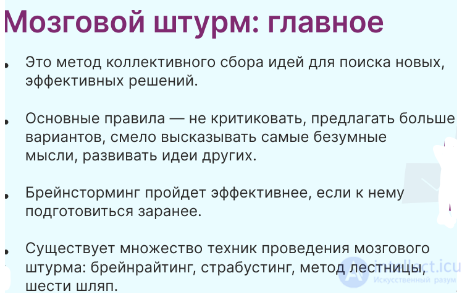
13. The process of making a group decision using a technique for stimulating creative activity and productivity is called:
14. Social inhibition implies a(n) ... influence of one person on another:
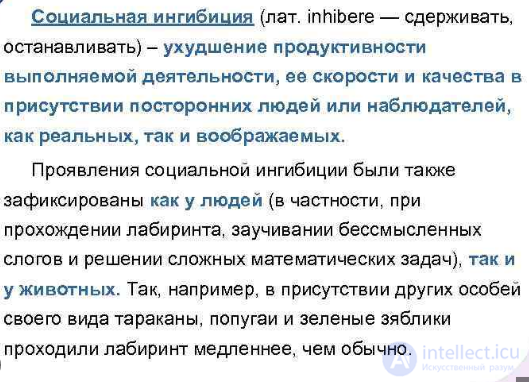
15. Social facilitation implies a(n) ... influence of one person on another
Learning elements: defining the concept of the large social group as a socio-psychological phenomenon; types and classifications, conflicts of large social groups
A large social group is a large number of people who are united by common characteristics, interests, ideology, or other shared traits, and who can interact with and influence one another over an extended period. Large social groups can vary in size and structure, but they usually represent a significant part of society and exert a substantial influence on the behavior and psychology of their members.
Types and classifications of large social groups:
Interest and hobby groups: These groups unite people on the basis of shared interests, such as sports, art, music, and other pursuits.
Religious groups: People may unite on a religious basis, belonging to a single religious confession or denomination.
Political parties and movements: These groups are united around a common political ideology or program and can influence political decisions and processes in society.
Professional organizations: People may be members of professional associations that protect their interests and set standards for particular professions.
Ethnic and cultural groups: These groups unite people on the basis of a shared ethnic or cultural affiliation, and they may observe their own traditions, customs, and language.
Conflicts among large social groups:
Conflicts between large social groups can arise for various reasons, including:
Conflict of interests: Groups may come into conflict due to competition for limited resources, such as territory, jobs, or economic benefits.
Conflict of ideologies and values: Differences in political, religious, or cultural ideologies can lead to conflict between groups.
Group bias: Bias and stereotypes can contribute to hostility and conflicts between groups.
Political and social pressure: Groups may exert pressure on the government or society to protect their interests or achieve change.
Territorial and national conflicts: Conflicts between nations or ethnic groups can arise from disputes over borders, territory, or autonomy.
Resolving conflicts between large social groups may require efforts toward mediation, diplomacy, establishing dialogue, and cooperation in order to reach a peaceful agreement and reduce tension.
1. Large social groups that differ in their relation to the means of production, their role in the social organization of labor, and the ways and amounts by which they receive and possess a share of wealth are:
2. Large social groups include social communities such as:
3. The basis for distinguishing sex-and-age types of large social groups is:
4. The basis for distinguishing classes and nations as particular types of large social groups is:
5. People's belonging to socio-demographic communities:
6. Examples of large social groups to which belonging is the result of people's conscious desire to unite are:
7. A crowd, as a social group, belongs to the type of ... groups.
8. An ethnic formation, as a social group, belongs to the type of ... groups.
9. Sex-and-age groups, as social groups, belong to the type of ... groups.
10. A festive procession, as a social group, belongs to the type of ... groups.
11. People present at a meeting, as a social group, belong to the type of ... groups.
12. The basis for distinguishing conditional and real types of groups is the following features:
13. The basis for distinguishing open and closed types of groups is the following feature:
14. By the type of dominant emotion, a(n) ... type of crowd is distinguished.
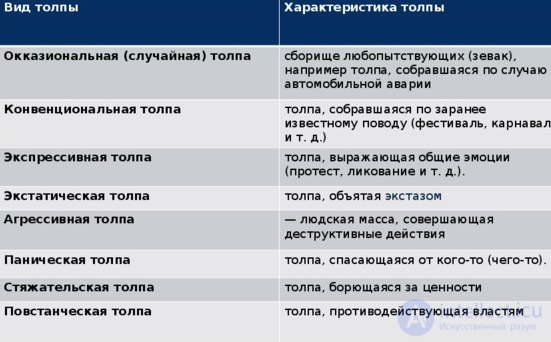
15. The spontaneously arising state and behavior of a large body of people in conditions of behavioral uncertainty, in a state of heightened emotional arousal from uncontrollable fear, is:
|
No. |
Name of Didactic Unit |
1 |
2 |
3 |
4 |
5 |
6 |
7 |
8 |
9 |
10 |
11 |
12 |
13 |
14 |
15 |
|
5.1. |
Introduction to Social Psychology |
c |
b |
d |
a |
c |
d |
a |
c |
b |
a |
b |
c |
a |
c |
a |
|
5.2. |
The Problem of Communication in Social Psychology |
b |
d |
b |
a |
c |
a |
d |
b |
a |
d |
c |
b |
a |
b |
a |
|
5.3. |
The Problem of Personality in Social Psychology |
b |
c |
a |
d |
a |
b |
d |
a |
d |
c |
b |
a |
c |
a |
b |
|
5.4. |
The Psychology of the Small Group |
d |
a |
c |
b |
c |
d |
a |
b |
a |
b |
a |
b |
a |
b |
d |
|
5.5. |
The Psychology of Large Social Groups |
a |
b |
a |
c |
d |
a |
c |
a |
b |
d |
a |
b |
c |
a |
d |

Comments