
Lecture
Assessment of knowledge on the topic "Pedagogical Psychology: Features" can be organized in various ways, depending on the goals and context of instruction. Below is a sample description of an assessment on this topic:
Assessment title: "Pedagogical Psychology: Features"
Assessment objective: To evaluate students' level of understanding of the basic concepts and principles of pedagogical psychology, as well as their ability to apply this knowledge in pedagogical practice.
Assessment format:
Theoretical test: Students are offered a series of questions with a choice of one or more answer options, as well as questions with short and extended answers. Sample questions may include:
Case study: Students are asked to consider a pedagogical case and apply knowledge from pedagogical psychology to analyze it and propose solutions. Sample case:
Situation: Your student has trouble concentrating in class and is often distracted. What pedagogical methods and strategies would you apply to help this student improve their concentration and academic performance?
Project work: Students are asked to choose a topic and develop a project that integrates the principles of pedagogical psychology. For example, they might develop an educational program for children with special needs, taking into account their psychological characteristics.
Interview: An individual or group interview in which students are asked questions and given scenarios that test their understanding and ability to apply pedagogical psychology in practice.
Grading criteria: Students' grades may be based on the accuracy and depth of their answers to questions, their analytical skills in examining cases, and the quality of the projects they develop. Their ability to justify their decisions and use relevant scholarly sources can also be assessed.
This assessment format makes it possible to evaluate both the theoretical and practical skills of students in the field of pedagogical psychology and gives them the opportunity to demonstrate their knowledge and abilities in various teaching and educational situations.
Learning elements: subject, tasks, methods, history of pedagogical psychology
Pedagogical psychology is a scientific discipline that studies the processes of instruction and upbringing, as well as the psychological aspects of educational and upbringing practices. It is concerned with how people learn, what factors influence their learning and development, and how pedagogical methods can be optimized for more effective instruction and upbringing.
Tasks of pedagogical psychology:
Studying learning and development: Pedagogical psychology examines how the learning process occurs in different age groups and in different educational environments. It analyzes the factors that influence successful learning.
Developing teaching methods: One of the tasks of pedagogical psychology is to create effective teaching methods and strategies that take into account the individual needs and characteristics of learners.
Studying motivation and interests: Pedagogical psychology examines how the motivation and interests of learners affect their academic success, and how they can be stimulated.
Personality development: This branch of psychology is also concerned with the personality development of learners, including their social and emotional aspects.
Methods of pedagogical psychology:
Experiment: Pedagogical psychology uses experimental methods to study various aspects of instruction and upbringing. Experiments make it possible to identify cause-and-effect relationships and establish the effectiveness of pedagogical methods.
Observation: Researchers in pedagogical psychology observe learners and teachers in various educational environments in order to identify patterns of behavior and interaction.
Interviews and surveys: Interview and survey methods are often used to study the opinions, motivation, and needs of learners and educators.
Document analysis: Researchers can analyze teaching materials, curricula, student diaries, and other documents in order to understand which teaching methods are used and what results are achieved.
History of pedagogical psychology:
Pedagogical psychology as a scientific field began to develop in the 19th century. Important milestones in its history included:
The work of Johann Heinrich Pestalozzi (1746-1827): The Swiss educator Pestalozzi is considered one of the founders of modern pedagogical psychology. He emphasized the importance of developing children's individual abilities and stressed the significance of experience and active learning.
Ivan Pavlov's theory (1849-1936): The work of the Russian physiologist Pavlov on reflexes and conditioned reflexes influenced the understanding of learning and the conditions that contribute to its successful implementation.
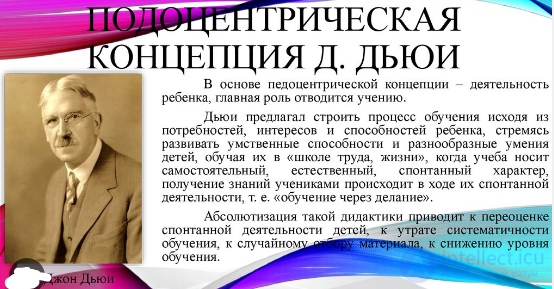
John Dewey (1859-1952): The American philosopher and educator Dewey developed the concept of experiential learning and emphasized the importance of experience and practice in education.
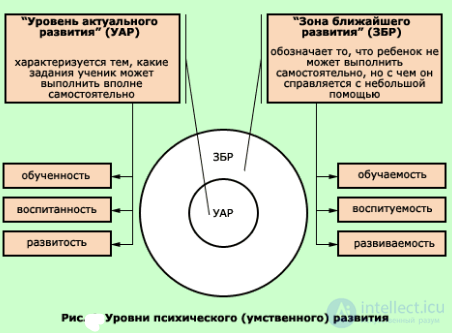
Lev Vygotsky (1896-1934): The Russian psychologist Vygotsky made an important contribution to understanding the relationship between the development of intelligence and learning, formulating the theory of the zone of proximal development.
The history of pedagogical psychology is rich in various theories and concepts that continue to influence education and pedagogical practice today
1. The term «pedagogical psychology» was introduced into scientific use by:
2. The founder of Russian pedagogical psychology is:
3. The author of the statement: «If pedagogy wants to educate a person in every respect, it must first come to know him in every respect» is:
4. The method of pedagogical psychology aimed at studying changes in a child's psyche in the process of the researcher's active influence on the subject is:
5. Pedagogical psychology took shape as an independent branch of scientific knowledge in:

6. The didactic concept of pedagogical psychology in which the main role is assigned to learning, i.e., the child's activity, is called:
7. The object of pedagogical psychology is:

8. The facts, mechanisms, and laws governing a person's acquisition of socio-cultural experience, and the changes this process brings about in the level of intellectual and personal development of the person as a subject of learning activity, constitute the ... of pedagogical psychology (according to I.A. Zimnyaya).
9. According to A.M. Stolyarenko, the conditions and laws governing the formation of psychological new formations under the influence of education are the ... of pedagogical psychology.
10. In the work «Man as the Subject of Education», the educator who defined the subject of a teacher's work as the upbringing, instruction, and knowledge of the various sides of a person was:
11. In the history of the development of pedagogical psychology, the following psychological-pedagogical trend existed:
12. In pedagogical psychology, observation carried out by an educational psychologist in the process of joint activity with learners is called:
13. Among the three didactic concepts of pedagogical psychology, the one that is absent is:
14. The structure of pedagogical psychology includes the psychology of:
15. Improving the methods of educational influence is the concern of ... psychology.
Learning elements: the concept of learning activity, learning motivation, mechanisms of the educational process, the relationship between instruction and development, problems of school underachievement
Learning activity is a complex psychological and pedagogical activity associated with instruction and the acquisition of knowledge, skills, and abilities. It includes learning processes, tasks, methods, strategies, and is oriented toward achieving educational goals.
Learning motivation:
Learning motivation is the internal or external force that drives a learner toward learning and achieving learning goals. Intrinsic motivation is based on one's own interest in the subject and satisfaction from learning activity, while extrinsic motivation is associated with external rewards and punishments. Effective learning often requires supporting and developing learners' intrinsic motivation.
Mechanisms of the educational process:
The mechanisms of the educational process are the processes and factors that ensure effective learning. They include pedagogical methods and strategies, the organization of learning material, assessment and feedback, the use of technologies and resources, as well as the learning environment and climate at the educational institution.
The relationship between instruction and development:
Instruction and development are closely interrelated. Instruction is the process of transmitting knowledge and skills, while development is the process of expanding and deepening the cognitive, social, and emotional capacities of the individual. An optimal combination of instruction and development in the learning process promotes the formation of competent and harmoniously developed individuals.
Problems of school underachievement:
Problems of school underachievement can be caused by various factors, including:
To address problems of school underachievement, it is necessary to conduct diagnostics, develop individual support plans for learners, cooperate with parents, and create favorable educational environments that promote successful learning.
1. A learner's own actions aimed at developing their abilities and acquiring knowledge, skills, and abilities are called:
2. The joint activity of teacher and learner that ensures schoolchildren's mastery of knowledge and ways of acquiring knowledge is called (according to A.K. Markova):
3. One of the main types of human activity, aimed at the acquisition of knowledge in the process of solving theoretical problems, is called:

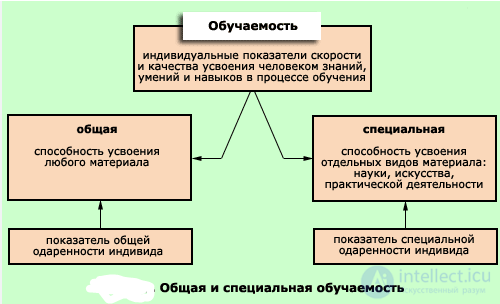
4. The capacity of a person to acquire cultural-historical experience is called:
5. Very rapid, practically automatic learning using genetically predetermined, i.e., innate forms of behavior, is called:
6. The level of actual mental development is characterized by:
7. Learning motives characterized by the learner's orientation toward mastering knowledge (facts, phenomena, laws) are called:
8. The main goal of traditional instruction is the formation of:
9. From N.F. Talyzina's point of view, the ability to learn necessarily includes the actions of modeling, encoding, and decoding, which are ... actions.
10. The reinforcement of correct responses in programmed instruction is achieved through:
11. The highest level of problem-based learning is characterized by:
12. The creator of the concept of the acquisition of scientific concepts by primary school students is:
13. Developmental instruction is based on the concept of:
14. Instruction in which learning information is divided into small parts and the learner cannot take the next step in mastering the material without having mastered the previous one constitutes the essence of ... instruction:
15. Instruction aimed at stimulating awareness of a contradiction in the process of activity, leading to the need for new knowledge, is called ... instruction:
Learning elements: upbringing, morality, ethics, spirituality, moral norms
These concepts are important for the formation of personality and society. Let us examine each of them:
Upbringing: Upbringing is a systematic process aimed at forming personality and developing skills, values, and norms of behavior. It is carried out through the influence of educational institutions, the family, the surrounding environment, and social communities on a person's development. Upbringing promotes adaptation to society and forms an understanding of moral and ethical values.
Morality: Morality is a system of norms and rules determining what is considered right or wrong in society. It forms the basis for evaluating moral actions and decisions. Moral norms may include such aspects as honesty, fairness, kindness, respect for others, and many others.
Ethics: Ethics is a characteristic of the personality related to its ability to observe moral norms and act in accordance with them. It reflects how sensitive a person is to moral issues and how willing they are to adhere to moral values in their life.
Spirituality: Spirituality is a deeper aspect of personality related to the search for the meaning of life, spiritual values, and faith. It can be expressed through religious beliefs, but can also include more general aspects such as self-development, ethicality, and inner growth.
Moral norms: Moral norms are specific rules and expectations that determine how one should behave in certain situations from a moral standpoint. They are usually based on more general moral principles and are applied in specific circumstances. For example, moral norms may include a prohibition on theft, an obligation to help those in need, and other specific rules of behavior.
These concepts play an important role in the formation of personality, the shaping of public morality and ethics, and in defining values and behavior in various spheres of life. They influence how people perceive and interact with one another, and they shape the formation of culture and norms in society.
1. The branch of psychology that recognizes external influence on personal behavior as the primary upbringing factor:
2. From the standpoint of the activity approach, educational influence should be directed primarily at the ... sphere of personality.
3. Representatives of humanistic psychology believed that educational influence should be carried out by purposefully influencing the pupil's ...
4. The founder of the theory of collective upbringing is considered to be:
5. For a child, the teacher becomes the most significant figure at ... age.
6. In terms of upbringing, ... instruction is considered the most effective.
7. According to behaviorists, the psyche is a ... object of influence of the surrounding world.
8. The purposeful psychological-pedagogical process of organizing and stimulating diverse activity aimed at mastering moral and ethical experience is called:
9. The impossibility for a person to violate norms that have become internal regulators of behavior is defined as:
10. A parent's ability to influence a child, who recognizes the parent's right to make responsible decisions and change the child's behavior, is called:
11. The conscious activity of a subject aimed at changing the properties of their individuality in accordance with clearly set goals is called:
12. Specific ways of influencing the consciousness, feelings, and behavior of pupils in order to solve psychological-pedagogical tasks in joint activity and communication are called the ... of upbringing.
13. Means of upbringing, by the nature of their influence on a person, can be divided into:
14. The ways of organizing the upbringing process and the activity of learners are called the ... of upbringing.
15. The conventional level of morality (from 10 to 13 years) is characterized by (according to L. Kohlberg):
Learning elements: pedagogical activity, the teacher's personality, the teacher's professional and personal growth, professional mastery
Pedagogical activity is the process of a teacher's educational and upbringing work with learners. It includes planning and conducting lessons, assessing academic achievement, organizing extracurricular activities, interacting with parents, and other aspects of the educational process. Pedagogical activity is aimed at the development of learners' personalities, the transmission of knowledge and values, and the formation of skills and moral qualities.
The teacher's personality is the set of characteristics, properties, and qualities that determine his or her individuality as a professional and influence his or her pedagogical activity. The teacher's personality includes his or her value orientations, pedagogical philosophy, degree of empathy, and professional and personal readiness to work with learners.
The teacher's professional and personal growth is a continuous process of developing his or her professional competencies and personal qualities. It includes learning new teaching methods and technologies, professional development, and work on oneself as a person. Professional and personal growth allows the teacher to perform his or her duties more effectively and to better meet the needs of modern education.
A teacher's professional mastery is a high level of professional skills and competencies that allows him or her to successfully carry out the educational process and achieve good results for learners. It includes the ability to effectively use a variety of teaching methods, diagnose learners' needs, adapt learning material, establish effective interaction with parents and colleagues, and constantly improve his or her professional skills.
Professional mastery and the professional and personal growth of the teacher are key aspects of successful pedagogical activity. Teachers who strive for the continuous improvement of their skills and their development as individuals contribute to higher-quality education and upbringing of new generations.
1. According to N.F. Talyzina, a teacher's ability to penetrate into a student's inner world, and psychological perceptiveness, constitute the essence of ... abilities.
2. Professional changes in a teacher's personality are considered negative deformations if these changes:
3. A person's predisposition to educational influences is designated by the term:
4. A method of psychological influence addressed to the pupil's consciousness and logic is:
5. The structure of pedagogical activity includes the following components:
6. The ability to establish personal contact with each of the learners is most characteristic of:
7. According to N.F. Talyzina, a teacher's abilities to convey learning material to learners in an accessible and interesting way, and to prompt learners' mental activity, are called:
8. The requirements placed on a specialist's qualities, capabilities, and abilities are established by:
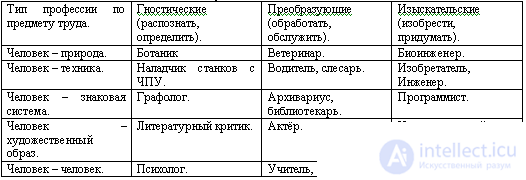
9. According to E.A. Klimov's classification, the teaching profession belongs to the type:
10. The model of the teacher's personality (according to L.M. Mitina) includes the pedagogical:
11. According to N.F. Talyzina, a teacher's ability to communicate with children, to find the right approach to learners, to establish appropriate relationships with them from a pedagogical point of view, and the presence of pedagogical tact, constitute ... abilities.
12. The student is given complete freedom and the opportunity to influence the pedagogical process under a ... style of pedagogical leadership.
13. The component of pedagogical activity associated with the ability to mentally plan the upbringing-and-education process is called:
14. A.K. Markova identifies three main aspects of a teacher's work:
15. The style of pedagogical communication in which the student is regarded as an equal partner in communication, a colleague in the joint pursuit of knowledge, is called:
|
No. |
Name of the Didactic Unit |
1 |
2 |
3 |
4 |
5 |
6 |
7 |
8 |
9 |
10 |
11 |
12 |
13 |
14 |
15 |
|
4.1. |
Introduction to Pedagogical Psychology |
c |
a |
d |
b |
d |
b |
d |
c |
a |
a |
a |
d |
c |
d |
b |
|
4.2. |
Psychology of Learning |
d |
b |
c |
d |
a |
d |
c |
d |
a |
d |
b |
a |
b |
d |
b |
|
4.3. |
Psychology of Upbringing |
a |
c |
d |
a |
c |
d |
a |
d |
b |
c |
a |
c |
d |
a |
b |
|
4.4. |
Psychology of Pedagogical Activity |
d |
a |
b |
c |
a |
d |
a |
b |
a |
c |
a |
c |
b |
a | d |

Comments