
Lecture
Learning elements: subject, tasks, methods, history of developmental psychology
The subject of developmental psychology:
The subject of developmental psychology is the study of a person's psychological development throughout life, with regard to age-related characteristics. This branch of psychology analyzes how psychological processes and characteristics change with age, from early childhood through old age. The subject of study includes the cognitive, emotional, social and physical aspects of development.
The tasks of developmental psychology:
Studying age-related characteristics: The main task is to determine which psychological characteristics change with age and which remain stable.
Identifying key developmental stages: Studying age stages and critical transitions, such as the adolescent crisis or the midlife crisis.
Investigating the influence of the environment: Analyzing the influence of family, education, the social environment and culture on personality development.
Developing methods of teaching and upbringing: Developmental psychology helps devise effective methods of teaching and upbringing that take into account the age-related characteristics of children and adults.
Methods of developmental psychology:
Longitudinal studies: Studies carried out over an extended period of time in order to track changes in participants' psychological development.
Comparative studies: Comparing different age groups to identify differences and similarities in their psychological characteristics.
Statistical analysis of development: Using statistical methods to analyze data and identify developmental trends.
Observation and interviews: Observing behavior and talking with participants in order to obtain psychological information.
The history of developmental psychology:
In the 19th century, Feodorov Golovin studied child development and concluded that children pass through various stages of psychological development.
In the early 20th century, G. Stanley Hall and Arnold Gesell developed methods for observing children and systematizing data on their development.
In the mid-20th century, Janet Taurndike created a theory of development that emphasized the importance of internal factors in psychological development.
With the development of the psychology of aging and gerontology, developmental psychology came to include the study of the psychological aspects of aging.
Research in the field of developmental psychology continues today, and it is important for understanding a person's psychological development throughout life.
1. J.-J. Rousseau called the «period of storm and stress» the age period:

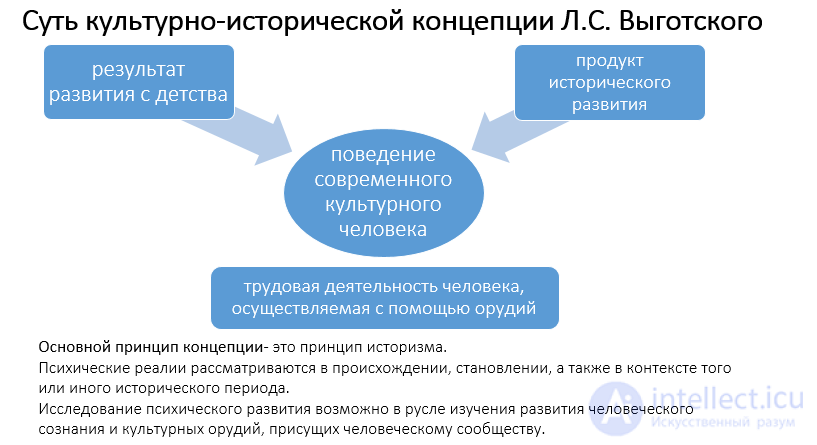
2. In the 20th century, developed the «Cultural-historical theory of the development of higher mental functions in man»:
Laws of a child's mental development
a) Child development has a complex organization in time: it has its own rhythm, which does not coincide with the rhythm of clock time, and its own tempo, which changes in different years of life.
b) The law of metamorphosis in child development: development is a chain of qualitative changes.
c) The law of uneven child development: each aspect of the child's psyche has its own optimal period of development.
b) The law of development of higher mental functions: «Every higher mental function appears twice in the course of the development of behavior: first as a function of collective behavior, as a form of cooperation or interaction, as a means of social adaptation, i.e. as an interpsychological category, and then a second time as a mode of the child's individual behavior, as a means of personal adaptation, as an internal process of behavior, i.e. as an intrapsychological category».
3. The category of developmental psychology that denotes discrete time intervals in a person's life and is derived from a specific developmental theory and the principle of its periodization is:

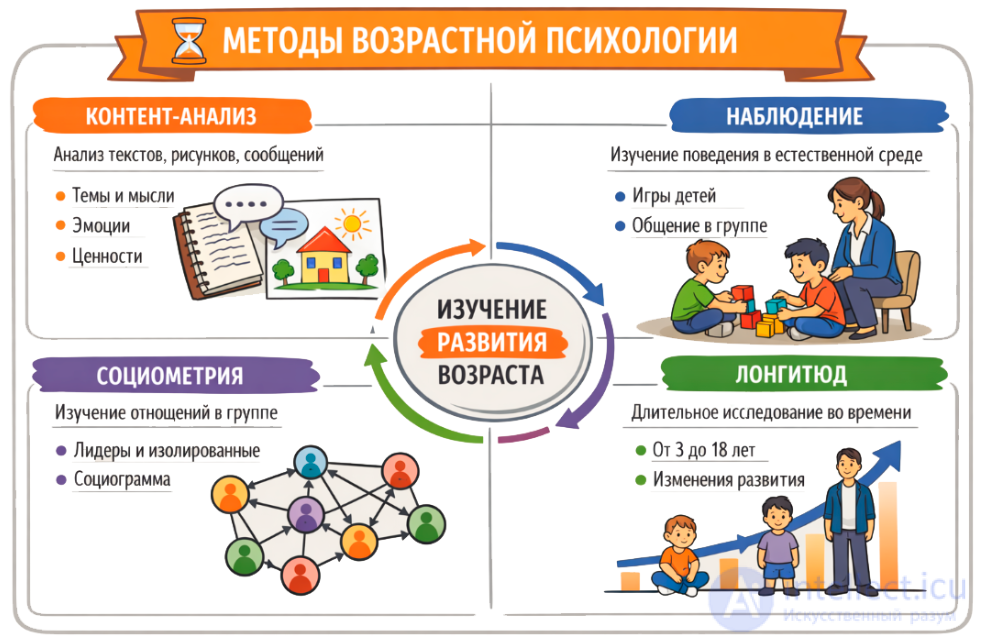
4. The organizational method of developmental psychology that makes it possible to continuously and over the long term track the course of an individual's mental development is:
Content analysis — a method of studying psychological phenomena through the analysis of texts, statements, drawings, messages and other products of human activity.
Observation — a method of systematically studying human behavior in natural or specially created conditions without interfering in the person's activity.
Sociometry — a method of studying interpersonal relationships within a group. It was developed by the American psychologist J. Moreno.
The longitudinal method — a long-term study of the development of the same people over many years. Features of the method: the same group is studied; measurements are taken repeatedly at set intervals of time.
5. Developmental psychology emerged as a science:
Developmental psychology emerged in 1882. Its emergence is linked to the publication of a book by the outstanding German physiologist and psychologist Wilhelm Preyer, «The Mind of the Child», devoted to child psychology.
In the 1920s, developmental psychology took shape as a branch of psychological knowledge, as an independent science.
6. Among the three main research strategies identified in developmental psychology, the following strategy is absent:
7. The development of the human psyche is understood as the development of:
8. The connection between developmental psychology and ... psychology is explained by the fact that it is impossible to effectively teach and raise a child without knowing that child's psychological characteristics.
9. Accumulating facts and arranging them in temporal sequence is the goal of the strategy of:
10. The subject matter of developmental psychology consists of the laws governing:
11. Developmental psychology studies the … of a person.
12. The basic concept of developmental psychology is:
13. The structure of developmental psychology includes:
14. In the 20th century, the most significant contribution to the development of developmental psychology was made by:
15. The structure of developmental psychology includes:
Learning elements: the main approaches to the development of a child's psyche in world psychology, basic theories
There are several main approaches to studying the development of a child's psyche in world psychology, as well as basic theories that researchers use to explain this process. Here are some of them:
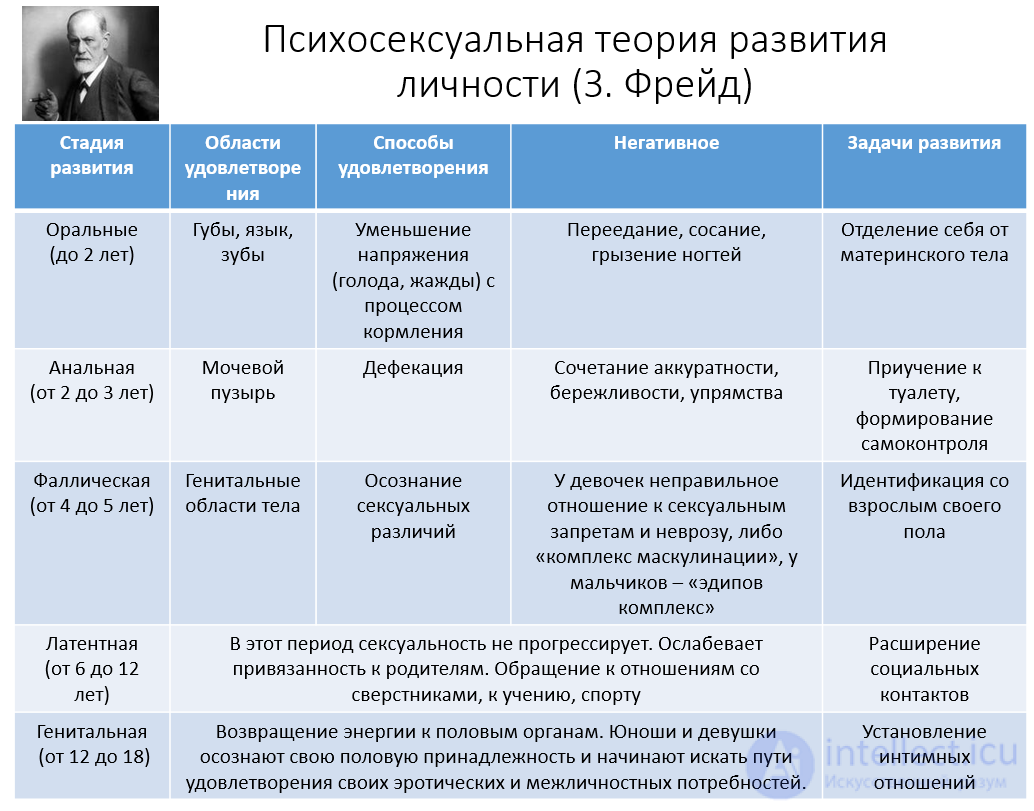
1. The psychoanalytic approach (Sigmund Freud): This approach holds that the development of a child's psyche is linked to the process of forming consciousness and unconscious manifestations. Freud identified several stages of psychosexual development, such as the oral, anal and phallic stages, each characterized by particular conflicts and each influencing personality formation.
2. The behaviorist approach: Representatives of this approach, such as Ivan Pavlov and B. F. Skinner, focus attention on observable behavior and its formation on the basis of external stimuli and responses. They hold that the development of a child's psyche is determined by learning and experience.
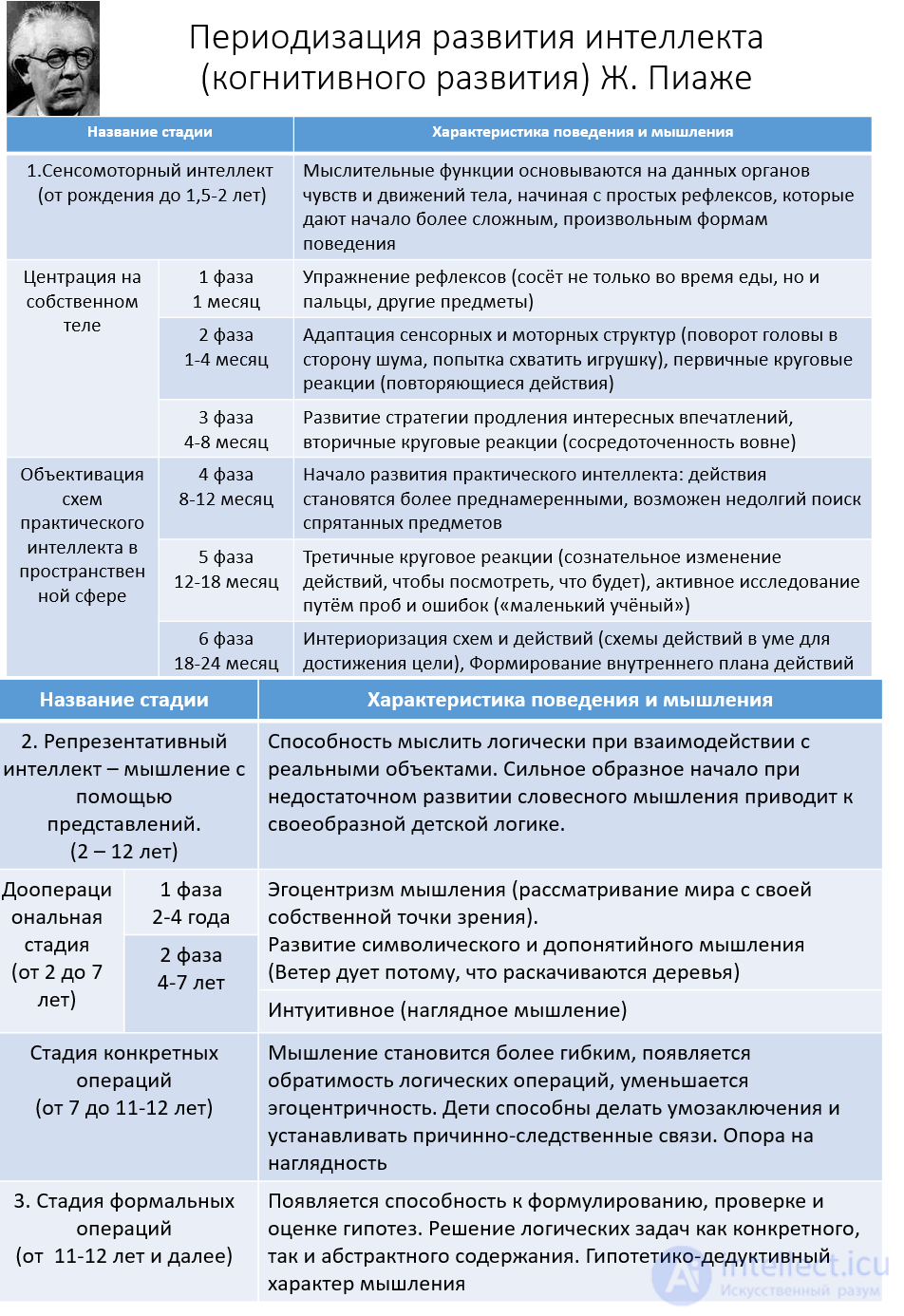
3. The cognitive approach (Jean Piaget): Jean Piaget developed a theory of cognitive development that emphasizes the importance of the child's active role in constructing their own knowledge and understanding of the world. He identified several stages of cognitive development, such as the sensorimotor, preoperational, concrete-operational and formal-operational stages.
4. The sociocultural approach (Lev Vygotsky): Vygotsky held that the development of a child's psyche occurs in the context of cultural and social interaction. He emphasized the importance of the zone of proximal development, that is, the level of development a child can reach with the support and guidance of a more experienced adult.
5. The ecological approach (Urie Bronfenbrenner): Bronfenbrenner proposed a model in which the development of a child's psyche is examined in the context of a system of interaction between the microsystem (family, school), the mesosystem (society, culture) and the macrosystem (the socio-historical context).
6. The evolutionary approach (James Mark Bolkhuizen): This approach is concerned with studying the evolution of the development of the psyche and mental processes in children. It holds that a child's psychic development can be viewed as the result of an evolutionary process that took shape over millions of years.
Each of these approaches and theories offers a unique perspective on the development of a child's psyche and explains it from a different point of view. In contemporary psychology, researchers often combine elements of different approaches for a fuller understanding of this complex process.
1. Leading activity – the activity in which:
2. The theoretical approach that views human development as maturation, the unfolding of hereditary data, is:
3. Russian (domestic) developmental psychology regards ... as the driving force of mental development:
4. The degree and indicators of a person's (child's) mental development in the course of, and at various stages of, the formation of their personality are called the … of mental development.
5. The system of a subject's relations to social reality that is specific to each age period, reflected in their experiences and realized by them in joint activity with other people, is:
6. The Russian psychologist who succeeded in establishing the existence of mediated needs of a conscious character, and in demonstrating that in the course of the development of the motivational-need sphere there occurs a liberation from the dictates of «natural» needs, was:
7. The principle of Russian (domestic) psychology – «Learning does not trail behind development but leads it forward» - was formulated by:
8. In L.S. Vygotsky's conception, age-related crises are viewed as:
9. The zone of proximal development (according to L.S. Vygotsky) is characterized as:
10. In the course of ontogeny, mental actions are formed through the process of:
11. Unstable, reversible developmental changes that require reinforcement and further practice are called:
12. The position that any psychological and behavioral traits, abilities and talents can be formed in any person, regardless of their innate characteristics, corresponds to the concept (theory) of:
13. A change expressed in quantitative and qualitative transformations of mental processes is called:
14. The basis for defining the psychological criteria of age-related development is:
15. The theory of convergence of two factors, equally significant for a child's mental development, was proposed by:
Learning elements: definitions of the concepts of age, the social situation of development, leading activity, and stable, critical and sensitive periods in human development; the main approaches to constructing periodizations of mental development in world psychology
Age is a chronological period of time that characterizes a person's biological and psychological status at a given stage of their life. Age can be measured in years, months or other units of time and serves as the basis for studying various aspects of human development.
The social situation of development: The social situation of development is the totality of sociocultural, family, educational and other factors that influence the development of the individual. This situation includes interaction with the environment, social roles, expectations and norms.
Leading activity: Leading activity is the primary sphere of activity or interest that determines an individual's psychological development at a given stage of their life. This may be schooling, play, work or another form of activity.
Stable periods in development: Stable periods are time intervals during which characteristic psychological features remain relatively constant. For example, stable periods may include the stable formation of personality in adulthood.
Critical periods in development: Critical periods are time intervals during which development can proceed most actively and readily. Developmental processes may be most sensitive to external influences during these periods. For example, critical periods in development may include the formation of basic speech skills in childhood.
Sensitive periods in development: Sensitive periods are time intervals during which an individual is more receptive to certain stimuli or experiences that may have a long-term effect on their development. These periods may be associated with the formation of particular skills or psychological characteristics.
The main approaches to constructing periodizations of mental development:
Age stages: This approach is based on dividing a person's life into particular age periods, such as childhood, adolescence, adulthood and old age. Each of these periods is assumed to have characteristic psychological features.
Structural approaches: These approaches focus on identifying changes in the structure of the psyche and in cognitive processes at different stages of development. Jean Piaget's theory of the stages of cognitive development is an example of such an approach.
Functional approaches: These approaches analyze changes in the functions and capacities of the psyche at different stages of development. The study of the development of intelligence is one example.
Contextual approaches: Contextual approaches take into account the role of the social and cultural environment in shaping mental development. Such approaches emphasize the importance of context in understanding an individual's development.
Combining different approaches and theories allows for a fuller understanding and explanation of human psychological development at different stages of life.
1. Brief periods of ontogeny characterized by abrupt psychological changes and belonging to the normative processes necessary for a person's progressive development are called:
2. Qualitative transformations of personality and psyche that arise at the end of each age stage are:
3. Symptoms such as negativism, stubbornness, obstinacy, willfulness, protest-rebellion, devaluation of adults and despotism are indicators of the crisis of:
4. Psychological reactions such as emancipation, «negative imitation», grouping, and hobby interests (the hobby reaction) arise at ... age.
5. The sense of adulthood is a psychological neoformation of ... age.
6. The period in which visual-active thinking and the initial forms of visual-figurative thinking are formed is:
7. Chronological age is determined by:
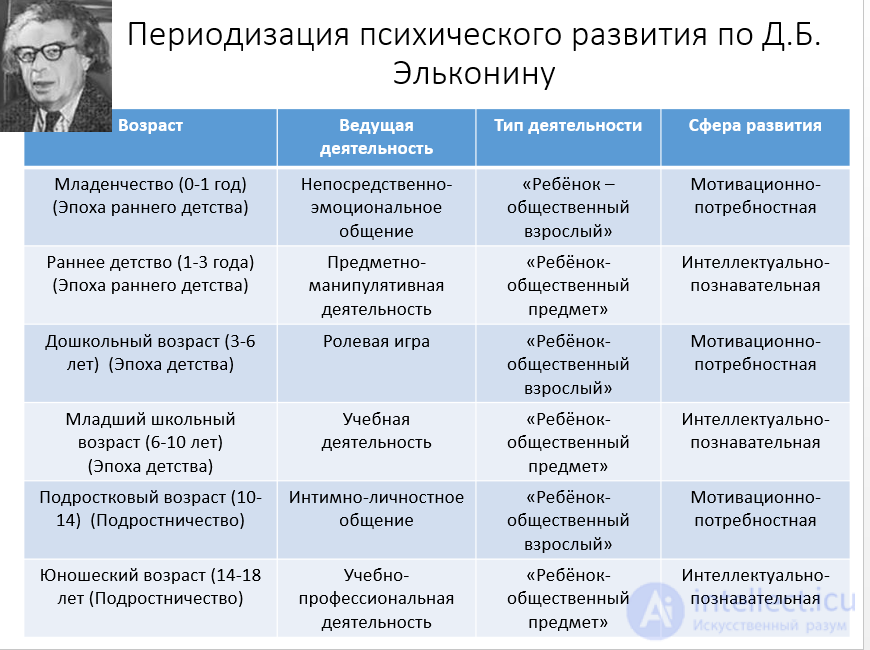
8. According to D.B. Elkonin's periodization, direct emotional communication serves as the leading activity in ... age.
9. The integral characteristic of the state of an organism, reflecting its degree of biological maturity and correspondence to average group characteristics, is called:
10. The author of the work «The Problem of Age in Psychology», in which various characteristics of age are identified, is:
11. The latency stage of mental development (according to S. Freud) corresponds to the age period:
12. According to Jean Piaget's theory, the process of incorporating a new object or a new problem situation into schemas of understanding and action the child already possesses is called:
13. According to D.B. Elkonin, preschool childhood is a period in which the ... sphere is predominantly developed.
14. The age periodization based on the development of intellectual structures was developed by:
15. According to S. Freud's psychoanalytic conception, the dominant factor determining mental development is:
Learning elements: the main neoformations, the leading type of activity, and the features of the social situation of development, of cognitive processes and of personality formation in infancy, early childhood and preschool age; the crisis of the newborn; the «revival complex»; the crisis of the first year; the crisis of age 3
Infancy (0-1 year):
Early childhood (1-3 years):
Preschool age (3-6 years):
Each of these developmental stages has its own unique characteristics and tasks, and they play an important role in shaping a person's personality and behavior in the future.
1. Visual and auditory concentration is a psychological neoformation of the period of:
2. The personal neoformation of the period of early childhood is:
3. The leading activity in preschool age is:
4. The syndrome of pathological child mental and personal development that appears in a child as a result of a «deficit» of communication and a lack of attention, love and care is:
Deviation — a departure from a norm, rule or standard. In psychology and sociology this can mean behavior that falls outside social expectations.
Hospitalism — a mental and physical condition that arises in children who spend a long time in a hospital or orphanage without sufficient emotional contact. It is characterized by developmental delay, apathy and attachment disorders.
Assimilation — the process of absorbing and adapting new knowledge, cultural norms or experience. In psychology — the incorporation of new information into existing thinking schemas; in sociology — an individual's or a group's adaptation to another culture.
Abulia — a pathological lack of will, expressed as an inability to make decisions and take actions even while retaining an understanding of the need for them.
5. Speech, object-oriented activity and walking are the three most important neoformations of:
6. A positive emotional attitude toward the surrounding world that forms in a child in early childhood given a psychological atmosphere of love, warmth and support from adults is:
7. The sign-symbolic function of consciousness is formed:
8. The type of activity in which children, in make-believe situations, reproduce a particular sphere of adults' activity and communication, is:
9. A child plays alone («alongside, but not together»), reproducing the actions of adults that he observes in life, at:
10. The contradiction the child experiences between increased independence and the old forms of communication with adults is the cause of the crisis of:
11. A neoformation of preschool age is:
Subordination of motives is the process of weighing a question from several angles when a decision must be made. In this process each motive is assessed independently against different selection criteria, and the more important one is chosen
12. The leading activity in early childhood is:
13. The extra-situational-personal form of a child's communication with an adult is typical of … years.
14. Contact between the child and the mother immediately after birth is important for the formation of:
15. The social situation of development in early childhood takes the form:
Learning elements: the main neoformations of age 7, the leading type of activity, features of the social situation of development, of cognitive processes, of the primary-school child's personality formation, manifestations of the crisis of age 7
The main neoformations at age 7:
Development of abstract thinking: At age 7 children begin to develop the capacity for more abstract and logical thinking. They become able to solve more complex problems and analyze information.
Expansion of vocabulary: At this age children actively expand their vocabulary and begin to use language in speech and writing in a more advanced way.
Development of social skills: Children begin to develop more complex social skills, such as the ability to work in a team, resolve conflicts and understand other people's emotions.
Leading type of activity:
For children aged 7, the leading type of activity can become schooling and learning, since they begin attending school and actively studying various subjects. Learning activity becomes more structured and oriented toward mastering new knowledge and skills.
Features of the social situation of development:
Introduction into the school environment: Children start attending school and enter a new social environment, where they learn to interact with teachers and peers.
Expansion of the circle of communication: Children aged 7 can take part in various extracurricular activities and clubs, which allows them to broaden their circle of communication.
Cognitive processes:
Learning activity: Children begin to learn to read, write, solve mathematical problems and study other subjects.
Development of critical thinking: Age 7 is characterized by the development of the capacity to analyze and evaluate information.
Formation of the primary-school child's personality:
Development of self-esteem: Children begin to form ideas about themselves and their abilities.
Formation of moral values: At this age children begin to develop an understanding of society's moral norms and values.
Manifestations of the crisis of age 7:
The crisis of age 7 can manifest itself through both internal and external changes in the child's behavior. Some manifestations may include:
The crisis of age 7 is a period of adaptation to new learning and social conditions, and how it unfolds can differ for each child. It is important to support children and help them cope with new challenges.
1. Voluntary control of behavior and mental activity is a psychological neoformation at ... age.
2. An indicator of intellectual readiness for schooling is:
3. A component of a child's psychological readiness for school is ... readiness.
4. The formedness of cognitive processes belongs to the ... component of psychological readiness for school.
5. The formedness of the ability to communicate with adults and peers belongs to the ... component of psychological readiness for school.
6. The formedness of adequate self-esteem belongs to the ... component of psychological readiness for school.
7. The formedness of persistence and purposefulness belongs to the ... component of psychological readiness for school.
8. A neoformation of primary-school age is:
9. The age period sensitive for the development of will is ... age.
10. The leading type of activity of the primary-school child is:
11. For the social situation of development of children of primary-school age the main line is:
12. The need for socially significant and socially evaluated activity is a neoformation of the crisis of:
13. The type of thinking that develops predominantly in primary school and allows the pupil to solve problems by relying on the internal, essential properties and relations of objects is called:
14. One of the authors of the theory of developmental instruction worked out in Russian psychology is:
Daniil Borisovich Elkonin (16 February 1904 or 1 March 1904, Malaya Pereshchepina, Poltava Governorate — 4 October 1984, Moscow) — a Soviet psychologist and educator, author of an original line of research in child and pedagogical psychology. Candidate of Pedagogical Sciences (1940), Doctor of Psychological Sciences (1962), corresponding member of the USSR Academy of Pedagogical Sciences (1968). Of great importance was the periodization developed by Elkonin, in which he distinguished two sides of activity — the cognitive and the motivational. These sides exist within every leading activity, but they develop unevenly, alternating in their pace of development at each age period.
15. Signs of the crisis of age 7:

Learning elements: the main neoformations, the leading type of activity, features of the social situation of development, of cognitive processes, of personality formation in adolescence and youth
The main neoformations in adolescence and youth:
Formation of identity: Adolescents begin to search for answers to questions about their personality, values and life beliefs. This is the time when they actively form their identity and begin to determine who they are.
Development of abstract and critical thinking: Adolescents become able to think abstractly and analyze information more deeply. They can see multiple points of view and reflect on the consequences of their decisions.
Social awareness: Adolescents begin to recognize their role in society and develop social skills, such as the ability to interact with different people and resolve conflicts.
Formation of a future orientation: At this time adolescents begin to think about their future, choice of profession and education.
Leading type of activity:
For adolescents and young people, the leading type of activity can be the process of personality formation and self-identification. They actively explore themselves and the world around them, striving to understand who they want to become and what values matter to them.
Features of the social situation of development:
Cognitive processes:
Personality formation:
Manifestations of the crisis of adolescence:
The crisis of adolescence is a normal stage of development that helps adolescents move from childhood to adult life, but it requires support and guidance from adults.
1. According to D.B. Elkonin's periodization, intimate-personal communication is the leading type of activity at ... age.
2. The cognitive processes of an adolescent develop predominantly in:
3. Professional and moral self-determination is a psychological neoformation at ... age.
4. The subjective experience of an adolescent who wants to be regarded as a full-fledged member of society, expressed in a striving for independence and in defending one's own point of view, is called:
5. The system of views on the objective world and the place of the human being in it that takes shape in senior pupils is called:
6. The leading type of activity of an adolescent is:
7. A neoformation of adolescence is:
8. One of the causes of the adolescent's pubertal crisis is:
9. Personality development in youth is determined predominantly by the process of:
10. The central psychological neoformation of youth is:
11. The main difference characterizing relations with peers in youth compared with adolescence is:
12. A combination of a critical attitude toward one's past self and an orientation toward the future is typical of ... age.
13. The motives of learning activity in adolescence are determined chiefly by:
14. The leading activity in youth is:
15. Among the psychological neoformations of early youth is:
Learning elements: features of the social situation of development, of cognitive development, of self-awareness, of an adult's professional and personal self-determination; the crisis of maturity; the problems of old age and aging
Features of the social situation of an adult's development:
Family and marital relations: Adults most often have families and marital relations. Over time they may face challenges related to raising children and maintaining family relationships.
Work and career: Adults actively engage in work activity, build a career and develop their professional skills.
Social ties: With age, various social ties take shape, including friendship, communication with colleagues and participation in public events.
Caring for parents and older generations: Adults may face the task of caring for aging parents or relatives.
Features of cognitive development:
Preservation and deepening of cognitive abilities: Adults continue to develop their cognitive abilities, including analytical thinking, memory and the ability to solve complex problems.
Accumulation of knowledge: Adults accumulate experience and knowledge, which can contribute to more effective decision-making.
Abstract thinking: They are capable of abstract and critical thinking, which allows them to analyze complex issues.
Features of self-awareness:
Formedness of personal identity: Adults usually have a more stable sense of their own personality and identity.
Assessment of the past and the future: They can review their achievements and failures in the past and make plans for the future.
Self-understanding: With age they come to understand their strengths and weaknesses, as well as their values and beliefs, better.
Features of professional and personal self-determination:
Professional development: Adults may reconsider their professional goals and make career choices.
Personal self-determination: They may reconsider their life priorities and aspirations.
Self-acceptance and life satisfaction: An important aspect is assessing one's life and achieving satisfaction in important spheres.
The crisis of maturity:
The crisis of maturity (or midlife crisis) can manifest itself in doubts and a reconsideration of life priorities. This is a time when people may reconsider their professional and personal goals, and also face emotional stress.
The problems of old age and aging:
With age, physical and psychological problems related to aging may arise, such as a decline in health, reduced physical activity and diminished cognitive abilities. Aging can also trigger a reconsideration of life priorities and adaptation to new conditions. It is important to provide support and care for the aging generation in order to ease this period of life.
1. Traditionally, the following boundaries are used to denote old age:
2. The age boundaries of the midlife crisis:

3. The intensification of the conflict between involutional and evolutional processes is typical of ... age.
4. The crisis that promotes the development of self-knowledge and self-actualization is typical of ... age.
5. Activity and personality orientation combined with a developed self-awareness in the structure of the «self-concept» are the most important characteristics of a ... personality.
6. The Russian psychologist, founder of the school for the study of the mature personality, who gave a new assessment of maturity as a stage of a person's ontogenetic development:
7. The crisis of maturity:
8. The feeling of inner unity, based on satisfaction from a person's summing-up of his life and its perception as a single whole, is:
9. The most typical mental state in old age is:
10. «Verbal» intelligence on the whole remains at its former level, while «nonverbal» intelligence shows a tendency to decline - this is typical of the cognitive sphere of ... age.
11. The mental health of an aging person is determined by his involvement in:
12. The exercise of a person's individual right to a voluntary death (mercy killing) is denoted by the term:
13. Fear of death is a … property of the human psyche.
14. An expert system of knowledge oriented toward the practical side of life, according to research by P. Baltes's school, is:
15. Old age is a period whose characteristic feature is:
|
No. |
Name of the didactic unit |
1 |
2 |
3 |
4 |
5 |
6 |
7 |
8 |
9 |
10 |
11 |
12 |
13 |
14 |
15 |
|
3.1. |
Introduction to developmental psychology |
d |
a |
c |
d |
a |
d |
a |
d |
b |
a |
b |
d |
a |
c |
a |
|
3.2. |
Theories and laws of mental development |
a |
c |
d |
a |
d |
b |
d |
b |
a |
d |
c |
a |
c |
a |
d |
|
3.3. |
Periodizations of mental development |
a |
c |
b |
c |
d |
b |
c |
a |
b |
c |
b |
d |
a |
b |
d |
|
3.4. |
Mental development of children from birth to age 6 |
d |
c |
a |
b |
c |
b |
d |
c |
a |
b |
a |
c |
d |
a |
b |
|
3.5. |
Psychological development of the primary-school child |
d |
a |
c |
b |
a |
b |
d |
c |
a |
d |
a |
c |
d |
a |
b |
|
3.6. |
Psychological development in adolescence and youth |
a |
c |
a |
b |
d |
a |
c |
a |
b |
d |
c |
d |
c |
b |
a |
|
3.7. |
The psychology of adulthood and old age |
b |
b |
c |
a |
c |
b |
d |
c |
a |
d |
a |
c |
b |
c |
a |

Comments