
Lecture
The NEET generation (Not in Education, Employment or Training) or the ni-ni generation (Spanish: ni estudia, ni trabaja) refers to a generation of young people who, due to various economic, social, or political factors, are neither working nor studying. The acronym NEET was first used in the United Kingdom at the end of the 20th century, but it subsequently became widely used in other countries as well, for example in Japan and in Latin American countries.
NEET should also be distinguished from the relatively recently introduced term NLFET (Neither in the Labour Force nor in Education or Training), which was used in the International Labour Organization's report «Global Employment Trends for Youth 2013». The main difference is that NLFET excludes unemployed young people who are part of the labor force from the statistics.
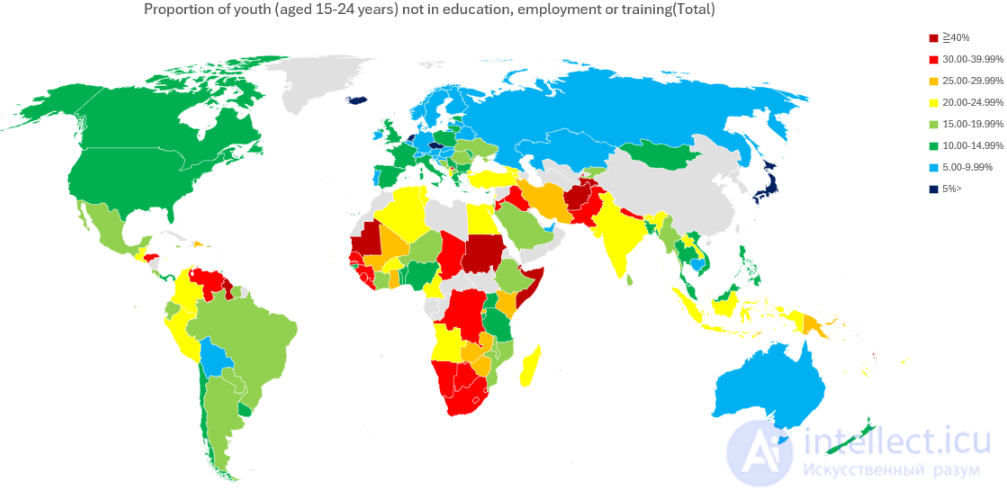
The term was initially used by the UK government and only later spread throughout the world. In Spanish-speaking countries, instead of NEET, the exactly equivalent term Nini or Ni-Ni is much more commonly encountered.
Several causes underlie the emergence of the NEET phenomenon at once. Among them are causes at the macro level (features of a country's society, its education system, general working conditions), at the meso level (particular schools or firms), and at the micro level (problems of a specific individual). In Europe, the focus tends to be on two main causes behind the emergence of an entire NEET generation:
Members of the NEET generation are usually divided into two large groups: those who will soon return to work in the near future, and those who have no plans to look for work in the foreseeable future.
Reiko Kosugi, a leading labor market expert at Japan's Ministry of Health, Labour and Welfare, identifies four types of NEET:
One of the main critics of the NEET concept was Sara Elder, an employee of the International Labour Organization. In a working paper titled «What does NEETs mean and why is the concept so easily misinterpreted?», published in January 2015, Sara Elder rather sharply criticizes the new term, arguing that its use leads to genuine chaos in youth employment research.
According to the ILO staffer, the NEET concept reflects the potential vulnerability of entire segments of the young population, namely issues of unemployment, early school leaving, and low motivation in the labor market. For a long time the term NEET did not attract researchers' attention, but by 2015 it was already appearing in sustainable development reports, underscoring its significance. However, there are a great many incorrect opinions regarding this concept.
First and foremost, Sara Elder emphasizes that there is no single unified approach to the NEET concept. This fact alone already complicates the work of researchers studying the phenomenon. Moreover, as Elder notes, many countries do not use NEET as a criterion for the youth unemployment indicator, and unemployment statistics as a whole are largely closed and inaccessible to analysts. As such, NEET is a rather raw concept, adopted by only a small number of states and one that has not found support among developing countries.
In total, Elder believes, more than 10 different definitions of NEET are in circulation around the world. And that's without even taking national perspectives on the concept into account. Although, according to the ILO worker, each definition is broadly correct in essence, each has a number of significant shortcomings in the details. For instance, the SDSN (Sustainable Development Solutions Network) emphasizes type of work, even though, as Sara Elder points out, the NEET concept gives no indication whatsoever of what a given person is actually doing. Sara Elder also criticizes the conflation of concepts, namely attempts to equate the NEET concept with several other categories, specifically: people who have stopped looking for work, the unemployed, and marginalized individuals.
In effect, in her work Sara Elder tries to make the point that the term NEET is too complicated and adds further confusion to what is already a rather complex terminology in the field of the labor market in general and unemployment in particular. Certainly, in an ideal world the NEET concept could allow the problem of youth employment to be viewed from a different angle, but at the current stage, in the ILO worker's opinion, it would be far better to abandon the NEET concept and use other categories to assess youth unemployment instead. First, to focus attention on the education problem, it is worth using a separate criterion, namely NLFET, which covers only the 15-to-19 age category. To focus attention on youth unemployment, one can, in Sara Elder's view, simply use the standard unemployment rate. Finally, to try to study the issue of at-risk youth — that is, those working in semi-legal business or under extremely poor conditions — a separate index should be developed, namely the so-called «informal unemployment rate». This, according to the ILO worker, would allow the problem of youth employment to be studied in a far more detailed and effective way. The NEET concept, by contrast, tries to generalize the problem, which prevents researchers from getting to the root causes of the phenomenon.
The word NEET was first used in 1999 in a report published by the Social Exclusion Unit (SEU). Previously in the United Kingdom a similar phenomenon was called «Status Zero». Despite the fact that a number of government reports provide a definition of the term NEET, the acronym has no established classification criteria as such. And whereas the NEET problem was initially approached purely from a scientific point of view, this social group gradually came to be viewed in a negative light.
NEET statistics for England are published by the UK Department for Education. The data-collection methodology for NEET differs depending on the age group. For Britons aged 16 to 18, several methods are applied at once. For the 16-to-24 age group, Labour Force Survey data is used. The different approaches are explained by the fact that a significant proportion of young people under 18 have not yet completed secondary education and therefore may, at the very least, not be interested in looking for work.
According to a 2007 Prince's Trust report, around 20% of Britons aged 15 to 24 are NEET. In the period from 1995 to 2008, the number of young people who could be classified in this social group remained steadily at around 10%. In 2011 The Guardian published an article stating that since 2003 the number of employed Britons aged 16-18 had fallen by 16%, while the number of those involved in education had risen by 7%. Some media outlets began to associate the word NEET with antisocial elements. For example, a number of British media outlets have repeatedly claimed that members of the NEET generation are far more prone to committing crimes.
The UK government has been making every effort to solve the NEET problem. In 2007 the government introduced the so-called «September Guarantee», which guaranteed every UK citizen a place in an educational institution until they came of age, that is, until 18. Additional guarantees for the country's young population were included in the 2009 budget. These provided a job, upskilling courses, or an internship to any Briton aged 18 to 24 who had been registered as unemployed at the job center for more than six months. These guarantees came into force on 25 January 2010, but were already scrapped by 2012.
It is quite difficult to judge the effectiveness of these government measures, since the number of NEETs among Britons aged 16 to 24 exceeded 17% in 2011. In other words, no significant progress has been achieved compared to the start of the 21st century. At the same time, it is specifically emphasized that not all the blame should be placed on the 2007–2008 economic crisis and the prolonged recession that followed. In the UK itself, it is believed that the NEET problem is linked to an outdated education system and profound transformations in the labor market.
In Japan the term NEET caught on quite quickly, since it captured a new social phenomenon for the country very concisely and clearly. As in European countries, NEET in Japan refers to people, mostly young people, who prefer to go for long periods without working or studying anywhere. They mostly live off their parents, onto whose shoulders it is easy and simple to shift the entire burden of their own material and everyday problems. NEET usually includes able-bodied Japanese aged 15 to 34.
Andy Furlong, a professor at the University of Glasgow, links the rise of NEET in Japan to the financial bubble of the 1980s and the subsequent recession of the 1990s, from which Japan has essentially been unable to escape to this day. It was precisely then, in the academic's view, that Japan's young population was sharply confronted with the growing problem of unemployment, which led to an increase in the number of NEETs.
Genda Yuji, a professor at the University of Tokyo, argues that NEETs often show a desire to work, but simply cannot even get through a job interview due to a lack of self-confidence, a shortage of social skills, and a low level of qualification. The problem is further aggravated by the Japanese media, which portray an extremely negative image of NEETs.
In order not to leave the parental home, NEETs often do not even start families. On average, NEETs make up about 10% of the country's entire working population.
They are also sometimes called «parasite singles». This term was first used by Yamada Masahiro, a sociologist and professor at Gakugei University. Nevertheless, what distinguishes «parasites» from NEETs is that the former have jobs. «Parasites» earn their own living, but nonetheless leave their parents' home very late. A similar phenomenon can also be found in South Korea, Italy, and other Southern European countries.
Socialization problems can also lead to more serious consequences, such as voluntary self-isolation, which in Japan is known as «hikikomori». This term was coined by the psychologist Saito Tamaki, who claims that approximately 20% of young Japanese people (about 1% of the country's population) really do spend years shut away in their own rooms.
The Japanese government is quite seriously concerned about the NEET problem, and so, back in 2004, it developed a program under which schools teach a separate subject that helps students better understand what to do next after finishing school. Tokyo also actively encourages the establishment of working relationships with universities, as well as any projects that help develop students' social skills.
The topic of NEET has become so relevant for Japanese society that it has gradually come to be actively explored in Japanese literature (manga and light novels), whose main audience is precisely the 15-to-34 age group. The most prominent representative of this genre is NHK ni Youkoso!, which reveals the harmfulness of a typical NEET's lifestyle. Among more recent works, one can single out Higashi no Eden and ReLife, which likewise try, in their own way, to convey to the audience the need for socialization within society.
According to an OECD report, around 580,000 Australians can be classified as NEET. The document also notes that the number of NEETs in the country rose sharply after the global financial crisis of 2007–2008, and that the total number of NEETs is now around 13% of all Australian residents aged 15 to 28.
In Spain, Mexico, Argentina, and Uruguay the term «Ni-Ni» has become widespread — an abbreviation of the Spanish phrase «La generación Ni-Ni: los que ni estudian ni trabajan» (the generation of those who neither study nor work, doing neither one nor the other). In Portugal and Brazil there is a similar concept, «Nem-Nem». In Mexico this problem is especially relevant, since, as observations in Mexico show, it is precisely the «ni-ni generation» that turns out to be most susceptible to the harmful influence of drug cartels and becomes actively involved in drug trafficking and crime.
Statistics Canada first conducted a study of the NEET problem in Canada in 2012. It turned out that around 13% of Canadians aged 15 to 29 could be classified in this social category. Although, as the report states, this is the lowest rate among the G7 countries, the total number of NEETs in Canada exceeds one million people. The study also found that about 513,000 Canadian NEETs are not interested in looking for work.
In Russia, too, there is no single unified view of this term. Thus, according to A. Sh. Zhvitiashvili, a leading researcher in the department of social structure at the Institute of Sociology of the Russian Academy of Sciences, the emergence of the NEET generation, which in the 21st century makes up a noticeable segment of developed societies, indicates a contraction of the forces of hired labor and a strengthening role for non-market groups in society whose existence depends on state social welfare policy. At the same time, from the academic's point of view, the dominant demographic group within NEET is young people aged 15 to 29. Zhvitiashvili links this to problems in obtaining education and work. Also drawing on the work of Western researchers, Zhvitiashvili notes that NEET is a product of globalization, and that this social group's reproduction occurs due to periodic economic crises, especially the global financial crisis of 2008. This same position is held by Yu. R. Vishnevsky, a doctor of philosophical sciences, who believes that Russian society will inevitably face similar problems in the near future. As for the statistics, the share of NEETs among young people fluctuates around 15%.
A similar social phenomenon exists in the USA, where these people are called «basement dwellers». The Telegraph Herald reported in 2010 that, since the end of 2007, the number of NEETs in the US had increased by 20%. For the most part, these are people who have just finished their education. They are also sometimes called «sadgrads» (short for «sad graduate», a young person experiencing depression due to their lack of employment). Sociologists note that, as a rule, these graduates have not yet paid off their education debts (education in the US being quite expensive) and live with their parents, since they cannot afford to rent or buy their own housing. As far back as 2002 there were forecasts that 36% fewer graduates would find work than in the previous year. After 2007, when the global economic crisis broke out, the situation continued to worsen. Moreover, rising tuition costs are forcing many young people to forgo higher education, which may also contribute to failures in further socialization.
In 1995 the «Leonardo da Vinci» program supported transnational mobility, skills, and employment. The program was extended until 2013.
In 2021 the European Commission launched the ALMA social inclusion initiative («Aim, Learn, Master, Achieve») to ease the transition from NEET status to education and employment. ALMA provides individualized training for adults under 30 in their own country, and learning and mentoring opportunities in another EU country for a period of 2–6 months. It operates in conjunction with the EURES network and in cooperation with businesses, youth organizations, and training centers. The scheme began as a German government initiative called Integration durch Ausbildung (IdA) in 2008.
In Spain, Mexico, Argentina, Chile, Peru, and Uruguay the term ni-ni («neither-nor») has become a widely used equivalent of the term NEET. It stands for ni estudia, ni trabaja («neither studies nor works»). In Portuguese there is an equivalent term, nem-nem.
This term has become a subject of controversy in Mexico, where the government believes that people who could be classified as NEET more often join drug-trafficking organizations to meet their economic and personal needs than to look for work or study. Some states and organizations in Mexico are creating employment programs and scholarships to shield the NEET population from drug cartels.
According to World Bank estimates, in Latin America and the Caribbean one in five people aged 15 to 24 is a nini — a total of 20 million, 2 million more than in 1992. A 2016 study notes that two-thirds of ninis are women, mainly due to early marriage, teenage pregnancy, or both. It is noted that the number of male ninis has increased by 46% since 1992; men account for the entire growth in the region's nini population. Male ninis usually drop out of school to work low-paying jobs, and during periods of economic instability they lose their jobs, with virtually no chance of returning to school.
In Mexico, according to statistics, ninis account for at least a quarter of the increase in homicides in high-crime areas in the period from 2007 to 2012, though in low-crime areas no link is observed between ninis and the crime rate. The World Bank noted that, as of 2010, the number of ninis in Latin America and the Caribbean was somewhat below the world average, but significantly higher than in higher-income countries. On a global scale, of the 260 million ninis counted by the World Bank in 2010, the largest share was in the regions of the Middle East, North Africa, and South Asia. [35]

Comments