
Lecture
Social stress – is stress that arises from a person's relationships with other people and from the social environment as a whole. According to appraisal theory of emotion, stress occurs when a person appraises a situation as personally relevant and recognizes that they lack the resources to cope with it.
The activation of social stress is not necessarily tied to some specific event; the mere thought that such an event might occur can trigger it. This means that any factor that pulls a person out of their personal and intimate surroundings can become a stressful experience. Such a situation renders the person socially incompetent.
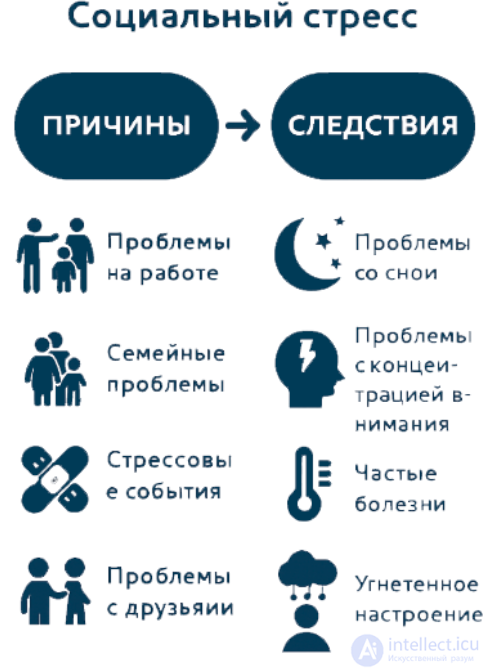
There are three main categories of social stressors. Life events are defined as abrupt, serious changes in life that require a person to adapt quickly (for example, sexual assault, sudden trauma). Chronic stressors are defined as persistent events that require a person to adapt over an extended period of time (for example, divorce, unemployment). Daily hassles are defined as minor events that occur and require adaptation within the course of a day (for example, traffic jams, disagreements). When stress becomes chronic, a person experiences emotional, behavioral, and physiological changes that can increase the risk of developing a mental disorder and physical illness.
Humans are social creatures by nature, as they generally have a fundamental need and desire to maintain positive social relationships. Accordingly, they typically regard maintaining positive social bonds as beneficial. Social relationships can offer care, foster a sense of social inclusion, and lead to reproductive success. Anything that disrupts or threatens to disrupt their relationships with others can lead to social stress. This can include low social status in society or in particular groups, giving a speech, interviewing with prospective employers, caring for a child or spouse with a chronic illness, meeting new people at a party, the threat or actual death of a loved one, divorce, and discrimination. Social stress can arise from the microenvironment (for example, family ties) and the macroenvironment (for example, a hierarchical social structure). Social stress tends to be the most frequent type of stressor that people encounter in everyday life, and it affects people more strongly than other types of stressors.
Researchers define social stress and social stressors in different ways. Uhdman, Durkin, and Conti-Ramsden (2011) defined social stress as «feelings of discomfort or anxiety that people may experience in social situations, and the associated tendency to avoid potentially stressful social situations». Ilfeld (1977) defined social stressors as «circumstances of everyday social roles that are generally considered problematic or undesirable». Dormann and Zapf (2004) defined social stressors as «a class of characteristics, situations, episodes, or behaviors related to psychological or physical strain and of a social nature».
Social stress is typically measured using self-report questionnaires. In laboratory settings, researchers can induce social stress using a variety of methods and protocols.
Several questionnaires are used to assess environmental and psychosocial stress. Such self-assessment instruments include the Test of Negative Social Exchange, the Marital Adjustment Test, the High-Risk Family Questionnaire, the Holmes-Rahe Stress Inventory, the Trier Inventory for the Assessment of Chronic Stress, the Daily Stress Inventory, the Job Content Questionnaire, the Perceived Stress Scale, and the Stress and Adversity Inventory.
In addition to self-report questionnaires, researchers may use structured interviews. The Life Events and Difficulties Schedule (LEDS) is one of the most popular instruments used in research. The purpose of this type of measure is to encourage the participant to describe in detail the stressful events in their life, rather than simply answering isolated questions. The UCLA Life Stress Interview (LSI), similar to the LEDS, includes questions about romantic partners, closest friends, other friendships, and family relationships.
In rodent models, social disruption and social defeat are two common paradigms of social stress. In the social disruption paradigm, an aggressive rodent is placed in a cage with males that have already established a natural social hierarchy. The aggressive «intruder» disrupts the social hierarchy, causing social stress in the cage's residents. In the social defeat paradigm, an aggressive «intruder» and another non-aggressive male rodent fight.
In human studies, the Trier Social Stress Test (TSST) is widely used to induce social stress under laboratory conditions. In the TSST, participants are told that they must prepare and deliver a speech about why they would be an excellent candidate for their ideal job. The experimenter films the participant while speaking and informs them that their speech will be evaluated by a panel of judges. After the public speaking phase, the experimenter has the subject perform a math task that involves counting backward by a specific increment. If the participant makes a mistake, the experimenter has them start over. The threat of negative evaluation is a social stressor. Researchers can measure the stress response by comparing salivary cortisol levels before and after the stressor. Other common stress measures used in the TSST are self-report measures, such as the State-Trait Anxiety Inventory, and physiological measures, such as heart rate.
In a laboratory conflict discussion, couples identify several specific areas of conflict in their relationship. They then select several topics for further discussion during the experiment (for example, finances, child-rearing). Couples are asked to discuss the conflict(s) for 10 minutes while being videotaped.
Brouwer and Hogervorst (2014) developed the Sing a Song Stress Test (SSST) to induce stress under laboratory conditions. After viewing neutral images followed by 1-minute rest periods, the participant is told that they will need to sing a song at the end of the next 1-minute rest period. Researchers found that skin conductance and heart rate were significantly higher during the interval after the announcement of the song than during the preceding 1-minute intervals. Stress levels are comparable to those induced in the Trier Social Stress Test. In 2020, a systematic review of the TSST provided several recommendations for standardizing the use of the TSST across different studies
A statistical indicator of stress — the simultaneous increase in variance and correlations — has been proposed for diagnosing stress and has been used successfully in physiology and finance. Its applicability for the early diagnosis of social stress in large groups has been demonstrated through the analysis of crises. It was studied over a prolonged period of stress preceding the Ukrainian economic and political crisis of 2014. A simultaneous increase in the overall correlation among 19 major public fears in Ukrainian society (by approximately 64%), as well as in their statistical variance (by 29%), was observed during the pre-crisis years.
The risk of developing clinical depression significantly increases after experiencing social stress; people with depression often experience interpersonal losses before becoming depressed. One study found that depression developed roughly three times faster in people with depression who had been rejected by others than in those who experienced stress unrelated to social rejection. Several studies have shown that unemployment roughly doubles the risk of developing depression. In non-clinically-depressed populations, people whose friends and family members make excessive demands, criticize, and create tension and conflict tend to have more symptoms of depression. Conflict between spouses leads to greater psychological distress and depressive symptoms, especially in wives. In particular, unhappy married couples are 10–25 times more likely to develop clinical depression. Similarly, social stress arising from discrimination is associated with more pronounced depressive symptoms. In one study, African Americans and non-Hispanic whites reported on their daily experiences of discrimination and depressive symptoms. Regardless of race, those who perceived greater discrimination had more pronounced depressive symptoms. In 2016, Posselt and Lipson found that students had a 37% higher risk of developing depression if they perceived their academic environment as highly competitive.
The biological basis of anxiety disorders is rooted in the repeated activation of the stress response. Fear, which is the defining emotion of an anxiety disorder, arises when someone perceives a situation (a stressor) as threatening. This activates the stress response. If a person has difficulty regulating this stress response, it may become activated inappropriately. Thus, stress can occur when there is no actual stressor present or when something is not actually threatening. This can lead to the development of an anxiety disorder (panic attacks, social anxiety, OCD, etc.). Social anxiety disorder is defined as the fear of being judged or evaluated by others, even when no such threat actually exists.
Research shows a link between social stress, such as traumatic life events and chronic tension, and the development of anxiety disorders. A study examining a subpopulation of adults, both young and middle-aged, found that those diagnosed with panic disorder in adulthood had also experienced sexual abuse in childhood. Children who experience social stressors such as physical and psychological abuse, as well as the loss of a parent, are also at greater risk of developing anxiety disorders in adulthood than children who did not experience such stressors.
In 2016, an analysis of 40,000 students from 70 institutions conducted by Posselt and Lipson found that they were 69% more likely to develop anxiety if they perceived their learning environment as highly competitive.
Social stress arising in early life can have psychopathological effects that develop or persist into adulthood. One longitudinal study found that children are more likely to suffer from mental disorders (for example, anxiety, depression, disruptive, personality, and substance use disorders) in late adolescence and early adulthood when their parents exhibit more maladaptive parenting behaviors (for example, loud arguments between parents, verbal abuse, difficulty controlling anger toward the child, lack of parental support or availability, and harsh punishment). The child's temperament and the parents' mental disorders do not account for this association. Other studies have documented strong links between children's social stress in the family environment and depression, aggression, antisocial behavior, anxiety, suicide, and hostile, oppositional, and delinquent behavior.
Social stress can also exacerbate existing psychopathological conditions and jeopardize recovery. For example, patients recovering from depression or bipolar disorder are twice as likely to experience relapse if there is tension in the family. People with eating disorders are also more likely to relapse if their family members make more critical remarks, are more hostile, or are overinvolved. Similarly, outpatients with schizophrenia or schizoaffective disorder show more pronounced psychotic symptoms if the most influential person in their life is critical, and are more prone to relapse if there is tension in their family relationships.
With regard to substance abuse, people with cocaine dependence report increased cocaine cravings after exposure to a social stressor. Traumatic life events and social stressors can also trigger the worsening of mental disorder symptoms. Children with social phobia who experience a stressful event may become even more withdrawn and socially inactive.
Research has also revealed a close relationship between various social stressors and aspects of physical health.
Social status, a macro-social stressor, is a reliable predictor of death. In a study of more than 1,700 British civil servants, socioeconomic status (SES) was inversely related to mortality. Those with the lowest SES have worse health outcomes and higher mortality rates than those with the highest SES. Other studies have replicated this relationship between SES and mortality across a range of diseases, including infectious, digestive, and respiratory diseases. A study examining the relationship between SES and mortality among older adults found that education level, household income, and occupational prestige were associated with lower mortality in men. In women, however, only household income was associated with lower mortality.
Similarly, social stressors in the microenvironment are also associated with increased mortality. A longitudinal study covering nearly 7,000 people found that socially isolated individuals had a higher risk of death from any cause. [
Social support, defined as «comfort, assistance, and/or information received through formal or informal contacts with individuals or groups», is associated with physical health outcomes. Research shows that three aspects of social support — having attachments, perceived social support, and frequency of social interactions — can predict mortality thirty months after assessment.
Social stress also makes people more likely to become ill. People who have fewer social contacts are at greater risk of developing diseases, including cardiovascular disease. The lower a person's social status, the higher the likelihood of developing cardiovascular, gastrointestinal, musculoskeletal, tumor-related, pulmonary, renal, or other chronic diseases. These associations are not explained by other, more traditional risk factors such as race, lifestyle, age, sex, or access to healthcare.
In one laboratory study, researchers interviewed participants to determine whether they were experiencing social conflict with spouses, close family members, and friends. They then exposed the participants to a cold virus and found that participants with conflictual relationships were twice as likely to develop a cold as those without such social stress. Social support, especially in terms of buffering socioeconomic stressors, is inversely related to physical morbidity. A study examining the social determinants of health in urban slums in India found that social isolation, stress, and lack of social support are significantly associated with diseases such as hypertension, coronary heart disease, and diabetes.
Students who are bullied may show signs of depression, declining academic performance, worsening sleep quality, and anxiety disorders.
Exposure to social stress in childhood can also have long-term consequences, increasing the risk of developing disease later in life. In particular, adults who were mistreated (emotionally, physically, sexually abused, or neglected) in childhood report a greater number of disease outcomes, such as stroke, heart attack, diabetes, and hypertension, or greater severity of these outcomes. The Adverse Childhood Experiences (ACE) Study, which included more than seventeen thousand adults, also found that the likelihood of cardiovascular disease increased by 20% for each type of chronic family social stressor experienced in childhood, and this was not accounted for by typical cardiovascular risk factors such as demographics, smoking, exercise, obesity, diabetes, or hypertension.
Social stress is also associated with worsening health in patients already suffering from an illness. Patients with end-stage renal disease had a 46% higher mortality risk with a more negative attitude toward their spouse, even after accounting for disease severity and treatment. Similarly, women who had suffered an acute coronary event were three times more likely to have a recurrent coronary event if they had moderate or severe marital problems. This result held even after accounting for demographics, lifestyle, and disease status.
With regard to HIV/AIDS, stress can affect the progression of the virus into disease. Studies show that HIV-positive men who experienced more negative life events, social stress, and lack of social support progress to a clinical AIDS diagnosis faster than HIV-positive men whose level of social stress is not as high. For HIV-positive women who are also infected with the herpes simplex virus, stress is a risk factor for genital herpes outbreaks.
Social stress leads to a number of physiological changes that mediate its relationship with physical health. In the short term, the physiological changes described below are adaptive, as they allow an organism under stress to better cope with the situation. Dysregulation of these systems, or their repeated activation over the long term, can be detrimental to health.
The sympathetic nervous system (SNS) is activated in response to stress. Sympathetic arousal stimulates the adrenal medulla to secrete adrenaline and noradrenaline into the bloodstream, which supports the «fight or flight» response. Blood pressure, heart rate, and sweating increase, veins constrict, allowing the heart to beat with greater force, arteries leading to the muscles dilate, and blood flow to parts of the body not necessary for the fight-or-flight response decreases. If stress persists over a long period, blood pressure remains elevated, leading to hypertension and atherosclerosis, which are precursors to cardiovascular disease.
A number of animal and human studies have confirmed that social stress increases the risk of negative health outcomes by increasing SNS activity. Studies in rodents show that social stress causes hypertension and atherosclerosis. Studies in non-human primates also show that social stress clogs arteries. Although humans cannot be randomly assigned to experience social stress for ethical reasons, studies have nevertheless shown that negative social interactions characterized by conflict lead to increased blood pressure and heart rate. Social stress arising from perceived daily discrimination is also associated with elevated blood pressure levels throughout the day and a lack of nighttime blood pressure decline.
In response to stress, the hypothalamus releases corticotropin-releasing hormone (CRH), stimulating the anterior pituitary gland to release adrenocorticotropic hormone (ACTH). ACTH then stimulates the adrenal cortex to secrete glucocorticoids, including cortisol. Social stress can lead to adverse health outcomes due to chronic activation of the HPA axis or dysregulation of the HPA system. A number of studies have linked social stress and signs of HPA axis dysregulation; for example, infant monkeys left unattended by their mothers show a prolonged cortisol response following a stressful event.
In humans, women who have experienced abuse show a prolonged elevation in cortisol levels after a standardized psychosocial laboratory stressor compared to those with no history of abuse. Children who have been mistreated show higher morning cortisol values than children who have not been mistreated. Their HPA systems also fail to recover after a stressful social interaction with a caregiver. Over time, children with low SES show progressively higher cortisol output. Although these studies point to a dysregulated HPA system as explaining the link between social stress and physical health, they did not include disease outcomes. Nevertheless, a dysfunctional HPA stress response is believed to increase the risk of developing or worsening diseases such as diabetes, cancer, cardiovascular disease, and hypertension.
Inflammation is an immune response that is critical for fighting infection and repairing damaged tissue. Although acute inflammation is adaptive, chronic inflammatory activity can contribute to the development of adverse health outcomes such as hypertension, atherosclerosis, coronary heart disease, depression, diabetes, and certain types of cancer.
Studies have found a link between various social stressors and cytokines (markers of inflammation). Chronic social stressors, such as caring for a spouse with dementia, lead to elevated levels of the cytokine interleukin-6 (IL-6) in the blood, while acute social stress tasks in laboratory settings have been shown to trigger increases in pro-inflammatory cytokines. Similarly, when confronted with another type of social stress, namely the threat of social evaluation, participants showed increases in IL-6 and soluble tumor necrosis factor-α receptor. This enhanced inflammation can persist over time, as studies have shown that chronic relationship stress is associated with greater IL-6 production 6 months later, and children raised in a stressful family environment marked by neglect and conflict tend to show elevated levels of C-reactive protein, a marker of IL-6, in adulthood.
There is abundant evidence that the physiological systems described above influence one another. For example, cortisol generally has a suppressive effect on inflammatory processes, and pro-inflammatory cytokines can also activate the HPA system. Sympathetic activity can also enhance inflammatory activity. Given the interconnectedness of these physiological systems, social stress can also indirectly affect health by acting on one particular physiological system, which in turn affects another physiological system.

Comments